Zhiyuan Zheng, Yaoyao Yu (2025). Visual cultural symbols in the colonial context: A comparative analysis of Macau, Havana and Mexico City. In: Human Factors in Architecture, Sustainable Urban Planning and Infrastructure. AHFE Open Access, vol. 191, pp. 54–64. https://doi.org/10.54941/ahfe1006609
This study explores the visual cultural symbols shaped by the colonial histories of Macau, Havana, and Mexico City, and analyzes their role in urban identity and cultural heritage. By comparing architectural styles, public art, monuments and urban planning, the study examines how colonial influences shaped the visual landscape of these cities and their profound impact on local culture. The findings show that while all three cities have a colonial past, they exhibit unique paths and complexities in inheriting and transforming their colonial heritage. This study hopes to provide a new perspective for the construction of urban identity in the context of globalization through comparative analysis.This study is framed by interdisciplinary theories of visual cultural symbols, urban images, cultural heritage and colonial culture. Visual culture symbol theory emphasizes the role of image, symbol and visual expression in cultural transmission and identity formation. Urban image theory focuses on how iconic urban features affect perception and emotional connection, while cultural heritage emphasizes the importance of both material and intangible traditions in maintaining social continuity and diversity. Colonial culture examines the enduring cultural forms of the colonial period and their impact on postcolonial societies.Macau's visual cultural symbols reflect a unique blend of Eastern and Western elements, shaped by its Portuguese colonial past and current status as a special administrative region of China. This integration is evident in architecture, public Spaces and daily life, creating a unique cultural landscape. Similarly, the visual image of Havana shows the fusion of Spanish colonial heritage with Cuban traditions, reflected in its historic buildings, public art, and urban planning. Mexico City, on the other hand, demonstrates a dialogue between its colonial history and modernity, with its architectural design blending international styles and local cultural elements.The study highlights the dual challenges and opportunities that cities with colonial histories face in preserving and presenting their unique visual cultural symbols. These symbols are not only a bridge between history and modernity, but also between local and global identity. They play a vital role in shaping the image of cities, promoting tourism, and contributing to economic and social sustainability. However, the protection and use of cultural heritage also presents challenges in balancing environmental, social and historical values.The findings suggest that the colonial visual cultural symbols of Macau, Havana, and Mexico City represent a fusion of European styles and local traditions reflected in their art, architecture, urban planning, and cultural policies. These symbols are essential to showcase the diversity and inclusion of the city, while connecting historical and contemporary narratives. Despite its contributions, the study acknowledges limitations in the scope and depth of case selection, suggesting that future research could be extended to more cities and regions to explore how different cultural contexts and stages of development influenced the evolution of colonial heritage.
In today’s world where globalization and local culture converge, the shaping of a city’s image is particularly important. It is related to the city’s international status and attractiveness, as well as the economic well-being and identity of its residents. For cities with a colonial history, maintaining and displaying their unique visual cultural symbols is both a challenge and an opportunity. This article selects Macau, Havana and Mexico City as cases to explore how these cities deal with the development and protection of colonial cultural heritage during the modernization process, and the role of these visual cultural symbols in shaping the city’s image. This paper constructs the framework of the paper based on the concepts of visual cultural symbols, urban image, cultural heritage and colonial culture. Visual culture semiotic theory emphasizes the role of images, symbols and visual expressions in cultural communication and identity formation, and originates from the interdisciplinary research of visual culture and semiotics. City image theory involves fields such as urban planning, marketing and social psychology, and aims to understand how the iconic features of a city affect people’s cognition and emotional connections. The concept of cultural heritage originates from the study of anthropology and history, emphasizing the role of traditions, customs, material and intangible heritage in maintaining social continuity and cultural diversity. The concept of colonial culture focuses on the cultural
Visual Cultural Symbols in the Colonial Context 55
forms left over from the colonial period and their impact on post-colonial society.
International organizations such as the United Nations Educational, Scientific and Cultural Organization (UNESCO) have proposed a framework for protecting cultural heritage (Niebuhr, 1950), while local governments are exploring strategies that suit their own development. Although the academic community has conducted extensive theoretical research on the value of cultural heritage, there is still a lack of in-depth comparative analysis of the application Rof visual cultural symbols in shaping the city’s image. This article aims to fill this gap and provide a new perspective for urban planning and cultural policy through case studies and field surveys, helping cities with a colonial history to maintain and utilize visual cultural symbols in the context of globalization and promote sustainable economic and social development. The perspectives and insights provide theoretical and practical references for the understanding and construction of the image of cities with colonial history.
VISUAL CULTURAL SYMBOLS OF MACAU Macau’s city image and visual cultural symbols reflect Macau’s historical context. Since the Portuguese established trading posts on the southern coast of China in the 16th century, the imprint of colonial history has been deeply embedded in the city’s culture. From the perspective of design researchers, Macau’s architectural style and urban layout are a direct manifestation of the fusion of Eastern and Western cultures. The Portuguese architectural tradition and Chinese design philosophy are intertwined here, giving birth to a unique urban space language. In terms of urban planning and street composition, Macau demonstrates the urban management wisdom of the Portuguese colonial period and integrates European architectural technology to form a city image that conforms to functionalism while retaining regional characteristics. The characteristics of this city image are not only reflected in specific buildings, but also in the design of the city’s public spaces, such as Portuguese stone-paved streets, spacious squares and exquisite parks, which have become visual cultural symbols of Macau’s city image. The penetration of colonial culture has made Macau a hub for cultural exchange between the East and the West. The spires of Catholic churches coexist with the curved roofs of traditional Chinese temples, and Western sculpture art is integrated with Eastern tile decorations, forming a visually harmonious symbiosis. This unique urban landscape reflects Macau’s distinctive urban style as a cultural intersection. It also provides rich cases for urban design and architectural research, demonstrating how to reflect the value of multiculturalism in design.
Macao’s representative visual cultural symbols include the Ruins of St. Paul’s (the remains of St. Paul’s Cathedral), A-Ma Temple, Senate Square and other world heritage sites, as well as Portuguese stone paving, lotus statues, Macao Tower and the gambling industry. These symbols not only reflect Macao’s profound integration of Chinese and Western cultures and historical heritage, but also mark the new era and modernization process
56 Zhiyuan and Yaoyao
since its return to the motherland, becoming an important symbol of Macao’s economic, social and cultural identity. This article analyzes several major visual cultural symbols of Macao: The Ruins of St. Paul’s, as Macao’s most prominent landmark, its design details integrate Eastern and Western aesthetic concepts, becoming a model of visual cultural symbols. The architectural style of this facade combines the architectural aesthetics of the European Renaissance and oriental decorative techniques. The Chinese stone lions and cloud decorations on the facade, combined with reliefs depicting biblical stories, embody a design language that blends cultural elements. The use of color is more restrained, mainly showing the original color of the stone, which further highlights the delicacy and complexity of the facade carvings. A-Ma Temple is the embodiment of the fusion of Chinese and Portuguese cultures in Macau. Located on the rocks by the sea, this temple has unique terrain adaptability and feng shui layout. Its architectural style is deeply influenced by the religious architecture of southern China, with flying eaves, delicate roof tile decorations, and eaves carvings with traditional Chinese characteristics. The carving art inside and outside the temple is dominated by dragons, phoenixes and marine elements, reflecting the close connection between Mazu culture and the lives of fishermen. In terms of the use of colors, A-Ma Temple also displays a unique aesthetic. The wall paintings and tile decorations combine the Portuguese artistic style with the image of a Chinese temple and embellish the Eastern temple with European colors. In terms of color, the traditional red and gold colors of China and the blue and white tones of Europe complement each other, with unique characteristics of cultural integration. Portuguese cobblestones are a unique landscape on the streets of Macau. The technique of paving with black and white pebbles reflects the sophistication and complexity of the design. The wave pattern is not only a visual tribute to Portugal’s maritime history, but also symbolizes the flow and integration of Macau’s culture. In terms of color, the contrast between black and white is simple yet strong, creating a visual impact and recognizability, making this paving technique an important symbol of Macau’s multicultural integration. The architectural complex in Macau’s Old Town adopts Baroque and neoclassical styles, combined with Chinese architectural elements such as flying eaves and colorful paintings, and has a unique visual language. The use of colors in the building has both the calmness of Western architecture and the brightness of Chinese architecture, reflecting a cross-cultural design fusion. The emergence of street art, such as murals and sculptures, has further enriched the language of this visual cultural symbol, showcasing the charm of Macau’s fusion of Chinese and Western cultures. As an international trade port with a long history, Macau’s unique fusion of Eastern and Western architectural styles is an important feature of its visual cultural symbols. Macao’s Historic Center has been listed as a World Cultural Heritage Site, which is a recognition of its historical value and an important promotion of the city’s image.
Macau’s cultural heritage is an important part of its city image. As a World Heritage Site, Macau not only needs to protect its historical buildings and cultural sites, but also needs to manage the relationship with the growing tourism industry. Tourism brings significant revenue to Macau’s economy,
Visual Cultural Symbols in the Colonial Context 57
but also brings challenges to the protection of historical sites. How to balance the relationship between the two is an important issue facing Macau. Macau’s image as a place where Eastern and Western cultures meet has been deeply rooted in people’s minds. To maintain this brand image, Macau continues to promote its diverse cultural heritage while also incorporating traditional elements into new urban developments. Through hosting cultural events, festivals and exhibitions such as the Macau International Music Festival, Macau Arts Festival, Macau Light Festival and Macau Fireworks Display Competition, Macau showcases its modern image as a vibrant cultural exchange centre.
VISUAL CULTURAL SYMBOLS OF HAVANA Spain began colonial rule over Havana in the early 16th century, and this rule lasted until Cuba gained independence after the Spanish-American War in 1898. Spanish colonization had a profound impact on Havana politically and economically, and also left an indelible mark on its architecture and culture. Havana’s urban layout and architectural style reflect the urban planning principles and aesthetic concepts of the Spanish colonial period, which are still an important part of Havana’s urban landscape. Old Havana is the most representative historical area, with its streets and squares preserving a large number of colonial buildings. Havana Cathedral is a landmark building in the old city, famous for its Baroque facade and huge bell tower. The Moorish Castle is one of the oldest stone fortresses in the Americas and is historical evidence of Havana as an important military stronghold in the New World. Over time, Havana’s cityscape has evolved from the colonial period to the modern era. From the late 19th century to the early 20th century, with Cuba’s independence and the influence of the United States, Havana began to modernize and many neoclassical, art deco and modernist buildings appeared. These styles of buildings, together with colonial buildings, constitute the urban image of Havana.
Havana’s visual cultural symbols include the colonial buildings in the historic Old Havana, the coastal Malecon Avenue, the political symbol of the Revolution Square, the colorful American classic cars, the Morro Castle guarding the city, the world-famous Havana cigars, the vibrant art and music scenes, and the bar culture associated with Hemingway. Together, these elements shape the city of Havana’s unique identity, blending its rich history, diverse culture, and vibrant contemporary life. This article selects representative visual cultural symbols for analysis: Havana Cathedral is a prime example of Baroque architectural style in Latin America, integrating Moorish and Gothic elements, and embodies the profound influence of Spanish colonial culture. In terms of design, its facade creates visual dynamics and uniqueness through two asymmetrical towers. This design technique is often used in design to break monotony and introduce visual interest points. The three huge round arches functionally serve as the entrance to the church, and aesthetically they create a repetitive rhythm that enhances the grandeur and solemnity of the building. The fine carvings and use of sponge stone in the interior decoration reflect the colonial culture’s emphasis
58 Zhiyuan and Yaoyao
on arts and crafts and its exquisite craftsmanship. The design of these details has great value in cultural inheritance and craft tradition. The Revolution Square is the heart of Cuban political life. Its design and layout symbolize the country’s power and collective memory. The towering design of the José Martí Monument is a tribute to the Cuban founding father, and also expresses upward strength and inspiration in its design. The museum beneath the monument combines history and modernity, aiming to educate the public and commemorate the Cuban Revolution. The huge portraits of Che Guevara and Camilo Cienfuegos on the surrounding buildings, presented in modern steel structures, are not only symbols of revolution, but also an embodiment of the simplicity and functionalism of Cuban modernist architecture, which highlights the fusion of form and content, history and modernity in Cuban culture in design. Havana’s street murals and artworks are also part of the city’s visual culture. These works reflect Cuba’s social and political atmosphere and are also an expression of cultural connotations. Wall paintings often depict revolutionary heroes and national symbols such as José Martí and Fidel Castro, which is designed as a visual emphasis on authority and nationalism. The street art corridor of Hamel Alley showcases the influence of Afro-Cuban culture with its vibrant wall paintings, incorporating religious symbols and traditional motifs, which are designed to reflect the cultural diversity and inclusiveness of this World Heritage city in its colonial context. These public art forms transform the city’s walls into canvases for telling Cuba’s story, communicating the hopes, dreams, and lives of its people through visual art. Havana’s visual culture is evident in its architecture, public spaces, and street art, which together tell the story of Cuba’s history, culture, and social change.
In 1982, Old Havana was listed as a World Cultural Heritage by UNESCO. This affirms the historical and cultural value of Havana, but also brings new challenges to the city’s preservation and restoration. Many of Havana’s historic buildings have been carefully restored and rejuvenated, but many are still threatened with destruction due to financial and technical problems. Havana is not only a symbol of the Cuban Revolution, but also a showcase of cultural diversity. The city’s music, dance, art and food reflect a diverse mix of cultures from Spanish to African to Caribbean. Havana’s visual cultural symbols are multi-layered and multi-dimensional; they showcase the city’s history and aesthetics while also telling the cultural history of Cuba. These buildings, monuments and works of art form Havana’s unique urban image and cultural heritage.
VISUAL CULTURAL SYMBOLS OF MEXICO CITY Mexico City, formerly known as Tenochtitlan, was the capital of the Aztec Empire. The city was also the core of the country’s political, economic, cultural and religious life at the time. Aztec architecture and art are rich in symbolism, reflecting their deep understanding of nature, gods, and the universe. In 1521, the Spaniard Hernán Cortes conquered the Aztec Empire and established a new city on its basis. Spanish colonial rulers brought European Renaissance and Baroque architectural design concepts here. These
Visual Cultural Symbols in the Colonial Context 59
ideas, combined with local traditions and craftsmanship, resulted in the distinctive “Mexican Baroque” style, which is reflected in Mexico City’s churches, palaces, and public buildings. In terms of cultural traditions, the Spanish language, Catholic religion, and European art and music have all merged with local traditions to form Mexico City’s unique urban image. This fusion is reflected in Mexico City’s festivals, cuisine, music and dance, which have become visual cultural symbols of the city and attract tourists from all over the world. Mexico City’s visual cultural symbols and urban image are the product of its rich history and cultural fusion. From Aztec ruins to colonial architecture to contemporary artistic expressions, these elements together create Mexico City’s unique urban image.
Mexico City is a treasure trove of visual culture, with iconic symbols including the magnificent Cathedral of Mexico City, the historic Plaza de la Constitución, the ruins of Tenochtitlan revealing ancient Aztec civilization, and Chapultepec Castle, a witness to royal history. Additionally, the artistic legacy of Frida Kahlo and Diego Rivera, the spectacular Mexican mural movement, the iconic Ángel Independence Monument, and the rich street food culture are all manifestations of the city’s diverse and rich culture. The thriving modern architecture and art scenes also reflect Mexico City as a dynamic city that is constantly progressing and blending tradition and modernity. This article selects representative aspects for analysis: In terms of architectural design, buildings such as the Mexico City Metropolitan Cathedral and the National Palace are not only symbols of religious and political power, their design details and decorative elements also show the fusion of cultures. For example, the cathedral’s Baroque facade and Gothic interior have elements of European religious architecture, while the materials used, such as volcanic rock, make use of local resources. This integration is a process of assimilation and adaptation, which reflects the aesthetics of colonial culture and also embodies the environmental and resource conditions of the new era. In terms of urban planning, Mexico City’s “chessboard” layout reflects Mexico City’s urban planning’s pursuit of order and functionality as well as considerations of spatial aesthetics. This approach makes Mexico City easy to navigate and highly recognizable, while also emphasizing the importance of public space. Parks and squares, such as the Alameda Park, are places for citizens’ daily lives and serve as buffer zones in urban design. They provide a platform for rest, social interaction and cultural exchange, and enhance the sense of community and belonging of the city for citizens and tourists. The design of these buildings and spaces visually constructs a continuous historical narrative. The architectural styles of different periods can reflect the social changes and cultural interactions in different historical stages. Design elements such as sculptures, murals and decorative crafts are not only visually appealing, but also culturally informative. They are a medium for designers to communicate with history, providing city residents and tourists with a window to understand and experience the rich history and culture of Mexico City. In summary, Mexico City’s visual cultural symbols, through the design of its architecture and urban planning, demonstrate a visual expression of cross-era cultural
60 Zhiyuan and Yaoyao
dialogue and social values. These design elements serve functionality and practicality and also constitute the city’s unique visual cultural symbols.
Contemporary Mexico City maintains its historical heritage while striving to combine these traditional elements with modern design and cultural expressions. A prominent example is the urban mural movement, which originated in the early 20th century and aimed to spread social and political messages through public art. Mexico City muralists, such as Diego Rivera and David Alfaro Sixiers, created murals that not only became visual icons of the city but also reflected Mexico’s social realities and history. In addition, Mexico City’s modern architecture, such as the skyscrapers surrounding the Zocalo Square, is a modern expression of traditional visual symbols. The buildings are designed with the clean lines of an international style while also incorporating elements of local culture, such as the use of local materials and traditional motifs. This design fusion showcases the modern face of Mexico City while also expressing respect and inheritance for its cultural heritage.
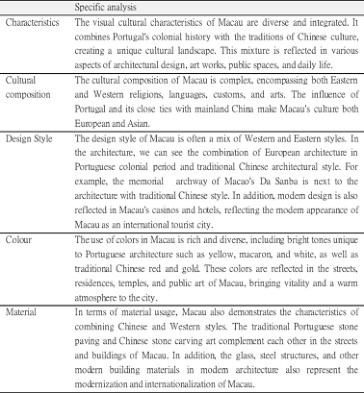
COMPARATIVE ANALYSIS Macau’s visual culture is a unique blend of Eastern and Western elements, reflecting its dual identity as a historical Portuguese colony and a modern Special Administrative Region of China. The following is an analysis of the overall characteristics of Macao’s visual cultural symbols:
Figure 1: Characteristics of visual cultural symbols in Macau (self-drawn by the author).
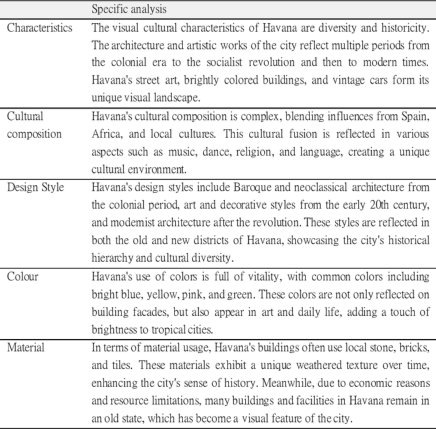
Havana has a rich historical and cultural heritage. Its visual cultural symbols have elements of Spanish colonial history, African cultural influences, and socialist revolution. The following is an analysis of the overall characteristics of Havana’s visual cultural symbols:
Visual Cultural Symbols in the Colonial Context 61
Figure 2: Characteristics of Havana’s visual cultural symbols (self-drawn by the author).
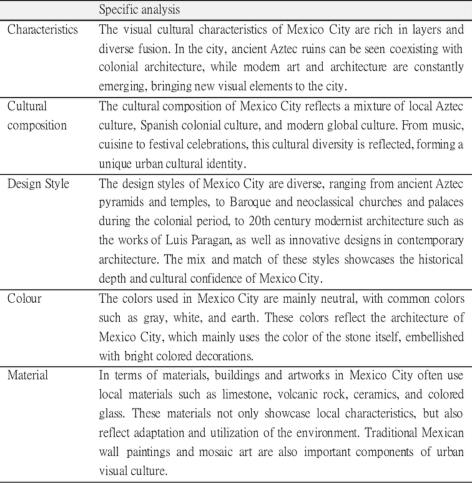
Mexico City is the capital of Mexico and one of the largest cities in Latin America, with a long and rich history and diverse culture. Mexico City’s visual culture reflects its indigenous heritage, pre-Columbian heritage, colonial history, revolution, and modern multiculturalism. The following is an analysis of the overall characteristics of Mexico City’s visual cultural symbols:
Figure 3: Visual cultural symbol characteristics of Mexico City (self-drawn by the author).
62 Zhiyuan and Yaoyao
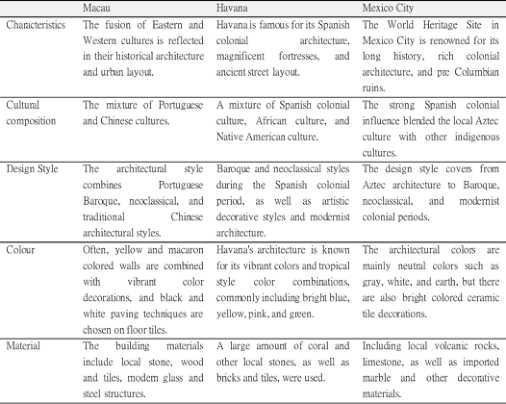
Comparison between Macau, Havana and Mexico City:
Figure 4: Mexico City Metropolitan Cathedral (self-drawn by the author).
Colonial architecture and art often combined elements of the colony’s original culture with the style of colonial culture. This fusion is particularly evident in the city’s visual cultural symbols.
In Macau, Havana and Mexico City, visual cultural symbols under colonial influence reflect the fusion of European and local cultures. For example, Macau’s Portuguese tiles are combined with Chinese stone carvings, Havana’s Spanish colonial architecture incorporates Caribbean elements, and Mexico City showcases a combination of Aztec civilization and Spanish style. The visual symbols of these cities, such as building facades, religious motifs, and the design of public spaces, are all manifestations of cultural integration. These symbols are manifested in artistic values, as well as cultural diversity in urban planning and architectural functions.
The construction of a city’s image involves not only urban planning and design, but also the shaping of cultural identity and historical memory. The city’s image showcases cultural integration through public art, monuments, festivals and celebrations. For example, the Sino-Portuguese Cultural Festival in Macau and the Day of the Dead in Mexico City both demonstrate the contribution of cultural integration to the city’s image. However, conflicts may also arise in the process of cultural integration, such as the contradiction between the protection of historical sites and the needs of modernization. The construction of urban image needs to balance people’s needs and expectations and handle the relationship between history and modernity.
The protection and utilization of cultural heritage is the focus of urban development, which is not only related to the inheritance of history, but also involves the development of the city. The protection of cultural heritage faces pressure from environmental change, urban expansion and commercial
Visual Cultural Symbols in the Colonial Context 63
development. How to restore and utilize the site without destroying its historical value is a major challenge in design and planning. The rational use of cultural heritage can bring new vitality to the city, such as through the development of museums, cultural centers and tourism projects. This will not only help protect heritage, but also promote cultural exchange and economic development.
COMPLETION This study explores the role of visual cultural symbols under colonial influence in the construction of urban image, as well as the importance of cultural heritage protection and contemporary utilization in urban planning. Research has found that visual cultural symbols from the colonial period exhibit a fusion of European style and local culture in places such as Macau, Havana, and Mexico City. This integration is not only reflected in art and architecture, but also in urban planning and cultural policies. At the same time, the protection and utilization of cultural heritage provide opportunities for the development of tourism and economy in cities, but also bring challenges in terms of environmental, social, and historical value protection. In the context of globalization, colonial heritage has become a bridge connecting history and modernity, local and international, showcasing urban diversity and inclusiveness, and an important manifestation of urban image. By maintaining and revitalizing cultural heritage, cities can shape their own unique visual cultural symbols.
The limitations of this study are limited by the scope and depth of case selection, and do not cover the diversity and complexity of all colonial heritage. Future research can be expanded to more cities and regions, analyzing in depth how cities with different cultural backgrounds and development stages can develop their colonial heritage effectively.
ACKNOWLEDGMENT
Firstly, I would like to thank my partner Ms. Yu Yaoyao for providing me with a lot of help and support during the process of writing my paper. Thank you to my family, your understanding and support have enabled me to focus on studying and researching. I want to thank my school for providing me with a good learning environment and necessary resources. Finally, I would like to express my gratitude to all those who have directly or indirectly helped me during the process of writing my paper.
REFERENCES
Burian, E. R. (1997). Modernity and the Architecture of Mexico. University of Texas press. Chui Zhenyu (2002). The characteristics of Macau culture Yunnan Social Sciences
(03), 92–94. Colantonio, A., & Potter, R. B. (2006). Havana. Cities, 23(1), 63–78. Dieleman, H. (2013). Mexico-City, sustainability and culture: A plea for hybrid sustainabilities for a baroque and labyrinthine city. City, Culture and Society, 4(3), 163–172.
64 Zhiyuan and Yaoyao
Edge, K., Scarpaci, J., & Woofter, H. (2006). Mapping and designing Havana: Republican, socialist and global spaces. Cities, 23(2), 85–98. Fan Feihao & Zhou Zhengxu (2017). Restoration of public space to maintain
cultural identity: A case study of the Historic Center of Macao Urban Design (01), 76–87. Guo Zhan (2014). Macau urban planning associated with World Heritage sites Urban Planning (S1), 86–90. Hao Jincheng (2018). The taste and memory of Havana’s old city in Cuban narrative
Digital Photography (04), 98–103. Huang Qichen (1999). Macau - a bridge for cultural exchange between China and the West from the 16th to the 19th century Comparative Law Research (01), 15–36. Krieger, P. (2011). The image of the megalopolis–understanding the complex visual
construction of Mexico City. Diogenes, 58(3), 55–66. Li Shiyuan (1999). Famous historical buildings in Macau Cultural Relics (11), 43–47+101-102+2. Marín, V. (2007). Havana: The Making of Cuban Culture. Meng Jian (2002). Visual Cultural Communication: Interpretation of a Cultural
Form and Communication Concept Modern Communication (03), 1–7. Niebuhr, R. (1950). The Theory and Practice of UNESCO. International Organization, 4 (1), 3–11. Cheng Hong&Wang Genlan (2019). The planning and influence of Spanish colonizers on the political construction of Mexican cities Journal of Jianghan University (Social Sciences Edition) (01), 54–64+125. Roche, Diana Williams (1998). Sustainable Development Strategy for Havana Ancient City - Putting the Interests of Residents and Tourists at the Core Foreign Urban Planning (03), 21–25.
LISTED IN THE AHFE DIGITAL BOOKSTORE CATALOGUE
Explore the complete digital volume
Human Factors in Architecture, Sustainable Urban Planning and Infrastructure
Read this individual research paper free through the original publisher, or explore the full digital proceedings book.
ISBN 978-1-964867-67-0
Explore this ISBN in the AHFE Bookstore ↗Listed in the July 2026 bookstore catalogue; search by ISBN to confirm current availability · Digital book purchase optional