Qiuyu Lin, Kaiyuan Tang, Tianming Xu (2025). OlfaCare: A Portable Testing and Rehabilitation Assistance Service Designed for Groups with Olfactory Dysfunction. In: Design for Inclusion. AHFE Open Access, vol. 169, pp. 48–58. https://doi.org/10.54941/ahfe1006153
Olfactory dysfunction, including conditions such as anosmia, affects a significant portion of the population, particularly the elderly. It can substantially impair daily activities, including the ability to detect hazardous situations such as gas leaks, and diminish the enjoyment of food, ultimately affecting individuals' quality of life. Despite the high prevalence of olfactory disorders, existing at-home testing and rehabilitation solutions are often cumbersome and lack sufficient user engagement.The Olfacare system aims to bridge these gaps by providing a comprehensive, user-friendly solution for olfactory dysfunction. The proposed system consists of three main components: a portable olfactory test kit, an olfactory recovery kit, and a mobile application. The portable test kit enables users to self-assess their olfactory abilities at home using a series of standardized odour samples. The recovery kit, tailored for individuals with olfactory dysfunction, provides clinically proven odour-based stimuli for training, supporting personalised rehabilitation. The mobile application serves as the core platform for the system, guiding users through the testing and rehabilitation process, recording data, offering real-time feedback and supervision. Key features of the app include olfactory testing and training sessions, progress tracking and rehabilitation reminders.Through this approach, Olfacare addresses the major challenges faced by individuals with olfactory dysfunction, such as limited access to professional services and difficulties maintaining at-home rehabilitation routines. The system is designed to enhance user autonomy by offering a seamless, engaging experience that encourages sustained participation in olfactory training. This research represents an important step toward improving the daily lives of those affected by olfactory disorders, promoting independence, and reducing reliance on healthcare providers. Future evaluations and user feedback will further refine the system’s effectiveness and usability.
Olfactory dysfunction, a partial or total loss of the ability to smell (Hummel et al., 2009), is a common impairment. Multiple studies have shown that it has a high prevalence in the population and negatively affects people’s quality of life, psychological well-being, and safety of life (Deems et al., 1991; Miwa et al., 2001; Temmel et al., 2002; Shu et al., 2011; Hüttenbrink et al., 2013; Philpott and Boak, 2014; Blomqvist et al., no date). The problem with olfactory dysfunction is the lack of easy-to-use and accessible measures for detection, rehabilitation, and monitoring.
This study investigates the feasibility of designing a more user-friendly solution. The OlfaCare system is designed to bridge the research gaps by providing a comprehensive, user-friendly solution for olfactory dysfunction. The proposed solution consists of four main components: a portable olfactory test box, odour capsules, a capsule case, and a mobile application. Key features include olfactory testing and training sessions, progress tracking, reminders and communication. The system is designed to enhance user autonomy by offering a seamless, engaging experience that encourages sustained participation in olfactory training, and future evaluations and user feedback will further refine the system’s effectiveness and usability.
OlfaCare: A Portable Testing and Rehabilitation Assistance Service 49
LITERATURE REVIEW
Olfactory dysfunction is a common disorder that shows partial or total absence of the sense of smell (Hummel et al., 2009). It is estimated that the general prevalence of olfactory dysfunction is 16%, and the prevalence of anosmia (losing the ability to smell) is around 5% (Vennemann, Hummel and Berger, 2008). Olfactory dysfunction is prominent in all age groups, with 19% of the population over the age of 20 and 24% of the population over the age of 53 having different levels of olfactory dysfunction (Murphy, 2002; Brämerson et al., 2004). These numbers tend to be lower than the number of people with actual olfactory dysfunction due to a number of potential patients who may not be aware of their reduced sense of smell (Mullol et al., 2012).
Causes and Effects The causes of olfactory loss are varied. Two major causes include sinus disease and post-viral olfactory loss (PVOL) (Damm et al., 2004; Khan et al., 2023). In addition, recent studies indicate that the COVID-19 virus can have an impact on olfactory functions (Le Bon et al., 2021; Gudziol et al., 2022; Schepens et al., 2023), causing more cases of olfactory dysfunction.
Olfactory dysfunction can have huge negative impacts on people’s life quality. Studies have shown that it is mainly presented in several aspects: difficulty in identifying spoilt food, reduced ability to eat and cook, difficulty in perceiving gas leak and smoke, reduced enjoyment of eating, less awareness of personal hygiene, etc. (Deems et al., 1991; Miwa et al., 2001; Temmel et al., 2002; Shu et al., 2011; Blomqvist et al., no date). Also, decreased capacity of olfaction has been shown to trigger depression (Pause et al., 2001; Negoias et al., 2010). These factors may significantly affect the physical, mental, and social well-being of people with olfactory dysfunction (Philpott and Boak, 2014). In addition, difficulty perceiving dangerous scenarios can also pose a threat to people’s life experience and even their safety (Hüttenbrink et al., 2013). These effects suggest that olfactory dysfunction is a widespread and high-impact hidden disability.
Existing Testing and Rehabilitation Solutions Although the principles of olfaction are still under research, some simple detection and training methods can be effective. Odour devices and scales are generally required for olfactory testing. A common testing method is Sniffin’ Sticks, which is an olfactory testing kit to detect olfactory dysfunction and can be completed in several minutes. An odour dispenser stick is placed under the subject’s nose, and the subject is required to identify the odour from a list of four choices (Hüttenbrink et al., 2013). While Sniffin’ Sticks are more versatile and less costly, they have the disadvantage of not being portable and needing to be performed in a clinic or laboratory.
Olfactory rehabilitation treatment relies on chemicals, olfactory training, or other physical stimuli (Hummel et al., 2009). However, they are not readily accessible or are difficult to operate. In contrast, olfactory training, a non-pharmacological method that exposes patients to a variety of odours
(Doty, 2019), is relatively effective and has minimal harm, and is therefore widely recommended (Miwa et al., 2019; Hura et al., 2020). Besides, several studies have shown that the olfactory pathway has neuroplasticity (Mainland et al., 2002; Kollndorfer et al., 2015), and vision is strongly associated with olfactory function (Gottfried and Dolan, 2003). This suggests that multisensory stimulation using vision in conjunction with olfaction can help to stimulate olfactory neuroplasticity to enhance olfactory sensitivity.
The most effective duration of training has yet to be investigated, but most studies have set the duration at 3–14 months (Kattar et al., 2021). For trainees, prolonged training may pose problems in compliance and transparency, affecting the effectiveness of olfactory detection and rehabilitation. In studies using physical diagnostic tools, commonly used supervision measures include telephone reminders (Hummel et al., 2009) and nicely designed user diaries (Birte-Antina et al., 2018). However, these measures are difficult to motivate users to maintain their training habit (Niedenthal et al., 2021).
With advances in electronic technology, new designs aim to utilise digital interaction technology to improve adherence and participation in training tasks for people with olfactory dysfunction. In 2021, Niedenthal et al. (2021) presented Exerscent, an olfactory assessment kit based on Arduino and 3D printing implementations. It consists of a base, RFID reader and tags, and bottles containing odorous substances. The whole system can be controlled by a computer where the user uses a laptop for olfactory assessment and training. The device includes a gamified interface and has been tested and proven to make it easier for users to detect and train their sense of smell at home (Niedenthal et al., 2021). However, Exerscent’s wooden table mat requires a relatively large space, and the system needs to be connected to a computer. This may restrict users’ possibility to perform olfactory recovery training outdoors. For users to persist with olfactory training, the training device needs to be made more portable and accessible.
Problem Statement Olfactory disorders have problems with low testing participation and difficulties with in-home training. Only a relatively small proportion of patients with olfactory disorders have formal assessment of olfactory function on a routine basis (McNeill, Ramakrishnan and Carrie, 2007). This may be due to the lack of a convenient, home-operated olfactory assessment and assisted rehabilitation service on the market. At the same time, although digital interaction technology reduces the ease of use and increases user autonomy, existing methods are facing difficulties in supervising the users’ ongoing rehabilitation. Based on the above issues, this project proposes the following research questions:
RQ1: How might we design a method to enable more portable and easy-to- use olfactory assessment and rehabilitation service for people with olfactory dysfunction?
RQ2: Is the proposed method effective in testing and rehabilitation? RQ3: Does the proposed method make users more likely to use it?
OlfaCare: A Portable Testing and Rehabilitation Assistance Service 51
DESIGN PROCESS This study adopts the Double Diamond Model as its approach (Design Council, 2025). The Double Diamond Model is an effective method in creating tangible and impactful designs (Shen et al., 2024). It involves four processes: discover (background and user research), define (problem statement and ideation), develop (prototyping of mobile app, electronic functions and physical products) and deliver.
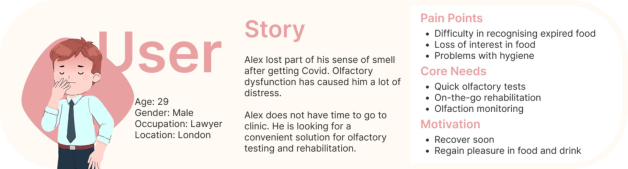
Ideation The project summarised the common characteristics of young people with olfactory dysfunction and created a user persona. The project is theoretically suitable for any age group, but in its early stage, the users were identified mainly as people aged 20 to 40. To explore the possible directions of the project’s outputs, a brainstorming session based on digital olfactory interaction technology was conducted by three students with a background of disability design, and several possible directions were generated.
Figure 1: User persona.
Solution Design After investigating and analysing the users, and diffusely generating a variety of potential solutions, this study proposes the design of OlfaCare, a portable olfactory testing and rehabilitation assistance service. The system is designed to provide users with convenient, safe and efficient olfactory testing and rehabilitation training support to help them better manage their olfactory health in their daily lives while reducing their reliance on healthcare providers. The system consists of several key components: A box, several scent capsules, a capsule case, and a mobile application.
The storage box serves as the outer packaging for the entire kit. It holds the scent capsules and comes with RFID reading and Bluetooth functions. RFID module is used to read the RFID tags on scent capsules, and Bluetooth module transmits the contents of the tags to the accompanying mobile application.
The odour capsules are made of plastic and contain a variety of odour essence oil (e.g. floral, citrus, coffee, etc.). The concentration of each sample is scientifically regulated to accurately assess the user’s olfactory sensitivity and recognition ability. The capsule has a rounded shape, which can be less likely to harm the users’ nasal passages. There are small holes at the top and bottom, which can accelerate air circulation and prevent children from accidentally
swallowing it and blocking their airways. Each scent capsule is affixed with a pre-written RFID tag. Its contents can be read by the RFID reader on the box while the user is unaware of the contents. This design is intended to reduce the possibility of users cheating behaviour during olfactory testing.
The Capsule case is an easy-to-hold plastic bottle. It is hollow inside and can hold a scent capsule and keep it uncontaminated when carried outdoors. Since some young users tent to not reveal their impairments due to potential discrimination or stigma (Temmel et al., 2002), the capsule case provides protection as well as decoration. It can be used as a pendant on the user’s bag. This also aims to alleviate their shame in using assistive rehabilitation devices outdoors.
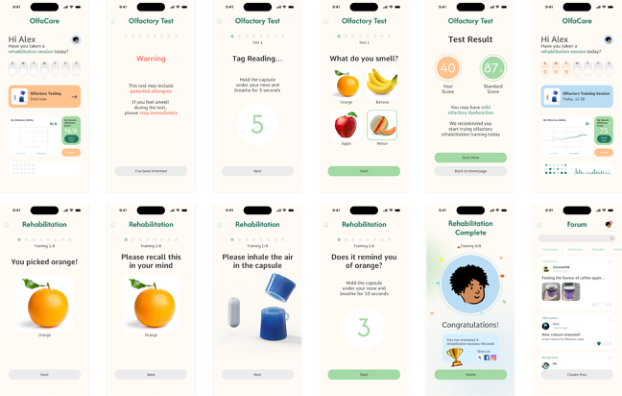
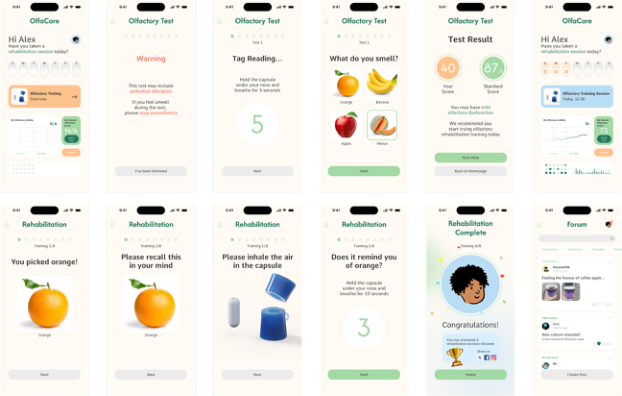
The Mobile application is the core control platform of the whole system, which undertakes functions such as data recording, rehabilitation guidance and user interaction. The testing module guides the user with the portable olfactory test kit and generates an easy-to-understand feedback report, containing detection results and olfactory level trend in real time. The rehabilitation module provides users with different phases of olfactory training programmes, including reminders, progress tracking and incentives to increase participation. Users can follow the guidance to gradually carry out olfactory training, and the system will monitor the recovery progress and dynamically adjust the users’ training programmes. The social and support module allows users to share their experiences with others who are also experiencing olfactory dysfunction through the platform.
Application Development Wireframe was created using Figma, with the aim of identifying broad page categories and functional hierarchies. The main functional layers of the mobile application include the main interface, testing, rehabilitation, test reports and forum. Screen-based prototypes were printed out and to uncover possible problems with interaction processes. It was found that too many menu bars could lead to redundancy of functionality and affect the user’s interest. Considering that users would complete the test in a short time, some of the functions were reduced or grouped together on the same page. For example, recent test results and data will be placed on the home page instead of using a separate screen to make the interface more intuitive. High- fidelity Prototypes were created using Figma software, using some of the open-source iPhone components. This Prototype is designed using iPhone 16 as the base size.
Digital Prototyping Digital prototyping includes the implementation of RFID writing, reading and Bluetooth transmission functions. A total of Arduino Uno, A-Z RC-522 RFID kit and A-Z RC-05 Bluetooth transmission component are used in this study.
The RFID writing function will not be available to the user, but only to the manufacturer; the RFID component will read the RFID tag and erase the information on it, after which it will write words in blocks 1 and 4 of the tag
OlfaCare: A Portable Testing and Rehabilitation Assistance Service 53
and encode them in ASCII. For example, if the first odour is citrus, the word ‘citrus’ will be written.
Figure 2: Some of the high-fidelity prototypes of OlfaCare’s mobile application.Figure 3: RFID writing function (before using).
The RFID reading function is implemented using the same RC522 kit. the reader detects the tag and reads the code on block 1 and block 4 of it and decodes it into the pre-written word.
The Bluetooth module is responsible for transmitting word information to the OlfaCare mobile application and choosing to reveal or not depending on the scenario. For example, during olfactory testing, the application will not disclose odour information, whereas during rehabilitation training, the user will be informed of what scent capsule they are choosing.
Figure 4: RFID writing function (during olfactory test).
Figure available in the original PDF paper.
Figure 5: RFID writing function (during olfactory rehabilitation).
Figure available in the original PDF paper.
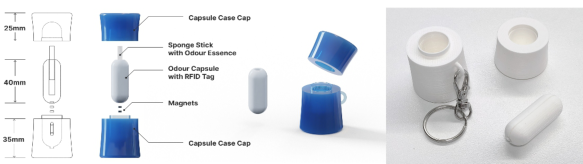
Physical Product Based on ideation, a series of sketches were made, with the core components (capsule and capsule case) being adapted in more detail. 3D modelling was carried out using Rhinoceros 8 software. The model includes odour capsule and capsule case. Considering the accuracy of 3D printing, the model has undergone some minor adjustments in size.
Figure 6: OlfaCare’s product specification and 3D printed prototypes.
DISCUSSION
This project explores the design concept, process and next stage of evaluation of OlfaCare, a more accessible olfactory testing and rehabilitation service based on digital olfactory interaction technology. The design improves on the previous olfactory testing and rehabilitation services. Compared to Exerscent, OlfaCare focuses more on portability, interchangeability and easier mobile phone interaction. In addition, OlfaCare has added extra forum function to increase communication between user groups and to develop user habits. The new design makes it easier for users to interact with mobile phones and allows for a variety of interaction modes, such as reminders and data viewing.
Limitations Due to limited resources, the completion of this project is slightly flawed, as evidenced by the fact that the Bluetooth transmission feature has not yet been reflected in the application, and the flawed shape of the 3D printed capsule. The current work is able to show the feasibility of the functionality, but the product itself still deserves refinement.
This design is based on mobile application interaction, so it may be more acceptable to younger users. However, it remains to be investigated whether older users are more receptive to this new method of testing at home. Future research may recruit older users for testing and discuss the suitability of this group for the same design framework.
Although the design goal is to allow users to complete the testing and rehabilitation training easily at home, users may face unfamiliarity with the operation, omit the training steps, or not strictly follow the guidelines in actual use, which may affect the rehabilitation effect and data accuracy.
Currently, the prototype has only been trialled on a small scale with 10 students and its effectiveness lacks systematic validation. Larger scale user
OlfaCare: A Portable Testing and Rehabilitation Assistance Service 55
testing will be conducted in subsequent research to explore the effectiveness and ease of use of this product.
FUTURE WORK
Subsequent research plans to use a combination of qualitative and quantitative methods to evaluate this design and to provide answers for RQ2 and RQ3.
The project plans to recruit 2–4 young users with self-reported mild or moderate olfactory dysfunction to participate in a 15-day trial session. Recruitment methods are flyer campaigns, social media, etc. Participants need to do a simple questionnaire first to make sure they can stick to the whole process. The questions include their basic information, whether they have a history of diagnosed olfactory dysfunction, whether they agree to participate in the test, and whether they agree to the data collection. Users will then receive an OlfaCare Kit and download the OlfaCare mobile application. participants will be asked to use OlfaCare for one test and one rehabilitation session per day. To minimise the effect of extraneous variables on the test, users will be asked to conduct it in a well-ventilated environment. Their score for each olfactory test will be recorded by the system. Users who persist in completing the user test will be rewarded at the end of the first week of the test and at the end of the session.
Users who have completed the full testing process will be invited to fill out a questionnaire. The questionnaire consists of a number of questions on a Likert scale, including difficulty of use, effectiveness of use, and whether they are more likely to use it. Thereafter, they will be invited to participate in an interview, which will cover the experience of using the product, whether they have developed a habit of using it, how they feel about using it outside the home, and other feelings about using the product.
Participants’ 15-day test scores will be analysed to evaluate the effectiveness of OlfaCare. SPSS will be used to evaluate the mean, standard deviation, median and range. Their daily scores over a 15-day period will be plotted on a line graph to show trends in their olfactory recovery. Participants’ final questionnaires will be used to analyse the ease of use and user acceptance of OlfaCare.
The interviews will be recorded and transferred to text using iflyrec software. The texts will be further analysed using thematic analysis to provide qualitative insights.
Through a combination of qualitative and quantitative evaluation methods, this project plans to derive a multi-dimensional evaluation of user satisfaction with OlfaCare. This will provide insights into parts that need to be iterated in the future.
Figure 7: Evaluation process.
Figure available in the original PDF paper.
CONCLUSION
This project is a step towards enhancing the quality of life for people with olfactory impairments, encouraging self-sufficiency, and decreasing dependence on medical professionals. Notwithstanding its current limitations, this study could provide a feasible design idea and part of the underlying validation for digital interventions in olfaction. Through a combination of physical products and digital interventions, OlfaCare addresses the major challenges and proposes a solution for individuals with olfactory dysfunction.
ACKNOWLEDGMENT
We are grateful to Mr. Merlin Kelly and Professor Youngjun Cho for their assistance and guidance in this study.
REFERENCES
Birte-Antina, W., Ilona, C., Antje, H., & Thomas, H. (2018). Olfactory training with older people. International Journal of Geriatric Psychiatry, 33(1), 212–220. https://doi.org/10.1002/gps.4725 Blomqvist, E. H., Brämerson, A., Stjärne, P., & Nordin, S. (n.d.). Consequences of
olfactory loss and adopted coping strategies. Brämerson, A., Johansson, L., Ek, L., Nordin, S., & Bende, M. (2004). Prevalence of olfactory dysfunction: The skövde population-based study. The Laryngoscope, 114(4), 733–737. https://doi.org/10.1097/00005537-200404000-00026 Deems, D. A., Doty, R. L., Settle, R. G., Moore-Gillon, V., Shaman, P., Mester, A. F.,
Kimmelman, C. P., Brightman, V. J., & Snow, J. B. (1991). Smell and Taste Disorders, A Study of 750 Patients From the University of Pennsylvania Smell and Taste Center. Archives of Otolaryngology - Head and Neck Surgery, 117(5), 519–528. https://doi.org/10.1001/archotol.1991.01870170065015 Design Council. (2025). History of the Double Diamond. https:// www.designcouncil.org.uk/our-resources/the-double-diamond/history-of-the- double-diamond/ Doty, R. L. (2019). Treatments for smell and taste disorders: A critical review.
Handbook of Clinical Neurology, 164, 455–479. https://doi.org/10.1016/B978- 0-444-63855-7.00025–3 Gottfried, J. A., & Dolan, R. J. (2003). The Nose Smells What the Eye Sees: Crossmodal Visual Facilitation of Human Olfactory Perception. Neuron, 39(2), 375–386. https://doi.org/10.1016/S0896-6273(03)00392-1 Gudziol, H., Kirschstein, T., Pletz, M. W., Weis, S., Guntinas-Lichius, O.,
Bitter, T., The CoNAN Study Group, Hotz, T., Enders, P., Koch, R., Mai, S., Ullrich, M., Richert, C., Eibner, C., Meinung, B., Stötzer, K., Köhler, J., Cipowicz, H., Pinkwart, C., … Kuhn, S. (2022). High prevalence of long- term olfactory dysfunction confirmed by olfactory testing after a community COVID-19 outbreak. HNO, 70(3), 224–231. https://doi.org/10.1007/s00106- 021-01129-7 Hummel, T., Rissom, K., Reden, J., Hähner, A., Weidenbecher, M., & Hüttenbrink,K.
(2009). Effects of olfactory training in patients with olfactory loss. The Laryngoscope, 119(3), 496–499. https://doi.org/10.1002/lary.20101
OlfaCare: A Portable Testing and Rehabilitation Assistance Service 57
Hura, N., Xie, D. X., Choby, G. W., Schlosser, R. J., Orlov, C. P., Seal, S. M., & Rowan, N. R. (2020). Treatment of post-viral olfactory dysfunction: An evidence-based review with recommendations. International Forum of Allergy & Rhinology, 10(9), 1065–1086. https://doi.org/10.1002/alr.22624 Hüttenbrink, K.-B., Hummel, T., Berg, D., Gasser, T., & Hähner, A. (2013).
Olfactory Dysfunction. Deutsches Ärzteblatt International. https://doi.org/ 10.3238/arztebl.2013.0001 Kattar, N., Do, T. M., Unis, G. D., Migneron, M. R., Thomas, A. J., & McCoul, E. D. (2021). Olfactory Training for Postviral Olfactory Dysfunction: Systematic Review and Meta-analysis. Otolaryngology–Head and Neck Surgery, 164(2), 244–254. https://doi.org/10.1177/0194599820943550 Khan, A. M., Piccirillo, J., Kallogjeri, D., & Piccirillo, J. F. (2023). Efficacy of
Combined Visual-Olfactory Training With Patient-Preferred Scents as Treatment for Patients With COVID-19 Resultant Olfactory Loss: A Randomized Clinical Trial. JAMA Otolaryngology–Head & Neck Surgery, 149(2), 141. https://doi.org/ 10.1001/jamaoto.2022.4112 Kollndorfer, K., Fischmeister, F. Ph. S., Kowalczyk, K., Hoche, E., Mueller, C. A., Trattnig, S., & Schöpf, V. (2015). Olfactory training induces changes in regional functional connectivity in patients with long-term smell loss. NeuroImage: Clinical, 9, 401–410. https://doi.org/10.1016/j.nicl.2015.09.004 Le Bon, S.-D., Konopnicki, D., Pisarski, N., Prunier, L., Lechien, J. R., &
Horoi, M. (2021). Efficacy and safety of oral corticosteroids and olfactory training in the management of COVID-19-related loss of smell. European Archives of Oto-Rhino-Laryngology, 278(8), 3113–3117. https://doi.org/10.1007/s00405- 020-06520-8 Lindsay, S., Cagliostro, E., Leck, J., Shen, W., & Stinson, J. (2019). Disability disclosure and workplace accommodations among youth with disabilities. Disability and Rehabilitation, 41(16), 1914–1924. https://doi.org/10.1080/ 09638288.2018.1451926 Mainland, J. D., Bremner, E. A., Young, N., Johnson, B. N., Khan, R. M., Bensafi, M.,
& Sobel, N. (2002). One nostril knows what the other learns. Nature, 419(6909), 802–802. https://doi.org/10.1038/419802a McNeill, E., Ramakrishnan, Y., & Carrie, S. (2007). Diagnosis and management of olfactory disorders: Survey of UK-based consultants and literature review. The Journal of Laryngology & Otology, 121(8), 713–720. https://doi.org/10.1017/ S0022215107006615 Miwa, T., Furukawa, M., Tsukatani, T., Costanzo, R. M., DiNardo, L. J., &
Reiter, E. R. (2001). Impact of Olfactory Impairment on Quality of Life and Disability. Archives of Otolaryngology–Head & Neck Surgery, 127(5), 497. https://doi.org/10.1001/archotol.127.5.497 Miwa, T., Ikeda, K., Ishibashi, T., Kobayashi, M., Kondo, K., Matsuwaki, Y., Ogawa, T., Shiga, H., Suzuki, M., Tsuzuki, K., Furuta, A., Motoo, Y., Fujieda, S., & Kurono, Y. (2019). Clinical practice guidelines for the management of olfactory dysfunction—Secondary publication. Auris Nasus Larynx, 46(5), 653–662. https://doi.org/10.1016/j.anl.2019.04.002 Mullol, J., Alobid, I., Mariño-Sánchez, F., Quintó, L., De Haro, J., Bernal-
Sprekelsen, M., Valero, A., Picado, C., & Marin, C. (2012). Furthering the understanding of olfaction, prevalence of loss of smell and risk factors: A population-based survey (OLFACAT study). BMJ Open, 2(6), e001256. https:// doi.org/10.1136/bmjopen-2012-001256
Murphy, C. (2002). Prevalence of Olfactory Impairment in Older Adults. JAMA, 288(18), 2307. https://doi.org/10.1001/jama.288.18.2307 Negoias, S., Croy, I., Gerber, J., Puschmann, S., Petrowski, K., Joraschky, P., &
Hummel, T. (2010). Reduced olfactory bulb volume and olfactory sensitivity in patients with acute major depression. Neuroscience, 169(1), 415–421. https:// doi.org/10.1016/j.neuroscience.2010.05.012 Niedenthal, S., Nilsson, J., Jernsäther, T., Cuartielles, D., Larsson, M., & Olofsson, J. K. (2021). A Method for Computerized Olfactory Assessment and Training Outside of Laboratory or Clinical Settings. I-Perception, 12(3), 20416695211023953. https://doi.org/10.1177/20416695211023953 Pause, B. M., Miranda, A., Göder, R., Aldenhoff, J. B., & Ferstl, R. (2001). Reduced
olfactory performance in patients with major depression. Journal of Psychiatric Research, 35(5), 271–277. https://doi.org/10.1016/s0022-3956(01)00029-2 Philpott, C. M., & Boak, D. (2014). The Impact of Olfactory Disorders in the United Kingdom. Chemical Senses, 39(8), 711–718. https://doi.org/10.1093/ chemse/bju043 Schepens, E. J. A., Kamalski, D. M. A., Stegeman, I., & Lifelines Corona Research
Initiative. (2023). A Comparative Analysis of the Incidence, Severity and Duration of Smell and Taste Loss in COVID-19 Cases Versus Non-COVID-19 Cases: A Longitudinal Cohort Study. Journal of Clinical Medicine, 12(19), 6267. https://doi.org/10.3390/jcm12196267 Shen, Y., Bosch G., Pino, L., & Gopalan, V. (2024). Use of the ‘double diamond’ design framework to nurture creativity in life sciences research. Trends in Biochemical Sciences, 49(8), 654–657. https://doi.org/10.1016/j.tibs.2024.04.008 Shu, C. H., Lee, P. O., Lan, M. Y., & Lee, Y. L. (2011). Factors Affecting the Impact
of Olfactory Loss on the Quality of Life and Emotional Coping Ability. Rhinology Journal, 49(3), 337–341. https://doi.org/10.4193/Rhino10.130 Temmel, A. F. P., Quint, C., Schickinger-Fischer, B., Klimek, L., Stoller, E., & Hummel, T. (2002). Characteristics of Olfactory Disorders in Relation to Major Causes of Olfactory Loss. Archives of Otolaryngology–Head & Neck Surgery, 128(6), 635. https://doi.org/10.1001/archotol.128.6.635 Vennemann, M. M., Hummel, T., & Berger, K. (2008). The association between
smoking and smell and taste impairment in the general population. Journal of Neurology, 255(8), 1121–1126. https://doi.org/10.1007/s00415-008-0807-9
LISTED IN THE AHFE DIGITAL BOOKSTORE CATALOGUE
Explore the complete digital volume
Design for Inclusion
Read this individual research paper free through the original publisher, or explore the full digital proceedings book.
ISBN 978-1-964867-45-8
Explore this ISBN in the AHFE Bookstore ↗Listed in the July 2026 bookstore catalogue; search by ISBN to confirm current availability · Digital book purchase optional