Yuexi Qiao (2024). Exploring the Path of City Image Communication through IP Image Design: A Comparative Study of China and Japan. In: Human Factors in Design, Engineering, and Computing. AHFE Open Access, vol. 159, pp. 414–421. https://doi.org/10.54941/ahfe1005606
In the traditional media era, city images were primarily constructed by government departments. However, in the new media era, city images are mainly built by the public through online channels, with IP images being an important carrier for promoting city images. This paper examines the cases of Kumamon in Kumamoto Prefecture, Japan, and the giant panda Hua Hua in Sichuan, China, to explore the experiences and shortcomings of using IP images to assist in city image communication in different countries. It aims to construct a design system for IP images suitable for Chinese cities from aspects such as establishing the image, endowing it with vitality, artistic construction, and long-term assurance. The study finds that integrating regional history and culture into IP image design can optimize city images, enhance cultural added value, and open new avenues for city cultural communication, thereby promoting sustainable economic development. This research provides new ideas and practical guidance for innovative urban cultural communication strategies.
RESEARCH BACKGROUND Lewis Mumford described the city image as the subjective impression of a city formed by the interaction of mass media, personal experiences, interpersonal communication, cultural memory, and physical environment. Research has shown that in today’s network era, the image of a city in people’s minds affects their overall perception and evaluation of the city. The media encodes and decodes comprehensive city information, creating a simulated environment that affects individual cognition and ultimately forms the city’s image.
IP (Intellectual Property) refers to rights like copyrights, trademarks, patents, and design rights in the cultural industry. The cases discussed in this paper, including Japan’s Kumamon and the giant panda Hua Hua, are specific cultural IP images that result from the integration of local culture with the modern entertainment industry. Designing and promoting cultural IP images can promote the dissemination of local culture.
Combining IP images with urban tourism’s cultural and creative products in various ways could enhance tourism appeal and promote economic development in modern cities.
Exploring the Path of City Image Communication Through IP Image Design 415
CASE STUDY OF JAPAN’S CITY IP IMAGE AND ANALYSIS OF SUCCESS FACTORS: KUMAMON IN KUMAMOTO PREFECTURE Background Introduction
Kumamoto Prefecture, located in western Japan, is primarily an agricultural city with limited local resources and geographical advantages. In 2011, to attract tourists to stop at the newly opened Kyushu Shinkansen Kumamoto Prefecture station, the Kumamoto Prefectural Government designed and launched the virtual IP image Kumamon. Kumamon was appointed as the Sales Manager of the prefecture, and a series of stories about Kumamon were released through new media to increase its recognition among the Japanese public. The image of Kumamon was imprinted on subway stations, government websites, food packaging, and gradually themed stores, hotels, and tourist areas were established, continuously developing and selling related derivative products. This IP image creation linked the entire industry chain, significantly enhancing Kumamoto Prefecture’s city visibility and bringing substantial economic benefits and promotional effects.
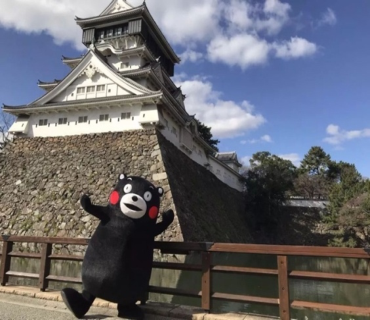
Figure 1: The image of Kumamon in Kumamoto Prefecture.
Appropriate Image Design A suitable image design is the first step to successful IP image marketing. The Good Design Company studio in Japan used the black bear as a prototype, constantly refining it by discarding complex decorations and softening its aggressiveness, ultimately forming Kumamon’s rounded and solid figure with a neutral expression and blush, highlighting its adorable temperament. In terms of colour, to emphasize regional characteristics, the studio designed Kumamon with an entirely black body based on Kumamoto Prefecture’s city colours, with a neutral facial expression painted white and cheeks adorned with blush. The simple design and strong colour contrast made Kumamon stand out among many IP images, quickly sparking heated discussions and gaining high acceptance among the public. Its simple image design also enabled Kumamon to be commodified across various fields.
416 Qiao
Government Support and New Media Marketing The Kumamoto Prefectural Government played a leading role in the marketing activities of the Kumamon IP image. The government’s bold innovations laid a solid foundation for the success of this IP image. The prefectural government opened a Twitter account for Kumamon and applied for the corresponding promotional budget. Utilizing the three main characteristics of new media—timeliness, interactivity and extensiveness— the government expanded Kumamon’s influence.
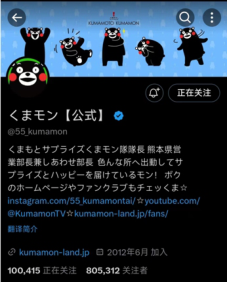
Figure 2: Kumamon’s Twitter account.
The government employed Kumamon as a formal civil servant, incorporating endearing human traits like ‘laziness’ and ‘gluttony’, gradually promoting Kumamon to the Sales Manager through a series of marketing activities, endowing Kumamon with increasingly human characteristics and establishing it as a beloved pet in the public eye. The government did not stop after making Kumamon famous; they continuously pushed daily updates from Kumamon’s perspective across multiple platforms, interacting with fans. As of now, Kumamon has over 800,000 followers on Twitter.
The promotional team designed a sustainable promotional plan, leveraging Kumamon’s lost event for a grand debut and the blush search incident to lead tens of thousands of netizens to experience Kumamoto Prefecture’s sweet potatoes, volcanoes, hot springs, and agricultural products, achieving advertising effects equivalent to spending 400 million yen with minimal expenses.
Free Licensing and Commercialization To expand the sales channels of local products in Kumamoto Prefecture, the government adopted an unconventional IP image operation strategy, offering free licensing of Kumamon illustrations to merchants that meet promotional purposes. Under strict usage rules, merchants only need to submit an application and get approval to use the Kumamon IP image. The official website provides detailed requirements for Kumamon’s expressions, actions, and language, ensuring the quality of peripheral products to some extent, even though the illustration usage rights are free.
Exploring the Path of City Image Communication Through IP Image Design 417
Statistics show that Japan has always valued cultural soft power, and the success of the IP image is the result of a long development process. As seen from the above analysis, the success of Japan’s Kumamon IP image is not accidental. Its design concept emphasizes regional culture, innovative use of new media, and attention to market marketing and economic benefits. Today, we also focus on enhancing national cultural soft power. The successful experience of Kumamon’s IP image provides a reference for promoting local culture. We can combine traditional and modern cultures from different regions to design market-accepted IP images, effectively promoting local unique cultures, fostering the development of related industries, and improving cultural awareness and competitiveness.
CHINA’S CITY IP IMAGE DEVELOPMENT EXPERIENCE AND ISSUE Background Introduction
The giant panda is unique to China, mainly distributed in Sichuan, Gansu, and Shaanxi. Unlike the Kumamon case in Japan, the giant panda culture is an existing carrier for Sichuan city image communication, a microcosm and a concentrated embodiment of Sichuan culture. In 2019, on the 150th anniversary of the scientific discovery of the giant panda, the world’s first official chronicle <Sichuan Province Chronicle: Giant Panda Chronicle> and the world’s first official illustrated chronicle focusing on the giant panda, <Giant Panda Illustrated Chronicle (Chinese and English versions)>, were officially released, becoming key measures for Sichuan to create a three- dimensional giant panda culture communication pattern.
In 2024, a news report titled ‘Hua Hua Takes Office, Official Announcement!’ immersed people in revelry. Chengdu Cultural and Tourism Bureau announced that Hua Hua would serve as the Honorary Director of Chengdu Cultural and Tourism Bureau and issued a Panda Appointment notice: Hua Hua, female, 3 years and 9 months old, born in Chengdu, Sichuan, with a full-time doctoral degree in kindergarten, representative of Chengdu Research Base of Giant Panda Breeding, former spokesperson of the Universiade, special guest of the 2024 Spring Festival Gala, is now appointed as the Honorary Director of Chengdu Cultural and Tourism Bureau. Chengdu Cultural and Tourism Bureau launched the ‘Chengdu Today Panda News’ column, where Director Hua Hua reported on tourism work during May Day holiday. Hua Hua serving as the Honorary Director of Chengdu Cultural and Tourism Bureau ushered in the panda IP era. Netizens left messages on social media platforms like Douyin, Xiaohongshu, and Weibo, such as ‘Congratulations, Director Hua’, ‘Director Hua deserves it’, ‘The most awesome cat in Sichuan’, and ‘Fully support Director Hua’s work, let’s go to the World Expo’. This marks the beginning of the panda IP era.
Panda IP Image Selection Sichuan has over 1,500 giant pandas, so why choose Hua Hua as the spokesperson for Chengdu Cultural and Tourism? This question is worth exploring. Capturing the audience’s attention is the premise for gaining
418 Qiao
traffic. Only by attracting the attention of the audience can we successfully gain traffic. Nowadays cute animals have become ‘healing medicine’ for adults. Research shows that under the influence of the Cute culture, creating an influential IP image not only broadens city brand recognition but also enhances intimacy with the audience.
Figure 3: The image of the giant panda Hua Hua.
Hua Hua stands out with its high appearance and strong recognition, characterized by tear-shaped eye patches, a sharp fox-like snout, a guinea pig-like side profile, longer fur, a fluffy appearance when young, a rounded figure as it grows, and pure white fur. Hua Hua’s distinctive appearance and personality traits make it a beloved IP image.
New Media Platform Promotion The panda IP image of Hua Hua is promoted through a series of short videos on social media platforms. The Chengdu Panda Base launched a Douyin account named Panda Guolai, where they share captivating videos featuring Hua Hua and its companions. These videos tell stories such as Hua Hua’s relaxed eating style’, ‘competing for bamboo shoots with panda Run Yue’, and ‘playing with younger brother He Ye’, showcasing their charming daily lives. These short videos have garnered exceptionally high views on social media platforms.
As of July 2024, Panda Guolai account has attracted 725,000 followers. ‘The Grandpa Tan and Hua Hua’ series has reached 280 million views, the ‘Hua Hua Little Bear Genius’ series has reached 470 million views, and the ‘He Ye Funny Panda’ series has reached 120 million views. These short videos allow fans who are unable to visit in person to immerse themselves in an engaging environment, continuously boosting the popularity of The panda IP image of Hua Hua.
Other Aspects The Chengdu Panda Base has launched several interactive projects centered around Hua Hua, including Hua Hua Theme Park and Hua Hua’s birthday celebrations. These initiatives aim to enhance public interaction with Hua Hua through various channels. For example, they have inaugurated the world’s first Panda-themed pop-up store and introduced derivative cultural
Exploring the Path of City Image Communication Through IP Image Design 419
products, significantly increasing Hua Hua’s visibility and boosting revenue in Sichuan’s cultural and tourism sectors.
Thus, Hua Hua’s rapid rise in popularity can be attributed to its rarity, endearing characteristics, diligent promotion efforts by government agencies and the Chengdu Panda Base, and its profound symbolic importance as a national treasure. These elements have collectively garnered widespread social attention for Hua Hua.
Figure 4: Panda-themed pop-up store of Hua Hua.
Analysis of Shortcomings and Improvement Measures In recent years, Sichuan has launched a series of initiatives aimed at integrating cultural and tourism sectors, focusing on developing the giant panda IP image into a cultural symbol. This endeavor seeks to boost economic growth through Panda Culture, which has emerged as a prominent representation for narrating Sichuan’s narratives and bolstering its reputation. Yet, there remains a significant opportunity to delve deeper into traditional Chinese cultural roots beyond the widespread promotion of the giant panda image.
Compared to Japan’s Kumamon IP image, China’s panda IP image communication still encounters several challenges and shortcomings. Firstly, Hua Hua lacks an officially recognized illustrated cartoon persona, resulting in weak development of related cultural and creative products. Secondly, there is insufficient integration with regional and modern cultures. Thirdly, in today’s dynamic landscape, relying solely on singular hotspots proves challenging in sustaining long-term public interest. It is crucial to continually develop Hua Hua’s character, foster interactive engagement with the public, and craft narratives that align with contemporary preferences.
Looking forward, inspired by leading examples and the spirit of the new era, efforts can be intensified to cultivate a vibrant cultural ecosystem around the Hua Hua IP image. This involves establishing science education museums, innovating with IP products, and harnessing technologies like VR and AR to enrich digital and interactive experiences. Simultaneously, there should be a strategic focus on enhancing consumer engagement through themed
420 Qiao
dining experiences, themed hotels, and other services centered around the Hua Hua panda IP. This approach aims to establish a holistic industry ecosystem covering clothing, food, housing, transportation, travel, shopping, and entertainment.
SUMMARY AND PROSPECTS In summary, the success of Kumamon’s IP image in Japan, and the panda IP image in China, both demonstrate the positive impact of IP images on city image communication. The integration of regional history and culture into IP image design can optimize city images, enhance cultural added value, and open new avenues for city cultural communication, thereby promoting sustainable economic development. This research provides new ideas and practical guidance for innovative urban cultural communication strategies, suggesting that we can combine traditional and modern cultures from different regions to design market-accepted IP images, effectively promoting local unique cultures, fostering the development of related industries, and improving cultural awareness and competitiveness.
IP Image-Based Regional Character Symbols Compared to simple text and graphics, anthropomorphized IP images can more concretely convey information and evoke emotional resonance, thereby enhancing cultural identity. Starting from the city’s regional characteristics, carefully integrating information and designing the IP image’s appearance, expressions, dynamic features, and stories can more effectively serve as dissemination carriers.
Multi-Platform and Multi-Mode Dissemination of Popular Topics Discovering regional characteristic symbols is only the first step in shaping a city image. It is necessary to construct a three-dimensional IP, establish a complete symbol industry system, and disseminate and guide traffic through various media. This can attract more platform audiences to experience and consume, develop the IP economy, and help refresh the city’s image.
A thorough study of the characteristics of various media platforms is essential. On Douyin, most short videos are under one minute, allowing users to watch repeatedly in a short time, so selecting attractive clips that quickly capture the public’s attention is crucial. Bilibili’s strength lies in longer videos with distinctive viewpoints. Government promotion departments can produce documentaries or micro-movies showcasing city culture and beauty for release on Bilibili to promote city images. Xiaohongshu’s tone leans towards recommendations; sharing IP image check-ins and city travel guides on Xiaohongshu can highlight the city’s features and attractions to the audience.
Immersive Experience Presenting Distinctive Elements Using China’s rich cultural resources and natural landscapes, a model of ‘IP image + cultural creative products + city culture + interactive experience’ can be developed to create distinctive cultural and creative products with
Exploring the Path of City Image Communication Through IP Image Design 421
cultural and commercial value. By creating immersive interactive experience spaces and consumption models, tourists can deeply experience and identify with the city’s unique culture.
In today’s booming new media environment, interactive IP images can fully engage the audience’s participation and interactivity, creating immersive experiences and providing new avenues for product promotion and marketing innovation. Each city can extract its unique natural resources, regional characteristics, cultural stories, etc., for artistic re-creation, fully exploring its cultural core and interacting with IP images. This can be achieved through emoticons, interactive apps and mini-programs, video clips, VR, interactive mascots, and more, reasonably utilizing IP image creativity for online and offline promotion and marketing, further realizing the transmission of city cultural values.
Achieving Sustainable Development of IP Images Many city IP images currently face sustainability issues. Governments and cultural tourism departments need to develop long-term development strategies and adopt different measures at various stages to maintain their appeal and durability. Encouraging multi-stakeholder participation in proactive city image dissemination and producing content tailored to different platforms can achieve effective topic association and dissemination.
This paper introduces and analyses the successful experiences of Japanese and Chinese cases from the perspective of city IP image shaping strategies, reflects on the current problems in China, and points out directions for improvement. With the advent of the IP era, cities can actively utilize the plasticity, ease of replication, and interactivity of virtual images to develop and operate IP images, achieving effective city image dissemination. This paves the way for sustained, rapid, and healthy development of city cultural dissemination and cultural tourism industries. China, with its 5,000 years of brilliant civilization and vast 9.6 million square kilometres of territory, can leverage local city characteristics and integrate them with modern civilization to enhance city cultural soft power and spread city charm domestically and internationally.
REFERENCES
Aiqin Shi, Haiqi Dong, Jianying Guo. Design Value and Interactive Experience of Rural Tourism Cultural Creativity under the Perspective of IP Innovation. Social Scientist, 2022(03): 50–55. Jing Chen. “Research on Urban Image Construction and Communication.” Journal
of Chinese Broadcasting & Television, 2021(05): 127–129. Lan An. Analysis of the Success Path of Kumamon. Communication Power Research, 2018, 2(16): 229. Weixin Jin, Miao Miao, Chenxi Dong. Insights from Overseas Super Cultural IPs
for Chinese Cities: Reflections on the New Path of Design Agency Branding. Architectural Design and Management, 2020, 37(07): 30–34. Yaqin Chen, Guoxin Wei. Exploring New Pathways of Urban Image Communication through Linked Special IPs. News Frontline, 2024(10): 80–82.
LISTED IN THE AHFE DIGITAL BOOKSTORE CATALOGUE
Explore the complete digital volume
Human Factors in Design, Engineering, and Computing
Read this individual research paper free through the original publisher, or explore the full digital proceedings book.
ISBN 978-1-964867-35-9
Explore this ISBN in the AHFE Bookstore ↗Listed in the July 2026 bookstore catalogue; search by ISBN to confirm current availability · Digital book purchase optional