Taisei Kiryu, Chikori Ino, Yusaku Okada (2024). Human error prevention activities in manufacturing sites based on information from normal work. In: Human Factors in Design, Engineering, and Computing. AHFE Open Access, vol. 159, pp. 2269–2278. https://doi.org/10.54941/ahfe1005795
In factories such as aircraft manufacturing, where the number of productions is small and the defective rate must be reduced to zero, a large number of human error prevention measures are taken. “CRM” in the airline industry is a specific example of ones. However, the burden on workers due to too many measures has exceeded the limit, and there is an urgent need to optimize the management of error prevention measures as a whole. To achieve this, (1) Detailed collection of human factor information on problematic events such as nonconformity events, (2) Collection of human factor information during normal times of the target work, (3) Structural analysis of human factor, (4) Proposal of guidelines for human error prevention measures based on the analysis results and presentation of multiple specific measures. Of these, (3) and (4) have already been developed in our laboratory and are at the practical stage. Structural analysis methods for human factors include the Swiss cheese model, m-SHELL, PSF list and variation tree. It has been confirmed that (1) can be resolved by measuring human factor management courses for work team leaders through e-learning and factor analysis training incorporating active learning for six months. The realization of safety among business operators has also changed from the traditional "Safety-I" to "Safety-II," and the demand for (2) is increasing, but method (2), which seeks to discover issues when no problems have occurred at all, cannot be addressed with methods such as traditional near-miss event analysis. Therefore, in this study, the image of collected information was changed to "hints that lead to good work" and methods of collecting human factor information from on-site conversations were examined, centering on stimulating constructive communication on-site.
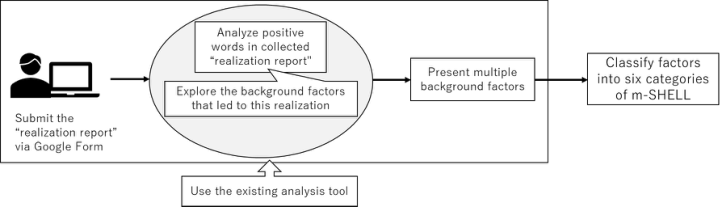
INFORMATION GATHERING SYSTEM We call the “hints that lead to good work” as “positive words,” and we have already developed a tool to extract background factors that may lead to severe incidents by collecting, analyzing, and evaluating this information. Figure 1 shows the flow of using this support tool. The analysis was carried out using m-SHELL. SHELL is a way of classifying and evaluating the factors involved in accidents and incidents into five categories: Software, Hardware, Environment, and Liveware (the worker himself and others). m-SHELL is an analysis method that adds the element of Management to SHELL.
Figure 1: Conventional awareness information gathering system.
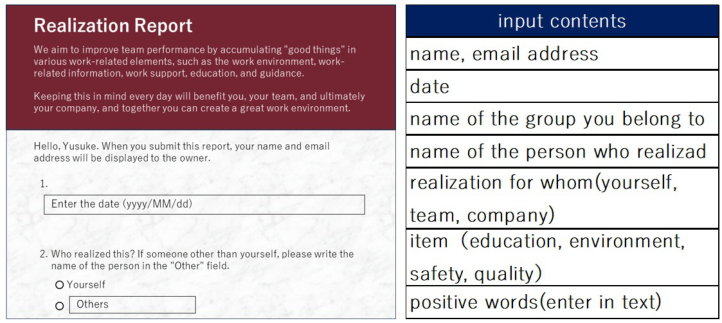
In the collection stage of positive words, Google Form is used, which allows workers to input information at any time from their information terminals, and the simple tally is fed back to the site as a flash report the following morning. The input screen and contents of the realization report are as follows:
Figure 2: The input screen and contents of the awareness report.
By analysing the input positive words with existing tools, the system searches for background factors that may lead to the accident that triggered the realization and presents multiple possible causes. The presented background factors can then be classified into 6 categories of m-SHELL. This makes it possible to find latent background factors in daily work, which can lead to improvements in work and the work environment and help prevent accidents.
PRELIMINARY INVESTIGATION Experimental Details
This time, we asked four assistant managers of an aircraft manufacturing company, Company A, to submit positive words. They are in a position to
Human Error Prevention Activities In Manufacturing Sites 2271
guide the workers, and are required to have management skills. The positive words they submitted were analysed and evaluated from various perspectives.
Number and Trends of Background Factors Extracted per Positive Word
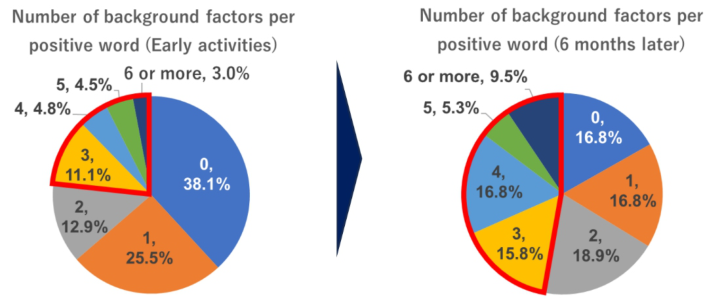
Figure 3 shows the transition of the number of background factors included per positive word. When we started collecting, the percentage of cases containing three or more background factors was only about 25%, but about half a year later, that percentage had increased to nearly 50%. This means that workers’ sensitivity to risks that may lead to accidents in their daily work is increasing. Specifically, this shows that the quality of awareness is improving, and it means that rather than simply stating facts, they are now able to think about what factors are in the background and what kind of accidents or incidents those factors may lead to. Unlike the passive safety activities that have been conducted in classrooms until now, this activity is expected to develop human resources who can look at daily work from various perspectives and output the knowledge gained in classrooms, and who can see things objectively and actively engage in safety activities to solve problems. In addition, by sharing the contents of realization at regular meetings, Company A is able to develop human resources who can actively encourage this activity, and by expanding the activity throughout the company, it is thought that it is possible to raise the level of sensitivity to realization throughout the company.
Figure 3: Number of background factors per positive word.
m-SHELL Analysis and Issues With Current Analysis Method The presented background factors can then be classified into 6 categories using m-SHELL analysis. This analysis makes it possible to recognize not only the mental and physical state of the person involved but also where the human factors are hidden in each element surrounding the site, and therefore makes it possible to take measures. However, when a problem occurs after the measures have been put in place to a certain extent, measures
to strengthen the existing measures, such as “insufficient existing measures” and “insufficient public awareness of existing measures,”are taken. However, in the actual field, there are not enough surplus personnel or spare time to strengthen the measures, which increases the physical and mental burden. In addition, since strengthening existing measures is difficult to feel effective despite the large burden, it is difficult to establish in the field and does not lead to a fundamental solution. Therefore, there are problems such as the same accident occurring again or a decrease in safety awareness and motivation. Even at this stage, safety education is implemented in a planned manner, but the background and intention of the measures are not fully explained to the workers on the site, so the understanding of safety activities among those on the front lines is not sufficient even if a safety management system is established. Therefore, simply identifying human factors at the site and taking measures against them will result in a “formal safety management” where there is a safety management system but no substance. The possibility of falling into a “formal safety management” state can be eliminated by the management layer accurately indicating the strategy, sorting out the problems that need to be solved in order to operate the safety management system based on that strategy, and planning and implementing solutions (tactics) to the problems. However, it is realistically impossible for the management layer to respond to the tactical level other than the strategy planning. Therefore, it is necessary to develop human resources who can develop human resources who can accurately devise ways to improve the effectiveness of various activities and measures (methods of publicizing, guidance, education, etc.). In terms of position, they are people at the work foreman and team leader level, which were also the subjects of this preliminary experiment. It is necessary to utilize positive words so that they become human resources who can turn the safety management cycle. For this purpose, the current analysis method is insufficient.
DEVELOPMENT OF A METHOD WITH ADDED ANALYTICAL FUNCTIONALITY THAT LEADS TO INCREASED MOTIVATION TO PARTICIPATE IN SAFETY ACTIVITIES Overview of the Proposed System
When considering the development of workers’ human resources, it is necessary to analyse from a higher perspective. Therefore, this time we propose a system that adds an analysis function to the existing system that leads to increased motivation to participate in safety activities among workers. Specifically, we developed a method to evaluate in four dimensions as shown in Table 1 by combining collected information with multivariate statistical analysis methods. We then added a mechanism to calculate the bias of positive words in the evaluated site and present a correction policy for the future reporting system of positive words in each team. As a result, workers submit new positive words based on the proposed correction policy. By repeating this cycle, workers’ awareness will improve, leading to good work and helping to prevent the occurrence of human error, and it is believed that it will also contribute to the growth of the person who fills it out.
Human Error Prevention Activities In Manufacturing Sites 2273
Table 1. Evaluation guideline according to 4 dimensions.
Table available in the original PDF paper.
Dimensions Details
1. Team Resource Management
Words that lead to setting growth goals within the team and finding short-term solutions to them, taking into account the characteristics of the team. 2. Future Production
Imagine your team in five years’ time and set growth goals for the team based on each member’s career. Furthermore, be actively involved in setting those goals. Words that lead to an improvement in the price you can offer, not the cost. 3. Incentive Management
To increase motivation as a team, incentives for the team must be set appropriately. In addition, incentives for members must be designed based on the values of the members. Word that leads to discussions on appropriate incentive design. 4. Social Contribution
Words that contribute not only to factory productivity, but also to the local community and to the future of society.
EVALUATION METHOD ON EACH DIMENSION Team Resource Management
Team resource management was created as a program to improve the safety and efficiency of air traffic management by properly managing the human resources of all personnel engaged in air traffic operations, whether as small teams in their respective workplaces or as teams in the entire huge and complex system in which they are organically combined to form a network. A EUROCONTROL initiative led to the creation of one of the first TRM training programmes. This prototype included separate modules on Teamwork, Team roles, Communication, Situational Awareness, Decision Making and Stress Management. Later two additional modules were added to cover the Management of Error and Violation and Impacts of New Automation. In addition, a requirement for those who implement on-site management is the ability to provide individual guidance to subordinates. To do this, it is necessary to individually grasp the knowledge and experience of subordinates and make statements and guidance that are appropriate to them. This is where communication with subordinates becomes necessary. It is important to share the intention of guidance with subordinates, including the act of “scolding,” and to explain the intention of educational guidance from a medium- to long-term perspective while clearly indicating the subordinate’s career path. In order to develop such human resources, three abilities are necessary: Leadership and Followership, Communication, and Customized Individual Support. We believe that the multiple abilities introduced so far can be associated with m-SHELL as follows.
Table 2. Relationship between m-SHELL and each ability.
Table available in the original PDF paper.
m-SHELL Abilities Software Decision Making, Management of Error and Violation Hardware Impacts of New Automation Environment Situational Awareness Management Stress Management Liveware(others) Teamwork, Team roles, Communication, Leadership and Followership, Customized Individual Support
Therefore, we believe that it is possible to improve team resource management skills by using the existing analytical method.
Future Production (Stimulating On-Site Work Improvement Activities) Team Resource Management is a useful skill for solving short-term problems. However, in order to further increase corporate value, it is necessary to develop human resources who can manage the field in line with the management strategy. The necessary measures are: 1) building a system for collecting and sharing information in the field, 2) an educational curriculum that looks to the next generation, and 3) a generalist orientation with diverse knowledge. Human resources who are aware of these things will become future management talent. Therefore, this time we analysed and evaluated how many people have these awarenesses in their daily work. The method of analysis involves a morphological analysis of the positive words and evaluating them by referring to the following Indices on Future Production.
years from now / years later / future / next stage / next term / next generation / from now on / goal / career Information sharing/collection Educational curriculum Educate / teach / raise / curriculum / train / instruct / guide / introduce / practice / lesson / manage / course / growth Generalist General / wide / multi / all-round / talented / intelligent / versatile / ingenious / proficient / well-endowed
Incentive Management (Motivation Management for On-site Workers) To maintain the enhanced safety activities, it is necessary to adjust the strategy based on the actual state of the safety activities. The aim is not to revise the fundamental management strategy, but to enhance the continuity (sustainability) of on-site management by incorporating some contents into the strategy. Ensuring continuity leads to future safety and security. A possible
Human Error Prevention Activities In Manufacturing Sites 2275
countermeasure is to disseminate enhanced safety activities through on-site management. If understanding of safety activities and measures spreads, the motivation to participate in safety activities in general will also increase. In addition, if the supervisor has acquired high conceptual skills, on-site activities will be appropriately deployed to other departments. This will give the group that considered new activities a sense of accomplishment and stimulate their motivation for further improvement. When on-site management functions in this way, safety activities will be in a virtuous cycle. Furthermore, if the reputation outside the company is improved by disseminating information, it will also lead to increased motivation of employees. In this way, by actively disseminating information rather than simply keeping safety activities within the company, it will lead to employee incentives and lead to the continuation of safety activities. Therefore, this time we analysed and evaluated how many people had these realizations in their daily work. The method of analysis involves a morphological analysis of the positive words and evaluating them by referring to the following Indices on Motivation Management for On-site Worker.
Table 4. Indices on motivation management for on-site worker.
Table available in the original PDF paper.
Required Skills Reference Words Information dissemination capabilities
Social Contribution Finally, it is important to be aware of the leap forward of accurate safety activities into the future and to incorporate them into the strategy. What is necessary for this is social contribution. The purpose of safety activities is to provide safety not only to users and employees, but to all stakeholders. The accumulation of safety and security of each business operator also forms the safety of the region. Therefore, raising the perspective and reaffirming the significance of safety activities from the standpoint of the region and society will also lead to increased motivation of employees. Therefore, this time we analysed and evaluated how many people had realized these things in their daily work. The method of analysis involves a morphological analysis of the positive words and evaluating them by referring to the following Indices on Social Contribution.
Table 5. Indices on social contribution.
Table available in the original PDF paper.
Required Skills Reference Words Social Contribution
Society / community / contribute / SDGs / public / serve / stakeholder / life / back casting / collaborate / effort / dedicate
CONTENTS OF THE VERIFICATION EXPERIMENT AND VERIFICATION HYPOTHESIS This time, we examined the extent to which the contents of 96 positive words submitted by four subjects at Company A between June 1st and 24th, 2024 contained elements related to the first to fourth dimensions. In the current safety activities at Company A, attention is focused on solving short-term problems in front of the employee, and not many people are able to take a long-term perspective. Therefore, it is thought that there are not many reports from the perspective of up to two dimensions. Furthermore, it is thought that there are almost no reports from the perspective of the third and fourth dimensions.
RESULT OF VERIFICATION EXPERIMENTS
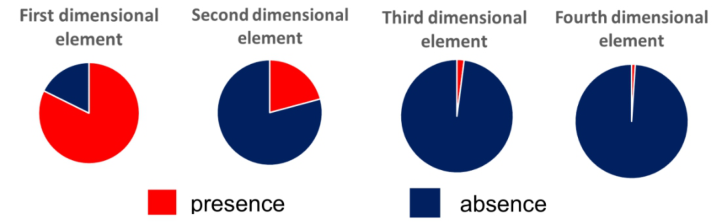
Figure 4 shows the number of cases in which each dimension was included in the contents of the 96 submitted realizations. Of the 96 cases, 79 cases confirmed background factors of the first dimension, 20 cases confirmed elements of the second dimension, 2 cases confirmed elements of the third dimension, and 1 case confirmed elements of the fourth dimension. As hypothesized, the number of reports from the perspective of the second dimension is significantly lower than that of the first dimension, and it can be said that the training of human resources who can manage the field in line with the business strategy is still insufficient. In addition, there are almost no reports from the perspectives of the third and fourth dimensions, and it can be said that there are almost no human resources who can disseminate information about activities that consider team incentives and who can work on safety activities from a high perspective of contributing to society. In order to avoid safety activities being merely a formality, it can be said that it is necessary to train human resources who can look at safety activities from a long-term and broad perspective and run the safety management cycle.
Figure 4: Number of positive words that contained elements of each dimension.
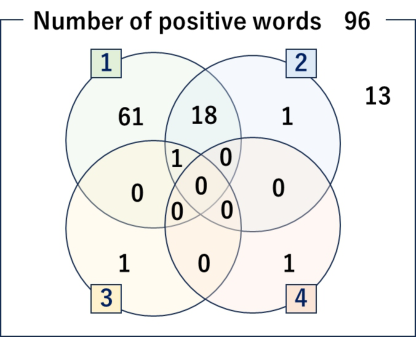
Figure 5 shows which dimensional elements were included in the 96 positive words. Of the 20 cases that had second dimensional elements, 19 contained first dimensional elements. From this, it can be said that people who are conscious of on-site management that looks to the future and is in line with management strategies have a strong realization of team resource
Human Error Prevention Activities In Manufacturing Sites 2277
management. In other words, it can be said that it is difficult to become a person with a long-term perspective that can produce the future without having a perspective on team resource management that leads to short- term problem solving. On the other hand, of the two cases that had third dimension elements, one had both a second dimensional element and a first dimensional background factor, while the other did not have both. In addition, in the one case that had a fourth dimensional element, first, second and third dimensional elements were not confirmed. From this, it was found that third and fourth dimensional elements can be confirmed even if there are no lower dimensional elements. However, since the number of subjects is small to begin with, future prospects include nurturing people who can have a third and fourth dimensional perspective and increasing the number of reports that include third and fourth dimensional elements.
Figure 5: Results of positive words analysis.
The 21 positive words containing second dimensional elements were further classified into 4 categories of Indices on Future Production. Looking at the results, many perspectives related to education were detected, while not a single perspective related to generalist was detected. From this, it can be said that while we are currently cultivating human resources who can observe the field from a long-term perspective, we are not yet cultivating human resources with a multifaceted perspective and diverse knowledge. Therefore, even for workers who submit awareness content that includes second dimensional elements, they do not necessarily have all the abilities necessary for future producing, so it can be said that education and human resource development is necessary to enable everyone to acquire the perspectives they lack.
CONCLUSION
As hypothesized, the number of sentences containing elements decreases as the dimension increases, so it is believed that currently many workers are engaged in safety activities from a short-term perspective. Therefore, it is necessary to develop human resources who can carry out safety activities
with an eye on the future and local community. In addition, since it is generally difficult to imagine that human resources with a high-dimensional perspective do not also have a low-dimensional perspective, we thought that it is necessary to further improve the accuracy of this system. To do this, it is necessary to review whether the reference words are appropriate. In addition, we are currently using an analysis support app using generative AI that is currently being developed. Specifically, we have it learn from past management data as teacher data. Then, when the quantitative data from the four-dimensional evaluation proposed in Chapter 4 is input, the system analyses the data and performs a qualitative assessment to connect it to safety activities. This will allow generative AI to replace the consultant work that has been done by human factor experts until now. In this way, we would like to use generative AI to support the increase in human resources who can realize things from a higher perspective by adapting the functions of generative AI and providing more detailed information according to the situation. The developed four-dimensional word analysis system is undergoing trial operation in an actual factory, and is proving effective in preventing nonconformity incidents.
REFERENCES
Chandler F. T., Chang Y. H. J., Mosleh A., Marble J. L., Boring R. L., and Gertman D. I., Human reliability analysis methods. (2006). selection guidance for NASA, NASA/OSMA Technical Report. Erik Hollnagel. (2014). Safety-I and Safety-II The Past and Future of Safety
Management EUROCONTROL. (2021). Team Resource Management guidelines for the Implementation and Enhancement of TRM. Hawkins, F. H. (1987). Human Factors in Flight. Hollnagel E. (1998). Cognitive Reliability and Error Analysis Method (CREAM), Elsevier. Rasmussen, J. (1987). Analysis of Human Errors in Industrial Incidents and
Accidents for Improvement of Work Safety, New Technology and Human Error, Edited by Rasmussen, et. Al., John Wiley & Sons. Reason, J. (1997). Managing the risk of organizational accidents, Ashgate Publishing Limited. Robert L. Helmreich. (1997). Managing Human Error in Aviation, Scientific
American Vol. 276, No. 5, pp. 62–67 Swain A. D., and Guttmann H. G. (1983). Handbook of Human Reliability Analysis with Emphasis on Nuclear Power Plant Applications Final Report, NUREG/CR- 1278, U. S. Nuclear Regulatory Commission.
LISTED IN THE AHFE DIGITAL BOOKSTORE CATALOGUE
Explore the complete digital volume
Human Factors in Design, Engineering, and Computing
Read this individual research paper free through the original publisher, or explore the full digital proceedings book.
ISBN 978-1-964867-35-9
Explore this ISBN in the AHFE Bookstore ↗Listed in the July 2026 bookstore catalogue; search by ISBN to confirm current availability · Digital book purchase optional