Lake Crowell, Quintin Williams, Irina Buhimschi, Heather Weinreich (2024). Determination of Women Patentees and Their Impact on Participatory Ergonomics. In: Human Factors in Design, Engineering, and Computing. AHFE Open Access, vol. 159, pp. 1911–1920. https://doi.org/10.54941/ahfe1005758
This study examines the role of women inventors in patents and their impact on participatory ergonomics in design. The primary objective was to explore the relationship between the presence of women inventors in patent fields and the academic disciplines from which they graduated. Using correlation testing, the study analyzed the relationship between the number of women inventors in patent sectors and the degrees awarded to women in specific fields. The data was drawn from extensive databases containing patent records and information on the educational backgrounds of women inventors. This approach allowed for an assessment of how participatory ergonomics influences the patenting activities of women, particularly in areas related to their academic training. A similar analysis was conducted for male inventors to provide a comparative perspective. The study showed that women inventors are more likely to engage in patenting within fields that align with their educational backgrounds which differed from that of male inventors. Despite the increasing number of women earning degrees, there remains a significant gender gap in patent filings. This suggests the presence of systemic barriers or disparities. The study also recommends strategies to increase women’s participation in patenting, such as creating supportive environments in academia and the workplace, addressing biases, and encouraging inclusivity in innovation-focused industries. Overall, this study provides valuable insights into the contributions of women inventors to participatory ergonomics in the patenting process, and it adds to the ongoing discussion on gender equity in innovation.
The participation of women in the design process is essential for creating products, services, and systems that meet the diverse needs of all users. Participatory ergonomics, a collaborative design approach, actively involves stakeholders—such as employees, managers, and end-users—in shaping the design and decision-making processes (Townsend et al., 2014). Unlike traditional design methods that often overlook the needs of marginalized groups, including women, participatory ergonomics ensures that products are functional and reflective of real-world experiences.
The importance of this approach is evident as it relates to persistent biases found in traditional design. Findings suggest that if all the patents between 1976 and 2010 had been invented by men and women equally, an additional 6500 female-focused inventions would have been made. (Koning, 2021) This may have helped with historical oversights, such as the lack of female crash test dummies in the automotive industry, which has led to higher injury rates for women in car accidents (Fu, 2021). Addressing these disparities is crucial not just for fairness but also for the health and safety of all individuals. By incorporating participatory ergonomics into design practices, more inclusive and effective solutions can be created, ultimately benefiting society as a whole.
Participatory ergonomics also enhances product usability and user satisfaction. Involving workers in the design process can. produce tools, workstations, and processes which can be tailored to better meet end-user needs (Vink, 2006). The core belief behind this approach is that workers, equipped with the right knowledge and resources, are best positioned to identify problems and develop effective solutions (Haines, 1998). This method not only improves functionality but also fosters innovation and creativity within organizations, empowering employees to drive improvements in efficiency, productivity, and safety (Guimaraes, 2015).
Despite the clear benefits of inclusive design practices, significant disparities remain in patenting and invention activities, particularly between women and men. Research has consistently identified systemic barriers that women face in the patent process, including lower representation in STEM fields, which are critical for patent-related activities (Sugimoto, 2015; Hunt, 2019). These challenges are further enhanced by persistent gender disparities in STEM education and careers, where women encounter a range of obstacles that hinder their advancement.
Moreover, the types of innovations women are more likely to engage with may not be as highly valued within the traditional patent system, which has historically been shaped by male-driven priorities (Charlesworth, 2019). As a result, the underrepresentation of women in patent ownership suggests that many inventions may not fully address the needs of female users and consumers.
Research indicates that gender-diverse teams are more likely to produce patents that focus on women’s health and well-being, underscoring the importance of inclusive innovation for societal progress. A study showed that a 10% increase in female inventors is associated with a 1.2% rise in female-focused patents, and research teams composed of women are 19% more likely to produce patents for women (Weinreich, 2022). Female health outcomes were also found to be 26% more likely to be prioritized by women-led research teams (Weinreich, 2022). Yet, the relatively low proportion of female patentees raises concerns about whether existing inventions adequately serve all genders.
By incorporating diverse perspectives, particularly those of women, the STEM field can better meet the needs of all users and improve overall device usability. This project aims to explore the relationship between women’s fields of study and the respective International Patent Classification (IPC)
Determination of Women Patentees and Their Impact on Participatory Ergonomics 1913
sections in which they receive patents; to compare this with men; and to quantify the differences in patenting outcomes relative to educational backgrounds.
METHODOLOGY
Patent Dataset The patent dataset that the study used was retrieved from the European Patent Office (EPO) and Worldwide Patent Statistical Database (PATSAT) and contained bibliographic data relating to more than 90 million patent documents from leading industrialized and developing countries. The data set was divided into gender using two different methodologies, one from the Massachusetts Institute of Technology (Matias methodology) and the other from Peking University/NYU Polytechnic School of Engineering/Max Planck Institute for Software Systems (Tang methodology). The Matias methodology collected open-source annual birth data from the US Social Security Administration and the UK Office for National Statistics (ONS) into a single database. The sources provided both the names and genders by each year. The Tang methodology involved crawling millions of Facebook public profile pages to generate an annotated name-gender list. Both methodologies resulted in an open-source dataset that listed names along with a count of how many entries were male and female. Patent applications were broken up into bibliographic information and stored in different relational tables regarding applicants, inventors, classifications, and publications.
Degree Datasets The tables for the number of degrees conferred were obtained from the National Center for Education Statistics. The source for the data in the tables is the U.S.Department of Education, National Center for Education Statistics, and Integrated Postsecondary Education Data System (IPEDS). Bachelor’s, Master’s, and Doctoral degrees conferred to males/females by postsecondary institutions, race/ethnicity, and field of study: 2005–2016 are the specific tables that were used for this dataset. A total of 36 different datasets were used to display the male and female degrees conferred by all degree levels over the course of 10 years.
WIPO Classifications The World Intellectual Property Organization’s (WIPO’s) guide to the International Patent Classification (IPC) was used to classify each field of study into a respective IPC section. IPC is the technological classification of patents unified internationally according to the Strasbourg Agreement Concerning the International Patent Classification to internationally standardize each country’s patent classification. The IPC has 8 sections, 120 classes, 628 subclasses, and 69,000 groups. Each section of IPC divides all the technological fields in which the patent may be made. Each section is represented by a capital alphabet letter followed by a section title, as shown below.
Section A: Human Necessities Section B: Performing Operating; Transporting Section C: Chemistry; Metallurgy Section D: Textiles; Paper Section E: Fixed Constructions Section F: Mechanical Engineering; Lighting; Heating; Weapons; Blasting Section G: Physics Section H: Electricity Each of these sections has a breakdown which expands into more detailed information called a subsection. There are several subsections within each section. The subsections are written as informative headings without any classification symbols. Each subsection contains groups of classes related to a subject matter. Each of the sections are divided by classes. The class symbol consists of a section symbol followed by a two-digit number. Each class has one or more subclasses. The subclass symbol consists of class symbols followed by a capital letter. Vowels are not used to identify subclasses for linguistic reasons. The title of each subclass shows a precise subject matter covered by the subclass. An example is shown below.
Figure 1: IPC subclasses.
PROJECT DESIGN The project involved integrating datasets from the Digest of Education Statistics, categorized by gender and degree level, into a comprehensive Excel spreadsheet. The analysis began by compiling ten datasets that detailed the total number of Bachelor’s degrees conferred to women across various fields of study from 2006 to 2016. This process was repeated for Master’s and Doctoral degrees for women, followed by a similar aggregation for men at each degree level.
Using the IPC guide, each academic field of study was mapped to its corresponding IPC classification. This classification process enabled the
Determination of Women Patentees and Their Impact on Participatory Ergonomics 1915
creation of a pivot chart, displaying the total number of students by IPC section and degree field. Once all degree levels for both genders were organized in tables, the analysis proceeded. To assess the relationship between degree fields and patenting activity, Pearson’s Correlation test was applied to determine the significance of the correlation between the IPC classification and the number of degrees conferred. Pearson’s Correlation was chosen as it is ideal for quantifying the linear relationship between two continuous variables – academic fields and associated patenting activities- allowing trends to be identified. The underlying hypothesis was that greater participation of women in specific fields would correlate with a higher number of patents emerging from those fields, reflecting participatory ergonomics. After computing the Pearson Correlation, the correlation strength was interpreted using a standardized coefficient correlation guide. While Pearson’s correlation indicated the presence of a relationship, a Regression analysis was performed to test the statistical significance of these correlations. This analysis was essential for validating the null hypotheses for each gender and degree level, using Excel’s Data Analysis functions.
Following the regression analyses for all hypotheses, a comparative analysis was conducted to examine the total number of male and female inventors relative to the total number of degrees awarded to each gender. The patent data, encompassing the years 2005–2015, provided the basis for extracting and totaling the number of male and female inventors. Since the dataset was developed in 2016, complete patent information for that year was not available. The cumulative number of degrees conferred from 2006 to 2016 was calculated for each gender, enabling a decade-long comparison to identify which gender received the most degrees and which had the most inventors over the same period.
LIMITATIONS The study faced several data limitations. The Matias and Tang methodologies allowed inference of gender data for only about 75% of the patents, leaving 25% unusable. Additionally, 5% of the patent data could not be classified under IPC sections due to NULL entries. Regarding the degree dataset, certain fields of study, which accounted for 28% of the data, could not be mapped to specific IPC sections and were classified as N/A. These fields included:
Area, Ethnic, Cultural, Gender, and Group Studies
Foreign Language, Literatures, and Linguistics
Legal Professions and Studies
Multi/Interdisciplinary Studies
Philosophy and Religious Studies
Psychology
Public Administration and Social Services
Social Science and History
Theology and Religious Vocations Another limitation was the absence of degree fields corresponding to IPC sections D (Textiles; Paper) and H (Electricity), which represent 17% of the inventors in both male and female patent data.
RESULTS
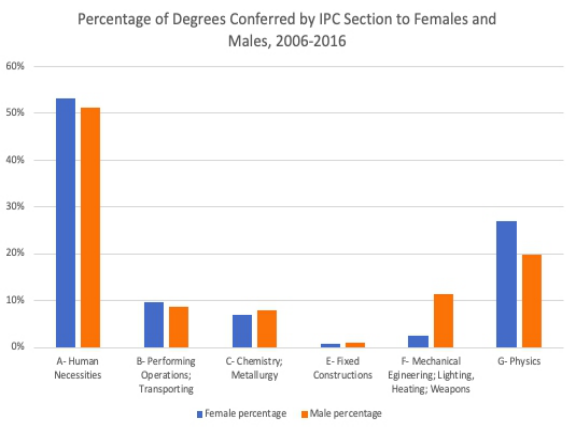
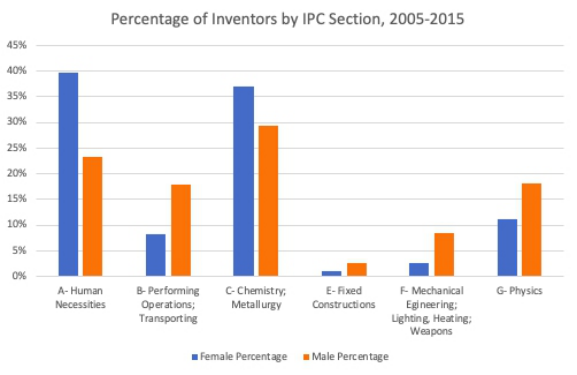
For the first aim, which examined the relationship between the number of women in various fields of study and the number of female inventors per IPC section, Pearson correlation and regression analyses were conducted for bachelor’s, master’s, and doctoral degrees. Tables 1–4 show the results from the Women and men, bachelor’s and master’s degrees and IPC Section Correlation. The results indicated a statistically significant relationship across all degree levels, with the strongest correlation found at the doctoral level. This suggests that the fields in which women pursue degrees are the same fields where they are more likely to become inventors and receive patents, particularly in the IPC sections with high female participation, such as Human Necessities. For the second aim, which focused on men, a similar analysis was performed. A statistically significant relationship was found at the bachelor’s and doctoral levels, but the master’s level showed a non- significant relationship. Like the women, men were more likely to become inventors in fields aligned with their educational background, with the highest male participation in the Human Necessities IPC section. The final aim, shown in Figures 1 and 2, revealed that, despite women earning degrees at a rate 138% higher than men across all levels from 2006-2016, men were recognized as inventors at a rate 965% higher than women. This significant disparity highlights a substantial gender gap in patenting activity, despite comparable academic achievements.
Table 1. Women Bachelor’s degrees and IPC section correlation.
Table available in the original PDF paper.
Table 2. Women Master’s degrees and IPC section correlation.
Table available in the original PDF paper.
Determination of Women Patentees and Their Impact on Participatory Ergonomics 1917
Table 3. Men Bachelor’s degrees and IPC section correlation.
Table available in the original PDF paper.
Table 4. Men Master degrees and IPC section correlation.
Table available in the original PDF paper.
Figure 2: Number of degrees conferred by IPC section to females and males.Figure 3: Number of inventors by IPC section.
DISCUSSION
Despite the growing number of women earning degrees, men are still more likely to receive patents at a much higher rate. As women increasingly enter STEM fields, they are likely to patent, but an educational gap in Intellectual Property (IP) awareness needs to be addressed to bridge this disparity. Universities play a crucial role in this effort. Technology Transfer Offices (TTOs) at universities have helped increase the share of patents held by women by providing guidance through the patent process (Millie, 2016). However, not all universities have TTOs, and women must often seek out these resources independently. Introducing IP education earlier in academic programs could help level the playing field. For example, the University of Southern California launched an undergraduate course on IP basics, which has been positively received by students and is seen as filling an important education gap (Kline, 2018). This initiative could serve as a model for other institutions. Open-source teaching kits and online courses, like those developed by the European Patent Academy and the Michelson Institute for Intellectual Property, offer valuable resources that can be adapted by universities to educate students about patents. Integrating such courses into STEM curricula, especially in the later years when students focus on their specific fields, could equip them with the knowledge and support needed to pursue patents, thereby promoting gender equity in innovation.
CONCLUSION
The study concludes that participatory ergonomics significantly influence the relationship between women’s fields of study and the classifications in which they receive patents. As more women earn degrees in STEM fields, their participation in patenting within these areas increases. However, barriers still exist that impact women’s likelihood of obtaining patents. Introducing mandatory Intellectual Property and patent specific courses in university
Determination of Women Patentees and Their Impact on Participatory Ergonomics 1919
curricula could empower more women to engage in the patenting process. Given that men are over 900% more likely to patent than women, such educational initiatives are crucial for promoting gender equity in innovation and enabling women to invent for women.
REFERENCES
Barry, K. (2019, October 23). The crash test bias: How male-focused testing puts female drivers at risk. Consumer Reports. Retrieved July 11, 2022, from https:// www.consumerreports.org/car-safety/crash-test-bias-how-male-focused- testing- puts-female-drivers-at-risk/ Bose, D., Segui-Gomez, M., & Crandall, J. R. (2011). Vulnerability of female drivers involved in motor vehicle crashes: An analysis of US population at risk. American Journal of Public Health, 101(12), 2368–2373. https://doi.org/10.2105/ajph.2011.300275 Charlesworth, T. E. S., & Banaji, M. R. (2019). Gender in science, technology,
engineering, and mathematics: Issues, causes, solutions. Journal of Neuroscience, 39(37), 7228–7243. https://doi.org/10.1523/jneurosci.0475 18.2019 Ely, K. (2016, April 18). The world is designed for men. Medium. Retrieved June 21, 2022, from https://medium.com/hh-design/the-world-is-designed-for-men- d06640654491 Fu, W., Lee, J., & Huang, H. (2021). How has the injury severity by gender changed
after using female dummy in vehicle testing? Evidence from Florida’s crash data. Journal of Transport & Health, 21, 101073. https://doi.org/10.1016/j.jth.2021. 101073 Guimarães, L. B., Anzanello, M. J., Ribeiro, J. L., & Saurin, T. A. (2015).
Participatory ergonomics intervention for improving human and production outcomes of a Brazilian furniture company. International Journal of Industrial Ergonomics, 49, 97–107. https://doi.org/10.1016/j.ergon.2015.02.002 Hazelwood, V., Carpenter-Smith, E., Continisio, M., DeAngelo, V., Mugurusa, R., Gray, M., Hassler, C., & Wos, J. (2019). What might we do to encourage more women to write patents? Technology & Innovation, 21(1), 43–48. https://doi.or g/10.21300/21.1.2019.43 Hunt, J., Garant, J.-P., Herman, H., & Munroe, D. (2012). Why don’t women patent?
National Bureau of Economic Research Working Paper (No. 17888). https://doi. org/10.3386/w17888 Intellectual Property Office. (2019, October 1). Gender profiles in worldwide patenting: An analysis of female inventorship (2019 edition). GOV. UK. Retrieved July 2, 2022, from https://www.gov.uk/government/publications/gender-profiles-i n-worldwide-patenting-an-analysis-of-female-inventorship-2019-edition Kline, D. (2018, January 20). Every college student’s dream: An 8am class on patents.
Wired. Retrieved July 4, 2022, from https://www.wired.com/story/every-college- students-dream-an-8-am-class-on-patents/ Koning, R., Samila, S., & Ferguson, J.-P. (2019). Female inventors and inventions.
SSRN Electronic Journal. https://doi.org/10.2139/ssrn.3401889 Milli, J., Williams-Baron, E., Berlan, M., Xia, J., & Gault, B. (2016, November 29). Equity in innovation. Institute for Women’s Policy Research. Retrieved July 4, 2022, from https://iwpr.org/wp-content/uploads/2020/12/C448-Equity-in-In novation.pdf Rosser, S. (n.d.). The gender gap in patenting: Is technology transfer a feminist issue?
Retrieved July 11, 2022, from https://www.jstor.org/stable/pdf/20628174.pdf
Sugimoto, C. R., Ni, C., West, J. D., & Larivière, V. (2015). The academic advantage: Gender disparities in patenting. PLOS ONE, 10(5). https://doi.org/10.1371/jour nal.pone.0128000 Townsend, V., Boulos, P., & Urbanic, J. (2015). An ethical roadmap for engineering
participatory design and sociotechnical participation: A manufacturing case study. Proceedings of the ASME 2014 International Mechanical Engineering Congress and Exposition (IMECE2014), V014T08A032. https://doi.org/10.1115/IMEC E2014-38492 Vink, P., Koningsveld, E. A. P., & Molenbroek, J. F. (2006). Positive outcomes of participatory ergonomics in terms of greater comfort and higher productivity. Applied Ergonomics, 37(4), 537–546. Webster, M. (n.d.). Class 2: Patent classification. Class 2: Patent Classification.
Retrieved July 12, 2022, from https://docplayer.net/25101625-Class-2-patent- classification.html Weinreich, H. (2022). Surgical instrument designers and inventors: Where are the women? New England Journal of Medicine.
LISTED IN THE AHFE DIGITAL BOOKSTORE CATALOGUE
Explore the complete digital volume
Human Factors in Design, Engineering, and Computing
Read this individual research paper free through the original publisher, or explore the full digital proceedings book.
ISBN 978-1-964867-35-9
Explore this ISBN in the AHFE Bookstore ↗Listed in the July 2026 bookstore catalogue; search by ISBN to confirm current availability · Digital book purchase optional