Alfredo Soeiro (2024). United Nations Sustainable Development Group (UNSDGs) and Health and Safety. In: Training, Education, and Learning Sciences. AHFE Open Access, vol. 155, pp. 18–25. https://doi.org/10.54941/ahfe1005386
A system was developed by ISHCCO (International Safety and Health Construction Coordinators Organization) enabling the benchmarking based on technical standards, on international and national criteria. For these reasons the option made was to deduce the quality criteria from the European legislation and from respective national implementations and support these with already established professional and international standards of the European Qualification Framework (EQF). The qualification framework is divided in three criteria for knowledge, skills and attitudes referring to the individual qualifications. In this detailed proposal the existing and accepted criteria from the area of Safety Health Construction Coordinators professionals were examined and compared with the contents of the European Directive 92/57 by institutions, companies, educational and training organizations in Europe and rest of the world. Considering changes brought by UNSDGs to construction sector, ISHCCO prepared a proposal adapting the current IQF (ISHCCO Qualification Framework) to include sustainability concerns about Ethics, Work and Health. Main topics of the proposal addressed mainly the UNSDGs goals 3: Good Health and Well-being, 4: Quality Education, 8: Decent Work and Economic Growth, 9: Industry, Innovation and Infrastructure, 11: Sustainable Cities and Communities, 12: Responsible Consumption and Production, 16: Peace and Justice Strong Institutions and 17: Partnerships to achieve the Goal. The adaptation of competences reflects the needs of SHCC to acquire knowledge, skills and attitudes necessary to have an effective contribution towards the development of the UNSDGs goals. The proposal also includes the recent implications provoked by the publication of the European Union - JRC "Green Comp Sustainability Competence Framework". Proposal includes suggestions on how these adapted competences can be acquired by active SHCC, by other active HS professionals and by future professionals in terms of training and of education.
The European Temporary or Mobile Construction Sites Directive, 92/57/EEC, through national legislation in member states, places an obligation on clients to appoint safety and health coordinators for the both the preparation stage and the execution stage of a construction project (European Directive, 1992). The tables below describe the core knowledge, skills and attitudes required
United Nations Sustainable Development Group (UNSDGs) and Health and Safety 19
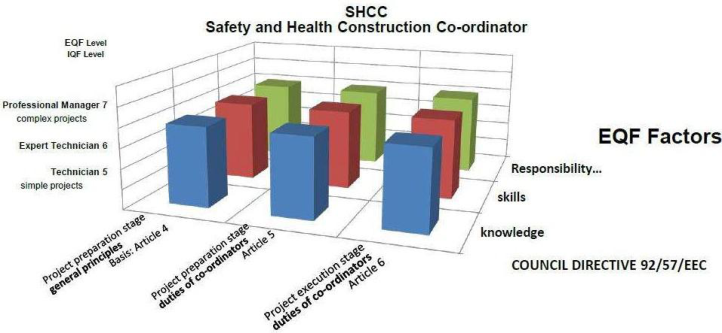
by coordinators at three EQF levels: 5, 6 and 7 (CEDEFOP, 2008). The relationship can be observed in Figure 1.
Figure 1: Application of IQF to the safety and health construction coordination. (ISHCCO 2017).
Each table of IQF starts with the standard EQF descriptor for each level, describes a typical construction for which a person at that level might be an appropriate coordinator and presents some of the job names for that level of person that might be in common usage in some of the member states (ISHCCO, 2017). The functional requirements of coordinators are the same at each of the three levels. These are the levels of skill, knowledge and autonomy and attitudes that increase at the higher levels.
For the IQF following tables it presents the requirements on coordinators from the Directive, using the respective article numbers and beneath each requirement lays out the knowledge, skills and attitudes that are required to discharge the function to that level. Each of the three tables starts with the functions of the preparation stage coordinator (Article 5) and then addresses the functions of the execution stage coordinator (Article 6).
The definitions of knowledge, skills and attitudes used in this ISHCCO Qualifications Framework are adapted to Safety and Health Construction Coordination from the European Qualification Framework (EQF). The EQF definitions are:
Knowledge - outcome of assimilation of information through learning. Knowledge is the body of the facts, principles, theories and practices related to a field of study or work;
Skills - ability to perform tasks and solve problems;
Autonomy and responsibility (Attitudes) - the ability of the individual to apply knowledge and skills autonomously and with responsibility.
These requirements expressed in the IQF are set in the context of health and safety construction coordination. The importance of understanding the design and construction processes to identify the interface risks between
20 Soeiro
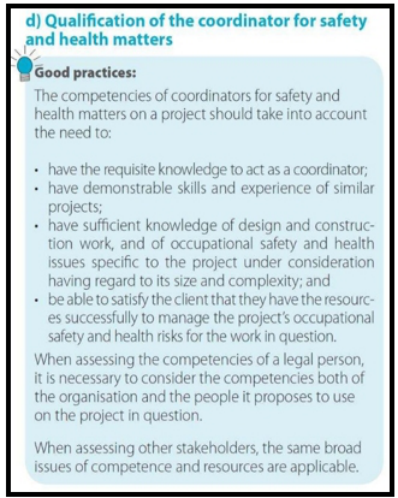
construction techniques. The European Commission has produced a Non- Binding Guide on the application of the Directive. In addition to the knowledge, skills and attitudes identified in IQF, HSCC wanting to work in European Union member states or in other countries around the world will also need to demonstrate that they understand and can apply the national requirements of the country of operation. An illustration of the requirements of HSCC can be presented in Figure 2.
Figure 2: From IQF (ISHCCO, 2017).
In terms of the project stages different member states and countries have different definitions of the stages of a project (European Union, 2011).
The ‘Project’ starts when the client first makes contact with the construc- tion industry and ends when the structure is complete.
The ‘Preparation Stage’ starts at the start of the Project and ends when the role of the Preparation Stage safety and health construction coordinator is complete. This might be when the contractor starts work, when the design is complete, or at the end of the Project.
The ‘Execution Stage’ starts when the construction work starts and ends at the end of the Project.
ISHCCO has produced the IQF with the contribution of a working group of members. The work was done in about four years and it was the result of several meetings held for a day dedicated to several steps towards the current IQF. Initially it was supposed to be developed as an accreditation tool for SHCC professionals. It was noted by some association members that the task and responsibilities of carrying such a job of accrediting the professionals in
United Nations Sustainable Development Group (UNSDGs) and Health and Safety 21
each country was difficult due to the difference of procedures to be qualified as SHCC (ISHCCO, 2019).
Intermediate step consisted in defining modes of assessment that were ade- quate for the different types of competences and various levels of SHCC activities. In this approach, the tool TALOE was used to define for each type of competence adequate modes of assessment like peer review, case studies, multiple choice questions, problem based questions, etc. (ISHCCO, 2019). This phase was concluded and the proposals for evaluating the different competences were discussed and established. These are available for those interested in using these assessment methods.
The last phase consisted in developing training materials that could lead to the acquisition of the required competences. Some countries have their own training schemes based on local safety conditions and on construction practices. These training programs are different in terms of content, duration, periodicity, levels of qualification and definition of learning outcomes/com- petences. The idea of defining a common training program was researched but abandoned due to existing variations across countries. IQF now has this collection of training programs as an annex to the IQF so the choice of an adequate training program can be made.
EXAMPLE OF COMPETENCES IN IQF FOR SHCC The IQF requirements for qualification of a SHCC in terms of knowledge, skills and attitudes corresponds to the European Qualification Framework level 7 (master degree in academic level). This Safety and Health Construc- tion Coordinator (SHCC) professional, according to IQF requirements for being qualified, must have knowledge, skills and attitudes of the processes, as presented in Table 1. These competences can be acquired through training, experience or accreditation of prior learning.
In this approach to define the descriptor’s Knowledge is described as theoretical and/or factual. On the other hand Skills described as cognitive (involving the use of logical, intuitive and creative thinking) and practical (involving manual dexterity and the use of methods, materials, tools and instruments). Finally Responsibility and Autonomy are presented as the abil- ity of the learner to apply knowledge and skills autonomously and with responsibility (ISHCCO, 2017).
These descriptors resulted from the analysis of the performance standards of professionals and from the contribution of selected experts in SHCC and in Sustainability comprehending academics, researchers and practitioners. It is a set of definitions to be improved with future studies and debates.
22 Soeiro
Table 1. Descriptors at level 7 for SHCC of IQF.
Table available in the original PDF paper.
Knowledge Skills Attitudes Specialised problem-solving skills required in research and/or innovation in order to develop new knowledge and procedures and to integrate knowledge from different fields.
Highly specialized knowledge, some of which is at the forefront of knowledge in a field of work or study, as the basis for original thinking and/or research; critical awareness of knowledge issues in a field and at the interface between different fields
Manage and transform work or study contexts that are complex, unpredictable and require new strategic approaches; take responsibility for contributing to professional knowledge and practice and/or for reviewing the strategic performance of teams.
Example of projects: Process plant; complex geotechnical challenges; multi-story above 25 metres/10 floors; bridge structures with pre-stressing; tunneling; deep excavations greater than ten meters; dams.
Article 5(a) Project preparation stage: duties of SHCC (Coordinators) The coordinator(s) for safety and health matters during the project preparation stage appointed in accordance with Article 3(1) shall coordinate implementation of the provisions of Article 4 (General Principles of Prevention) Knowledge Skills Attitudes
Demonstrate professional advocacy in relation to construction safety and health coordination
Understand the principles of ethical practice in construction safety and health
Justify construction coordination actions against organisational objectives Justify the principles and applicability of the tools and techniques available to measure risk
Utilise appropriate national and European standards to improve SHCC performance Develop internal construction coordination competence schemes Apply the theory of organisational communication with respect to construction safety and health Coordination
SUSTAINABILITY IMPLICATIONS IN IQF The international umbrella organization of professionals finds that having a proper set of terms of reference to evaluate who is capable of performing the SHCC tasks and jobs is fundamental to ensure society that professionals perform their tasks with quality. In an area like construction safety, where accidents and fatalities rates are high, it is a civic duty to assure that con- struction safety is coordinated by qualified and capable professionals (Safety Compass, 2020).
The possible developments of the IQF are various. The first could be to become a standard for HSCC around the world. That would give pos- sibility for mobility of SHCC across countries and would ensure that the
United Nations Sustainable Development Group (UNSDGs) and Health and Safety 23
competences have obtained quality levels. The second is that IQF can be adapted to the users acquaintance with competence frameworks using descriptors with concrete examples instead of competence definition. A third possibility is to specifically prepare IQF for different types of constructions like bridges, buildings, highways, dams, etc.
The sustainability concerns have risen in society and in the professional sectors. It has affected the activity of SHCC professionals and the qualifica- tion framework has been under review to accommodate the requirements, for instance, of the United Nations Sustainability Goals (United Nations, 2019) and of the Green Competence Framework (Green Comp, 2022). The associ- ation working group has discussed the possible adaptations of the IQF. The current result of that list of additional competences is translated as a draft version in Table 2.
Table 2. Sustainable IQF competences proposal.
Table available in the original PDF paper.
Valuing sustainability To reflect on personal values; identify and explain how values vary among people and over time, while critically evaluating how they align with sustainability values.
Knowledge Skills Autonomy/responsibility (Attitudes) Is prone to acting in line with values and principles for sustainability
Can articulate and negotiate sustainability values, principles and objectives while recognising different viewpoints
Knows the main views on sustainability: anthropocentrism (human-centric), technocentrism (technological solutions to ecological problems) and ecocentrism (nature-centred) and how they influence assumptions and arguments Exploratory thinking To adopt a relational way of thinking by exploring and linking different disciplines, using creativity and experimentation with novel ideas or methods
Knowledge Skills Autonomy/responsibility Knows the main concepts of a circular economy and society Is committed to decreasing material consumption
Can help build consensus on sustainability in an inclusive manner
Systems thinking To approach a sustainability problem from all sides; to consider time, space and context in order to understand how elements interact within and between systems Knowledge Skills Autonomy/responsibility
Knows that every human action has environmental, social, cultural and economic impacts
Can describe sustainability as a holistic concept that includes environmental, economic, social and cultural issues
Is concerned about the short- and long term impacts of personal actions on others and the planet Problem framing To formulate current or potential challenges as a sustainability problem in terms of difficulty, people involved, time and geographical scope, in order to identify suitable approaches to anticipating and preventing problems, and to mitigating and adapting to already existing problems
(Continued)
24 Soeiro
Table 2. Continued Knowledge Skills Autonomy/responsibility
Table available in the original PDF paper.
Knows sustainability claims without robust evidence are often mere communication strategies, also known as greenwashing
Trusts science even when lacking some of the knowledge required to fully understand scientific claims
Can analyse and assess arguments, ideas, actions and scenarios to determine whether they are in line with evidence and values in terms of sustainability
Collective action To act for change in collaboration with others Knowledge Skills Autonomy/responsibility
Can propose alternative pathways for sustainability
Knows policies that assign responsibility for environmental damage (e.g. “polluter pays”)
Is committed to becoming an agent of change to achieve sustainability Individual initiative To identify own potential for sustainability and to actively contribute to improving prospects for the community and the planet
Knowledge Skills Autonomy/responsibility Knows one’s own potential to bring about positive environmental change Is confident about anticipating and influencing sustainable changes
Can apply the following principles: using fewer resources, doing better with fewer resources, and reusing the same resources
Recognises that everyday action matters
Can take personal initiative and persist in achieving sustainability objectives even in contexts of uncertainty
Knows that preventive action should be taken when certain action or inaction may damage human health and all life forms (precautionary principle)
CONCLUSION
The use of a qualification framework that defines the minimum qualifications of SHCC produced by its professional association has been evolving for about two decades. It has been proven as a valid instrument to act as terms of ref- erence for training of professionals and for recognition in professional and academic terms. IQF follows the current European legislation and respects the frameworks for academic and professional qualifications. The pro-active attitude of the association to adjust its IQF to the needs of UNSDGs derived from the sustainability concerns due to the goal of having properly quali- fied professionals in SHCC and has adopted the global requirements for a sustainable future.
The draft list of competences to be added to IQF are the result of a small working group. It is the intention of the professional association in SHCC to present this draft to professionals of the sector, to construction companies, to official health and safety agencies, to organizations involved in promot- ing sustainability and to society in general. These are unexplored fields and sectors addressing the actual major challenge of the world. Maybe these are small steps towards a major change but it must be underlined that it is an active process and intends to improve the future world. In fact, there is no other world and anything moving in the direction of improving the history
United Nations Sustainable Development Group (UNSDGs) and Health and Safety 25
of the future is worth the effort. The SHCC guild asks for help and for contributions from all stakeholders to enrich the current IQF.
REFERENCES
CEDEFOP (2008). The European Qualifications Framework - EQF. Retrieved 12 January 2024, from https://eur-lex.europa.eu/legal- content/EN/TXT/HTML/?uri=CELEX:32017H0615(01) &from=EN. European Directive 92/57 (1992). European Directive on temporary or mobile construction sites. Retrieved 12 January 2024, from https://eur-lex.europa.eu/legal content/EN/TXT/ ?uri=CELEX:01992L0057-20190726. European Commission (2011). Non-binding guide to good practice for under-
standing and implementing Directive 92/57/EEC on the implementation of min- imum safety and health requirements at temporary or mobile construction sites. Retrieved on 12 January 2024, from https://op.europa.eu/en/publication-detail/- /publication/96b5fe83-ef7d-4628-9af0-e02b25810c1d. GreenComp (2022). Green Competence Framework. Retrieved 12 January 2024, from https://joint-research- centre.ec.europa.eu/greencomp-european- sustainability-competence-framework_en. ISHCCO (2017). ISHCCO Qualification Framework. Retrieved 12 January 2024, from https://www.ishcco.org/ishcco-qualification-framework/. ISHCCO (2019). Evaluation of the EU Occupational Safety and Health Directives.
Retrieved 12 January 2024, from https://www.ishcco.org/publications/. Safety Compass (2020). Creating a World Where Everyone Comes Home From Work. Retrieved 12 January 2024, from https://thesafetycompass.au. Soeiro, A. et al., (2022), Competence Framework for Sustainable Construction
Safety: ISHCCO proposal, ORP Conference. TALOE (2015). Time to assess learning outcomes. Retrieved 12 January 2024, from https://taloe.up.pt. United Nations (2019). United Nations Sustainable Development Goals. Retrieved
12 January 2024, from https://www.undp.org/.
LISTED IN THE AHFE DIGITAL BOOKSTORE CATALOGUE
Explore the complete digital volume
Training, Education, and Learning Sciences
Read this individual research paper free through the original publisher, or explore the full digital proceedings book.
ISBN 978-1-964867-31-1
Explore this ISBN in the AHFE Bookstore ↗Listed in the July 2026 bookstore catalogue; search by ISBN to confirm current availability · Digital book purchase optional