Tomoyuki Shigeta, Tomohiro Uemura, Yasunobu Ito (2024). Micro-ethnography of Creativity in the Learning Process of “Design Thinking”: A Case Study at a Japanese Liberal Arts University. In: The Human Side of Service Engineering. AHFE Open Access, vol. 143, pp. 296–304. https://doi.org/10.54941/ahfe1005110
In Japanese university education, Design Thinking is taking root in the educational program for human resource development. A characteristic feature of design thinking is that it draws out the creativity of participants through group work. However, it cannot be said that the research to date has fully elucidated how participants’ creativity is brought out in group work. Therefore, the purpose of this study is to clarify how students in group work influence each other to exhibit their creativity in design thinking. In the analysis process, new methods based on the micro-ethnography are applied. This paper reports on a set of analytical methods.
The purpose of this study is to present a method for analyzing design thinking by conducting micro-ethnography in the creative process of design thinking. The goal is to contribute to the development of creativity education using design thinking.
In Japanese universities, design thinking has been widely introduced as an educational method to enhance students’ creativity. However, it has already been pointed out that there are cases in which students fail to demonstrate their creativity despite the use of design thinking (Shigeta and Ito, 2023). In response to this, an attempt was made to clarify the factors that constitute cre- ativity in design thinking by conducting ethnography of student group work in the class which applies design thinking by elucidating the relationships between people and objects. The analysis revealed that the process of design thinking in group activity has three components: the roles that exist for each member, complementary relationship spur discussion, and the use of objects to facilitate discussions (Shigeta and Ito, 2023). These are the overview of activities through an overarching analysis of the creativity in design thinking.
The results of the study were presented at the Japanese Society for the Science of Design and various research conferences. The feedback from the
Micro-Ethnography of Creativity in the Learning Process of “Design Thinking” 297
participants claimed the need to explore the mechanism of creativity, rather than just grasping an overview, to understand how creativity originates. To explore the mechanism of creativity, it was necessary not only to take a bird’s-eye view of the activities, but also to capture and analyze in detail the interactions among the students that occurred during the activity. Design researcher Kimbell noted that design thinking is a contingent combination of various factors; and that “we might attend to the material and discursive practices in which designers of particular kinds do, know, and say particular things and how they come to do, know, and say these things but not others. In so doing we might develop a richer understanding of professional design and its effects,” (Kimbell, 2012 :130) suggesting that in examining design think- ing, we can gain better understanding by focusing on the discourses that occur in the activity and in their relationships with objects. Given this background, we recognized the need to capture the students’ activities in detail. Therefore, we conducted our analysis using micro-ethnography techniques to observe their activities from a microscopic perspective. In this paper, we report on the analytical methods used in the course of our research and the results of our analysis.
METHOD
As a preceding example on the use of ethnography in the design creation process, a study investigated how design thinking contributes to creativity (Felder et al., 2023). In this study, analysis was conducted using partici- pant observation and semi-structured interviews to investigate the impact of design thinking on organizational change. Another research method similar to ethnography was a case study which analyzed the relationships of concepts that designers have in the design thinking process via video recordings and participant observation of the design creation process (Kimbell, 2012). The “micro” in micro-ethnography means close-up analysis of practices (Alvehus and Crevani, 2022). This is a method of analyzing relationships and inter- actions based on the observation of conversations and actions at a finer scale than ethnography. In previous studies, there are no examples of micro- ethnography being used to analyze the design creation process. Therefore, this paper reports on the method of analysis conducted from the viewpoint of micro-ethnography in the design creation process.
The subject of the study was the class “Design Theory B” held in the Department of Art, Faculty of Letters, University A. This class was taught by the author. The students were 3rd and 4th year students. In the class, a workshop was held in group work to think about products according to the design thinking process. The period of the workshop was from October to December 2021. The class was conducted online using Microsoft Teams. The class consisted of two parts. Part 1 was an individual assignment, in which students were asked to examine an issue that arose in their student life and present it to the class. In Part 2, students were asked to select a topic of their interest from the presentations, and the teacher divided them into groups accordingly. There were five teams and each group consisted of three to six students. The class lasted 90 minutes. In Part 2, the class was structured based
on the five steps of Design Thinking: Empathize, Define, Ideate, Prototype, and Test. Many educational institutions in Japan have adopted programs that apply these steps. In this class, however, prototyping was difficult to apply in the classroom and school facilities. Therefore, the contents of the Prototype and Test sections were changed. The changed contents consisted of prepar- ing presentation materials and presenting the group’s design (Table 1). Ideate and preparing presentation materials were conducted over a two-day period due to delay in the work.
Table 1. Class contents and dates.
Table available in the original PDF paper.
The class contents from Empathize to Ideate were analyzed in Part 2. Two data types were collected for analysis in Part 2. The first type was video data recorded using the Teams screen recording function. The video included images of faces and sketches captured by the camera, as well as the audio of the conversation. The second type was the data saved and sorted by date from the screen of JAMBOARD, a Google service that I, as the instructor prepared for taking the minutes of the group’s activities. The subject of this analysis was a group of three members. The group addressed the themes of reducing traffic congestion on commuter buses and the hassle of purchasing bus tickets. In addition, this paper focused on the steps in Define. The analysis method was divided into two main phases. Phase 1 is an analysis to understand the overall picture of the activity. Phase 2 is an analysis to extract patterns from activity trends. The following details explain the analysis result.
RESULT
Phase 1: Analysis to Understand the Overall Picture of Activities For the first step, we made a table of the conversations from the recorded video to grasp an overall picture of the activity (Table 2). The table included the following elements related to the activity, besides the conversation.
Tags: Conversations were broken down into contents with a title for each. Actions: Actions taken in conjunction with the conversation (e.g., taking minutes, etc.) Reference images: Minutes taken by the participants or reference images from the Internet. Tools used: Tools used by the participants Notes from observations: Notes taken by the observer From this table, it is possible to understand the conversations and actions that influenced the design. For example, the bold frame in Table 2 shows the scene where the decision was made on the design direction. By focusing on the conversation thread which lead up to this scene, we can understand the pro- cess of how the design was established. Here, the group member, CO, points out the problems and elicits comments from CI, also a member, on ideas that
Micro-Ethnography of Creativity in the Learning Process of “Design Thinking” 299
will lead to a solution. CI states, “The problem that will come up once we solve the bus ticket, and that is what we are going to do.” This suggests that multiple problems can be solved by combining past ideas with ideas gener- ated this time. Ultimately, CI’s statement generated empathy among group members and formed the design direction.
Table 2. Speech in the target group.
Table available in the original PDF paper.
Take a bird’s eye view on Table 2, it is possible to roughly grasp the rela- tionships between the statements that led to the design. However, in order to grasp the process of design in more detail, we thought it necessary to focus on the speaker’s intentions and its relationship by going back-and-forth in the thread. Communication between members takes place on a time axis. Under this context, we came up with a way of expressing conversations along a time axis as the method for grasping relationships.
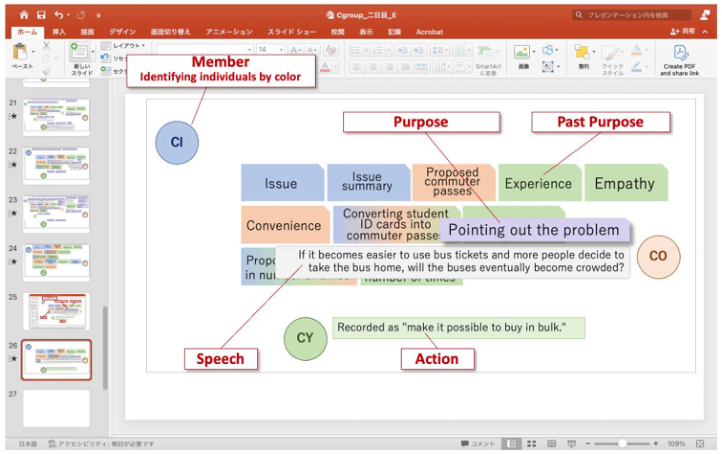
We transcribed the conversation in Table 2 one frame at a time for each utterance and the method was to analyze by continuously viewing them as if they were a flip-book animation (Figure 1). The production was created using Microsoft PowerPoint. The following is a description of each frame. Each member is identified by different color of circles. The circles are fixed in position so that they do not move when the page is switched. The gray rectangle with text indicates each member’s statement was and positioned near the speaker icon. The rectangles are displayed each time a statement is made, and when the next statement is made, the previous statement is erased. The text in the purple rectangle indicates the purpose statement. These are displayed until the end of a topic in order to analyze the relationship between the statements. Whenever a topic ends, Purpose is moved to the background as a Past purpose; the Past purposes are then arranged in order of appearance until they fill up the screen width, when it becomes full, it displays on the next line. For each utterance, each speaker was given a color so that he or she can be identified. Besides that, when a specific action was observed in the statement, such as “referring to a document”, the text in a green rectangle describes it as an Action, and places it near the subject. Past
purposes shared by several members were represented by a mixed gradation of individual colors.
Figure 1: Flip-book conversations using power point.
The production procedure is as follows: First, Speech and Action were extracted and described from Table 2. Next, we viewed the PowerPoint slides, by switching back-and-forth. While reflecting on the students’ activities, we watched back video recordings to analogize and describe the Purpose as needed. If a new Purpose was generated in response to a new statement, the Purpose was noted down consecutively, in parallel.
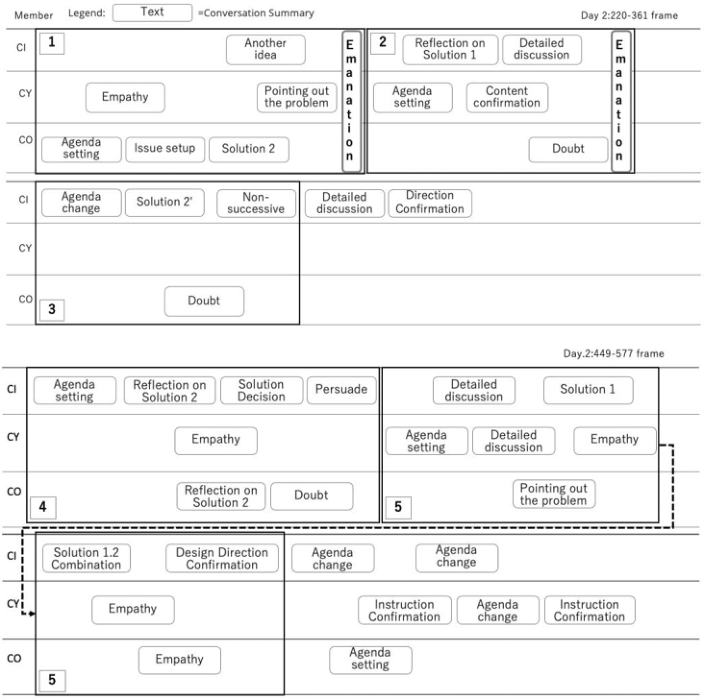
Phase 2: Analysis to Extract Patterns From Activity Trends By analyzing the relationship of purpose, detailed activities become visible as a trend. Figure 2 is an excerpt from a table where the keywords listed under purpose in the Define section are arranged in chronological order by the per- son who mentioned them. In the table, the passage of time flows from left to right. In addition, the parts of the table that do not fit within the page are shown at the bottom. One can read the pattern of the group’s activities from Figure 2. In the figure, the bold frame shows the patterns that appeared in the Define section. The bold numbers in the frame indicate the order in which the patterns appeared. The number 5 is the rearrangement of the Purpose extracted from Figure 2. These patterns have a common part and a unique part. The progression of the common part is as follows: First, an agenda is set to trigger discussion. Next, the issues are set as the theme, and solutions and specific ideas are presented. Afterwards, problems and questions on the solu- tions are presented. The process of unique part has two patterns. The first pattern is where the discussion is not coherent and diverges; items 1 through
Micro-Ethnography of Creativity in the Learning Process of “Design Thinking” 301
4 fall into this pattern. The second pattern is where the discussion is coherent, consensus is reached, and convergence is achieved. Item 5 is a case in point.
Figure 2: Extraction of activity patterns.
DISCUSSION
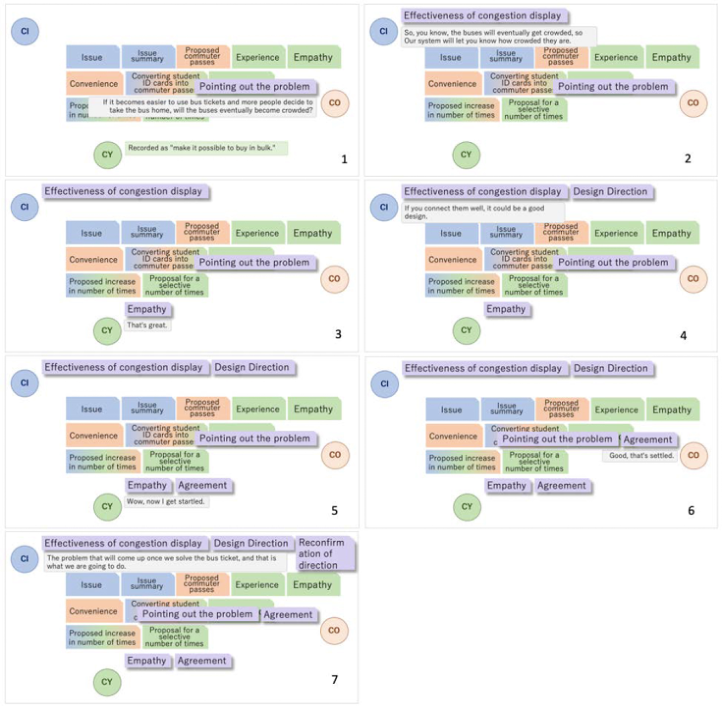
The following are the findings from each of the analysis methods described in the Methods section. In the comprehensive analysis of activity, Purpose serves a critical role. As shown in Figure 1, the relationship between Purpose and the change process in the members’ ideas can be clarified by visualizing Purpose in the conversation and displaying them along the time axis. For example, Figure 3 shows the conversational frames from the bold frames of target group in Table 2. The conversation transitioned in numerical order. When focusing on Purpose in this scene, a problem was pointed out in response to the previously discussed idea, and its solution, which was to express the degree of traffic congestion was proposed and its effectiveness was demonstrated. This idea cultivated empathy in other members, which then determined the design direction. Thus, Purpose serves to convert the students’
conversational contents into an elevated abstract vocabulary. The analyst can conceptually capture the relationships and changes between conversations by focusing on Purpose.
In Figure 2, two patterns of divergence and convergence exist in the analy- sis of extracting patterns based on activity trend. Comparing the differences between them reveals the characteristics of each pattern. In the case of diver- gence, an idea put forth by one member is not agreed upon by other members, or the member who put forth the idea ignores it, thus discontinuing the dis- cussion, so that the next item on the agenda is presented. In convergence, one member presents an integrated solution to the problems or questions raised by other members, and they empathize with the presenter. In this case, convergence led to a decision on the design direction.
Figure 3: Conversation change by frame expression.
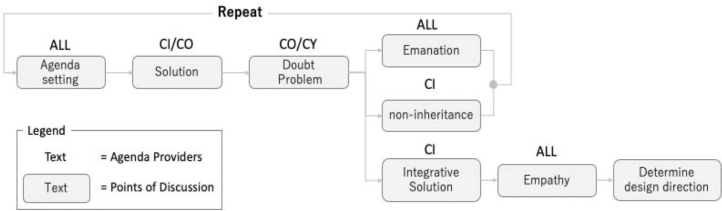
As a result of these analyses, we found that the structure of Figure 4 exists in the Define items of the analyzed group. After the agenda is set for dis- cussion, one member presents a solution or idea to the issue. In response,
Micro-Ethnography of Creativity in the Learning Process of “Design Thinking” 303
other members point out problems or questions. If the discussion becomes unmanageable and begins to diverge, topic loses continuity and the discussion becomes stagnant, the agenda is set again. After the repetition of these activ- ities at some point, an idea which relates and combines previous solutions to multiple problems and issues is presented. This idea was able to gener- ate empathy among the members. Hence a decision was made on the design direction.
Figure 4: Structure of define items in design thinking.
CONCLUSION
In this paper, we applied two methods of analyzing creativity in the learning process of design thinking; one method was to understand the whole of the activity and the other method was to extract patterns from the activity trends which was used to clarify the structure inherent in design thinking. By using these analysis methods together, we interpreted the activities of the students, going back-and-forth between the whole and the parts of their activities. In other words, switching perspectives between whole and part activities, lead to the discovery of commonalities in the intentions behind the activities. Another key factor in the process of analysis is diagramming. In this paper, we attempted two types of diagramming. In the first diagramming, conversation is converted into a single frame to inferentially clarify the speaker’s inten- tions. The second diagramming extracts intentions and derives relationship patterns from them. By combining these methods, we were able to extract the structure of the discussion in the Define step of Design Thinking. We can analyze other steps in the same manner, by extracting the structure and exam- ining these relationships, and realize the possibility of deriving the mechanism of creativity in design thinking.
One limitation of this method of analysis is the difficulty in selecting the vocabulary used in the analysis. Depending on the phase or step in the analy- sis, oscillations may occur during the analysis, such as using different words when having the same intentions or using the same word with different nuances. Moreover, the words used in the process of analysis may not always be interpreted in the same way for others, even if it indicates a deeper mean- ing for the analyst. In addition, the rules for diagramming are not yet fully defined.
The agenda going forward, in view of this analysis method, it is necessary to define the vocabulary and the drawing of the diagram in detail to be better understood by others.
REFERENCES
Alvehus, Johan. Crevani, Lucia. (2022). Micro-ethnography: Towards An Approach for Attending to the Multimodality of Leadership, Journal of Change Manage- ment, 26 May 2022. Felder, Martijn. Kleinhout-Vliek, Tineke. Stevens, Marthe. De Bont, Antoinette.
(2023). From ‘if only’ to ‘what if’: An ethnographic study into design thinking and organizational change, Design Studies, Volume 86. Kimbell, Lucy. (2012). Rethinking Design Thinking: Part II, Design and Culture, July
2012. Shigeta, Tomoyuki. Ito, Yasunobu. (2023). “Design Thinking” as Collaborative Creativity in Group Work: A Case Study at a Japanese Liberal Arts University, The Human Side of Service Engineering, Vol. 108.
LISTED IN THE AHFE DIGITAL BOOKSTORE CATALOGUE
Explore the complete digital volume
The Human Side of Service Engineering
Read this individual research paper free through the original publisher, or explore the full digital proceedings book.
ISBN 978-1-964867-19-9
Explore this ISBN in the AHFE Bookstore ↗Listed in the July 2026 bookstore catalogue; search by ISBN to confirm current availability · Digital book purchase optional