Akira Yasujima, Yasunobu Ito (2024). "Entrepreneuring" of Mature Small- to Medium-sized Companies in Crisis Situation: A Case Study of a Legacy Bakery with 90 Years of History. In: The Human Side of Service Engineering. AHFE Open Access, vol. 143, pp. 254–263. https://doi.org/10.54941/ahfe1005105
This study aims to elucidate the processes inherent in entrepreneurial activities by exploring how small- to medium-sized mature companies strive to reorganize as they respond to various crises. Specifically, we examine business reorganization processes through a case study of a well-established company in Japan, re-conceptualizing entrepreneurship — commonly considered a static and ambiguous notion — as a dynamic process of “entrepreneuring”. Recently in Japan, anticipation for the “emergence of transcendent individuals“ who generate innovations has been growing. However, there is a paucity of interests in analyses centered on small- and medium-sized mature companies which often grapple with constraints and limitations unique to themselves. In recent years, scholarly discourse have expanded beyond associating entrepreneurship solely with new business ventures, and the significance of dynamically analyzing entrepreneuring as a process in a world where practices and mindsets are already organized (Steyaert 2007: 462) is pointed out in international journals. Additionally, inquiries into how newly organized cultures emerge in the process of organizational and institutional changes (Hjorth & Reay 2022: 159) have gained traction. The conceptual viewpoint of entrepreneuring is shifting from methodological individualism towards practicalism and relationism. Building on these premises, this paper presents a hypothesis about the nature of entrepreneuring by delineating a case of organizational restructuring in a company, viewed through the lens of long-term process changes. The subject of this study is a legacy bakery with which a private equity (corporate restructuring) fund, managed by one of the authors (AY), has been engaged since 2019. Before the fund’s engagement, the bakery’s financial constraints led to severely limited investments in facilities and to a shortage of middle-ranking and younger staff. Furthermore, the COVID-19 pandemic and the Ukrainian conflict significantly strained its operations. Under these circumstances, the bakery has been engaged in the process of entrepreneuring in order to diversify its customer base and revamp its business portfolio. We conducted a qualitative examination of the data, which included records from participant-observations spanning nearly five years, individual interviews with key stakeholders and reflection sheets gathered after workshops. Comparative analyses with other cases of corporate turnarounds orchestrated by the fund have also been undertaken. Initially, the company's failure to recognize the necessity for organizational change had impeded attempts at autonomous or internal reorganization. However, the “institutional changes” brought from outside, namely the change in shareholders and the onset of a financial deficit, catalyzed the generation of reorganization efforts. During the process, the “institutions”, or corporate cultures, based on the bakery's decades-old customs created barriers against change. Also, potential conflicts between multiple “institutional logics” historically embedded in the company emerged during the change process. Nevertheless, through ongoing efforts across the organization,the employees began to explore the common benefits that emerged from such conflicts. The results of this study illustrate the process of a gradual diversification of relationships among involved agents that catalyzed the reorganization process. Innovations within small- and medium-sized companies with limited managerial resources can be perceived as processes of reorganization sparked by intersection and amalgamation of various actors representing a constantly evolving performative action.
This study aims to elucidate how mature small- to medium-sized compa- nies facing various crises manage to respond to them and reorganize their businesses in order to sustain and further develop their business organiza- tions. The focus of this study is to explore their entrepreneurial activities through the lens of “entrepreneuring” (Steyaert, 2007) and attempt to dis- ambiguate the notion of the term. Specifically, we investigate the case of entrepreneuring at a well-established bakery, marking its 90th anniversary (hereinafter referred to as Bakery A). The owner of Bakery A, who had no successor, decided to sell 80% of the shares to an investment fund (a corpo- rate turnaround fund hereinafter referred to as Company X) in hopes for the
“Entrepreneuring” of Mature Small-to Medium-Sized Companies in Crisis Situation 255
bakery’s growth in the years to come. Later, they were faced with macroeco- nomic (institutional) changes beyond its control, including a drastic decline in sales due to the COVID-19 pandemic and a sharp rise in raw material prices resulting from the Ukrainian conflict and yen depreciation. This paper outlines the process of collaborative efforts of Bakery A’s executives and staff with the team from Company X and the external personnel brought in by Company X in order to revamp and diversify Bakery A’s business portfolio.
Recently in Japan, as the government’s initiative to support new business ventures gained momentum, anticipation for the emergence of transcendent individuals who generate innovations, or for groundbreaking technologies that revolutionize global operations overnight has been growing. However, innovation is not solely contingent upon the attributes of individuals, as Takahashi and Matsushima (2009: 48) indicated that “the term ‘innovation’ in traditional entrepreneurial studies have largely adhered to the paradigm established by Schumpeter (1926), which primarily centers on the individual traits of entrepreneurs portrayed as heroes”. Additionally, while discussions on every kind of support for entrepreneurs tend to focus on start-ups, we have also believed that more attention should be paid to innovations in mature small- and medium-sized companies which, despite their constrained management resources, have supported the diverse procurement needs of Japan’s major corporations and have provided approximately two-thirds of the nation’s employment. Consequently, this study intends to juxtapose the succession processes in long-established, owner-operated companies with business ventures. We will specifically investigate how the deep-rooted rou- tines and employee perceptions, ossified by the company’s extensive historical background, foster internal and external organizational conflicts, as well as intricate relationships among various stakeholders.
Champenois et al. (2022: 2) indicated that the notion of “entrepreneur- ship”, often equated with start-ups and innovations, is ambiguous and commonly considered static, and it lacks the perspective that it is a process generated through constant and dynamic changes. Steyrert (2007: 462) sim- ilarly emphasized the significance of extending the concept of entrepreneur- ship beyond its traditional association solely with new business ventures, proposing dynamically analyzing entrepreneuring as a process in an already organized world of practices and mindsets. Furthermore, Hjorth & Reay (2022: 159) focus on how newly organized cultures are created during the change process of organizational institution.
Through these previous studies, the conceptual perspective of the static term “entrepreneurship” is evolving from methodological individualism towards practicalism and relationism, that is, towards a more dynamic term “entrepreneuring”.
In essence, when analyzing changes in organizational institutions, it becomes essential to consider that the current state is an amalgamation of cultures and institutions shaped by historical contexts.
In light of these questions, Steyaert (2011) underscores the necessity for researchers to engage actively in in-field interventions and process-oriented practices to enhance their understanding of entrepreneuring. However, Steyaert’s assertion that “entrepreneurship studies will have to go beyond
256 Yasujima and Ito
epistemological discussions of combining quantitative and qualitative studies and invest in methodological experimentation... these ontological under- standings of method and these experimentations will enable entrepreneurship studies to become truly part of the social sciences; that is performative, partic- ipative, in short, enactive” (Steyaert, 2011: 86), leaves some ambiguity, as the actual actors and actions encompassed by “participation” are not distinctly defined, leading to a lack of clarity regarding the term “methodological experimentation.”
In contrast, the title of Steyaert’s paper, “Entrepreneurship as In(ter)vention” (2011) combines the concepts of the potentially misleading term “intervention” with “invention” or “emergence”. Steyaert posits that the methodology of “participation”, derived from this amalgamation, entails more active and interactive acts with individuals at the site. This approach transcends the traditional view of the researcher as a detached third-party observer, instead advocating for a participatory, two-way involvement. For such “methodological experimentations”to be effective, as Steyaert proposes, active acceptance by the organization is a must. This approach challenges researchers to assess the extent of their involvement in on-site practices and to take responsibility for the outcomes of their actions.
Based on these the theoretical foundations, this paper proposes a hypothe- sis that examines the practice and future potential of entrepreneuring within companies – particularly its methodology as a dynamic process. We aim to explore how this concept manifests in real-world settings and consider its possible future trajectories and challenges.
METHOD
We investigate the business succession case of Bakery A, a well-established bakery with about 100 full-time and 200 part-time employees. This ongo- ing project is conducted by Company X, an investment limited partnership (ILP) established in 2002 as the first corporate turnaround fund in Japan and has since been managed by one of the authors (AY). Founded in 1933 by the A Family in Kojimachi, Tokyo, Bakery A, originally named A Store, cele- brated its 90th anniversary in 2023. In 1944, the Japanese Ministry of Foreign Affairs requested the establishment of the Karuizawa branch as a ration dis- tribution station for foreign embassies and expatriates in Japan. This branch, known as “A, the Bakery of Karuizawa,” remains popular among affluent and older demographics. Under the leadership of Mr. KA, the second pres- ident and a forward-thinking leader, the bakery flourished until the 1980s. However, a failed real estate investment during Japan’s economic bubble led to a period of bank control. After Mr. KA retired to take responsibility for the mismanagement, his eldest daughter, Ms. MA, unexpectedly took over as representative director from July 2006 to May 2020. Facing a lack of suc- cession options and stagnating management, she transferred ownership to Company X in 2019.
Company X specializes in supporting the growth strategies of small and medium-sized enterprises. Distinctively, it offers hands-on support, where Company X’s team members and experts from their established human
“Entrepreneuring” of Mature Small-to Medium-Sized Companies in Crisis Situation 257
resource network, developed over the past 20 years, actively collaborate on-site with client company personnel. In this study, we employed ethno- graphic methods primarily focusing on participant observations and inter- views conducted on-site. However, our approach diverges from traditional ethnography as the authors are actively involved in the field, collaborating and then analyzing and documenting these experiences at a meta-level. Fur- thermore, Company X typically conducts growth strategy workshops with its investees. Our analysis also incorporates questionnaires, reflection sheets, and narratives collected from employees during these workshops.
Table 1 presents a list of the executives from Bakery A who participated in our semi-structured interviews.
This group encompasses key figures from the manufacturing, sales, and management departments, including both full-time employees and external experts brought in by Company X. In this case of business succession, two individuals dispatched by Company X, including the newly appointed pres- ident, are stationed and actively involved at Bakery A. Although these four members from Company X, including one of the authors (AY), hold part-time positions, they have been engaging and communicating with Bakery A on an almost daily basis over the past five years.
Table 1. List of interviewees (as of January 2024).
Table available in the original PDF paper.
Name Age Years Worked
Current Role Previous Role (job) Educational Background
K 55 33 Manufacturing, Karuizawa (director)
Full-time (breadmak- ing) Vocational school T 53 31 Manufacturing (director)
Full-time High school R 46 26 Manufacturing/sales (director)
Full-time (breadmak- ing) Vocational school NM 48 5 Production control (manager)
Mid-career hire, food University (science) S 47 2 Marketing (executive officer)
Mid-career hire, department store Junior college U 68 2 President Manufacturing, presi- dent M.S. (science)
Included in descriptions and analyses in this paper are detailed accounts of the on-site intervention activities provided by one of the authors (AY), who, as mentioned above, is the owner of Company X. Insights from co-author (YI), team members of Company X, Mr. U and Mr. R are also incorporated in order to minimize bias in the descriptions of this paper.
258 Yasujima and Ito
RESULT AND DISCUSSION
Drawing on Bakery A’s activities for the last five years, we present the following hypotheses with regard to entrepreneuring at mature companies.
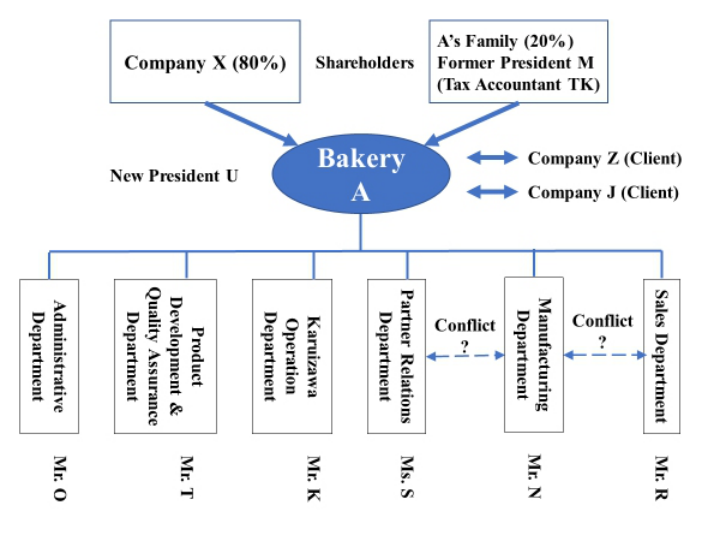
In Mature Companies With Strong Organizational Inertia and No Active Desire to Change Themselves, Changes in the External Environment and the Accumulation of Contradictions Within the Organization May Serve as a Trigger for Their Change As per the 2020 questionnaire, the majority of Bakery A’s employees were ini- tially resistant to organizational change, with few considering the company’s long-term future. The pivotal moment for change was the business succes- sion and share transfer in 2020. Exacerbating factors, such as the prolonged COVID-19 pandemic from 2020, escalating costs of wheat and oil due to the Ukrainian conflict from 2022, and the yen’s significant depreciation lead- ing to a severe business downturn, cumulatively drove the organization to a critical deficit. This situation heightened employee awareness and urgency, as evidenced by a recent statement from Mr. N, the new factory manager: “I was talking with my colleague, Mr. I, that Bakery A would not have sur- vived if Company X had not joined our business at that time (2020). In that sense, I am grateful. I think it was a good call for our company, too” (Inter- view on December 12, 2023). This case study of Bakery A illustrates that in mature companies, organizational change is often a response to the buildup of internal contradictions and shifts in the external institutional environment.
The Participation of External Parties and the Act of Intervention Are Two Sides of the Same Coin. Close Collaboration With Bakery A’s Employees Was Essential for the External Parties to Be Accepted by Frontline Workers Before making an investment, compared to their previous 20 years of work experience at other companies, the members of Company X had been won- dering why Bakery A’s employees were so uninterested in Bakery A’s overall issues and problems (Report by DD, 2020). Notably, Bakery A lacked funda- mental organizational structures, such as a board of directors and personnel evaluation standards, which contributed to a diminished sense of owner- ship among employees who were accustomed to receiving information in a top-down, irregular manner. The introduction of Company X’s cross- organizational workshops initiated a shift, fostering deeper relationships and collaborative mindsets among Bakery A’s staff. The establishment of a ‘co-creation room’ in the new factory significantly enhanced horizontal coop- eration within the company. These developments illustrate the critical role of shared spaces and experiences in driving organizational change. In this sce- nario, the distinction between the participation of external parties and their intervention becomes blurred. It underscores the importance of external par- ties not only being present but actively collaborating and engaging with other stakeholders in the change process.
“Entrepreneuring” of Mature Small-to Medium-Sized Companies in Crisis Situation 259
Figure 1: Organization after business succession.
The Introduction of a New Factory and Equipment Contributed to the Active Acceptance of Change by Bakery A’s Employees Historically, the bakery had limited its investment in management resources, including capital expenditure. However, the construction of a new fac- tory equipped with advanced machinery, in response to requests from the manufacturing staff, significantly boosted the morale of frontline workers. Previously, members of the manufacturing department were apprehensive about increased sales, viewing them merely as an added burden. However, the introduction of state-of-the-art equipment initiated a paradigm shift among them. They began to actively consider how to leverage these technological advancements to increase production efficiency.
For instance, they are contemplating the adoption of a quick freezer to bal- ance the workload between more challenging night shifts and day shifts. This proactive approach marks a substantial shift from their earlier stance of not anticipating or preparing for potential conflicts with the sales department. In this context, the relationship with the factory and its equipment, as artificial elements, has become crucial.
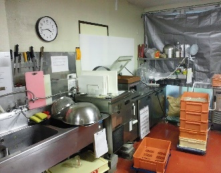
Another notable change is in the factory’s ‘5S’ activities (sort, set in order, shine, standardize, and sustain), which were previously neglected. Now, employees are taking the initiative to ‘visualize’ and improve these pro- cesses, demonstrating a newfound leadership and engagement with their work environment.
260 Yasujima and Ito
Figure 2: Images of old factories before “5S” activities.
New Talents Invited From Outside the Company, as Well as Those Who Had Been Buried Within the Company, Are Now Functioning as Good Intermediaries Within the Organization Another point is about the people. Before 2020, Bakery A had a tendency of creating closed loops for each of its workplace, or more specifically, smaller groups of close colleagues or individuals. Now, talents such as Ms. S, a mar- keter dispatched by Company X, and Mr. NK, a mid-career hire at Bakery A who has not been so prominent in the freezing factory, are now working as contacts between different groups of people, just like a “lubricant”. They share a few qualities in common: Since neither of them are originally from Bakery A, they can look at things fairly in a level-headed manner, and they each contribute to the company in their own specialized way.
The Future of Bakery A The outcomes mentioned above were not planned in advance. In the pro- cess of performing daily activities, the next issues were detected, and by carefully addressing them without ignoring them (as the people had done in the past), the issues were solved, and then the next issues were discovered. As a result of such successive processes, Bakery A’s differentiation gradually progressed. Whether Bakery A’s entrepreneuring efforts will succeed or not remains to be seen, but we can definitely say that the entire process has not progressed in a linear manner in accordance with a predetermined approach or methodology. Rather, the process has progressed under the influence of many factors (such as the external environment, various unexpected events, conflicts between institutional logics, people’s assumptions, the past orga- nizational structure and the current employees’ perceptions based on that structure), and by addressing such factors. Over the past year or so, we have really begun to see a movement among the employees to overcome Bakery A’s difficult situations on their own, without being told to do so by anyone, although the process is happening gradually and at a slow pace that cannot be recognized on a day-to-day basis.
Throughout their daily operations, the staff at Bakery A identified and addressed issues as they arose, in contrast to their previous tendency to over- look them. This iterative problem-solving approach has contributed to the gradual differentiation of the bakery. While the ultimate success of Bakery A’s entrepreneuring efforts remains uncertain, it is evident that the journey has not been linear or bound to a preset plan. Instead, it has been shaped by
“Entrepreneuring” of Mature Small-to Medium-Sized Companies in Crisis Situation 261
a myriad of factors, including external environmental changes, unforeseen events, clashes in institutional logics, and evolving perceptions of the employ- ees shaped by the bakery’s historical and current organizational structures. Over the past year, there has been a noticeable shift in employee initiative, with staff increasingly taking proactive steps to address challenges, albeit slowly and incrementally.
We can say that Bakery A has come this far because there was a certain consensus among all employees that they must somehow overcome the cur- rent situation. The author believes that taking a series of such actions even when you cannot clearly see the future is what entrepreneuring is all about.
This progress is reflected in Bakery A’s financial performance, which has been in the black for five consecutive months for the first time since 2020, and the establishment of a new corporate client relationship beginning in March 2024. Preparations are underway to balance the distribution of the workforce between day and night shifts in anticipation of this new venture. The effectiveness of these changes is expected to become clearer in the next six months.
Table 2. Activities on the agenda for January 2024.
Table available in the original PDF paper.
No Item Emphasis Profits and trade stability
1 Develop new corporate client base (2 companies) as long-term partners
2 Expand corporate client base in Karuizawa
Equal relationships, leveling operations at Karuizawa factory 3 Increase sales through satellite shops and events
Flexible approach to scrapping and building 4 Review product portfolio Balance and productivity of product mix (profit improvement) 5 Turn directly-managed stores profitable Reduction of complaints by half, cost control
Customer satisfaction, efficient operations with fewer employees 6 Eliminate inferior products ending up on the shelf, launch hot-selling products 7 Revise current production system Even distribution of workforce across day and night shifts 8 Optimize logistics network Review of distribution routes including for new shops 9 Overhaul management system Elimination of unnecessary tasks, increased employee tenure
In cases where involved parties independently resolve conflicts, as observed at Bakery A, where employees continuously engage in questioning, thinking, and acting, a novel approach emerges. Rather than merely determining a ‘winner’ among varying institutional logics, this approach garners collective acceptance, fostering the development of a new organizational culture.
The authors interpret Bakery A’s evolution as a dynamic interplay of extemporaneity and contingency in daily performative actions, leading to
262 Yasujima and Ito
innovative forms of performativity. Extemporaneity, in this context, extends beyond proactive measures and may include reactions to adverse external changes. Contingency involves strategic actions, like those in Johannisson’s (2005: 15) work, which influenced Steyaert, aiming to reshape perceptions within and outside Bakery A. Though subtle, these actions foster differentia- tion, which in turn shapes new realities. Importantly, this is not the effort of a single individual; it is the collective struggle and “acceptance” within Bakery A as an organization that drives organizational change.
CONCLUSION
This case study indicates that even within a traditional and established entity such as Bakery A, individuals who have long been part of a cohesive group will engage in novel actions to secure their survival amidst significant shifts in surrounding institutional dynamics. These actions encompass intensified interactions within the organizational field, which broadly includes entities such as investment funds. We would like to close this paper by proposing the hypothesis that entrepreneuring consists of an ongoing series of performa- tive actions, not necessarily restricted to the utilization of the most advanced technologies or methodologies.
Limitations of This Study and Implications for Future Research Also note that the case under investigation as of February 2024 is still ongo- ing. Consequently, there may be significant developments by the time of our presentation, necessitating revisions to the descriptions in the Results and Discussion section.
With regards to this case study, in “Theory of Effectuation” (Saravathy, 2008, 2015), in which insights from cognitive science and studies on exper- tization is applied to entrepreneurship studies, situations that new business ventures are placed in generalized as an “uncertain conditions”and expanded as an “effectual approach” (Saravathy 2008: 340). Here, “uncertain condi- tions” overlap with “ crisis situation” for the next research theme.
REFERENCES
Champenois, C., Dimov, D., Gherardi, S., Hjorth, D. & Thompson, N. A. (2022).
“Human Relations special issue call for papers,”in Human Relations, (New York), 75 (6): pp. 1194–120 true. DiMaggio, P. J., (1988) “Interest and agency in institutional theory,” Institutional Patterns and Organizations Culture and Environment, 3–21. Fligstein, N., (1997) “Social Skill and Institutional Theory,” American Behavioral
Scientist, 40(4): 397–405. Gartner, W. B., (1985) “A framework for describing and classifying the phenomenon of new venture creation,” Academy of Management Review, 10(4): 696–706. Hjorth, D. & Reay, T. (2022) “Organizational and Institutional Entrepreneuring:
Introduction to the Special Issue,” Organization Studies, 43(2): 159–177. Johannisson, B. (2002) “Enacting entrepreneurship: Using auto-ethnography to study organization creation,” Paper presented at the conference Ethnographic Organizational Studies, St Gallen, Switzerland.
“Entrepreneuring” of Mature Small-to Medium-Sized Companies in Crisis Situation 263
Kim, D. H. (2001) Organizing for Learning: Strategies for Knowledge Creation and Enduring Change, Pegasus Communications. Schumpeter, J. A., (1926) Theory of Economic Development, 2nd Edition, Duncker
& Humbolt. Steyaert, C., (2007) “‘Entrepreneuring’ as a Conceptual Attractor? A review of process theories in 20 years of entrepreneurship studies,” Entrepreneurship and regional development, 19(6): 453–477. Steyaert, C., (2011) “Entrepreneurship as In (ter) vention: Reconsidering the concep-
tual politics of method in entrepreneurship studies,” Entrepreneurship & Regional Development, 23(1–2): pp. 77–88. Takahashi, M. & Matsushima, N. (2009). “Big stories behind entrepreneurial narratives: Narrative approach as a method,” (In Japanese). Journal of Economics & Business Administration, volume 200, issue 3, pp. 47–69.
LISTED IN THE AHFE DIGITAL BOOKSTORE CATALOGUE
Explore the complete digital volume
The Human Side of Service Engineering
Read this individual research paper free through the original publisher, or explore the full digital proceedings book.
ISBN 978-1-964867-19-9
Explore this ISBN in the AHFE Bookstore ↗Listed in the July 2026 bookstore catalogue; search by ISBN to confirm current availability · Digital book purchase optional