Shinichi Fukuzumi, Nowky Hirasawa (2024). HCD and Software Development Process. In: Human Factors in Software and Systems Engineering. AHFE Open Access, vol. 140, pp. 53–58. https://doi.org/10.54941/ahfe1005037
ISO TC159 deals with Human Factors and Ergonomics Standards. They have four sub-committees (SCs), they are, SC1 "General ergonomic principles", SC3 "Anthropometry and biomechanics", SC4 "Ergonomics of human system interaction" and SC5 "Ergonomics of physical environment" and over 100 standards has been published. It is important that ISO is useful for industrial area. But it is also important to be supported by academic area.The theme and concept of ISO TC159/SC4 are as follows:1.Human centered design (HCD) / usability: process and concept, format related software engineering2.Interaction: interaction principles, principles of presentation of information3.Display/ image: hardware characteristics and image safety4.Environment: desk and chair in HCI, object about physical environment and things about work style.5.Control panel: design for central control room in a large size control systemIn these, most of standards Almost of them have been standardized as ISO9241 series in ergonomics standards.These five themes are much important for social system from the viewpoint of ergonomics. Especially, HCD is necessary for improving software usability. There are four activities in HCD, they are, clarify context of use, “Understand and specify the context of use”, “specify the user requirements”, “produce design solutions to meet these requirements”, “evaluate the designs against requirements”. As examples of outcome of HCD activities, format related software engineering, i.e., “Common Industry Format for usability related information (CIF)” are prepared.This paper shows the result of systematization relationship among standardization about interaction, presentation of information, HCD and software quality, especially software quality. To systematize these relations, it can be clarified that the relationship among process model, process assessment model, software quality and HCD.
Human centered design (HCD) is a traditional human Factors and Ergonomics concept. About the end of last century (1999), HCD is firstly standardized as process. It is rare case that the HCD which is not academic system is continued to discuss. The reason is considered that HCD is not used at development area. By ISO 9241–210 (2019), the purpose of applying HCD are as follows: a) increasing the productivity of users and the operational efficiency of organizations b) being easier to understand and use, thus reducing training and support costs c) increasing usability (effectiveness, efficiency and satisfaction) d) increasing accessibility (for people from a population with the widest range of user needs, characteristics and capabilities) e) improving user experience f) reducing discomfort and stress g) providing a competitive advantage, for example by improving brand image h) contributing towards sustainability objectives.
Especially, c) is much important purpose to apply HCD to developing interactive system. In ISO9241-110 (2020), “interactive system” is defined as follows.
Interactive System Combination of hardware and/or software and/or services and/or people that users interact with in order to achieve specific goals
Note 1 to entry: This includes, where appropriate, packaging, user documentation, online and human help, support and training.
Note 2 to entry: The term “system” is often used rather than “interactive system”.
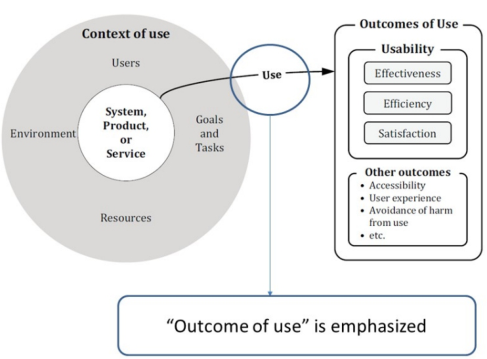
In this definition, “users interact with in order to achieve specific goals” is much related to usability. Figure 1 shows the concept of usability described in ISO9241-11 (2018).
In this figure, “use” is emphasized. This means that usability is outcomes to “use” system, product or services. Applying this sentence to the definition of interactive system, the “use” in Figure 1 means “interaction”. Hence, in order to improve usability of system, product or service, it is important to improve human-system interaction.
Principles Related Usability In ISO9241-110, seven principles for interactive system are prepared. They are:
Suitability for the user’s tasks: An interactive system is suitable for the user’s tasks when it supports the users in the completion of their tasks, i.e. when the operating functions and the user-system interactions are based on the task characteristics (rather than the technology chosen to perform the task).
HCD and Software Development Process 55
Self-descriptiveness: The interactive system presents appropriate infor- mation, where needed by the user, to make its capabilities and use immediately obvious to the user without unnecessary user-system inter- actions.
Conformity with user expectations: The interactive system’s behavior is predictable based on the context of use and commonly accepted conven- tions in this context.
Learnability: The interactive system supports discovery of its capabili- ties and how to use them, allows exploration of the interactive system, minimizes the need for learning and provides support when learning is needed.
Controllability: The interactive system allows the user to maintain control of the user interface and the interactions, including the speed and sequence and individualization of the user-system interaction.
Use error robustness: The interactive system assists the user in avoiding errors and in case of identifiable errors treats them tolerantly and assists the user when recovering from errors.
User engagement: The interactive system presents functions and infor- mation in an inviting and motivating manner supporting continued interaction with the system.
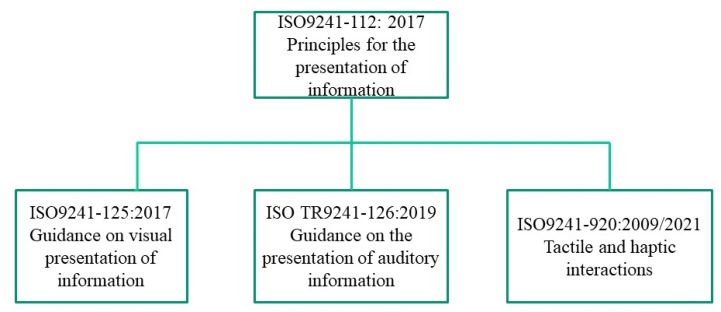
In order to improve usability of interactive system, it is necessary to sat- isfy these principles. However, it is difficult for developers to make software according to these principles because they are ambiguous. As the object of operation when user interacts with system is user interface (UI), in order to meet the interaction principles, it is necessary to make suitable UI based on ergonomics. In ISO, standards related UI, that is, principles for the presenta- tion of information and related documents are prepared as standards of UI. Their structure is shown in Figure 2.
Figure 2: Relationship among principles for the presentation of information and standards for each modal.
In this figure, ISO9241-112 (2017) is the principles for UI and other three documents are UI guidance for each modal (i.e. visual, auditory and
56 Fukuzumi and Hiraswa
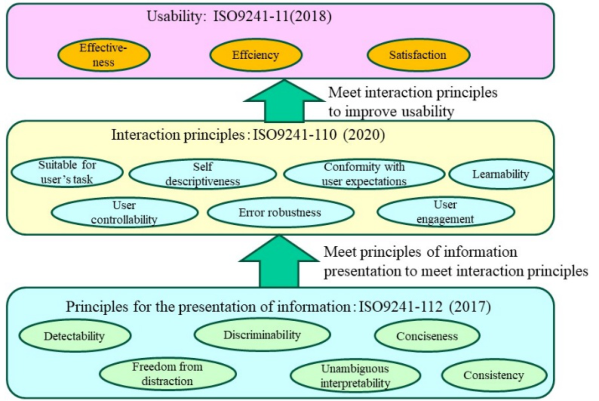
tactile/haptic). The relationship among these principles and concept is shown in Figure 3.
Figure 3: Relationship among principles to improve usability.
Usability in Software Engineering ISO/IEC JTC1 means a joint technical committee with International Organi- zation for Standardization (ISO) and International Electrotechnical Commis- sion The main theme is “Information Technology”. In this community, one of the theme related to ergonomics is “Software Engineering” which is dealt with in SC7.
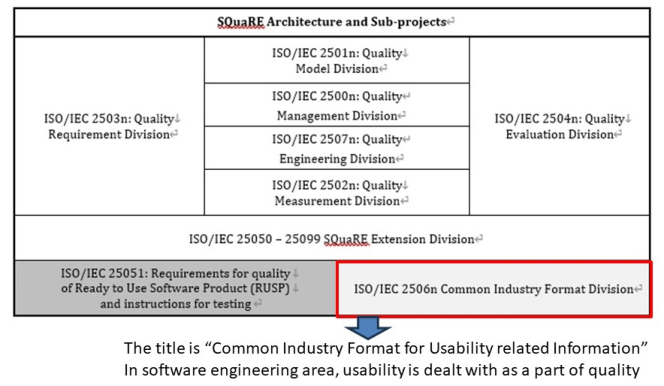
Figure 4: SQuaRE series structure.
HCD and Software Development Process 57
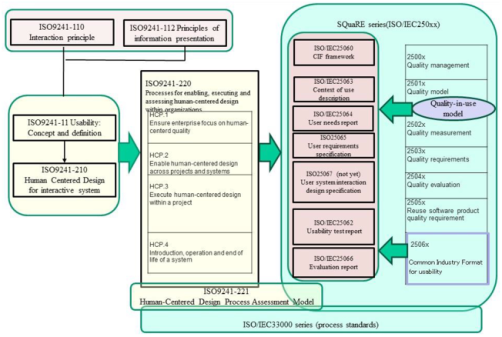
As described above, importance of usability has been considered in not only ergonomics area but also software engineering area (Fukuzumi, 2023). Figure 4 shows the structure of SQuaRE (System and software Quality Requirement and Evaluation) series. Quality model in SQuaRE (System and software Quality Requirement and Evaluation) series which are dealt with in ISO/IEC JTC1SC7 has product quality (ISO/IEC25010:2023, Fukuzumi, et al., 2022) and Quality-in-use (ISO/IEC 25019: 2023, Fukuzumi et al., 2021), and both documents have quality characteristics related usability. The former is “interaction capability” which is related to interaction principles. Product quality model has nine quality characteristics (e.g. compatibility, reliability, flexibility, safety, etc.). So, “interaction capability” is one of important ele- ments to improve product quality. The latter is “beneficialness” which is related to usability for direct user. The concept of quality-in-use has been expanded that the target is not only direct user but also other stakeholder such as indirect use or non-user. Quality-in-use model has three quality characteristics, they are “beneficialness”, “freedom from risk” and “accept- ability”. What they mean is how the use of your product, system, or service impacts them from a stakeholder needs perspective. As usability is one of quality sub-characteristics in beneficialness, this is an important element to improve product, system or service from the viewpoint of “use”.
Figure 5: Proposal of HCD related standards structure to improve usability.
Moreover, Common Industry Format for Usability (CIF) are also prepared in SQuaRE series. CIF documents are corresponding to HCD activities and they indicate how to describe each activities. In CIF series, “context of use description” (ISO/IEC25063: 2014), “user needs report” (ISO/IEC25064: 2013) and “user requirements specification” (ISO25065: 2019) are much important document to improve usability of interactive system. To clarify these items in upper step of developing phase, the goals related usability when making product, system or service is clear.
Previously, when applying HCD process to development process, devel- oper describes context of use for direct use directly. However, it is difficult to represent other stakeholders’ needs. To solve this problem, we propose to
58 Fukuzumi and Hiraswa
apply Quality-in-use model to analyse context of use and extract user needs shown in Figure 5.
This figure means that it is necessary approach by HCD and by software engineering to improve usability.
CONCLUSION
Human centered design (HCD) is a traditional human Factors and Ergonomics concept and HCD is necessary for improving software usabil- ity. However, for software, usage and influence on stakeholders by use are much important for usability due to diversity of users. So, the approach from software engineering is also important. As a merits to adopt both approaches are to be able to apply process assessment model by software engineering. To apply this, not only usability itself but also usability for development process can be evaluated.
To apply the structure shown in Figure 5, it can be dealt with usability as whole development process.
REFERENCES
Fukuzumi, S., and Wada, N.: Quality in Use-Case Study for Evaluation-, Human- Computer Interaction. Theory, Methods and Tools, Thematic Area, HCI 2021, Held as Part of the 23rd HCI International Conference, HCII 2021, Virtual Event, July 24–29, 2021, Proceedings, Part I, Editors: Kurosu, Masaaki (Ed.) pp. 343–350, 2021. Fukuzumi, S., Geis, T. and Earthy, J.: What is the difference between usability in
ISO 25000 and ISO 9241-11?, Asia Pacific Software Engineering Conference - 4th International Workshop on Experience with SQuaRE and its future direction, 2022. Fukuzumi, S.: HFE standardization and contribution by IEA: ISO experience and usability in new technology process, Asian conference of ergonomic and Design, 2023. ISO 9241-11: Ergonomics of human-system interaction, — Part 11: Usability:
Definitions and concepts, 2018. ISO 9241-110: Ergonomics of human-system interaction, — Part 110: Interaction principles, 2020. ISO 9241-112: Ergonomics of human-system interaction, — Part 112: Principles for
the presentation of information, 2017. ISO 9241-210: Ergonomics of human-system interaction, — Part 210: Humancentred design for interactive systems, 2019. ISO 25065: Systems and software engineering — Software product Quality Require-
ments and Evaluation (SQuaRE) — Common Industry Format (CIF) for usability: User Requirements Specification, 2019. ISO/IEC 25010: Systems and software engineering — Software product Quality Requirements and Evaluation (SQuaRE) —Product Quality Model, 2023. ISO/IEC 25019: Systems and software engineering — Software product Quality
Requirements and Evaluation (SQuaRE) —Quality-in-Use Model, 2023. ISO/IEC 25063: Systems and software engineering — Software product Quality Requirements and Evaluation (SQuaRE) — Common Industry Format (CIF) for usability: Context of use description, 2014. ISO/IEC 25064: Systems and software engineering — Software product Quality
Requirements and Evaluation (SQuaRE) — Common Industry Format (CIF) for usability: User needs report, 2013.
LISTED IN THE AHFE DIGITAL BOOKSTORE CATALOGUE
Explore the complete digital volume
Human Factors in Software and Systems Engineering
Read this individual research paper free through the original publisher, or explore the full digital proceedings book.
ISBN 978-1-964867-16-8
Explore this ISBN in the AHFE Bookstore ↗Listed in the July 2026 bookstore catalogue; search by ISBN to confirm current availability · Digital book purchase optional