Shinichi Fukuzumi (2023). The Issues for Improving Usability. In: Human-Centered Design and User Experience. AHFE Open Access, vol. 114, pp. 538–543. https://doi.org/10.54941/ahfe1004273
Center for Advanced Intelligent Project, RIKEN, Tokyo 103-0027, Japan; Faculty of System Design (Ergonomic Design Studio), Tokyo Metropolitan University Tokyo 191-0065, Japan ↗
Human centered design (HCD) is a traditional human Factors and Ergonomics concept. About the end of last century (1999), HCD is firstly standardized as process. It is rare case that the HCD which is not academic system is continued to discuss. The reason is considered not to solve the issues by using HCD. The purpose of this study is to investigate degree of recognition and application for promoting installation of HCD process to interactive system development area for usability and to clarify the issues and propose ways to solve this HCD problem. The questionnaire results by about 600 developers shows that known ratio about HCD is about 58% and applied ratio for in known ratio is about 42% (152 developers). However, overall, only 23% are covered. If HCD is recognized, nearly half of it will be applied, so it is important to raise overall recognition. The ratio of upper phase, development phase and evaluation phase that requirement definition related usability are similar. However, the ratio of deciding usability requirement in upper phase is only 13%. The ratio of evaluating usability requirement before specification is only 10%. Though the ration of recognition for HCD is not so low, many developing areas cannot decide usability requirement before requirement definitions. It is guessed that almost developers do not know how to decide usability requirements.To confirm this question, the other study was carried out. The ratio of recognition for Common Industry Format for usability (CIF) is about 39%. The number of developers to apply CIF to development is about 90. It is only 14%. The CIF is the format for applying HCD process to development process which is standardized in ISO. This standard series is belonged in Standard series for software quality called SQuaRE (System and software Quality Requirement and Evaluation). As the range of recognition for SQuaRE series is about 43%, it is necessary to spread CIF to software development areas.To verify the effectiveness of CIF, CIF is applied to self-driving bus system. Firstly, a high-level description of the context of use shown in the context of use description (ISO/IEC 25063) was made for a usual bus and self-driving bus system, respectively. After that, use needs and user requirements were extracted based on high level description. This process shows that it is easy to extract user requirements before requirements decision phase by using the CIF. However, it is found that management level does not understand the importance for the role of upper phase activities by this time investigation. For this reason, it seems that the ratio of recognition of HCD. It is necessary for improving usability to spread HCD, CIF and SQuaRE much more.
Human centered design (HCD) is a traditional human Factors and Ergonomics concept. About the end of last century (1999), HCD is firstly standardized as process. It is rare case that the HCD which is not academic system is continued to discuss. The reason is considered that HCD is not used at development area. By ISO 9241-210: 2019(ISO 9241-210, 2019), the purpose of applying HCD are as follows: a) increasing the productivity of users and the operational efficiency of organizations b) being easier to understand and use, thus reducing training and support costs c) increasing usability (effectiveness, efficiency and satisfaction) d) increasing accessibility (for people from a population with the widest range of user needs, characteristics and capabilities) e) improving user experience f) reducing discomfort and stress g) providing a competitive advantage, for example by improving brand image h) contributing towards sustainability objectives
They are dependent each other. However, it is not clear whether interac- tive system developers understand the meaning of HCD or not. If the ratio of recognition of HCD is low, it is difficult to apply HCD to developing
area. The purpose of this study is to investigate degree of recognition and application for promoting installation of HCD process to interactive sys- tem development area for improving usability and to clarify the issues and propose ways to solve this HCD problem.
SURVEY Questionnaire was carried out by web system to 1065 persons who engages interactive system development (valid responses are 644, response rate is 60.5%). The breakdown of respondents and survey items are shown below.
Table 1. Classification of an official position of panels.
Table available in the original PDF paper.
N % TOTAL 644 100.0 General staff 278 43.2 Assistant manager 149 23.1 Manager 116 18.0 Senior Manager 51 7.9 Officer 20 3.1 Executive 21 3.3 Others 9 1.4
Table 2. Classification of tasks of developers (multi answer).
Table available in the original PDF paper.
N % TOTAL 644 100.0 Marketing 35 5.4 Planning, design, development of system 546 84.8 operation and maintenance of system 275 42.7 Manufacturing, production control, quality control 61 9.5 Others 14 2.2
Survey items:
1. What is your role? 2. Do you know the term “usability”? 3. Do you know “user experience (UX)”? 4. Do you know “design thinking”? 5. Do you know “Human centered design process”? 6. Do you know the activities from understanding the context of use to evaluation (they are not development process)? 7. Does your organization apply these activities to the development process? 8. Do you indicate your team members to apply these activities? 9. Do you know the International Standards related system and soft- ware quality requirements and evaluation “System and software product quality requirements and evaluation (SQuaRE series) (ISO/IEC25000, 2014)”?
540 Fukuzumi
RESULTS
The questionnaire results by about 600 developers shows that known ratio about HCD is about 58% (Table 3) and applied ratio for in known ratio is about 42% (152 developers: Table 4). However, overall, only 23% are cov- ered. If HCD is recognized, nearly half of it will be applied, so it is important to raise overall recognition.
Table 3. Do you know HCD process?
Table available in the original PDF paper.
N % TOTAL 629 100.0 Known 154 24.5 I have heard (seen) about it 209 33.2 Unknown 266 42.3
Table 4. Do you apply HCD process to the development process?
Table available in the original PDF paper.
N % TOTAL 362 100.0 Applied 152 42.0 Not applied 182 50.3 Unknown 28 7.7
The ratio of upper phase, development phase and evaluation phase that requirement definition related usability are similar. However, the ratio of deciding usability requirement in upper phase is only 13% (Table 5). The ratio of evaluating usability requirement before specification is only 10% (Table 6).
Table 5. Decision phase of usability requirement (multi answer).
Table available in the original PDF paper.
N % TOTAL 141 100.0 Before requirement definition 88 62.4 Design phase 78 55.3 UI design 65 46.1 Not decided 18 12.8
Though the ration of recognition for HCD is not so low, many develop- ing areas cannot decide usability requirement before requirement definitions. It is guessed that almost developers do not know how to decide usability requirements.
To confirm this question, the other study was carried out. The ratio of use of Common Industry Format for usability (CIF: ISO/IEC 25060, 2010) is about 39% (Table 7). The number of developers to apply CIF to development is about 90. It is only 14%. The CIF is the format for applying HCD process
The Issues for Improving Usability 541
Table 6. Evaluation phase for usability requirements (multi answer).
Table available in the original PDF paper.
N % TOTAL 141 100.0 Specification phase 67 47.5 UI development phase 78 55.3 Integration test phase 74 52.5 Before release 31 22.0 Non 15 10.6
to development process which is standardized in ISO. This standard series is belonged in Standard series for software quality called SQuaRE (System and software Quality Requirement and Evaluation). As the range of recognition for SQuaRE series is about 43% (Table 8), it is necessary to spread CIF to software development areas.
Table 7. The ratio of using CIF.
Table available in the original PDF paper.
N % TOTAL 231 100.0 Using 90 39.0 Not using 121 52.4 Unknown 20 8.7
Table 8. Degree of SQuaRE series.
Table available in the original PDF paper.
N % TOTAL 629 100.0 Known 105 16.7 I have heard (seen) about it 170 27.0 Unknown 354 56.3
DISCUSSION
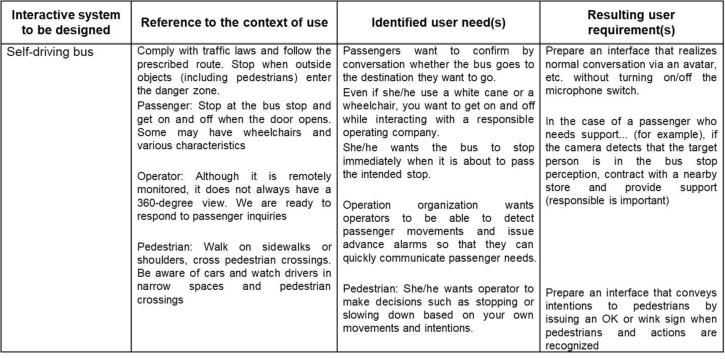
To verify the effectiveness of CIF, CIF is applied to self-driving bus system (Fukuzumi and Wada, 2021). Firstly, a high-level description of the con- text of use shown in the context of use description (ISO/IEC 25063, 2014) was made for a usual bus (Table 9) and self-driving bus system (Table 10), respectively. After that, user needs and user requirements were extracted based on high level description (Table 11). This process shows that it is easy to extract user requirements before requirements decision phase by using the CIF.
However, it is found that management level does not understand the impor- tance for the role of upper phase activities by this time investigation. For this reason, it seems that the ratio of recognition of HCD. It is necessary for improving usability to spread HCD, CIF and SQuaRE much more.
542 Fukuzumi
Table 9. High level description of context of use description (a traditional bus).
Table available in the original PDF paper.
Table 10. High level description of context of use (self-driving bus).
Table available in the original PDF paper.
CONCLUSION
This study investigates recognition ratio and application ratio related HCD process to interactive system developers and discuss methods to raise their ratio based on the recognition of CIF. From these results, it can be shown that it is necessary to raise not only HCD but also the ratio of software qual- ity. To the future, management area data will be analysed and application of HCD from the viewpoint of executive and management will be discussed
The Issues for Improving Usability 543
Figure 1: Context of use, identified user needs and generated user requirements (self- driving bus).
by using ISO9241-220 (Ergonomics of human-system interaction — Part 220: Processes for enabling, executing and assessing human-centred design within organizations) (ISO9241-220, 2019) and the other process assessment models.
REFERENCES
ISO9241-210: Ergonomics of human-system interaction -part220: Human-centred design for interactive system, 2019. ISO/IEC 25000: Systems and software engineering — Systems and software Quality
Requirements and Evaluation (SQuaRE) — Guide to SQuaRE, 2014. ISO/IEC TR 25060: Systems and software engineering — Systems and software product Quality Requirements and Evaluation (SQuaRE) — Common Industry Format (CIF) for usability: General framework for usability-related information, 2023. Fukuzumi, S. and Wada, N.: Quality in Use -Case Study for Evaluation-, Human-
Computer Interaction. Theory, Methods and Tools, Thematic Area, HCI 2021, Held as Part of the 23rd HCI International Conference, HCII 2021, Virtual Event, July 24–29, 2021, Proceedings, Part I, Editors: Kurosu, Masaaki (Ed.) pp. 343–350, 2021. ISO/IEC 25063: Systems and software engineering — Systems and software product Quality Requirements and Evaluation (SQuaRE) — Common Industry Format (CIF) for usability: Context of use description, 2014. ISO9241-220: Ergonomics of human-system interaction -part220: Processes for
enabling, executing and assessing human-centred design within organizations- human centred design for interactive system, 2019.
LISTED IN THE AHFE DIGITAL BOOKSTORE CATALOGUE
Explore the complete digital volume
Human-Centered Design and User Experience
Read this individual research paper free through the original publisher, or explore the full digital proceedings book.
ISBN 978-1-958651-90-2
Explore this ISBN in the AHFE Bookstore ↗Listed in the July 2026 bookstore catalogue; search by ISBN to confirm current availability · Digital book purchase optional