Aysegül Karakus (2023). Exploring the Ethical Dimensions of Accessible UX Design: Balancing Stakeholder Interests and User Intentions. In: Human-Centered Design and User Experience. AHFE Open Access, vol. 114, pp. 403–409. https://doi.org/10.54941/ahfe1004258
In the digital world, the significance of accessibility within user experience (UX) design cannot be overstated. However, accessibility has often been overshadowed by the prevalence of agile product development approaches, leading to its neglect. This paper aims to highlight the vital importance of accessible UX design for end-users and addresses the growing concern of diminishing accessibility in the realm of commercial software. Moreover, it delves into the ethical implications raised by the inclusion of dark UX patterns, intentionally inserted to manipulate user behavior, which not only raise ethical questions but also violate established ISO standards, such as ISO 9241.The presentation centers around the concept of dark UX patterns, which employ various visual triggers and element hierarchy manipulation techniques to guide users towards actions that may not align with their best interests. These patterns are not limited to non-compliant software alone; they are pervasive across various aspects of everyday life, showcasing their broader social impact. By referencing real-life examples, the discussion expands to explore the philosophical implications of UX design, diving into the fundamental question of whether ethically correct UX design can coexist with economical stakeholder interests and innovative practices.However, the challenge lies in balancing the needs and objectives of stakeholders, who seek to promote their products, with the aspirations of UX designers, who aim to enhance the overall user experience. This balance adds complexity to the ethical landscape surrounding UX design, leading to thought-provoking questions regarding intentional and unintentional unethical UX design. It prompts inquiry into the decision-making processes behind these approaches and explores the responsibilities of UX designers in navigating these ethical considerations. The primary objective of this paper is to initiate a discourse on these ethical dilemmas and foster a broader understanding of their implications. To achieve this, the research presents case studies that exemplify both ethically incorrect designs and counter-examples, showcasing how the needs of stakeholders and users can be addressed simultaneously without resorting to manipulative app flows. By examining these cases, the study aims to shed light on potential pathways for innovative yet fair software design, wherein the interests of stakeholders are respected without compromising the ethical responsibilities of UX designers.
The world around us has been shaped through intricate decision-making processes. Furniture, interior design, and everyday objects have undergone processes and choices that determine their appearance, functionality, and intended purpose. Behind each object, behind each interface, lies a complex decision-making process.
To simplify, decisions are said to emerge from contexts. Various everyday contexts give rise to needs, such as the need to address specific problems. The role of a designer is to propose a solution to fulfil these needs, which is then accepted or rejected. Behind this decision, whether a solution is adopted or not, lie diverse factors such as economic viability, cultural considerations, acceptance, and, of course, time.
However, rarely is the ethical or cultural aspect thoroughly examined. The ethical defensibility of a design decision is subject to complex considerations and is often overlooked. Applied to the human-centered design of user inter- faces, there exist several principles that designers can follow to create ethically acceptable software. Specifications like accessibility are empirically verified facts that can be challenged using established works and even tested with tools. Yet, various moral aspects are also part of the design process, which can intersect with other decision-making factors. In this paper, we explore both hard (empirically verified) and soft (not easily measurable) facts of ethically responsible design.
Ethics Ethics encompass the set of principles, values, and standards that guide individuals and groups in determining what is morally right and wrong. Rooted in philosophy and cultural norms, ethics provide a framework for evaluating actions and decisions in various contexts. This involves consid- ering the consequences of actions on individuals, communities, and society as a whole. Prominent ethical theories, such as consequentialism, deontol- ogy, and virtue ethics, offer diverse perspectives on how ethical judgments are formed. Additionally, professional fields often establish codes of ethics to guide practitioners’ conduct, incorporating industry-specific values and responsibilities. Central to ethical discourse are concepts like fairness, justice, and respect for autonomy. Ethical considerations also extend to technol- ogy and design, exploring the moral implications of innovations like AI and user interface manipulation. Through ongoing dialogue and critical analysis, ethics contribute to fostering a just and harmonious environment for human interactions and progress.
Ethics in UX Usability Design can be applied to everyday objects, and in this context, we often encounter examples of “Tragic Design” or “Defensive Architecture.” These are established terms that describe designed objects which align more with the stakeholders’ interests than with the users’ benefits. Whether it’s the convoluted hierarchy of consent buttons for cookie settings or intentionally shortened benches at bus stops to deter homeless individuals from resting
Exploring the Ethical Dimensions of Accessible UX Design 405
on them at night. These instances can lead to serious discussions between stakeholders and designers when translated to a software interface. However, before engaging in such discussions, it’s essential to consider and question the essence of ethics and UX.
The most well-known ethical principle adhered to by an entire professional group is the Hippocratic Oath of medical practitioners. Within this, the prin- ciples of clinical ethics include kindness, non-maleficence towards the patient, and impartial and fair behaviour. In the realm of UX design, such socially and professionally established principles are not yet present. Therefore, we draw from various sources and have the freedom to adapt our own principles individually.
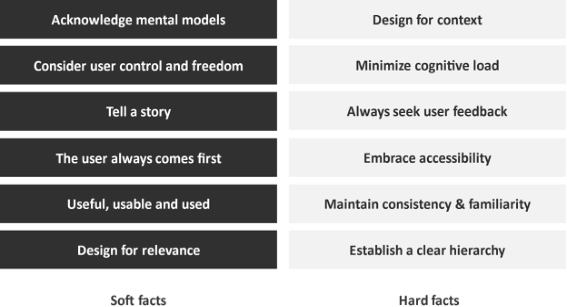
For example, one can orient themselves here using the compiled principles of the Usability Hub. These are as follows:
Acknowledge mental models
Consider user control and freedom
Design for context
Minimize cognitive load
Tell a story
Always seek user feedback
The user always comes first
Useful, usable and used
Design for relevance
Embrace accessibility
Maintain consistency and familiarity
Establish a clear hierarchy In this context, one can distinguish between the so-called hard and soft facts. Hard facts are those that can be measured and evaluated using various methods. In this regard, it is possible to cover aspects such as accessibil- ity, for instance, through ISO standards, such as the norm 9241-210, also known as Ergonomics of human-system interaction. Another possibility is to conduct detailed evaluations of individual elements of software interfaces by adhering to WCAG guidelines. These guidelines vary based on the degree of accessibility. Additionally, it is entirely possible to verify hard facts of accessible design, such as font sizes and colour contrasts, using tools and generate reports that measure the level of surface accessibility. This pro- cess also measures performance and cognitive triggers. By aligning these facts with various guidelines, the designer creates software interfaces for a much broader user group, thus fulfilling ethical principles and ergonomic advantages.
User Centered/Human Centered Design In the case of the remaining principles, combinations can arise here. It is no longer sufficient to merely rely on facts and research from manuals. At this point, the emphasis is more on actively building empathy towards users and convincing stakeholders that ethically valuable results can indeed be economically and innovatively beneficial.
406 Karakus
Figure 1: Presentation of the usability principles from Usability Hub and differentia- tion between points that can be factually verified (hard facts) and points that can be ethically questioned (soft facts).
To illustrate these often subjectively perceived principles like “User comes first” in data, it is advisable to align with the research methods of user- centered design.
It is strongly recommended that at regular intervals, both individual fea- tures and the entire product vision be evaluated in comparison to user expectations. Understanding requirements from all sides is a fundamental requirement to reaching a common ground within the team. Continuously, features, information representations, and the overall viability of the product are questioned and challenged together with users.
Figure 2: Repetitive user centered design process (adapted from ISO 9241-210).
In this process, conflicts of interest can certainly arise between for- mulated hypotheses and data from surveys. In such cases, rudimentarily designed prototypes can assist in comparing stakeholder hypotheses with user expectations.
Example An illustrative example:
Let’s consider a cross-functional Scrum team scenario. The Product Owner provides User Stories derived from various requirements. The UX Designer is assigned the task of the User Story “As a user, I want to be able to deactivate my account.”
Exploring the Ethical Dimensions of Accessible UX Design 407
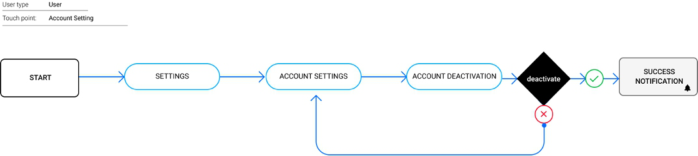
An anonymized example flow for the purpose of this paper could be depicted as follows:
Figure 3: Presentation of a simplified user flow for the mentioned example.
The user needs to trigger actions for the deactivation of their account about 3 times before arriving at the final deactivation step. Additionally, they must confirm once more their intention to delete the account. From an accessibility perspective, the deactivation should be presented as a hierarchically primary button. This is because the user has clearly approached the deactivation as their primary task.
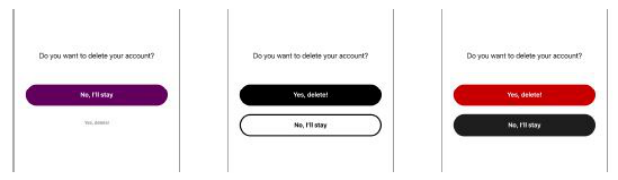
The hypothetical conflict of interest arises from the fact that the product team has received a clear directive to retain as few users as possible from leaving the platform. Consequently, they regard the deactivation button as secondary, even tertiary. This gives rise to three UI solutions of significant importance: one that leans more towards Product interests and another that leans more towards User interests. The third option is a compromise of two primary colours in the buttons.
Figure 4: Various options for representing button hierarchies. Depending on stakehold- ers and user goals, users can be guided to specific actions with different triggers.
In such an example, which could potentially lead to discrepancies, the team has the opportunity to test the designs using a very simple prototype and verify their hypothesis. In this case, the task can be presented to the user to figure out how the account is deactivated.
Alternatively, there is the possibility to modify the user story itself to “As a user, I do not want to delete my account and want to stay on the app.”As a UX designer, one can then refer back to the aforementioned Usability principles, specifically the point “Design for relevance.” From an idealistic perspective, the product should be created in a way that the user, in the course of using it, doesn’t develop a need to leave the app entirely. To create such relevance
408 Karakus
within a product, the team must repeatedly validate feature ideas with target audiences.
ACTIONS AND RESULTS As previously mentioned, hard facts can be checked, examined, and substan- tiated at any time based on established industry guidelines. Many elements designed to assist users with visual, physical, or mental impairments on the web comply to the guidelines of WCAG. This includes aspects such as size and contrast, as well as regulations that provide a better user experience for those with cognitive challenges, for example, through the reduction of animations.
As mentioned earlier, it is also recommended within the context of user- centered design to engage with the guidelines of the International Organi- zation for Standardization, abbreviated as ISO. These standards, especially those falling under the umbrella of ISO-9241 in the realm of user experi- ence, are ideal for maintaining specific interface criteria. They describe how components in expert systems and other user interfaces can interact with each other seamlessly to offer users a smooth interface for carrying out their tasks. Nevertheless, it is always wise to periodically assess the interaction of different components.
According to a study by MeasuringU, merely five users are sufficient to uncover approximately 85% of usability problems in a qualitative test. Many of these issues relate not only to operational elements but also to the general understanding of how users are guided through the program. Short qualitative tests can easily determine whether the task presented to the user is actually perceived and successfully executed. Subsequent itera- tive adjustments to the design are expected to reduce the bounce rate by an additional 50%, as per MeasuringU. This, in turn, has a positive impact on the profitability of the product.
CONCLUSION
We cannot afford, neither morally nor economically, to exclude groups of people from software interfaces. Barrier-free design has now become a critical aspect of UX/UI design. Designers and requirements engineers also have the responsibility to go beyond and truly understand user requirements. Only in this way can we avoid the so-called “tragic design” on the software UI side as well. Dark UX patterns and deliberate manipulative methods that place users on triggers they hadn’t even noticed are gradually being pursued legally.
A good UI means making information accessible to as wide an audience as possible, while good UX means understanding the user and guiding them through the product in the way that benefits them the most.
In the daily project routine, there will always be situations where ethical design behaviour might not align with our intentions. In the product team, creating a certain level of awareness, making conscious decisions regarding UX, and taking responsibility for the resulting consequences is sufficient.
Exploring the Ethical Dimensions of Accessible UX Design 409
ACKNOWLEDGMENT
The author would like to express their sincere gratitude to jambit GmbH for their support, which made this research possible. I also extend my apprecia- tion to Robert Kowalski for their valuable insights and recommendation to participate in the AHFE 2023 Hawaii Edition.
REFERENCES
Basil Varkey (2021), “Principles of Clinical Ethics and Their Application to Practice”. Beauchamp, T. L., & Bowie, N. E. (1988). “Ethical Theory and Business.” Prentice Hall. DIN ISO 9241 Ergonomics of human-system interaction - Part 210: Human-centred
design for interactive systems (ISO 9241-210:2019); German version EN ISO 9241-210:2019. Jakob Nielsen (2023), “Is Amazon.com Guilty of Dark UX Patterns?”, Jakob Nielsen on UX. Jonathan Shariat (2016), “Tragic Design: The True Impact of Bad Design and How
to Fix It”, O’reilly. First published January 25, 2016. Kai Tomboc (2022), “UX Design Principles”, Usability Hub. Lauren Pelley (2019), “How ‘Defensive Design’ Leads to Rigid Benches, Metal Spikes, and ‘Visual Violence’ in Modern Cities”, CBC News. Posted: Jul 02. Marc Viljoen, Huble Digital (2023), Making Accessibility a Priority in Your UX
Design Process. Sauro, Jeff, PhD. (2010). “Why you only need to test with five users” MeasuringU, https://measuringu.com/five-users/#many. Sauro, Jeff, PhD. (2019). “Margins of Error in Usability Tests” MeasuringU,
https://measuringu.com/test-margin/. Velasquez, M., Andre, C., Shanks, T., & Meyer, M. J. (2018). “What is Ethics?” Santa Clara University.
LISTED IN THE AHFE DIGITAL BOOKSTORE CATALOGUE
Explore the complete digital volume
Human-Centered Design and User Experience
Read this individual research paper free through the original publisher, or explore the full digital proceedings book.
ISBN 978-1-958651-90-2
Explore this ISBN in the AHFE Bookstore ↗Listed in the July 2026 bookstore catalogue; search by ISBN to confirm current availability · Digital book purchase optional