Chengcheng Guo, Jiaci Xie (2024). Machine Learning Builds Embedded Interaction Model to Guide Knocking Behavior in 3-6 Year Olds. In: Design for Inclusion. AHFE Open Access, vol. 128, pp. 171–181. https://doi.org/10.54941/ahfe1004802
Machine learning, as an emerging technology, is gradually starting to be applied in the field of children’s education (Nan, 2020). This article mainly investigates how to utilize machine learning technology to assist parents in guiding children aged 3-6 to develop good behavioral habits and manners. However, existing design studies aimed at children’s behavioral habits lack relevant academic experimental cases and also have certain technical limitations. Therefore, in this article, through user interviews, observational methods, and the creation of the FBM behavior model, the results of the interviews with the parents of seven children, aged between three and six years, were utilized as a basis for further observational analysis of the daily behavior of one child aged 3. In order to determine the direction of research on children’s formation of good knocking habits, two experimental studies were carried out while studying the behavioral model of children aged 3-6. The first experiment, based on the research results obtained through interviews and observations, children’s footsteps were identified as the training object of the machine learning MFE model to complete the model data construction. The second experiment involved building machine learning training models to configure hardware-device interaction models. The model was then deployed to the surveyed families for further validation and tracking of the children’s behavior. Finally, it was further confirmed that children’s behavior can be subtly changed with guidance, thereby fostering the habit of knocking on the door. Simultaneously, the research findings also indicate that leveraging machine learning to assist in guiding the formation of good behavioral habits among children aged 3-6 is a feasible and deeply valuable research direction.
In the early 20th century, famous educators such as Maria Montessori focused on cultivating children’s behavioral education, believing that chil- dren’s behavioral education has social significance (Montessori and Gutek, 2004). Human beings live in a diversified social system, and there is no sin- gular, entirely accurate and clear behavioral value system that can be used to regulate everyone’s behavior.
However, the home environment is critical to the education of children’s behavior. This is because the family is the primary place for shaping children’s personalities and values and profoundly impacts their development (Negraia and Augustine, 2020). Children who have used interactive behavior-guided educational products typically exhibit better behavior in their daily lives. This makes it easier for them to win the approval and affection of those around them.
Secondly, early education is gradually becoming a focus of attention for families and society. In particular, children aged 3–6 are in a sensitive stage of initiation to early behavioral enlightenment of education, and at the same time, it is a critical period for the development of norms for children’s behav- ior and conduct. Therefore, early education and behavioral guidance are considered to be a solid foundation on which to build the development of children ages 3–6. In child education, parents target cultivating their chil- dren’s behavioral abilities based on the characteristics of their nature and behavioral development at various stages.
This article is based on the Montessori theory of children’s sensitive periods and the behavioral guidance model (FBM), which uses a positive approach to guide children’s behaviors (Fogg, 2009). To compensate for the lack of a single method in in-depth research, two methods, “qualitative research” and “experimental research”, were introduced. Child observation strategies and “behavioral experiments” in the naturalistic family are objective and can promptly identify potential behavioral problems in children, such as “not knocking on the door” and “not establishing a sense of order at age 3.”
And in recent years, the use of AI in children’s education has contin- ued to grow. Combining new artificial intelligence (AI) technologies with human-computer interaction device design for guiding children’s behavior can stimulate children’s interest and desire to explore, creating and establish- ing an active behavior-guiding environment (Raffle, Parkes and Ishii, 2004). However, these new technologies, such as machine learning, are less used in applied to behavioral guidance for groups of children aged 3–6 years old and are more often used for groups of children with particular problems or cog- nitive skills training, such as robot programming for ages six and up (Yang, 2022). Therefore, new technology still has space for improvement in the field of early children’s behavioral development.
This article focuses on filling the gaps in applying new technologies, such as machine learning, in the early children’s behavioral education sector, com- mitted to helping children develop good “knocking” behavior at an early age through “play”(Nan, 2020).
Technological Developments Have Diversified the Forms of Children’s Education Technology contributes to the development of children’s behaviors, and its convenience and “easy-to-use” features can motivate children and accelerate the learning process. Harvard’s EcoLearn design team’s innovative research, the EcoXPT program, explores enhancing children’s learning motivation by combining machine learning technology with design to create immersive,
Machine Learning Builds Embedded Interaction Model 173
realistic simulation experiences. The project’s primary research is aimed at young students. This experience stimulates their curiosity and motivates them to take the initiative to explore, thus developing their ability to learn inde- pendently. This article is inspired by this and applies the goal of technological innovation education to children.
Despite the many conveniences that technology brings to children, some scholars remain concerned about its potential negative impact on child devel- opment. Electronic devices, especially when used excessively, can be harmful 93 to children and limit their free development. Electronic devices, espe- cially when used excessively, can be harmful to children and limit their free development, and so on (Christakis et al., 2004). Meanwhile, a segment of the population supports the concept of free development for the child and advocates not interfering too much with the child’s behavior. However, some scholars are critical, arguing that an overemphasis on freedom can have a negative impact on children’s abilities, especially under the influence of tech- nology, because children lack the ability to exercise good judgment (Bessant, 2014). When integrating technology into children’s daily lives, appropriate meth- ods should be used to guide their behavior correctly. Simply categorizing technology as good or bad is not an effective way to solve problems. In response to the design of new technology interactions for children ages 3–6, policymakers have developed guidelines for children’s use of technology that tend to focus on limitations. Therefore, when developers introduce new tech- nologies, they should include necessary restrictions in the product design and prevent younger children from accessing addictive screen games. The Amer- ican Physical Society points out that if the impact of the internet on children is simply treated as a problem, developers will face difficulties (Gottschalk, 2019). Therefore, developers must have an in-depth understanding of the advantages and disadvantages of technology and its impact on the growth of today’s children.
DEFINE RESEARCH DIRECTION Interview Record
Qualitative research methods are effective in exploring the phenomena of human behavior (Bentzen, 2009). We use it to study children’s behav- ioral habits in order to explore their behavioral characteristics. The main research data source comes from parent interviews, where parents describe their children’s behavior. In selecting the interview subjects, considering the requirements of child ethics, the research subjects chose relatives of team members with children aged 3–6 years to be interviewed, ensuring that parental consent was obtained and the entire interview was audio-recorded.
A total of 7 interviewees, including 2 face-to-face interviews and 5 interviews conducted via WeChat. During the interviews, parents expressed their anxiety about their chil- dren’s behavior. They mentioned that their children seemed to lack boundary awareness, often barging into their bedrooms without knocking and repeat- edly disturbing them. Therefore, the design outcomes should also consider
174 Guo and Xie
balancing the needs of both parents and children (Malan, Naranjo-Bock and Judge, 2015).
Children enter a golden development period starting at age 3 when their brains are in a rapid development phase. In order to promote synaptic con- nections in children’s brains, stimulation needs to be provided externally in a targeted manner. The synapses that are frequently used are retained and strengthened, which is based on behavioral research in social psychol- ogy (Christopher Rolfe Agnew et al., 2010). The Sensitive Period Theory of Montessori Educational Theory emphasizes the influence of environment and experience on the brain development of children aged 3–6. During this stage, children are particularly sensitive to the learning and development of certain abilities and are easily able to absorb them. This is a further expansion of research on the Montessori theory.
Swiss child development expert Jean Piaget proposed that parents need to pay attention to children’s behavior during the rapid development phase of children’s sensitive periods. Improving children’s abilities and comprehen- sive training remain the most effective methods, as abilities are interrelated, but it needs to be noted that each stage has its own specific focus. Helping aged 3–4 children establish a basic sense of order is essential; for aged 4–5 children, there is an increase in learning activities, focusing on cultivating concentration; and for aged 5–6 children, emphasis is placed on cultivating independence, enabling them to solve problems independently and smoothly transition into primary school (Piaget, 1969).
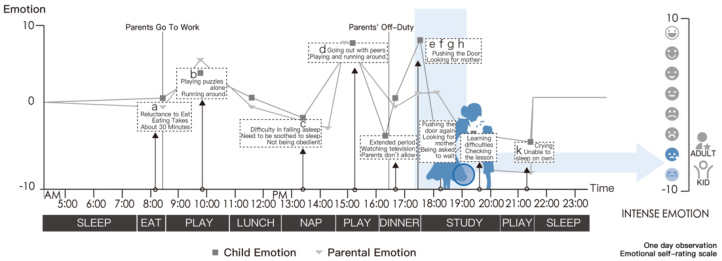
Child Behavior Observation The empirical research method employs fieldwork and child observation strategies in experiments that can obtain positive research results (Bentzen, 2009). In the user research phase, based on the collection of user needs using the interview method, the one-day-in-the-home observation method was used to record children’s and parents’ behaviors and emotions, to study children’s behaviors, and to determine research directions, thereby providing further effective solutions.
Machine Learning Builds Embedded Interaction Model 175
During the observation of a 3-year-old child, when the mother needed to attend to work-related matters, the child repeatedly barged into the room and defied dissuasion. This behavior triggered arguments and conflicts between the mother and child, resulting in the child crying. In the interview, the mother stated that when she needs to focus on work or other matters, the sudden intrusion of her child often causes her to feel startled and inconvenienced. She emphasized that if the child could learn to knock on the door and wait for permission to enter the room, she would have more time to react and prepare for such situations. On the other hand, the child expressed a desire for the mother’s company and a feeling of helplessness at the mother’s lack of attention.
Identify the Research Direction of Cultivating the Behavioral Habit of “Knocking” Among 3–6 Year-Old Children as the Ultimate Research Focus Based on interviews and observational research, it was found that 85% of the children in the study had a blurred sense of order and boundaries, which was more pronounced in children aged 3. Additionally, 72% of the parents were experiencing stress in their parenting. In order to solve this problem, the ini- tial model construction of this article tries to start from the establishment of children’s knocking habit. And for children behavior without permission to break into the bedroom conduct appropriate guidance. Although traditional educational methods may be effective in some cases, over-reliance on author- itative or communicative methods may not achieve long-term positive results, and repeated multiple uses may cause children to become impatient or irri- table. Currently, there is a generally accepted approach to engaging children through games. However, this strategy may cause children to lose interest in real life in certain situations and, therefore, is not suitable for behavioral education in real-life scenarios (Montessori and Gutek, 2004).
Technical Methods Therefore, this article combines the New Model of Child Behavior Guidance (FBM) with machine learning (ML) techniques to guide proactive behav- iors with short-term incentives to assist children in establishing an early sense of order and forming the habit of knocking on doors. FBM is a behavioral change system that has children complete some simple tasks and gain self-motivation through success, leading to repeated attempts to do more challenging things—driving children to exceed their expected goals and gradually transform interests into habits. The most valuable aspect is that children’s emotions are positive and proactive throughout the process (Fogg, 2009). Through interviews and observations, we found that children aged 3–6 mainly play in activities like running and jumping indoors. Therefore, in terms of technical design, attempts were made to use machine learning to identify “children’s footsteps” to provide innovative solutions.
176 Guo and Xie
This biometric process is based on the study of footstep signals, which can record sounds, pressure, vibrations, and other signals gen- erated when walking within the detection area. Using algorithms to extract sound features and incorporating these features into machine learn- ing systems to develop embedded human-computer interaction products (Marisol Zeledón-Córdoba, 2022).
Additionally, research has found that interactive products have a greater impact on children, as they can stimulate their interest and cultivate correct behavior habits.
Experiment 1: Knocking Acquisition and Child Footstep Machine Learning Model Build The machine learning model in this article is built using the Edge Impulse cloud platform to identify “child footsteps.” Machine learning algorithms are adept at converting cluttered, high-bandwidth raw data into small usable signals. It can quickly establish learning models, improve the efficiency of feasibility testing, and shorten the product development lifecycle.
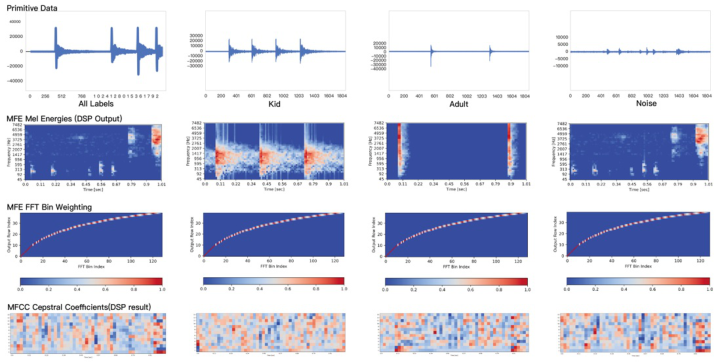
Sound data collection. The equipment utilizes an omnidirectional micro- phone recording device equipped with a high-sensitivity condenser micro- phone chip with excellent frequency stability and noise cancellation. The noise that affects footstep recognition in the environment is set as the “noise” condition to reduce errors when identifying footsteps from children and par- ents. A cross-double footstep segmentation algorithm is used to ensure that each segment contains at least two footsteps, avoiding truncated data that could reduce recognition accuracy (Xu and Li, 2020).
Figure 2: Spectrograms of four different sound samples, MFE Mel energy plots, FFT box-car weighted and MFCC cepstral coefficients: all labels, children, adults, and noise.
Building Mel-Filterbank Energy Feature Model In this experiment, the MFE module is selected for configuration. This mod- ule uses Mel-frequency filterbank energy features to extract spectrograms
Machine Learning Builds Embedded Interaction Model 177
from audio signals, enabling better recognition of sound signals other than speech.
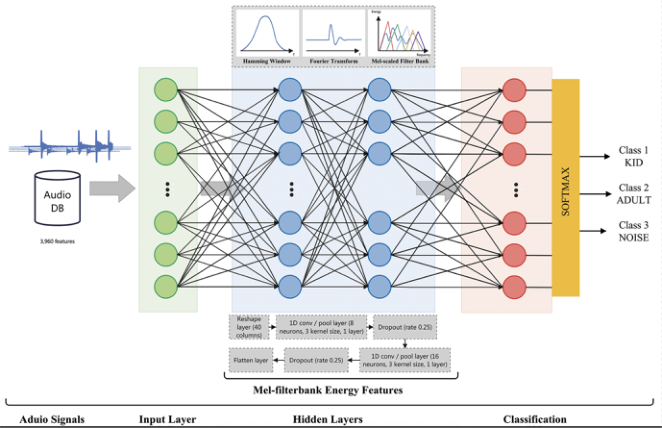
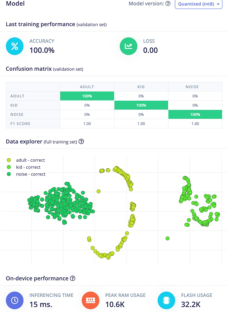
An impulse takes raw data, uses signal processing to extract features (Three kinds of voices), and then uses a learning block to classify new data, (Confidence 0.7, it corresponds to the feature).
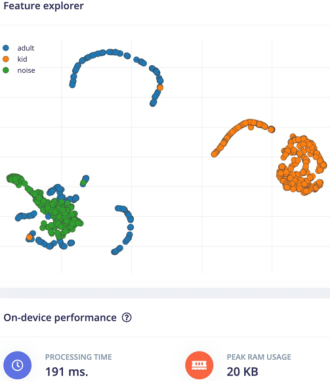
Figure 3: Mel-filterbank energy features model implementation flow.Figure 4: Mel-filterbank energy features proposed model architecture.
The audio MFE processing module is used to extract time-frequency fea- tures from the signal. The nonlinear Mel scale performs well when processing audio data in the frequency domain. After calculating the spectrogram, tri- angular filters are applied to the Mel scale to extract frequency bands. Configuring parameters, including filter quantity, low-frequency, and high- frequency, to determine the frequency bands and the number of features to be extracted, employing more filter groups aids in noise reduction, and in the high-frequency domain, fewer features can be extracted, contributing to the clarity and quality of feature extraction in sound signals.
Data collection and pre-processing: 406 valid audio segments of footsteps from children, adults, and noise; Feature engineering - Extraction of Mel- frequency filterbank energy features; Machine learning - Building of feature models, using 8:2 split for training and testing, with a model training accuracy of 100%; Model evaluation - Testing, with a new data feature threshold of >0.7, successfully identifies footsteps from children and adults.
Successful library(sound machine learning model) trained with Edge Impulse will then be deployed on hardware to build the final “footstep recognition” model.
Experiment 2: Building the Human-Machine Interaction Model – “Toucan” Through the “Arduino Library” generated by Edge Impulse, the machine learning “model” data is deployed to the single-chip Arduino Nano 33 BLE
Machine Learning Builds Embedded Interaction Model 179
Sense and Arduino, which drives the sensors and servo motor to realize the linkage function, and finally the Toucan model is designed and completed.
Figure 7: Toucan model.
Figure available in the original PDF paper.
The Toucan model utilizes “child” and “adult” footstep sounds to control door opening and closing while providing a voice to guide children to knock on the door.
The principle is that when the machine learning identifies “child footsteps” three times or more, the servo motor will drive the gear to close the bird mouth, blocking the door handle, and the sound sensor will emit a “Please Knock” voice prompt. When the machine learning identifies “adult” foot- steps three times or more, the servo motor drives the gear to open the bird’s mouth, and the voice announcement is turned off.
In practical use, the “Toucan model” is always turned on. When a child comes to find their parents, the machine recognizes the child’s footsteps, and the bird’s mouth closes and emits a “Please Knock” voice prompt. The par- ents hear the knocking sound and can quickly adjust their state to provide feedback to the child. When the machine learning recognizes the parents’ footsteps, the bird’s mouth automatically opens. This model design can avoid parents feeling embarrassed and helpless when a child suddenly barges in, and at the same time, it uses interesting design to guide children’s behavior and increases interactive and feedback design.
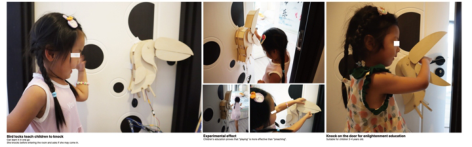
Model Feasibility Testing Behavioral change based on qualitative research is objective (Bentzen, 2009), and Children’s door-knocking behavioral change was analyzed by applying the Toucan Model to real-life scenarios. For ethical considerations, the chil- dren were accompanied by their parents, and the whole process was recorded and filmed.
Figure 8: Model testing (two children aged 3).
The design of the “Toucan model” attracted the attention of children, and they showed a strong interest in using it. Before entering the room, children
180 Guo and Xie
would knock and ask if they could enter, successfully changing their previous behavior of barging into the room randomly.
Behavioral Habits Testing
Table 1. Toucan model knocking statistics on days 1, 3, 5, 7, 9, 12 (two children aged 3).
Table available in the original PDF paper.
Label Day 1 Day 3 Day 5 (no Toucan)
Day 7 (no Toucan)
Day 9 (no Toucan)
Day 12 (no Toucan) Kid1 1 0.9 0.9 0.8 0.7 0.7 Kid2 1 1 0.9 0.9 0.8 0.6
The second test investigates how long it takes for children to form the habit of knocking on the door after using the “Toucan model” (Bentzen, 2009).
According to the parents’ observations, descriptions, and records, it has been demonstrated that the children’s habit of “knocking” on the door is persistent.
CONCLUSION
From the perspective of innovation, we aim to solve the problem of chil- dren aged 3–6 who cannot knock on the door and have no sense of order. We successfully utilized the Edge Impulse machine learning cloud platform to build the audio MFE feature processing module, the “child footstep sound feature recognition” model library, and the Toucan hardware model for human-machine interaction. This model guides children’s knocking-door behavior. Furthermore, we further assist children in developing knocking habits through behavioral testing and considering the general anxiety of parents due to children’s reckless behaviors. We strive to create a fun and meaningful interactive communication model for both children and parents.
Numerous scholars have shown that 85% to 90% of children’s personali- ties and lifestyles are formed between ages 3–6. Behavioral education lays a solid foundation for children’s development and is highly beneficial to their future lifelong learning and realizing social and economic benefits. Although behavioral testing is relatively short and may be subject to some margin of error, we will further research and consider how to use technology to support children’s behavioral development and learning so that children can become lifelong explorers who possess etiquette, respect others, and have a good upbringing.
ACKNOWLEDGMENT
Thanks to the participating parents and children and “Edge Impulse” plat- form.
REFERENCES
Bentzen, W. R. (2009). Seeing young children : a guide to observing and recording behavior. Clifton Park, Ny: Thomson Delmar Learning.
Machine Learning Builds Embedded Interaction Model 181
Bessant, J. (2014). A dangerous idea? Freedom, children and the capability approach to education. Critical Studies in Education, 55(2), pp. 138–153. doi: https://doi. org/10.1080/17508487.2014.873368. Christakis, D. A., Zimmerman, F. J., DiGiuseppe, D. L. and McCarty, C. A. (2004).
Early Television Exposure and Subsequent Attentional Problems in Children. Pediatrics, 113(4), pp. 708–713. doi: https://doi.org/10.1542/peds.113.4.708. Christopher Rolfe Agnew, Donal E. Carlston, William G. Graziano and Janice R. Kelly (2010). Then a miracle occurs: focusing on behavior in social psy- chological theory and research. New York, NY: Oxford University Press. Purdue Symposium On Psychological Sciences. <2008, Lafayette, Ind. Dede, C., Grotzer, T. A., Kamarainen, A. and Metcalf, S. (2017). EcoXPT: Designing for Deeper Learning through Experimentation in an Immersive Virtual Ecosys- tem. Journal of Educational Technology & Society, [online] 20(4), pp. 166–178. Available at: https://www.jstor.org/stable/26229215. Esteves, J., Rufer, L., D. Ekeom and Skandar Basrour (2017). Lumped-parameters
equivalent circuit for condenser microphones modeling. Journal of the Acoustical Society of America, [online] 142(4), pp. 2121–2132. doi: https://doi.org/10.1121/ 1.5006905. Edge Impulse platform website. Available at: https://edgeimpulse.com/. Fogg, B. (2009). A behavior model for persuasive design. Proceedings of the 4th International Conference on Persuasive Technology - Persuasive’09, [online] (40), pp. 1–7. doi: https://doi.org/10.1145/1541948.1541999. Gottschalk, F. (2019). Impacts of technology use on children. OECD Education
Working Papers, 195(19939019). doi: https://doi.org/10.1787/8296464e-en. Malan, L., Naranjo-Bock, C. and Judge, T. K. (2015). Balancing the needs of children and adults in the design of technology for children. In Proceedings of the 14th International Conference on Interaction Design and Children (IDC’15). doi: https: //doi.org/10.1145/2771839.2771927. Marisol Zeledón-Córdoba (2022). Un estudio experimental sobre el reconocimiento
del sonido de las pisadas como biométrico en condiciones ruidosas | Revista Tec- nología en Marcha. revistas.tec.ac.cr. [online] Available at: https://revistas.tec.ac. cr/index.php/tec_marcha/article/view/6467 [Accessed 28 Sep. 2023]. Montessori, M. and Gerald Lee Gutek (2004). The Montessori method : the origins of an educational innovation: including an abridged and annotated edition of Maria Montessori’s The Montessori method. Part I. Abridged ed. Lanham, Md.: Rowman & Littlefield Publishers, pp. 43–45. Nan, J. (2020). Research of Application of Artificial Intelligence in Preschool Edu-
cation. Journal of Physics: Conference Series, 1607, p. 012119. doi: https: //doi.org/10.1088/1742-6596/1607/1/012119. Negraia, D. V. and Augustine, J. M. (2020). Unpacking the Parenting Well-Being Gap: The Role of Dynamic Features of Daily Life across Broader Social Contexts. Social Psychology Quarterly, 83(3), pp. 207–228. doi: https://doi.org/10.1177/ 0190272520902453. Piaget, J. (1969). The psychology of the child. New York: Basic Books, pp. 84–100. Raffle, H. S., Parkes, A. J. and Ishii, H. (2004). Topobo. Proceedings of the 2004
conference on Human factors in computing systems - CHI’04. [online] doi: https: //doi.org/10.1145/985692.985774. Xu, F. and Li, P. (2020). Outdoor Human Footsteps Event and Environment Joint Recognition. [online] ieeexplore.ieee.org. Available at: https://ieeexplore.ieee.org/ document/9164355 [Accessed 30 Sep. 2023]. Yang, W. (2022). Artificial Intelligence education for young children: Why, what,
and how in curriculum design and implementation. Computers and Education: Artificial Intelligence, 3, p. 100061. doi: https://doi.org/10.1016/j.caeai.2022. 100061.
LISTED IN THE AHFE DIGITAL BOOKSTORE CATALOGUE
Explore the complete digital volume
Design for Inclusion
Read this individual research paper free through the original publisher, or explore the full digital proceedings book.
ISBN 978-1-964867-04-5
Explore this ISBN in the AHFE Bookstore ↗Listed in the July 2026 bookstore catalogue; search by ISBN to confirm current availability · Digital book purchase optional