Luisa Lange, Sonja Buxbaum Conradi, Tobias Redlich, Jens P Wulfsberg (2023). Exploring Fear and Hesitancy Among Machine Tool Operators — A Socio-Technical Approach on Enhancing Machine Tool Usability From a Developer, Educator and User Perspective. In: Human-Centered Design and User Experience. AHFE Open Access, vol. 114, pp. 715–726. https://doi.org/10.54941/ahfe1004292
Publisher statistics will load when you open Metrics.
AHFE OPEN ACCESS OPEN ACCESS CONFERENCE PROCEEDINGS PAPER
Exploring Fear and Hesitancy Among Machine Tool Operators — A Socio-Technical Approach on Enhancing Machine Tool Usability From a Developer, Educator and User Perspective
Due to the growing shortage of skilled operators and the increasing automation and digitization of manufacturing processes, the topic of machine tool usability has also become more prominent. Understanding the problems and issues which users have to overcome in order to be able to operate their machine tools is essential. Recent research on machine tool usability set a focus on three dimensions of usability: the affective, cognitive and technical dimension, which all influence the overall usability of machine tools. This paper takes a closer look at the affective dimension and the connected factor of fear and initial hesitance of machine tool users. Operating machine tools in a shop floor environment is often connected to time pressure and tight processes. Developers and educators therefore set a high focus on technical aspects and cognitive processes connected to the usage of a machine tool. Thus, the affective dimension of usability is often neglected during the training of machine tool operators and consequently affective aspects, such as fear of using machine tools are still present on the shop floor. In order to understand the nature of the affective dimension, a deeper understanding of the causes of these fears is essential. Therefore, the research question arises: “How can fears and initial hesitancies of machine tool operators be identified and categorized and what countermeasures can be taken to alleviate these initial fears?”. Qualitative expert interviews with control and machine tool developers as well as with educators, trainers and operators provided insights into the status quo of machine development and skilled worker training. Based on this interview study, the aspect of fear of using machine tools was examined in a multi-perspective manner. The researchers found various aspects of fear and obstruction which operators are facing, when working with machine tools. Three main motives for initial hesitance of the operators have been identified: fear of potential injury, fear of damaging the machine and fear of failure. These identified categories were subsequently connected to theories of workplace anxiety, allowing for a deeper understanding of their underlying dynamics. To provide further insights, specific guiding principles for developers, educators and managers were proposed, emphasizing actionable steps that can be taken to address and alleviate the identified fears. The understanding gained in this study forms an important basis for future approaches on machine tool usability from developer, educator and user perspectives.
Within the last decade, that nature and demand of machine tool operators in German Industry has changed. Machine tool operators used to undergo a three-year apprenticeship to learn how to program, operate and use machine tools, including drilling, milling and laser cutting machines. With this initial training, operators were able to interact flexibly with their machine tools (Industrie- Und Handelskammer Dortmund, 2022). Due to the demographic change and the resulting shortage of specialists, more unskilled personnel started operating machine tools. Unskilled machine tool operators lack the ability to interact with the machine tools in the way trained operators do. This change in the workforce has accentuated the general issue of machine tool usability, where overall higher need of usable machine tools arises. With this transformation of the labor market, a change of thinking from manufac- turers, machine tool developers and educators is underway. The focus started to shift from efficiency and effectiveness to an additional focus on usability and operability of machine tools (Lange et al., 2023; Puschmann et al., 2019).
The usability of machine tools presents a unique challenge that combines the fields of human factors engineering (HFE) and human-computer inter- action (HCI). Machine tools are externally powered machines employed for the purpose of shaping workpieces or parts, including CNC milling machines, turning machines, laser cutters, and, more recently, additive manufacturing machines like 3D printers (Rattat, 2016, S. 4; Tönshoff, 1995, S. 2). Machine tools consist of mechanical components and a user interface or control panel that serves as the primary point of interaction for operators. Unlike tradi- tional computer-based systems, using machine tools requires operators to have knowledge of the underlying hardware and its operations. This cre- ates a special connection between HFE and HCI, as machine tools involve both the physical aspects of machine operation and the usability of techni- cal interfaces and controls. However, the development of machine tools still often prioritizes technical aspects while neglecting other aspects of usability (Brecher et al., 2019).
The DIN EN ISO standard describes usability as the “extent to which a system, product, or service can be utilized by specific users to achieve specific goals with effectiveness, efficiency, and satisfaction in a defined con- text of use” (DIN EN ISO 9241-11, 2018). However, this DIN EN ISO standard maintains a general approach to the concept of usability, without specific emphasis on the usability of machine tools (DIN EN ISO 9241-11, 2018). Generally, the field of usability for machine tools, has received lim- ited attention in research. Existing studies primarily focus on enhancing the technical functionality of machine tools (Brecher et al., 2011) or improving the effectiveness and efficiency of processes, as outlined by the DIN EN ISO standard.
The Three Dimensions of Machine Tool Usability Recently, Lange et al. introduced an approach connecting different aspects of usability from research and describing machine tool usability in a three- dimensional approach with a technical, cognitive and affective dimension
Exploring Fear and Hesitancy Among Machine Tool Operators 717
(Lange et al., 2023). Cognitive and affective approaches to usability are widely spread in literature. Usability assessment and testing often focus on this cognitive aspect of users. Common methods such as cognitive task analysis (CTA) and cognitive walkthroughs are used to evaluate usability in relation to human actions, such as testing websites or interfaces (Sharit, 2012; Vu et al., 2012). The concept of Kansei engineering has set a focus on affection and feelings of consumer good users before. Kansei engineering is a specific aspect of affective engineering that employs semantic methods to analyze user emotions towards a particular design or product (Helander & Khalid, 2012). Liu et al. (2013) present an initial approach to studying the design of machine tools based on Kansei engineering. In a combined perspec- tive, Camerer et al. (2005) introduced a two-dimensional characterization of neural functioning that divides a person’s neural activities into cognitive and affective processes occurring either in a controlled or automatic man- ner. Helander and Khalid (2012) emphasize the importance of considering both cognition and affect or emotion together. However, to our knowledge, the approach by Lange et al. of linking technical cognitive and affective aspects in a three-dimensional manner is new. A concise overview of the three dimensions, as outlined by Lange et al. (2023), is presented below: The technical dimension encompasses various factors related to the soft- ware and hardware functions of digital machine tools. This includes con- siderations such as machine tool complexity, the number of parameters and their appropriate settings, interface design, efficiency of the machine tool, and the level of automation and digitization. The cognitive dimension relates to the cognitive processes that users undergo when operating a machine tool. According to Wogalter et al. (2012), cognition refers to mental processes including attention, memory, and decision making. The cognitive dimen- sion covers factors such as general understanding of the operating process, pre-existing knowledge about the machine tool’s functionality, the learning and teaching processes involved, and prior experiences with using machine tools. The affective dimension encompasses all aspects related to emotions. This includes negative emotions such as fear of operating the machine tool incorrectly, as well as positive emotions such as motivation, trust, pride, or a sense of safety while using the machine tools. It is important to recognize the interconnectedness of these dimensions. Factors influencing machine tool usability are not solely influenced by a single dimension, but are interdepen- dent among the three dimensions and influenced by all of them. Lange et al. concluded, that machine tool usability consists of all three dimensions. Only by considering these dimensions together, a holistic approach on machine tool usability can be gained.
The Affective Dimension and the Role of Fear Especially the affective side of machine tool usability has received little atten- tion so far. Thus, there is a need for further research in this area. Previous studies by Lange et al. have identified fear as a prominent factor within the affective dimension, with operators expressing apprehension or being scared when using machine tools. In light of this, this study focused on examining the phenomenon of fear within the affective dimension.
Fear is a multilayered human emotion that has been extensively studied across disciplines, leading to the development of various theories to explain its nature and origins (Gray, 1987, S. 3). Evolutionary theory, established by Charles Darwin, suggests that fear evolved to promote survival by helping individuals to avoid potential dangers (Hess & Thibault, 2009). Behavioral theory, including John B. Watson’s work, emphasizes the role of conditioning in fear acquisition (Watson, 1998). Cognitive theory, advanced by Albert Bandura, focuses on cognitive processes and how individuals perceive and interpret threatening situations (Bandura, 1999). Additionally, sociocultural theories explore the influence of culture, societal norms, and historical events on the development and expression of fear (Gray, 1987, S. 12). Research suggests that fear can influence users’ perceptions and intentions to adopt and use technology, as shown by the Technology Acceptance Model (Davis, 1989). Additionally, in the field of human-robot interaction, fear can arise when individuals interact with robots, especially in situations where there is a perceived loss of control or uncertainty, impacting trust and acceptance (Gustavsson et al., 2022).
These theories collectively contribute to our understanding of fear, as research continues to refine and expand upon these ideas. As discussed, fear is a complex topic, which is approached from several different angles. Existing studies in domains such as human-robot interaction or autonomous driv- ing have already explored the aspect of fear (Pettersson & Karlsson, 2015; Szollosy, 2017). Likewise, in the context of work-related industrial settings, theories on workplace anxiety offer valuable insights to consider (Cheng & McCarthy, 2018).
However, to date, there appears to be limited research specifically address- ing the fear associated with using machine tools. Nevertheless, gaining an understanding of the dynamics involved when individuals interact with machine tools is crucial. Consequently, the research question arises: “How can fears and initial hesitancies of machine tool operators be identified and categorized and what countermeasures can be taken to alleviate these initial fears?”.
This paper presents data gathered on initial fears and hesitancies of machine tool operators. On the basis of this data, the aspects of fears were analyzed and categorized. Three main motives for initial hesitance of the operators have been identified. These core categories of fear are outlined and connected to previous works on workplace anxiety by Cheng and McCarthy (2018).
Operationalization of the Research Question As mentioned before, the aspect of fear in machine tool usability is a relatively new topic with limited existing research. Therefore, a qualitative and explo- rative research approach was selected to address this gap. This approach involved conducting fieldwork to gather fundamental data, which was then utilized to generate a theory, based on the grounded theory approach by Glaser and Strauss (Glaser & Strauss, 2017). Given the significant transfor- mations witnessed in machine tool operation within the German industrial
Exploring Fear and Hesitancy Among Machine Tool Operators 719
landscape, the data collection process was intentionally focused on this specific context.
A. Expert Interviews and User Observations The primary objective of this study was to develop a comprehensive under- standing of machine tool usability. To achieve this, qualitative interviews were used as an established method for obtaining in-depth insights into causal fac- tors and relationships (Corbin & Strauss, 2015). Specifically, semi-structured expert interviews were conducted as they allow for open-ended questions that facilitate focused exploration while maintaining comparability (Williamson, 2002). The interviews involved both machine tool and control developers, as well as machine tool educators. In total, twelve machine tool and con- trol developers, along with ten machine tool educators participated in the interviews.
The interviews provided valuable insights into the current state of machine tool usability. During these interviews it became evident that fear plays a crucial role in usability, although understanding this phenomenon proved challenging. To further pursue this subject, user observations were conducted. By observing machine tool users in action, we gained profound insights into their actual practices. Participating observations allowed to establish a deeper connection and first-hand experience with the challenges faced by operators. Over thirty hours of observations were carried out in machine tool operator training facilities. While the observations captured any occurring usability issues, particular emphasis was placed on investigating the role of fear.
B. Analysis After the data collection phase, a systematic analysis approach was employed. The interviews and observations were transcribed and analyzed using qual- itative analysis software (Atlas.ti). Following this, a structured analysis was conducted based on the grounded theory approach developed by Glaser and Strauss (Glaser & Strauss, 2017). The text data was categorized, and codes were assigned to different segments. These codes were then interconnected and refined through several rounds of re-coding, known as axial coding. Through this analysis, networks and core categories related to fear emerged, revealing valuable insights into the research topic.
RESULTS AND DISCUSSION
During the interviews, two primary types of fear emerged: the fear of injury among machine tool operators and the fear of damaging the machine tools. However, evaluating feelings can be challenging in initial interviews; there- fore, we decided to further pursue the aspect of fear in the observation phase. During the observations, a third type of fear became apparent: the fear of failure and judgement. This particular fear was not explicitly dis- cussed but somehow omnipresent throughout the observations. By closely observing social interactions and behaviors, we gained valuable insights how fear was perceived and revealed. Even though users didn’t always express their fear directly, their actions provided clear indications of its presence.
The operators were cautious, unsure, asked a lot of questions, and waited for instructions before operating the machine tools. This observed fear highly resembled anxiety when using machine tools. It is noteworthy that this fear was often indirectly referenced and not addressed explicitly.
The data was analyzed in parallel to the collection process. While con- ducting the analysis using Atlas.ti, varying densities were observed among different aspects related to usability problems. This indicates that certain aspects appeared more or less frequently in the data. Notably, the aspect of fear emerged quite frequently during the analysis. In a total of 22 interviews and over 30 hours of observation, the code “fear”was assigned 80 times. The code was applied to interviews 47 times and during the observation notes 33 times. A subsequent analysis of the data was conducted with a specific empha- sis on the three identified categories of fear, leading to a clearer description of these categories. Table 1 provides a summary of these categories of fear and indicates their respective frequencies within the dataset. It should be noted that a single text section could be associated with multiple categories of fear, resulting in a non-additive representation of the numbers.
Table 1. Overview on identified fears of machine tool usability.
Table available in the original PDF paper.
Key fear Summary Frequency
24
General fear At times, the fear identified could not be clearly linked to a specific area but rather was a more general sense of fear
17
Fear of potential injury
The fear of machine tool operators of getting hurt, when wrongly operating a machine tool. This fear is connected to individual injuries that can occur.
44
Fear of damaging the machine tool
The fear of machine tool operators of damaging or breaking parts of the machine tool, when wrongly operating it. This fear is connected to the high cost that can be involved in damaging or breaking a machine tool.
10
Fear of failure and judgement
The fear of machine tool operators of failing and being judged by their peers, when wrongly operating a machine tool. This fear is highly linked to an operator’s social standing.
Below, we provide detailed descriptions of the key categories of fear. Each fear is introduced with a brief explanation, followed by specific examples. We then establish a connection between the three categories of fear and the broader concept of workplace anxiety. Lastly, we propose actionable recommendations for addressing each respective category of fear.
Fear of Potential Injury The fear of potential injury is deeply rooted in human nature and arises when facing unfamiliar and dangerous situations, including powerful forces and high speeds that occur when using machine tools. This natural response is also evident among machine tool operators when working with their machines. The fear revolves around the possibility of getting hurt while operating
Exploring Fear and Hesitancy Among Machine Tool Operators 721
the machine tools, which is associated with the risk of personal injuries. We observed this fear in nearly every instance, regardless of whether the operators were experienced trainers or apprentices still learning to use the machines. A sense of anxiety and caution was consistently apparent when initiating and handling machining processes. Operators seemed constantly aware of the potential dangers associated with operating machine tools. One trainer mentioned this in an interview: “[…] It is also a very dangerous machine. If the component is not properly clamped and I mill over it and it comes loose and flies through the area, then that’s very dangerous. Or another example: with a conventional milling machine, you often have a key on top that you put on to change the milling cutter, and if you don’t remove the key, it flies right through the hall. […] In the end, it’s almost like a hammer. When a hammer like that flies through the hall, or a key like that, it’s simply life-threatening.” (Educator, Translated from German by the authors).
Fear of Damaging the Machine Tool The fear of damaging the machine tool is closely connected to the fear of potential injury, as both fears revolve around the possibility of mishandling the machine and causing physical harm in the process. However, the fear of breaking the machine encompasses concerns about additional consequences. Machine tools are often costly investments, and the fear of operating them incorrectly and causing damage extends beyond personal safety to the poten- tial financial impact of such actions. Therefore, operators not only fear harm to themselves but also fear the financial impact that may arise from damaging the equipment. One user and educator described this fear as follow:
“[…] If I drive into my material at a rapid feed rate […], then it can eas- ily happen that €50,000 in damage occur. And for me personally, it has always been a challenge or just mentally dealing with it: “Hey, a mistake can have very big consequences”.” (Educator, Translated from German by the authors).
Fear of Failure and Judgement The last aspect of fear can be characterized as a social construct. It revolves around the apprehension of being rejected and judged by colleagues. Unlike the previous fears, this particular fear is not directly associated with the oper- ation of machine tools, but rather with the social implications that arise from it. It often related to comments about the work environment or the over- all atmosphere that both users and trainers experienced. This fear can be understood as the fear of failing to fulfill the assigned tasks and meeting expectations. One educator handles this issue as follows:
“[You should] created a certain climate where everyone feels comfort- able, without pressure and almost without hierarchical thinking. He [the student] should not think: “If I screw something up now, he’ll be mad and go straight to the boss and I will be told off.” I always said during the trainings: “Go ahead and make mistakes, try something, you learn from mis- takes, once you’ve broken something, you know you’ll never do it that way again”.”(Educator, Translated from German by the authors).
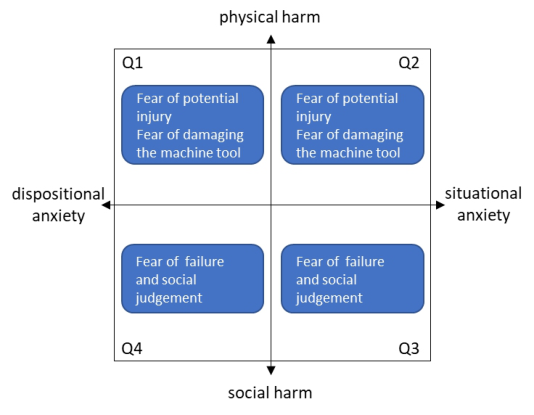
The first and second category of fear (fear of potential injury and fear of breaking the machine tool) can be collectively described as fears related to potential physical harm that arises from improperly operating a machine tool. In contrast, the third category of fear (fear of failure/judgement) relates to the social harm that can arise from wrongly operating a machine tool.
Connection to Workplace Anxiety Within the research on workplace anxiety, a common distinction is made between two primary types: trait-based or dispositional workplace anxi- ety, and state-based or situational workplace anxiety. (Cheng & McCarthy, 2018). Dispositional anxiety refers to a person’s general tendency to expe- rience anxiety across various situations, including the workplace. It is considered a trait-based anxiety, meaning it is a stable characteristic of an individual’s personality. Situational anxiety arises in response to specific sit- uations or events in the workplace. Unlike dispositional anxiety, situational anxiety is more context-specific and may not be present in other areas of an individual’s life (Cheng & McCarthy, 2018). These two types of anxiety were also observed during our study. After conducting the observations and anal- ysis, we connected the three identified categories of fear to the two types of workplace anxiety. This linking process aided in understanding the actions and behaviors observed.
Figure 1: Quadrants of fear of using machine tools.
To illustrate this relationship, we developed a two-dimensional model that places the type of anxiety (dispositional or situational) on one axis and the fear of consequences (physical harm or social harm) on the other axis, result- ing in a total of four distinct quadrants, as shown in Figure 1. Each quadrant signifies distinct causes of fear, thereby requiring different approaches to address and mitigate the fears within each quadrant.
Exploring Fear and Hesitancy Among Machine Tool Operators 723
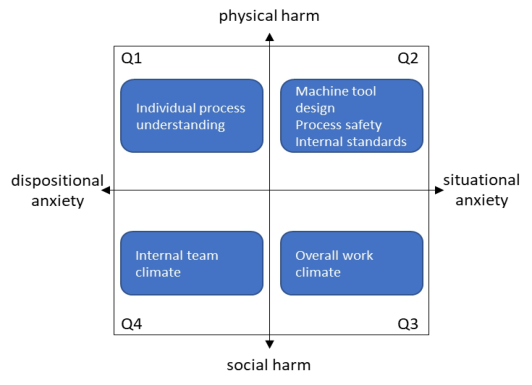
By categorizing the data into four distinct quadrants, determined by the type of anxiety and the fear of consequences, targeted recommenda- tions, deriving from the data, can be provided for machine tool developers, educators, and managers to address each specific quadrant effectively.
In the first quadrant (Q1), the risk of physical harm intersects with disposi- tional anxiety. Here it is crucial for leadership to comprehend the underlying causes of fear. Dispositional anxiety stems from highly individual factors, however the fear of physical harm is linked to machine and hardware related complications. Thus, efforts should be focused on enhancing the operators’ individual understanding of the processes involved.
The second quadrant (Q2), combines the risk of physical harm with situa- tional anxiety. Situational anxiety arises from institutional factors, in combi- nation with the fear of physical harm, this requires attention to machine tool design, process safety, and internal standards.
In the third quadrant (Q3), situational anxiety intersects with the risk of social harm. Here, operators may experience fear related to failure and social judgment. Given that situational anxiety is influenced by external factors, analyzing and influencing these situations is crucial. This may involve foster- ing a positive work climate throughout the organization and emphasizing a culture of constructive criticism rather than punishment or threat.
Lastly, in the fourth quadrant (Q4), the risk of social harm intersects with dispositional anxiety. Considering the internal team structures and underly- ing causes becomes important. Dispositional anxiety is driven by individual factors, highlighting the need to address internal dynamics and support mechanisms within the team structure.
A summary of these key action points for each quadrant is shown in Figure 2.
By addressing these aspects, machine tool stakeholders can effectively mit- igate fears, promote a safer and more supportive environment, and enhance the overall usability of machine tools.
Figure 2: Actions against fear of using machine tools.
SUMMARY AND OUTLOOK This study explored the aspect of fear within the affective dimension of machine tool usability through an explorative interview study, supplemented by user observations. During the data analysis, three distinct categories of fears emerged as significant factors to consider: the fear of potential injury, the fear of breaking the machine, and the fear of failure and social judgement. The fear of potential injury stems from our distinct response to unfamil- iar situations. Machine tool operators, regardless of their experience level, show caution when operating machine tools, due to the potential for per- sonal injuries. The fear of breaking the machine extends beyond personal safety to the consequences of damaging expensive equipment. Lastly, the fear of failure and social judgement is a social fear, linked to concerns about meet- ing expectations and being judged by colleagues. These fears were then linked to the theory of dispositional and situational workplace anxiety, resulting in the identification of four quadrants of fear of using machine tools and corre- sponding recommendations for improvement of machine tool usability from an educators, developers and workplace perspective. By understanding and addressing the identified fears, the usability of machine tools can be greatly enhanced.
While this research contributes to understanding machine tool usability, it is important to acknowledge its limitations. The data for this study was obtained through qualitative methods, consequently the findings may not be entirely generalizable but instead provide an initial overview and approach to the field. Therefore, it is advisable to conduct further evaluations of the research results, such as through experts or focus groups, in order to enhance the generalizability of the findings. Nonetheless, the identification of these three categories of fear, along with the practical recommendations provided, offer valuable insights and directions for improving the overall usability of machine tools.
ACKNOWLEDGMENT
This research is funded by dtec.bw – Digitalization and Technology Research Center of the Bundeswehr. dtec.bw is funded by the European Union NextGenerationEU.
We would like to acknowledge the use of Open AI tools, for assistance in refining the language of this paper.
REFERENCES
Bandura, A. (1999). Social cognitive theory of personality, Handbook of Personality 2. https://admin.umt.edu.pk/media/site/std1/filemanager/osamaarticle/26aug ust2015/bandura1999hp.pdf Brecher, C., Kolster, D. & Herfs, W. (2011). Innovative Benutzerschnittstellen
für die Bedienpanels von Werkzeugmaschinen. Zeitschrift für wirtschaftlichen Fabrikbetrieb, 106(7-8), 553–556. https://doi.org/10.3139/104.110607 Brecher, C., Sittig, S., Hellig, T., Obdenbusch, M. & Herfs, W. (2019). Ansatz eines Maschinenzentrierten ortsspezifischen Bedienkonzepts für Werkzeugmaschinen auf Basis applikations-und situationsabhängiger Informationsbereitstellung. In
Exploring Fear and Hesitancy Among Machine Tool Operators 725
GfA, Dormund (Hrsg.): Frühjahrskongress 2019, Dresden Arbeit interdisziplinär analysieren - bewerten - gestalten. Camerer, C., Loewenstein, G. & Prelec, D. (2005). Neuroeconomics: How Neuroscience Can Inform Economics. Journal of Economic Literature, 43(1), 9–64. https://doi.org/10.1257/0022051053737843 Cheng, B. H. & McCarthy, J. M. (2018). Understanding the dark and bright sides
of anxiety: A theory of workplace anxiety. The Journal of applied psychology, 103(5), 537–560. https://doi.org/10.1037/apl0000266 Corbin, J. & Strauss, A. (2015). Basics of qualitative research: Techniques and procedures for developing grounded theory (4. Aufl.). Core textbook. SAGE Publications. Davis, F. D. (1989). Perceived Usefulness, Perceived Ease of Use, and User Acceptance
of Information Technology. MIS Quarterly, 13(3), 319. https://doi.org/10.2307/ 249008 DIN EN ISO 9241–11 (2018). Ergonomie der Mensch-System-Interaktion - Teil 11: Gebrauchstauglichkeit: Begriffe und Konzepte (DIN EN ISO 9241-11). DIN. Glaser, B. G. & Strauss, A. L. (2017). The discovery of grounded theory: Strategies
for qualitative research. Routledge. https://doi.org/10.4324/9780203793206 Gray, J. A. (1987). The psychology of fear and stress (2. Aufl.). Problems in the behavioural sciences. Cambridge University Press. Gustavsson, L., Augustsson, S. & Vallo Hult, H. (2022). Trigger Points of Fear and
Distrust in Human-Robot Interaction: The Case of Cooperative Manufacturing. Helander, M. G. & Khalid, H. M. (2012). Chapter 20 - Affective Engineering and design. In G. Salvendy (Hrsg.), Handbook of human factors and ergonomics (4. Aufl., S. 569–596). Wiley. Hess, U. & Thibault, P. (2009). Darwin and emotion expression. The American
psychologist, 64(2), 120–128. https://doi.org/10.1037/a0013386 (2022). Lange, L., Buxbaum-Conradi, S., Redlich, T. & Wulfsberg, J. P. (2023). Soziotechnische Einflussfaktoren auf die Bedienbarkeit von Werkzeugmaschinen. Zeitschrift für wirtschaftlichen Fabrikbetrieb, 118(6), 371–375. https://doi.org/ 10.1515/zwf-2023-1079 Liu, X., Lei, T., Chen, T. J. & Wei, S. L. (2013). A Study on the Industrial Design
of Machine Tools Based on the Kansei Engineering Methods. Applied Mechanics and Materials, 437, 914–917. https://doi.org/10.4028/www.scientific.net/AMM. 437.914 Pettersson, I. & Karlsson, I. M. (2015). Setting the stage for autonomous cars: a pilot study of future autonomous driving experiences. IET Intelligent Transport Systems, 9(7), 694–701. https://doi.org/10.1049/iet-its.2014.0168 Puschmann, P., Becker, G., Camarinopoulos, A., Hussels, U., Wittstock, V. & Regel, J.
(2019). Von fertigkeitsbasiertem zu regelbasiertem Verhalten bei der Bedienung von Werkzeugmaschinen. In GfA, Dormund (Hrsg.): Frühjahrskongress 2019, Dresden Arbeit interdisziplinär analysieren - bewerten - gestalten. Rattat, C. (2016). 3D-Druck für Anspruchsvolle: Mit dem Ultimaker perfekte Werkstücke erstellen. dpunkt.verlag. Sharit, J. (2012). Chapter 26 - Human error and human reliability analysis. In
G. Salvendy (Hrsg.), Handbook of human factors and ergonomics (4. Aufl., S. 734–800). Wiley. Szollosy, M. (2017). Freud, Frankenstein and our fear of robots: projection in our cultural perception of technology. AI & SOCIETY, 32(3), 433–439. https://doi. org/10.1007/s00146-016-0654-7
Tönshoff, H. K. (1995). Werkzeugmaschinen: Grundlagen. Springer-Lehrbuch.
Springer Berlin Heidelberg. https://doi.org/10.1007/978-3-662-10914-4 Vu, K.-P. L., Proctor, R. W. & Garcia, F. P. (2012). Chapter 48 -Website design and evaluation. In G. Salvendy (Hrsg.), Handbook of human factors and ergonomics (4. Aufl., S.1323–1353). Wiley. Watson, J. B. (1998). Behaviorism. Transaction Publishers. Williamson, K. (2002). Research methods for students, academics and professionals:
Information management and systems (2. Aufl.). Topics in Australasian library and information studies: no. 20. Centre for Information Studies, Charles Sturt University. Wogalter, M. S., Laughery, K. R. Sr. & Mayhorn, C. B. (2012). Chapter 29. Warnings and Hazar Communications. In G. Salvendy (Hrsg.), Handbook of human factors and ergonomics (4. Aufl., S. 868–894). Wiley.
LISTED IN THE AHFE DIGITAL BOOKSTORE CATALOGUE
Explore the complete digital volume
Human-Centered Design and User Experience
Read this individual research paper free through the original publisher, or explore the full digital proceedings book.
ISBN 978-1-958651-90-2
Explore this ISBN in the AHFE Bookstore ↗Listed in the July 2026 bookstore catalogue; search by ISBN to confirm current availability · Digital book purchase optional