Hui Cheng, Xiao Qiu (2023). Exploring Correlations of PCMI Metrics in Museum Creativity through Line Chart. In: Human-Centered Design and User Experience. AHFE Open Access, vol. 114, pp. 50–59. https://doi.org/10.54941/ahfe1004221
The PCMI (Product Creativity Measurement Instrument) model assesses product creativity in design, which comprises dimensions of Novelty, Usefulness, Emotion, Attraction, Importance and Desire. This paper aims to understand the correlations of the creativity measurement metrics and provide evidence for simplifying the mode in the context of museum creativity. A 5-point online survey designed in the style of Likert Scales was proposed, and all the questions are adopted from the indicators of the PCMI model. The apparatuses used in this research are five Storm Bottles selected from top museums worldwide. Two hundred twenty-four participants were invited to assess the products, and 222 responses were valid (the overall Cronbach’s α of the data is 0.95). The data supported the integration of Attraction, Emotion and Desire into the Affect dimension, which corresponds with the finding from the second edition of the PCMI model. The results showed that the Affect dimension other than the Novelty is the factor that impacts creativity assessment of museums’ creativity positively, dominantly, and significantly. The survey data doubted whether Importance can be ignored in the context of museum creativity because it has little impact on the overall creativity score, but it needs further validation. The data suggested Novelty and Attraction influence Resolution, but the exact influencing mechanism needs to be explored further.
Our previous study (Cheng, 2019b, Cheng et al., 2023a, Cheng, 2021b, Cheng, 2021a, Cheng, 2018, Cheng, 2019a, Cheng et al., 2022) revealed that the museum’s cultural and creative industries face problems. The dom- inant issues are the homogenization and lack of creativity in their products. Through the investigation, we discovered three questions underlie the phe- nomenon and problem: (1) What does cultural creativity mean? (2) What measurements can be taken to evaluate creativity? Furthermore, (3) How can the overall creativity score for designing museums’ creative products be calculated? (Cheng, 2023) Few answers to these questions can be discovered in the literature. We summarised that the creativity measurement model is
Exploring Correlations of PCMI Metrics in Museum Creativity Through Line Chart 51
what the industries lack, and we started the inquiry into constructing a cre- ativity measurement model for museums’ creativity. Before the research on model construction, we tried to find whether the existing model’s metrics fit the context of museum creativity (Cheng et al., 2023d, Cheng et al., 2023c). Therefore, this paper (the second of the whole series) aims to understand the metrics’ correlations in the creativity measurement model and decide whether the metrics can be simplified for museum creativity assessment.
In the literature, three dominant measurement models may be suitable for assessing museum creativity. They are CAT (Consensual Assessment Tech- nique (Amabile, 1982)), CPSS (Creative Product Semantic Scale (Besemer and O’Quin, 1986, Besemer and Treffinger, 1981)) and PCMI (Product Creativ- ity Measurement Instrument (Horn and Salvendy, 2006, Horn and Salvendy, 2009)). Among them, the PCMI model is one of the most suitable models in the design realm, integrating the CPSS model and other research findings because it is a model designated for evaluating the “narrow product” close to the product category what museum creativity refers to (Horn and Salvendy, 2006). Moreover, this model orients to customers’ perceptions and considers their interests and preferences; thus, it is more practical to market managers and product design practices.
The model inventor divided product creativity into three scales: Attribute, Affect, and Preference. The Attribute has two subscales: Novelty and Appro- priateness (Resolution or Usefulness), corresponding with the consensus of product creativity definition. Affect means the emotional impact of product creativity on its consumers, and its subscales are Affect and Arousal. Pref- erence deals with consumers’ perception of product creativity comprising of Centrality (users’ interests in creativity) and Applicability (the significance of creativity to users, which also refers to the usability of product design).
METHOD
Survey Design and Instruments We adopted the indicators from the PCMI model as an instrument for creativity assessment. The PCMI model includes six dimensions (Novelty, Usefulness, Emotion, Attraction, Importance and Desire) and 18 indicators (Horn and Salvendy, 2006). Since many scholars label it a time-consuming assessment model (Hazeri et al., 2017, Lu and Luh, 2012), we reduced the number of indicators following the strategy introduced by Lu and Luh (2012), where a threshold (>0.8) was set beforehand. Indicators whose fac- tor loading does not reach the threshold were discarded. More specifically, we used a stricter standard to select indicators where only the ones with the high- est factor loading in each dimension were chosen. Therefore, 6 representative indicators have been included as the instruments for this survey. They are Rare (Novelty), Functional (Resolution), Appealed (Emotion), Favourable (Attraction), Important (Importance), Desirable (Desire) (See Table 1). We redesigned them into a 5-point Likert Scales (1 represents the lowest score and 5 means the highest score).
52 Cheng and Qiu
Table 1. Creativity dimensions from the PCMI model and the corresponding adjective pairs.
Participants and Materials The targeted participants are students, professors, and practitioners in the design realm. To improve the diversity of data, we attempted to invite them from different provinces of China. The category of museum creative product we chose in the survey is the “Strom Bottles” because this is a novel category for museum culture and creativity and a bestseller in the market. We selected storm glasses from top museums worldwide. The number of Storm Bottles from the museums is 3 from the Great British Museum, 1 from the Metropoli- tan Museum of Art, and 1 from the Palace Museum in Beijing. The British Museum occupied 60% because this museum sells the most Storm Bottles among the top museums on Taobao.com, a famous Chinese online shopping platform. The researchers sent participants a QR code linking to a question- naire form in a 5-point Likert Scale style in “Wenjuan Wang”, a professional online survey website in China. The participants are asked to rate the five museum creative products independently.
We finally invited participants from 27 Chinese administrative divisions, which covers 79.4%. Among the participants, the majority are design pro- fessors, teachers and practitioners, and the rest are design postgraduates. We received 224 responses, and 222 are valid (rate 99.10%). On the scale of gender, 32.58% of the participants are males, and 67.42% are females. On the scale of design experience, 43.44% of the participants have 3–5 years of experience, 19% have 5–7 years, 14.03% have 7–10 years, and the rest, 22.53%, have more than ten years of experience. We tested the reliability of the survey, and the overall Cronbach’s α of the result is 0.95, indicating that the result is reliable. Our previous report depicts descriptive statistics (Cheng et al., 2023b).
RESULT
After reviewing them individually, we deleted two duplicates and reserved the rest 222 valid responses. We tested the reliability and validity of the result. The Cronbach α is 0.95, indicating the result is highly reliable. The values of KMO (0.868) and Bartlett (p<0.05) support to conduct exploratory factor analysis. In the stage of confirmatory factor analysis, we found the AVE values are all above 0.5 (Rare: 0.552; Functional: 0.539; Appealed: 0.633; Favorable: 0.56; Important: 0.555; Desirable: 0.59) indi- cating the metrics are well extracted. The values which indicate the model fit
Exploring Correlations of PCMI Metrics in Museum Creativity Through Line Chart 53
Equation reproduced from the original PDF.
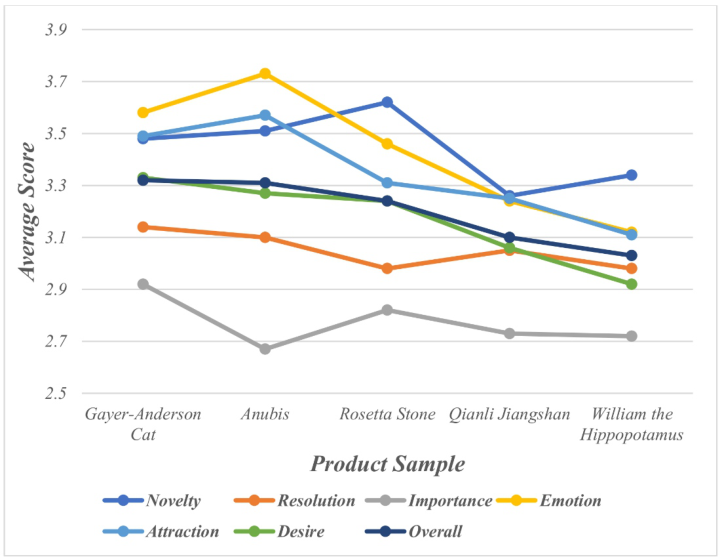
After the tests of reliability and validity, we presented the data in a line chart (See Figure 1).
Figure 1: The relationship of the six dimensions in five products.
Figure 1 shows that the Novelty, Attraction, and Emotion lines are above the Overall line, the Resolution and Importance lines all lie beneath the Over- all line, and the Desire line approximately overlaps the Overall line. Since the Desire and the Overall lines overlap each other and the gaps are no more sig- nificant than 0.11 (See Table 2), we might use the score of the Desire aspect to fast predict the overall level of creativity in museum culture and creativity.
Table 2. The gaps between the score of the desire dimension and the overall creativity.
Table available in the original PDF paper.
Product Sample Desire Overall Creativity Score Absolute Gap Score Gayer-Anderson Cat 3.33 3.32 0.01 Anubis 3.27 3.31 0.04 Rosetta Stone 3.24 3.24 0.00 Qianli Jiangshan 3.06 3.10 0.04 William the Hippopotamus 2.92 3.03 0.11
54 Cheng and Qiu
Besides this explicit information, we further explored the correlations of metrics through the chart.
The Correlations of Emotion, Attraction and Desire
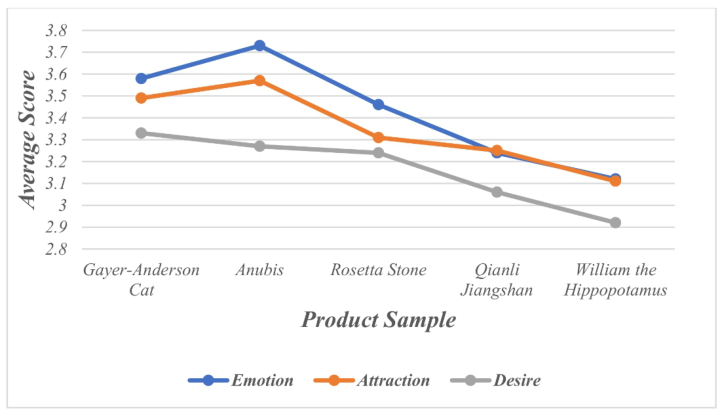
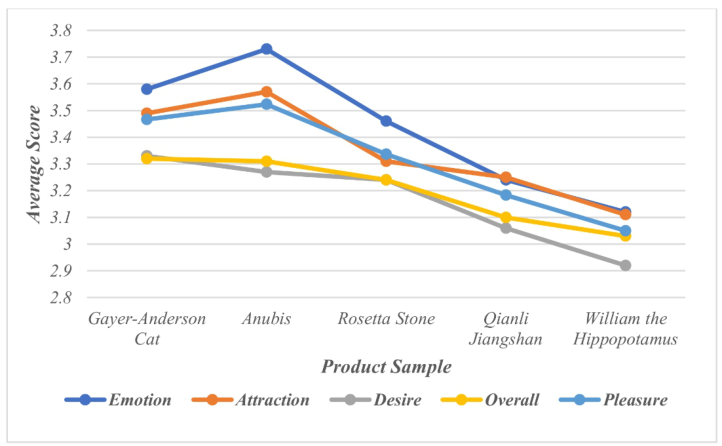
Figure 2 shows that Emotion, Attraction and Desire are positively relevant. To some extent, they can be bundled as Affect. Thus, we further calculated the average score of the three Affect aspects of the samples and compared them with their overall score (See Table 3).
Figure 2: The relationship of emotion, attraction and desire.Table 3. The average scores of affect aspects and their gaps between overall scores.
Table available in the original PDF paper.
Product Sample Affect Aspects Average Affect Score
From Table 3, we found the gap in score between the average and the overall of Anubis and Gayer-Anderson Cat all more significant than 0.10, and Anubis has a larger gap score than Gayer-Anderson Cat. The gaps between the average and the overall inferiors, including Rosetta Stone, Qianli Jiangshan, and William the Hippopotamus are small (See Figure 3).
We also compared other aspects with this Affect aspect (See Table 4). From Table 4, we found that if the score of Novelty approximates the average Affect score, the overall creativity score will be high, too. However, if
Exploring Correlations of PCMI Metrics in Museum Creativity Through Line Chart 55
the score of Novelty is far more significant than the Affect score, the products will be regarded as less creative. Moreover, we found that the line of Desire almost overlaps the line of Overall Creativity.
Figure 3: Affect and overall score.Table 4. The average scores of other aspects and the average affect scores.
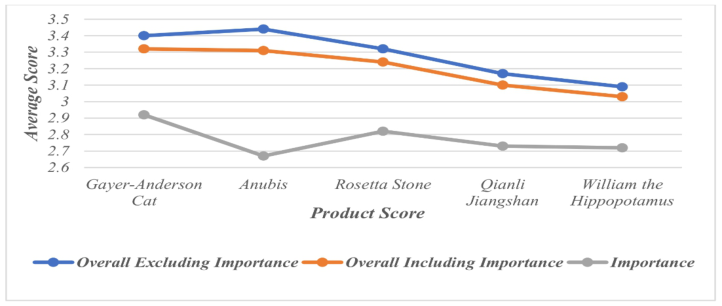
The Role of Importance Since the line of Importance lies at the bottom of the chart, we questioned the necessity of including the metric of Importance in the creativity assess- ment model for museum cultural and creative products. To explore the role of Importance, we drew another line that excludes the Importance score to compare with the Overall line, which includes the Importance (See Figure 4). From the chart, we discovered the two Overall lines parallel on most occasions except for causing a slight drop in the Overall score of Anubis.
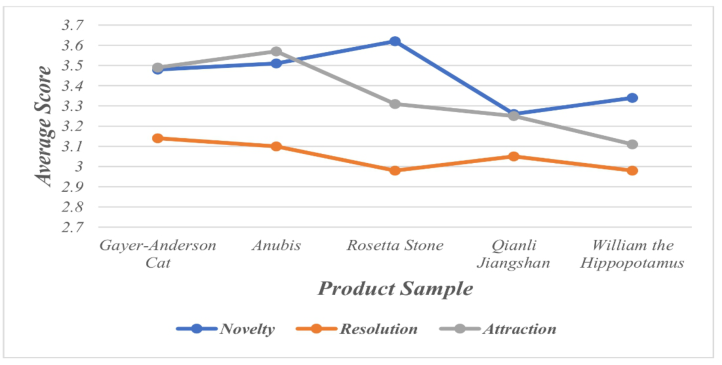
The Correlations of Resolution-Novelty and Resolution-Attraction From Figure 5, we detected Novelty as a factor influencing Resolution neg- atively. For example, Rosetta Stone has the highest Novelty score, but it is pretty low in Resolution; to the contrary, Qianli Jiangshan has the lowest
56 Cheng and Qiu
score in Novelty but has a medium score in the Resolution dimension. Apart from the negative impact of Novelty, Attraction is another factor that pos- itively impacts the rating of Resolution, although such positive relevance is not significant from the chart.
Figure 4: The influence of importance on the overall creativity score.Figure 5: The relationship of novelty, attraction and resolution.
DISCUSSION
We discovered three findings regarding metrics correlations based on the results.
Emotion, Attraction and Desire The phenomenon discovered from the result indicates that the Affect aspect can be an important metric for creativity assessment of museum culture and creativity. If the Affect score of a product is prominent and predominant in
Exploring Correlations of PCMI Metrics in Museum Creativity Through Line Chart 57
the overall score, then the creativity score of it will probably be satisfying. This finding corresponds with the conclusion of the second PCMI model, where the authors also bundled Emotion, Attraction, and Desire into Affect (Horn and Salvendy, 2009).
The result was that the product with a high Novelty score did not achieve a high Creativity score. In contrast, the product with a high Affect score reached a high Creativity score, indicating that Novelty and Affect should be well balanced in designing museum cultural and creative products. Oth- erwise, the product may be able to have good performance in creativity. This finding may be significant for the design practice of museum creativ- ity because it pointed out a strategy for how museum creative products can survive in the fierce market competition.
Importance and Creativity The phenomenon that the Importance line is beneath the Overall Creativity line suggests that assessing Importance in museum culture and creativity may be a task of wasting time because it seems that Importance has little influence on the Overall creativity score except by pulling down the numeric value. Therefore, we may contend that the Importance metric is unnecessary for the creativity assessment of museum cultural and creative products. Thus, it can be ignored totally. However, this hypothesis needs further validation.
Resolution, Novelty and Attraction Although in the survey, we used products with the same function (weather forecast) for testing, we still discovered a phenomenon that the products have different scores in Resolution. The possible reason to explain such a phe- nomenon is that other dimensions may impact Resolution. From the result, we found that Novelty and Attraction may be the two potential metrics that impact Resolution.
Understandably, Novelty impacts Resolution because such a phenomenon has already been discussed in the traditional creativity literature: a novel idea may not be useful. In other words, Novelty is not the only metric for creativity assessment; therefore, another metric called Usefulness (Resolution) has been introduced and become the second metric for creativity assessment with wide acceptance.
The influencing mechanism of Attraction on Resolution is seldom seen in the literature. However, this phenomenon is not problematic to comprehend: if a customer favours a product, s/he will surely rate the Resolution score higher and contend it is useful. However, they are useless to other people.
CONCLUSION
After reviewing the literature on product creativity measurement, design sci- ence, museology and cultural and creative industries, the authors selected a relatively suitable measurement model (PCMI) to test whether this model is fit for assessing creativity in museum cultural and creative products. Through a survey with 222 valid responses (Cronbach α=0.95), the researchers analyzed the results and summarised three findings as follows: (1) Emotion, Attraction
58 Cheng and Qiu
and Desire have positive relevance, and they can be bundled as Affect; (2) Affect dimension other than the Novelty is the factor that impacts creativity assessment of museums’ creativity positively, dominantly, and significantly; (3) Importance has little impact on Overall creativity score, and this dimen- sion may be ignored, however, it needs further validation; (4) Resolution has significant negative relevance with Novelty, while it has positive relevance with Attraction; (5) Desire may be a fast predictor for Creativity, but it has not been validated in this research. The drawbacks of this paper are as fol- lows: (1) using the metrics with the highest factor loading lacks sufficient support from the literature; (2) data have not been analyzed via Structural Equation Modelling (SEM), leaving an impression on the reviewers and read- ers that the analysis is less scientific. We will cover these shortages in our relevant studies soon.
ACKNOWLEDGMENT
This research is supported by the Provincial Fundamental and Common- weal Research Projects of Zhejiang (LGF22G030015) and the Research Grant of Zhejiang University of Finance and Economics Dongfang College (2022DFYHN006).
REFERENCES
Amabile, T. M. 1982. Social psychology of creativity: A consensual assessment technique. Journal of Personality and Social Psychology, 43, 997–1013. Besemer, S. & O’quin, K. 1986. Analyzing Creative Products: Refinement and Test
of a Judging Instrument. The Journal of Creative Behavior, 20, 115–126. Besemer, S. & TreffingeR, D. 1981. Analysis of Creative Products: Review and Synthesis. The Journal of Creative Behavior, 15, 158–178. Cheng, H. 2018. Ways of Avoiding the Problem of Cultural Creative Products’
Similarity, Basing on Haining. Design, 298, 96–99. Cheng, H. 2019a. Museum’s Cultural and Creative Industry: Present Situation, Problem and Direction. Packaging Engineering (包装工程), 40, 65–71. Cheng, H. 2019b. A Study on the Causes of the “Homogenization” in Museum
Creative Products. Art and Design (Theory) (艺术与设计(理论版)), 2, 95–97. Cheng, H. 2021a. Model Construction of Museum Culture and Creativity Industry with Society Governance Targeted. In: Wen, F. & Ziaei, S. M. (eds.) Interna- tional Conference on Economic Innovation and Low-carbon Development 2021 (EILCD2021). Qingdao, China: EDP Sciences. Cheng, H. 2021b. Research of User-Centered Intelligent Technology in China’s
Cultural and Creative Product Design. In: Anpo, M. & Song, F. (eds.) Inter- national Conference on Energy Resources and Sustainable Development 2020 (ICERSD2020). Harbin, China: EDP Sciences. Cheng, H. 2023. Design Governance: Museum Cultural Creativity and Its Tool Design from a Perspective of Governance, Hangzhou, Zhejiang University Press. Cheng, H., Liu, B.-J., Luo, S.-j., Xie, J. & Xia, L. 2023a. Exploring the Chinese Design
Concepts That Shape China’s Cultural and Creative Products for Museums. In: JAIN, L. C., BALAS, V. E., WU, Q. & SHI, F. (eds.) International Symposium on Design Studies and Intelligence Engineering 2022 (DSIE2022). Hangzhou, China: IOS Press.
Exploring Correlations of PCMI Metrics in Museum Creativity Through Line Chart 59
Cheng, H., Luo, S.-J., Liu, B.-J., Xia, L., Xie, J. & Qiu, X. 2023b. Insights on Metrics’ Correlation of Creativity Assessment for Museum Cultural and Creative Product Design. In: STEPHANIDIS, C., ANTONA, M., NTOA, S. & SALVENDY, G. (eds.) International Conference on Human-Computer Interaction 2023 (HCII2023). Copenhagen, Denmark: Springer, Cham. Cheng, H., Qiu, X., Liu, B.-J., Sun, X. & Li, Y. 2022. Literature Review of Cul-
tural and Creative Product Design Method Research: An Analysis of Themed Papers Published by Packaging Engineering. Packaging Engineering (包装工程), 43, 339–347. Cheng, H., Qiu, X., Sun, X., Xie, J., Xia, L., Luo, S.-J. & LIU, B.-J. 2023c. The Preliminary Validation of PCMI in the Context of Museum Creativity. In: Jain, L. C., Balas, V. E., Wu, Q. & Shi, F. (eds.) International Symposium on Design Studies and Intelligence Engineering 2023 (DSIE2023). Hangzhou, China: IOS Press. Cheng, H., Sun, X., Qiu, X., Liu, B.-J., Xia, L., Luo, S.-J., Xie, J., Li, W., Li, Y. & Tian,
X. 2023d. An In-depth Analysis of PCMI Dimensions for Museum Creativity. Thinking Skills and Creativity, 101407. Hazeri, K., Childs, P. & Cropley, D. Proposing a new product creativity assessment tool and a novel methodology to investigate the effects of different types of product functionality on the underlying structure of factor analysis. International Confer- ence on Engineering Design 2017 (ICED17), August 21-25, 2017 2017 Vancouver, Canada. 579–588. Horn, D. & Salvendy, G. 2006. Product creativity: conceptual model, measurement
and characteristics. Theoretical Issues in Ergonomics Science, 7, 395–412. Horn, D. & Salvendy, G. 2009. Measuring consumer perception of product creativity: Impact on satisfaction and purchasability. Human Factors and Ergonomics in Manufacturing & Service Industries, 19, 223–240. Lu, C.-C. & Luh, D.-B. 2012. A Comparison of Assessment Methods and Raters in
Product Creativity. Creativity Research Journal, 24, 331–337.
LISTED IN THE AHFE DIGITAL BOOKSTORE CATALOGUE
Explore the complete digital volume
Human-Centered Design and User Experience
Read this individual research paper free through the original publisher, or explore the full digital proceedings book.
ISBN 978-1-958651-90-2
Explore this ISBN in the AHFE Bookstore ↗Listed in the July 2026 bookstore catalogue; search by ISBN to confirm current availability · Digital book purchase optional