Verena Wagner-Hartl, Katharina Gleichauf, Ramona Schmid, Nicole Dewald (2023). The Impact of the COVID-19 Pandemic on attitudes towards Human-Robot Collaboration in the Healthcare Environment. In: Human Systems Engineering and Design (IHSED 2023): Future Trends and Applications. AHFE Open Access, vol. 112, pp. 397–406. https://doi.org/10.54941/ahfe1004152
The need of nursing staff will continue to increase in the next years. At the same time, the healthcare system will face an increase of elderly people. So, the future society will be confronted with socio-political and economic challenges. It is expected that human-robot collaboration will increase in healthcare. This should support and relieve care staff. An online study was conducted to examine differences in the acceptance of different care robots and the general attitude towards robots in the healthcare sector. To additionally analyze the impact of the COVID-19 pandemic, two different measurement times were used, one at the beginning of the pandemic resp. after the first corona wave and the first lockdowns, and one five months later. The results of the study should help to understand the acceptance of the potential use of different robots in healthcare and the impact of the COVID-19 pandemic.
According to different predictions, the need for inpatient and outpatient nurs- ing staff will continue to increase in the coming years (Flaubert et al., 2021; IW Köln, 2018). Among other things, this is due to a rising life expectancy while there are low birth rates (Brossardt, 2012). As the increasingly older society results in a correspondingly larger number of people in need of care, more care staff will also be needed. This increasing demand for care staff is presenting a major challenge to health and social systems worldwide. There is already an existing shortage of skilled personnel in the health care sys- tem all over the world (Federal Ministry of Health, Germany, 2021; World Health Organization (WHO), 2022). To counteract this, there is an aim to increasingly use technical systems for control, routine, and logistical activities to provide support. This is where human-machine interaction in healthcare becomes relevant (Olaronke et al., 2017). Human-machine interaction in the healthcare sector is primarily concerned with supporting nurses in their work with and on patients. Corresponding systems can take on various tasks. Meanwhile, there are also socially interacting robots. These can improve the
quality and accessibility of health services. However, these robots do not only bring benefits but also challenges. These challenges include open questions about the ethical aspects, design, safety, usefulness and appropriateness of such systems. Such open questions contribute to low acceptance of robots in healthcare.
The confrontation with the coronavirus had a major impact on what was originally considered normality, and thus on how people lived and worked with each other (El-Bawab, 2020). According to Yang, Nelson et al. (2020), the escalation of the pandemic made the potential role of robotics increasingly clear. This can – for example – be highlighted by the relevance of cleaning con- taminated surfaces. Here, the use of so-called disinfection robots can have a huge advantage. In addition, the use of social-robots in healthcare and the resulting distancing can reduce the risk of infection for caregivers (El-Bawab, 2020). A study by Wagner-Hartl et al. (2020) has already investigated atti- tudes towards robots in the healthcare and various other fields. The results show that the general attitude towards robots in the care sector is neutral to negative. Age differences could not be proven for the care sector. A further study of our research group shows that participants working in the health- care sector reported less positive attitudes towards robots in care than those not working in the healthcare sector (Gleichauf et al., 2022). It is of great rel- evance to include the nursing staff in corresponding restructuring measures (Federal Ministry of Health, Germany, 2021; Gleichauf et al., 2022). In this context, it is important to promote the acceptance of corresponding technical systems and digital aids.
The aim of the study was to examine differences in the acceptance of dif- ferent care robots and the general attitude towards robots. Furthermore, to additionally analyse the impact of the COVID-19 pandemic, two different measurement times were used, one at the beginning of the pandemic resp. after the first corona wave and the first lockdowns (July 2020), and one five months later (December 2020). The following research questions should be answered:
1. Does the general attitude towards robots differ over time? Do age and being affected by the COVID-19 situation resp. having concerns due to COVID-19 have an impact on it? 2. Does the acceptance (usefulness and satisfaction) of different types of robots used within the care sector, differ over time as well as between age groups and groups according to affectedness by COVID-19?
METHOD
Sample As previously mentioned, the study consists of two different measurement times (within-subject design). At the first measurement time 115 women and 78 men (N = 193) aged between 18 and 74 years (M = 32.83, SD = 14.52; 2 participants did not report their age) participated in the online study (see Gleichauf et al., 2022 for more details). Overall, 65 of them provided their contact information for a new, voluntary participation invitation. Of those, 30 participated in the second measurement time: 19 women and 11 men
The Impact of the COVID-19 Pandemic on Attitudes Towards Human-Robot Collaboration 399
(N = 30) aged between 20 and 71 years (M = 39.03, SD = 17.61). Seven par- ticipants worked in the healthcare environment and/or have privately cared for a person for at least more than three weeks in the last 12 months. The participants were grouped in two different age groups using a median split (Md = 29): younger (n = 16), elderly (n = 14). The distribution of the two different age groups did not differ significantly for participants with and with- out care experience, χ2(1) = .05, p = .818. Furthermore, the distribution regarding sex did not differ significantly, χ2(1) = .01, p = .919.
To include their concerns towards COVID-19, the participants were divided into two groups based on their assessments regarding the variable “How often do you worry about the current situation due to COVID-19?” Therefore, the assessments of both measurement times were averaged. After- wards, the participants were grouped into two groups (less frequent, more frequent) using the mean value (M = 2.40). Following the results, no signif- icant difference regarding the distribution of the age-groups can be shown for the these groups, χ2(1) = .13, p = .714. Furthermore, the distribution regarding sex did not differ significantly, χ2(1) = .88, p = .348.
Material and Procedure The study was conducted with an online questionnaire. In total, it took the participants 15–20 minutes to complete the questionnaire. The questionnaire consisted of two different parts. In the first part, participants were asked about their sociodemographic data. Afterwards the participants assessed their general attitude towards robots using a 5-point rating scale from nega- tive (-2) to positive (+2). In addition, the questionnaire included further items about general aspects of human-robot collaboration and different possible tasks of robots in nursing, which are not presented within this paper.
The second part of the questionnaire consisted of four different scenarios of robots used in care, especially in assisting in the combat of the COVID-19 pandemic or problems related to it. Therefore, different robots with and with- out patient contact have been selected. The four scenarios included a visual representation with two pictures (requested from and used with the consent of the particular companies) and a description of the robot, its task and its field of application. Table 1 shows the description of the different robots of each of the four used scenarios (see also Gleichauf et al., 2022).
After each scenario, participants were asked to assess their subjectively perceived acceptance using the acceptance scale of Van der Laan et al. (1997; semantic differentials, ranging from -2 to +2). Acceptance was measured with the two subscales usefulness and satisfaction.
Identically questionnaires were used for both measurement times (t1: at the beginning of the pandemic resp. after the first corona wave and the first lockdowns – July 2020, t2: five months later – December 2020). At the end of the first survey (t1), study participants were asked to voluntarily provide their email address in order to participate in t2. To ensure anonymity as well as the traceability of the re-participating participants, a participant code accord- ing to Pöge (2011) was created individually by each study participant. The code was known only by themselves and can be replicated by them at any
time. Informed consent has been obtained from all participants at both mea- surement times. The research has been approved by the ethics’ committee of Furtwangen University.
Table 1. Description of the four different robots used for the scenarios.
The assisting robot “Moxi” helps hospital staff with tasks which are not performed directly on the patient. These include, for example, tasks such as bringing laboratory samples or delivering patient’s bed linen. Scenario 2: Disinfection robot (Aitheon)
The disinfection robot is used to disinfect rooms. It automatically irradiates each surface to be disinfected with UV light. This process is used to kill germs and should therefore prevent the spread of bacteria, viruses, etc. via surfaces. Scenario 3: Care robot (Frauenhofer IPA)
The “Care-O-Bot” is a mobile robot that should support care staff, and reduce their workload. Used in hospitals it could provide help for tasks like monitoring patient monitors and providing information to medical staff and triggering alarms in case of emergencies. Scenario 4: Social robot (SoftBank Robotics)
The social robot “Pepper” can be used in a wide variety of applications. Used in hospitals, “Pepper” can be a contact point for social interactions, especially as a contact person for patients. He is able to enter in conversation with them, entertains them and fulfils their wishes.
Statistical Analysis The software IBM SPSS Statistics was used for the statistical analysis. T-tests and univariate and multivariate analyses of variance with repeated measures were used as statistical procedure. A significance level of 5% was used.
RESULTS
General Attitudes Towards Robots Overall, the participants’ general attitudes towards robots were neutral to rather positive. The results of an ANOVA with repeated measures show a sig- nificant effect of age groups, F(1, 26) = 4.66, p = .040, η2part. = .152, as well as groups according to affectedness by COVID-19, F(1, 26) = 4.85, p = .037, η2part. = .157. All other effects did not reach the level of significance. Therefore, the general attitudes towards robots of younger participants (t1: M = 1.00, SD = .97; t2: M = .88, SD = .81) were significantly more posi- tive than those of elderly participants (t1: M = .36, SD = 1.01; t2: M = .14, SD = 1.10). Furthermore, participants that reported worries about the cur- rent situation due to COVID-19 less frequently (t1: M = 1.13, SD = 1.06; t2: M = .80, SD = 1.08) assessed their general attitudes towards robots as
The Impact of the COVID-19 Pandemic on Attitudes Towards Human-Robot Collaboration 401
significantly more positive than those who reported them more frequently (t1: M = .27, SD = .80; t2: M = .27, SD = .88).
Acceptance of Different Scenarios To answer the second research question, the participants’ acceptance, opera- tionalized as perceived satisfaction and usefulness using the acceptance scale of Van der Laan et al. (1997) of the four different scenarios, respectively types of robots, were analysed.
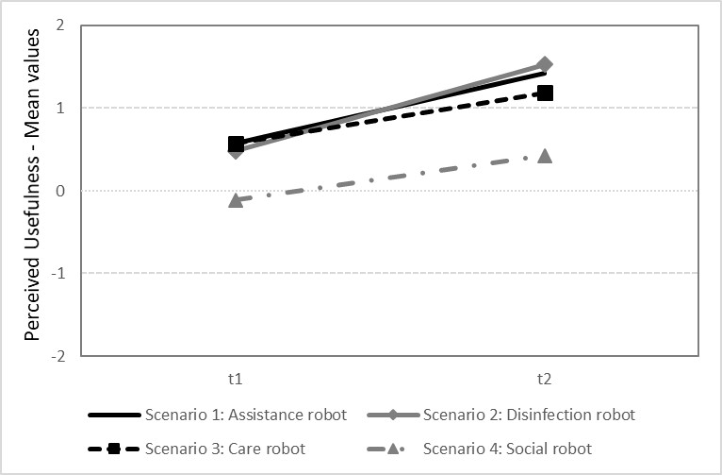
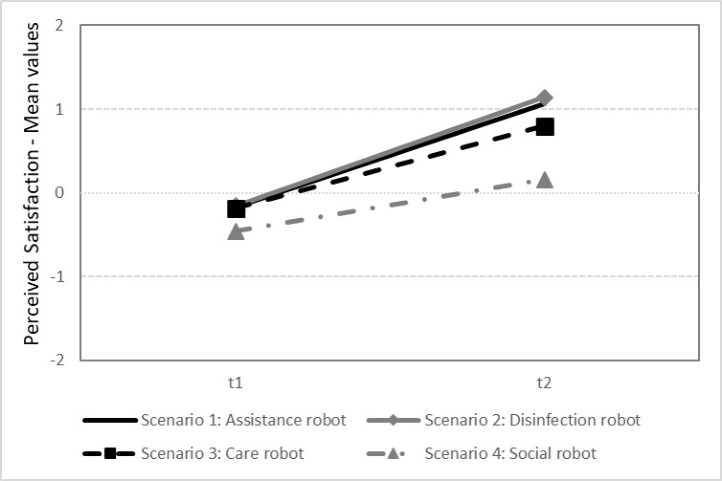
Scenario 1 – Assistance robot: The results of a MANOVA with repeated measures show a significant effect of measurement time, for both dimensions of the acceptance scale (Van der Laan et al., 1997), the perceived usefulness, F(1, 26) = 157.41, p < .001, η2part. = .858, and the perceived satisfaction, F(1, 26) = 93.57, p < .001, η2part. = .783. All other effects did not reach the level of significance. Following the results, the care robot “Moxi” (Diligent Robotics Inc.) was perceived as significantly more useful at t2 (M = 1.43, SD = .49) than at t1 (M = .57, SD = .29). Furthermore, it was perceived as significantly more satisfying at t2 (M = 1.06, SD = .55) than at t1 (M = −.17, SD = .40). The mean values are also presented in Fig. 1 and Fig. 2.
Figure 1: Perceived usefulness of the four different scenarios / robots.
Scenario 2 – Disinfection robot: A significant effect of measurement time for both, the perceived usefulness, F(1, 26) = 167.65, p < .001, η2part. = .866, and the perceived satisfaction, F(1, 26) = 51.43, p < .001, η2part. = .664, of the analysed disinfection robot (Aitheon) were shown as results of a MANOVA with repeated measures. Again, all other effects did not reach the level of significance. Following the results, the use of the disinfection robot
as described in scenario 2, was perceived as significantly more useful at t2 (M = 1.53, SD = .41) than at t1 (M = .48, SD = .30; see also Fig. 1). Fur- thermore, it was perceived as significantly more satisfying at t2 (M = 1.14, SD = .61) than at t1 (M = −.16, SD = .40; Fig. 2).
Figure 2: Perceived satisfaction of the four different scenarios / robots.
Scenario 3 – Care robot: Following the results of a MANOVA with repeated measures a significant effect of measurement time can be shown regarding the assessments of the perceived usefulness, F(1, 26) = 48.81, p < .001, η2part. = .652, and the perceived satisfaction, F(1, 26) = 46.69, p < .001, η2part. = .642, of the “Care-O-Bot” (Frauenhofer IPA). Here as well, all other effects did not reach the level of significance. Therefore, the care robot presented within scenario 3 was perceived as significantly more useful at t2 (M = 1.19, SD = .71) than at t1 (M = .57, SD = .33). In addition, it was perceived as significantly more satisfying at t2 (M = .80, SD = .77) than at t1 (M = −.18, SD = .46). The mean values are also presented in Fig. 1 and Fig. 2.
Scenario 4 – Social robot: The results of a MANOVA with repeated mea- sures show a significant effect of measurement time, for the social robot “Pepper” (SoftBank Robotics) regarding both dimensions of the acceptance scale (Van der Laan, 1997), the perceived usefulness, F(1, 26) = 14.97, p < .001, η2part. = .365, and the perceived satisfaction, F(1, 26) = 14.52, p < .001, η2part. = .358. All other effects did not reach the level of significance. Following the results, the assessed social robot was perceived as significantly more useful at t2 (M = .43, SD = 1.08) than at t1 (M = −.11, SD = .95; see also Fig. 1). Furthermore, it was perceived as significantly more satisfying at t2 (M = .16, SD = 1.24) than at t1 (M = −.46, SD = .76; Fig. 2).
The Impact of the COVID-19 Pandemic on Attitudes Towards Human-Robot Collaboration 403
DISCUSSION
In summary, with regard to the first research question, whether there is a dif- ference in the general attitude towards robots over time and the impact of age and the affectedness by COVID-19, the results show that over the period of the two measurement times, the participants’ general attitude towards robots was neutral to rather positive. Younger participants show a significantly more positive general attitude toward robots than elderly. Furthermore, those study participants who think about COVID-19 less frequently indicate a signifi- cantly more positive attitude towards robots than those who think about COVID-19 more frequently.
Regarding the second research question, whether the acceptance (dimen- sions perceived usefulness and satisfaction) of different types of robots used within the care sector, differ over time as well as between age groups and groups according to affectedness by COVID-19, the results indicate signifi- cant effects of measurement time for all four presented scenarios. Therefore, it was shown that the perceived usefulness as well as the perceived satisfac- tion of each of the four types of robots (assistance robot, disinfection robot, care robot and social robot) significantly increases over time during the first year of the COVID-19 pandemic. Various reasons could have led to these results: For example, the impact of the governmental restrictions during the COVID-19 pandemic. At the second measurement time (t2, December 2020) the inconveniences the participants had to cope with during the COVID- 19 pandemic lasted five months longer than at the first measurement time (t1, July 2020). This certainly also resulted in a lack of social contacts. Fur- thermore, the longer the pandemic lasted, the stronger the society tries to find possibilities to fight the pandemic back e.g. by limiting “unsafe” social contacts, disinfection and safety strategies (e.g., using masks and testing methods like PCR tests and rapid tests; Raje, et al., 2021; Zemmar et al., 2020). At the same time, digital offerings and discussions about digitalization were pushed through the increased necessity during lockdowns and phases of social distancing (Alkhowailed, et al., 2020; Almeida et al., 2020). This idea is strengthened by research results whereas physical distancing is – in many cases - not a valid option for the healthcare sector. Therefore, espe- cially regarding health and safety for patients, the use of robots can have many benefits (Yang, Nelson et al., 2020; Tavakoli et al., 2020; Yang, et al., 2020). Interestingly, while a significant effect regarding of how concerned peo- ple feel about the COVID-19 pandemic was reported for other applica- tions for robots like assembly, logistics and cleaning in former research by Wagner-Hartl et al. (2021), this could not be shown in the presented study for the healthcare environment. Regarding the application areas used by Wagner-Hartl et al. (2021), participants that were more concerned about the COVID-19 pandemic assessed the use of collaborative robots significant more positive than less concerned participants did. In the presented study, the two different groups of concerns regarding the COVID-19 pandemic did not differ significantly regarding their perceived satisfaction nor their per- ceived usefulness of the four different robots. At the same time, those study
participants who were less impacted indicate a significantly more positive general attitude towards robots than those who were more concerned. The same effect was shown regarding the age groups. Whereas, younger partici- pants show a significantly more positive general attitude toward robots than elderly participants, the two age groups did not differ significantly regarding their perceived satisfaction nor their perceived usefulness of the four differ- ent robots presented in the scenarios. At the same time, whereas the general attitude towards robots did not differ significantly over time, the significant effect of measurement time indicated an increase in the perceived usefulness and perceived satisfaction of all scenarios and therefore, for the assessed robots within the healthcare environment.
Nonetheless, the study has some limitations: First, the resulting sam- ple (people participating in both measurement times) was unfortunately not that large and included mainly individuals from German-speaking countries. Future research should try to consider this and involve participants from all over the world. Second, among others because of the restrictions during the COVID-19 pandemic, an online questionnaire was used. Therefore, partic- ipants did not really “work” with the robots or were cared for by them. They only had to imagine how it would be if the robot would support them within the different scenarios. In the future, research should be expanded by assessing robots in real environments.
To sum it up, the results of the study should help to understand the accep- tance of the potential use of different robots in healthcare and the impact of the COVID-19 pandemic. For the different scenarios within the healthcare environment resp. analysed robots (assistance robot, disinfection robot, care robot and social robot), a positive effect on their perceived usefulness and satisfaction can be shown over the course of the first year of the COVID-19 pandemic. Effects of age and how concerned people were about the pan- demic were only shown for the general attitude towards robots but not for the four different scenarios. Overall, to measure how sustainable the pre- sented effects are, it is suggested to replicate the study today, as “the head of the UN World Health Organization (WHO) has declared “with great hope” an end to COVID-19 as a public health emergency (…).” (United Nations (UN) News, 2023).
AUTHOR’S STATEMENT Authors state no conflict of interest. Informed consent has been obtained from all individuals included in this study. The research has been approved by the ethics’ committee of Furtwangen University.
REFERENCES
Aitheon. (n.d.). Reduce infections with UV Disinfection Robots. Website: https://ai theon.com Alkhowailed, M. S., Rasheed, Z., Shariq, A., Elzainy, A., El Sadik, A., Alkhamiss,
A., Alsolai, A. M., Alduraibi, S. K., Alduraibi, A., Alamro, A., Alhomaidan, H. T. and Al Abdulmonem, W. (2020). Digitalization plan in medical education during COVID-19 lockdown. Informatics in Medicine Unlocked Volume 20.
The Impact of the COVID-19 Pandemic on Attitudes Towards Human-Robot Collaboration 405
Almeida, F., Duarte Santos, J., & Augusto Monteiro, J. (2020). The Challenges and Opportunities in the Digitalization of Companies in a Post-COVID-19 World. IEEE Engineering Management Review, Volume 48 No. 3, pp. 97–103. Brossardt, B. (2012). Pflegelandschaft 2030 [Care Landscape 2030]. Prognose AG.
for vbw - Vereingung der Bayrischen Wirtschaft e. V. Diligent Robotics Inc. (n.d.). Care is a team effort. Website: https://www.diligentro bots.com/moxi El-Bawab, T. S. (2020). COVID-19 and Us!, IEEE Communications Magazine
Volume 58 No. 4. Flaubert, J. L., Le Menestrel, S., Williams, D. R. and Wakefield, M. K. (2021). The Future of Nursing 2020-2030: Charting a Path to Achieve Health Equity, National Academies Press. Frauenhofer IPA. (n.d.). Care-O-bot 4. Website: https://www.care-o-bot.de/en/care-
o-bot- 4.html Gleichauf, K., Schmid, R. and Wagner-Hartl, V. (2022) “Human-Robot- Collaboration in the Healthcare Environment: An Exploratory Study”, in HCI International 2022 – Late Breaking Papers. Multimodality in Advanced Interac- tion Environments, M. Kurosu, S. Yamamoto, H. Mori, D. D. Schmorrow, C. M. Fidopiastis, N. A. Streitz and S. Konomi (Ed.), Volume 13519, pp. 231–240. Federal Ministry of Health (2021) Konzertierte Aktion Pflege [Concerted action care]. Germany. IW Köln (2018) Prognostizierter Bedarf an stationären und ambulanten Pflegekräften* in Deutschland bis zum Jahr 2035 [Predicted demand for inpatient and outpatient nursing staff in Germany up to 2035]. Website: https://de.statista.com/statistik/daten/studie/172651/umfrage/bedarf-an-pflegekr aeften-2025/ Olaronke, I., Oluwaseun, O. and Rhoda, I. (2017) State Of The Art: A Study of
Human-Robot Interaction in Healthcare. International Journal of Information Engineering and Electronic Business Volume 9 No. 3. Pöge, A. (2011) The Empirical Test of Fault- Tolerant Linkage of Unencrypted and Encrypted Self-Generated Codes. mda – methods, data, analyses Volume 5 No. 1. Raje, S., Reddy, N., Jerbi, H., Randhawa, P., Tsaramirsis, G., Shrivas, N. V.,
Pavlopoulou, A., Stojmenovi´c, M. and Piromalis, D. (2021). Applications of Healthcare Robots in Combating the COVID-19 Pandemic, Applied Bionics and Biomechanics. SoftBank Robotics. (n.d.). Pepper. Website: https://www.aldebaran.com/en/pepper Tavakoli, M., Carriere, J. and Torabi, A. (2020). Robotics, Smart Wearable Technologies, and Autonomous Intelligent Systems for Healthcare During the COVID-19 Pandemic: An Analysis of the State of the Art and Future Vision, Advanced Intelligent Systems, Volume 2 No. 7. United Nations (UN) News. (2023). WHO chief declares end to COVID-19 as a
global health emergency. Website: https://news.un.org Van Der Laan, J. D., Heino, A. and De Waard, D. (1997). A simple procedure for the assessment of acceptance of advanced transport telematics, Transportation Research Part C: Emerging Technologies, Volume 5 No. 1. Wagner-Hartl, V., Gleichauf, K. and Schmid, R. (2020) “Are We Ready for Human-
Robot Collaboration at Work and in Our Everyday Lives? - An Exploratory Approach” in Human Systems Engineering and Design II T. Ahram, W. Kar- wowski, S. Pickl, & R. Taiar (Ed.), Volume 1026, pp. 135–141. Wagner-Hartl, V., Pohling, K., Rössler, M., Strobel, S. and Maag, S. (2021). Attitudes Towards Human-Robot Collaboration and the Impact of the COVID-19
Pandemic. In C. Stephanidis, M. Antona, & S. Ntoa (Eds.), HCI International 2021—Late Breaking Posters Volume 1498, pp. 294–299. World Health Organization (WHO). (2022). Global Strategy on Human Resources for Health: Workforce 2030: Reporting at Seventy-fifth World Health Assembly. Website: https://www.who.int/news/item/02-06-2022-global-strategy-on-human -resources-for-health-workforce-2030 Yang, G., Lv, H., Zhang, Z., Yang, L., Deng, J., You, S., Du, J. and Yang, H. (2020).
Keep Healthcare Workers Safe: Application of Teleoperated Robot in Isolation Ward for COVID-19 Prevention and Control, Chinese Journal of Mechanical Engineering, Volume 33 No. 1. Yang, G.-Z., Nelson, B. J., Murphy, R. R., Choset, H., Christensen, H., Collins, S. H., Dario, P., Goldberg, K., Ikuta, K., Jacobstein, N., Kragic, D., Taylor, R. H. and McNutt, M. (2020). Combating COVID-19—The role of robotics in managing public health and infectious diseases, Science Robotics Volume 5 No. 40. Zemmar, A., Lozano, A. M. and Nelson, B. J. (2020). The rise of robots in surgical
environments during COVID-19, Nature Machine Intelligence Volume 2 No. 10.
LISTED IN THE AHFE DIGITAL BOOKSTORE CATALOGUE
Explore the complete digital volume
Human Systems Engineering and Design (IHSED 2023): Future Trends and Applications
Read this individual research paper free through the original publisher, or explore the full digital proceedings book.
ISBN 978-1-958651-88-9
Explore this ISBN in the AHFE Bookstore ↗Listed in the July 2026 bookstore catalogue; search by ISBN to confirm current availability · Digital book purchase optional