Maryam Tabibzadeh, Mohammad Mokhtari (2024). Investigating the Barriers of High Quality of Care in Virtual Visits Using the AcciMap Framework. In: Healthcare and Medical Devices. AHFE Open Access, vol. 130, pp. 120–131. https://doi.org/10.54941/ahfe1004845
The COVID-19 pandemic caused a dramatic shift to telehealth in the U.S. and increased the demand for this modality of care. Although the peak in telehealth usage declined after the COVID-19 surge was over, it has remained an integral part of medical care. Quality of care has been a top priority for healthcare delivery systems. However, addressing this aim is not yet commensurate with the rapid growth of digital health. This paper focuses on virtual visits, as one of the main categories of telehealth, and provides a systematic analysis to enhance quality of care. It uses the AcciMap framework, originally developed by Rasmussen in 1997 for systematic incident investigation, to analyze barriers of high quality of care in virtual visits. It then provides recommendations to address some of those barriers.
The expanding application of digital healthcare in the time of an outbreak has been put to test with the recent COVID-19 crisis. The COVID-19 pan- demic caused a dramatic shift to telehealth in the U.S. According to the Department of Health & Human Services (HHS Issue Brief 2020, July 28), 43.5% of Medicare primary care visits were provided through telehealth in April 2020 compared to less than 1% in February before the pandemic started. Although the peak in telehealth usage declined after the COVID-19 pandemic, it has remained an integral part of medical care (Editorial 2021, Bestsennyy, Gilbert et al., 2021).
Although patient safety and more broadly, quality of care is a top priority for healthcare delivery systems, addressing this aim is not yet commensurate with the rapid growth of digital health. This paper focuses on virtual visits, as one of the main categories of telehealth, and provides a systematic analysis to enhance quality of care. It uses the AcciMap framework to analyze bar- riers of high quality of care and patient safety in virtual visits and provides recommendations to address them.
Investigating the Barriers of High Quality of Care in Virtual Visits 121
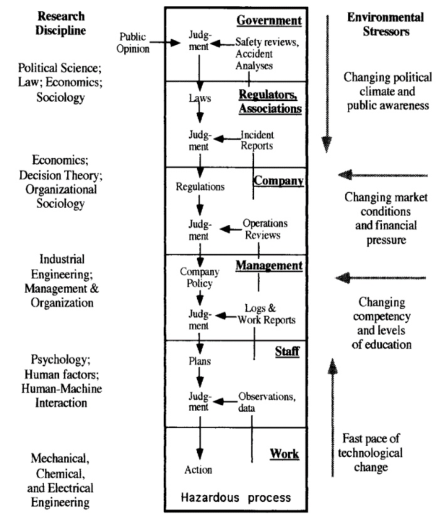
THE ACCIMAP METHODOLOGY The AcciMap methodology was developed by Rasmussen (1997) in conjunc- tion with his six-layer, hierarchical framework (Figure 1), known as risk management framework. Each layer of the framework represents a main group of involved decision-makers, players, or stakeholders in a studied sys- tem. These six layers, from top to bottom, are: government, regulators and associations, company, management, staff, and work.
This methodology captures the associated socio-technical factors of an incident within an integrated framework and analyzes the contribution of those factors in causing the incident. This graphical representation is use- ful in structuring the analyses of hazardous work systems and in identifying the interactions between different levels of decision-makers, which shape the landscape in which incidents may “unfold” themselves (Rasmussen, 1997). This characteristic avoids the unfair blame of front-line operators, since it provides a big-picture and background about events and conditions that led to incidents.
The AcciMap framework has been used for the investigation of accidents in different contexts. However, due to our knowledge, this is the first attempt to utilize this framework to systematically analyze barriers of high quality of care and patient safety in telehealth implementation.
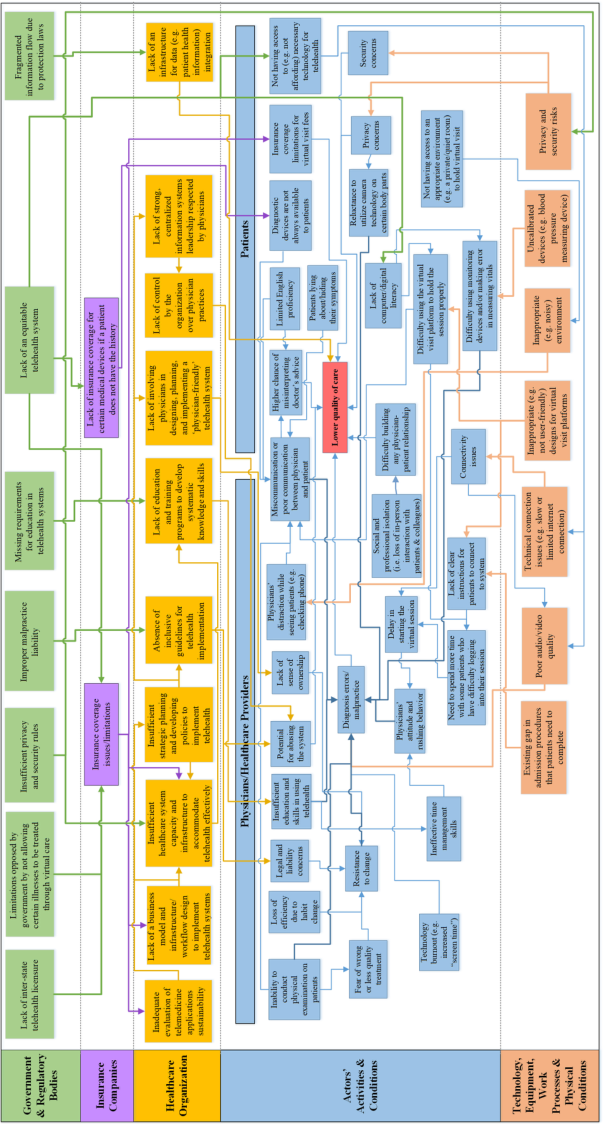
ACCIMAP FRAMEWORK TO INVESTIGATE BARRIERS OF HIGH QUALITY OF CARE IN VIRTUAL VISITS In this study, we have developed an AcciMap framework (Figure 2) to investigate barriers of high quality of care and patient safety in telehealth implementation. We have customized the layers of the AcciMap framework to the context of our problem. The modified layers from top to bottom: government and regulatory bodies; insurance companies; healthcare organi- zation; actors’ (including physicians and patients) activities and conditions; and technology, equipment, work processes, and physical conditions. In addi- tion to capturing the barriers of high quality of care in virtual visits across the layers of the framework, the interactions between those layers, each representing a main group of involved players, have been illustrated in the framework using arrows to connect the layers.
To capture the barriers of high quality of care in virtual visits, we con- ducted a comprehensive literature review using the OneSearch option pro- vided by the California State University, Northridge’s Library, which has subscriptions to several relevant databases such as PubMed, Scopus, Ovid, and ProQuest. We conducted six different searches with the keywords ‘virtual visit’, ‘virtual care’, ‘teleconsulting’, ‘telehealth’, ‘telemedicine’, and ‘digital health’ each being searched with the keyword “barriers”using an AND logic. In each search, the first keyword was searched to be “contained in title” and the second keyword to be “contained in any field”. These resulted in 19, 75, 2, 1236, 1085, and 749 search results in English, respectively. By narrowing down items to only articles, conference proceedings, book chapters, reports, and government documents published after 2000, we found 19, 72, 2, 1145, 963, and 716 search results, respectively. We further evaluated the results based on two main inclusion criteria: those that identified barriers of high quality of care and only in the context of virtual visits. We also looked at the references of the chosen articles to find more possible relevant sources. A total of 68 references were found to be suitable.
In addition to our exhaustive literature review, we were able to consult with some physicians and incorporate their opinion into our developed frame- work. We interviewed four physicians who used telehealth to see patients and received their inputs. Furthermore, we had access to the results of a survey distributed to more than 2,850 patients and caregivers by the Rare Patient Voice (2022) asking their opinion and experience with regard to telehealth barriers and facilitators. The captured barriers have not been cited in our AcciMap framework in Figure 2 due to space limitation. We, however, cited some of the references for the barriers that were explained in this section for each of the layers.
Government & Regulatory Bodies Telehealth practitioners can provide medical services across geographic bor- ders, sharing clinical expertise with patients and other health care providers. Lack of multistate licensure presents a barrier to telehealth as providers must obtain and uphold licensure in multiple states (Brooks, Turvey et al., 2013, Gajarawala and Pelkowski, 2021).
Investigating the Barriers of High Quality of Care in Virtual Visits 123
Limitations opposed by government by not allowing certain illnesses to be treated through virtual care is another barrier that have restricted patients from accessing high quality of care through telehealth. A ban on telemedicine- facilitated medication-induced abortion is an example of this barrier, which created difficulty for rural women seeking this procedure (Gajarawala and Pelkowski, 2021).
The practice of telehealth raises several questions regarding malpractice liability including informed consent, practice standards and protocols, and the provision of professional liability insurance coverage (Gajarawala and Pelkowski, 2021). Simply applying principles of malpractice liability for in- person visits to telehealth is not effective and appropriate; especially when it is unclear what the “standard of care” is in this context (Hall and McGraw, 2014).
Insurance Companies Reimbursement from telehealth services has been widely dependent on indi- vidual state policies (Rare Patient Voice, 2022). Lack of insurance coverage and reimbursement prevents or delays patients from using telehealth services. In the beginning of the COVID-19 pandemic, this was a big challenge for most entities, but over the months, it was resolved for most, but not all, cases. Moreover, providers reported that lack of insurance coverage for cer- tain medical devices if patients do not have the history is considered as a barrier in achieving high quality of care through telehealth (Moaddel, 2022; Rahimi, 2022).
Healthcare Organization In order to make telehealth applications sustainable, there should be a proper evaluation of the effectiveness of telehealth programs (Yellowlees, 2005). Lack of any business model to better analyze (economic) costs and benefits of implementing telehealth systems could lead to hesitation by healthcare orga- nizations to invest in this area (Lieneck, Weaver et al., 2021, Reeves, Ayers et al., 2021), which results in insufficient healthcare system capacity and infrastructure to accommodate telehealth effectively (Zhang, Mosier et al., 2021, Rahimi, 2022) as well as inadequate strategic planning and develop- ing policies to implement telehealth (Lieneck, Weaver et al., 2021, Kalal, Vel et al., 2022). This inadequacy can then lead to absence of inclusive guidelines for telehealth implementation (Breton, Sullivan et al., 2021, Lieneck, Weaver et al., 2021), which is another organizational barrier for high quality of care.
Moreover, lack of education and training programs to develop system- atic knowledge and skills is an organizational barriers of high quality of care (Brooks, Turvey et al., 2013, Edirippulige and Armfield, 2017, Leite, Hodgkinson et al., 2020, Zhang, Mosier et al., 2021). This factor negatively impacts physicians’ capability and skills to deliver acceptable quality of care to patients through telehealth.
Not involving enough physicians in designing, planning, and implementing a ‘physician-friendly’ telehealth system is another barrier in delivering high quality of care (Yellowlees, 2005; Moaddel, 2022) leading to lack of sense
124 Tabibzadeh and Mokhtari
of ownership for clinicians, as captured in the next layer of the AcciMap framework.
Actors’ (Physicians and Patients) Activities & Conditions Physicians/Healthcare Providers
Inability to conduct physical examination on patients during virtual visits has been a major barrier of high quality of care (Memar-Zia, 2022; Moaddel, 2022; Rahimi, 2022). Seeing patients from distance lowers the effective- ness of observing nonverbal cues and maintaining eye contact, which can lead to miscommunication between physicians and patients and misdiagnosis. Inability to examine patients has caused some fear of wrong or lesser quality treatment in physicians (Breton, Sullivan et al., 2021; Lieneck, Weaver et al., 2021).
Healthcare providers’ limited training in technology for telehealth (Lieneck, Weaver et al., 2021; Rangachari, Mushiana et al., 2021) as well as their insufficient education and skills in using it (Breton, Sullivan et al., 2021; Rangachari, Mushiana et al., 2021) are some other barri- ers in providing high quality of care, as they can lead to different issues including ineffective time management skills (Zhang, Mosier et al., 2021) and diagnosis errors (Breton, Sullivan et al., 2021; Kalal, Vel et al., 2022). This insufficient time management can then lead to physicians’ rushing behavior (Rare Patient Voice, 2022) while seeing patients virtually, which can then lead to misdiagnosis or negatively affect the quality of care.
Physicians’ distraction while seeing patients through telehealth is another barrier of high quality of care, as it can lead to miscommunication between physicians and patients. Checking phone or distraction from clinicians’ family members are examples of distraction happening during telehealth ses- sions (Memar-Zia, 2022). Patients connecting from a noisy environment can also lead to physician’s distraction and lack of focus (Reeves, Ayers et al., 2021). Healthcare providers’ burnout while delivering care through telehealth is another barrier (Memar-Zia, 2022; Moaddel, 2022). One type of burnout for healthcare providers is technology burnout. Spending longer number of hours in front of monitor makes clinicians exhausted. This negatively impacts their provided quality of care and their satisfaction is using telehealth. From another angle, some of the interviewed physicians mentioned that they have been burned out due to longer time they had to spend with each patient compared to in-person visits, as some patients liked to talk with someone due to loneliness or lack of social interactions (Moaddel, 2022; Rahimi, 2022).
Investigating the Barriers of High Quality of Care in Virtual Visits 125
Figure 2: AcciMap framework to analyze barriers of high quality of care in virtual visits.
126 Tabibzadeh and Mokhtari
Patients In addition to healthcare providers, as of a main group of actors in telehealth implementation, patients play a major role in facilitating or reducing quality of care. Miscommunication between the physician and the patient is one of the important contributing causes of misdiagnosis and/or lower quality of care in virtual visits (Breton, Sullivan et al., 2021; Lieneck, Weaver et al., 2021; Kalal, Vel et al., 2022). Different barriers such as diagnostic devices, e.g., a blood pressure measuring device, not being available to all patients (Moaddel, 2022; Rahimi, 2022), difficulty in using monitoring devices and/or making error in measuring vitals (Rahimi, 2022), not having access to an appropriate environment (e.g. a private, quiet room) to hold a virtual visit (Zhang, Mosier et al., 2021; Rare Patient Voice, 2022; Moaddel, 2022), and limited English proficiency (Moaddel, 2022; Rahimi, 2022) from patients’ side can lead to miscommunication between physicians and patients.
Moreover, patients’ lack of computer/digital literacy is a major barrier (Breton, Sullivan et al., 2021; Lieneck, Weaver et al., 2021; Zhang, Mosier et al., 2021; Kalal, Vel et al., 2022) that could lead to their difficulty using the online platform to hold their virtual session properly as well as difficulty in using monitoring devices and/or making error in measuring vitals (Rahimi, 2022).
Technology, Equipment, Work Processes, and Physical Conditions There are different barriers to high quality of care in telehealth implemen- tation that are related to technology, needed equipment, work processes, or physical conditions of the system. Inappropriate (e.g. not user-friendly or poor interface) design for virtual visit platforms is one of the major techno- logical barriers of high quality of care in this context (Agnisarman, Chalil Madathil et al., 2017; Breton, Sullivan et al., 2021; Zhang, Mosier et al., 2021). Uncalibrated devices, such as a blood pressure measuring device, is another technological barrier (Rahimi, 2022) that could lead to patients making error while measuring their vitals, which could then result in diagnosis errors. Fur- thermore, privacy and security risks due to technology-related features reduce quality of care (Hall and McGraw, 2014; Leite, Hodgkinson et al., 2020; Gajarawala and Pelkowski, 2021). Ability of companies who develop and provide digital platforms for telehealth to collect and access patients’ data in addition to healthcare providers (Hall and McGraw 2014) as well as the potential for virtual platforms to be hacked and patients’ data be exposed are two of the technological-related factors that could lead to potential privacy and/or security risks.
DISCUSSION AND RECOMMENDATIONS In addition to capturing the contributing factors of an investigated inciden- t/issue, another useful characteristic of the AcciMap framework is connecting those factors across different layers to show how different involved socio- technical factors interacted with each other in causing the incident. The
Investigating the Barriers of High Quality of Care in Virtual Visits 127
arrows in the AcciMap framework in Figure 2 illustrate the causal relation- ship between captured barriers of high quality of care across different layers and the way they are combined to produce the final negative outcome, lower quality of care in virtual visits in this context. In this way, following the arrows upward in the diagram enables us to uncover why each of the factors emerged and how those contributing factors interrelated with each other. For instance, one of contributing causes of lower quality of care is diagnosis errors in the layer of Actors’ Activities & Conditions in the AcciMap framework in Figure 2. One of the contributing causes of diagnosis errors is healthcare provider’s insufficient education and skills in using telehealth, which is cap- tured in the same layer. This can be due to lack of education and training programs to develop systematic knowledge and skills, as a factor captured in the layer of Healthcare Organization. One of the contributing causes of the lack of such programs is missing requirements for education in telehealth systems from the Government & Regulatory Bodies’ side. This way, different layers of the AcciMap framework are connected with each other manifesting different paths that contributed to the investigated negative outcome.
In this specific investigated problem, since some barriers in the lower layers cause barriers from upper layers, we also need to go downward to identify some other paths. For example, diagnosis errors from the layer of Actors’ Activities & Conditions can also be due to physicians’ attitude and rushing behavior, as a factor captured in the same layer. The rushing behavior can be caused by delays in starting the virtual session, which can be because the healthcare provider needed to spend more time with the patient who had difficulty logging into the session. A contributing cause for such difficulty is the inappropriate, e.g. not user-friendly, design of the online platform used by the patient, which is a captured barrier in the layer of Technology, Equipment, Work Processes, and Physical Conditions.
We used the tracking mechanism described above to identify the most influential barriers across each layer of the AcciMap framework. In this anal- ysis, the number of outgoing arrows from each node (captured barrier) as well as its indirect impact on lower-level elements through intermediate nodes is a representation of the node influence. Using this method of analysis, from the layer of Government & Regulatory Bodies, lack of an equitable telehealth system (Zhang, Mosier et al., 2021; Moaddel, 2022), as the first rank, and then the two barriers of lack of inter-state telehealth licensure and limita- tions opposed by government by not allowing certain illnesses to be treated through virtual care were identified as the top three influential factors in this layer. Insurance coverage limitations were the most influential barrier of high quality of care from the layer of Insurance Companies.
The two barriers of lack of any business model to better analyze costs and benefits of implementing telehealth systems and insufficient strategic planning and developing policies to implement telehealth had the highest influence in the Healthcare Organization layer. To this end, one recommen- dation is for healthcare organizations to develop a comprehensive strategic plan and related policies and procedures for telehealth implementation and allocate sufficient resources to create an infrastructure to accommodate
128 Tabibzadeh and Mokhtari
telehealth effectively. A critical component of this infrastructure is develop- ing effective education and training for healthcare providers and managers. Those programs must include adequate practical training to enable per- sonnel to develop necessary skillsets. Moreover, implementing telehealth requires changes in care delivery and workflow, which can be improved by appropriate education and training programs.
From the Actors’ Activities & Conditions layer, diagnosis error was one of the main causes of lower quality of care in virtual visits. Three of the main causes of that were healthcare providers’ insufficient education and skills in using telehealth, their inability to conduct physical examination on patients, and their attitude and rushing behavior. Among these three causes, the first one has roots in the Healthcare Organization layer, i.e. lack of education and training programs to develop systematic knowledge and skills, which was discussed above. The second cause of physicians’ inability to physically exam- ine patients is due to the nature of virtual visits, which cannot be changed. However, some recommendations can be developed for more effective virtual examination of patients. For instance, patients can take advantage of existing devices and technology in their possession, e.g. thermometer, smart phones and watches, to at least provide their physician with information on some of their vitals such as temperature and heart rate.
Finally, physicians’ rushing behavior was the third cause of diagnosis errors. This can be mainly due to two reasons: physicians’ ineffective time management skills while using telehealth and delay in starting the virtual session. The ineffective time management skills have roots in insufficient edu- cation and skills in using telehealth, which was discussed before, and delay in starting the session could be because the healthcare provider needs to spend more time with some patients to connect or because of connectivity issues. Lack of clear instructions for patients to connect to system and their difficulty using the online platform to hold the session properly are two causes that could require healthcare providers to spend more time to help them connect to their session. Connectivity issues could be because of technical connection issues, which can be due to patients not having, e.g. not affording, necessary technologies for telehealth. This was one of the main barriers stated by one of the interviewed physicians (Moaddel, 2022), which is a main concern for many patients coming from a low socio-economic background. This can be caused by the lack of an equitable telehealth system.
Lack of clear instructions for patients to enroll and connect to their vir- tual session was one of the causes that requires healthcare providers to spend more time with some patients to connect to their session. This can be due to existing gaps in admission procedures that patients need to complete or due to interface design issues, e.g. not user-friendly, in the online platform used by patients. To this end, providing clear instructions to patients on how to regis- ter for their virtual visit appointment and how to connect to the interface used to see their physician plays a critical role in effective communication between healthcare providers and patients. Moreover, designing and developing tech- nologies and interfaces that are more user-friendly is crucial for providing high quality of care. We have provided some analysis and recommendations on how to improve quality of care through the heuristic evaluations of the
Investigating the Barriers of High Quality of Care in Virtual Visits 129
user interface in telehealth in other studies (Khashe, Tabibzadeh et al., 2021; Khashe, Tabibzadeh et al., 2023).
Patients’ difficulty in using the online platform to hold their session prop- erly can be due to interface design issues or patients’ lack of digital literacy. Recommendations regarding addressing the first contributing cause were dis- cussed above. As for lack of digital literacy, lack of equitable telehealth system is a contributing cause. Providing care that is equitable is one of the ulti- mate goals of societies and healthcare delivery systems. As a matter of fact, equity is one of the six aims of quality of care according to the Institute of Medicine (2001). Achieving this goal is challenging, complex, and multidi- mensional. It also cannot happen over the night. Improving people’s digital literacy over time, offering systems and technologies that are effective yet affordable, and better reimbursement systems for patients as well as health- care providers using telehealth can improve high quality of care and lead to more equitable healthcare delivery.
CONCLUSION
Although the COVID-19 pandemic highlighted the role of telehealth in deliv- ering care and resulted in a dramatic growth in using this modality of care delivery, telehealth has continued to be used with a high rate beyond this global pandemic. Hence, ensuring high quality of care for those who receive care virtually is of paramount importance. In this study, we devel- oped an AcciMap framework to systemically analyze some of the major barriers in delivering high quality of care in virtual visits and provided some recommendations to address those barriers and enhance quality of care.
ACKNOWLEDGMENT
We would like to convey our extensive gratitude to four individuals for providing their subject matter opinion. One of them preferred to remain anonymous. We thank Dr. Majid Memar-Zia, a physician with private practice who is also affiliated with different hospitals including the Simi Val- ley Hospital; Dr. Narges Moaddel, attending physician at the ArrowHead Regional Medical’s Center, Fontana Family Health Clinic; and Dr. Maryam Rahimi, physician and Professor at the Division of Internal Medicine and Pri- mary Care, Dept. of Medicine, University of California, Irvine. Furthermore, we would like to thank the Rare Patient Voice LLC. for sharing the results of their survey with us. This work, however, should not necessarily be construed as their representative positions or be endorsed by them.
REFERENCES
Agnisarman, S. O., K. Chalil Madathil, K. Smith, A. Ashok, B. Welch and J. T. McElligott (2017). “Lessons learned from the usability assessment of home- based telemedicine systems.” Appl Ergon 58: 424–434. Bestsennyy, O., G. Gilbert, A. Harris and J. Rost (2021, July 9) “Telehealth: A
quarter-trillion-dollar post-COVI-19 reality?”.
130 Tabibzadeh and Mokhtari
Breton, M., E. E. Sullivan, N. Deville-Stoetzel, D. McKinstry, M. DePuccio, A. Sriharan, V. Deslauriers, A. Dong and A. S. McAlearney (2021). “Telehealth challenges during COVID-19 as reported by primary healthcare physicians in Quebec and Massachusetts.” BMC Fam Pract 22(1): 192. Brooks, E., C. Turvey and E. F. Augusterfer (2013). “Provider barriers to telemen-
tal health: Obstacles overcome, obstacles remaining.” Telemed J E Health 19(6): 433–437. Edirippulige, S. and N. R. Armfield (2017). “Education and training to support the use of clinical telehealth: A review of the literature.” J Telemed Telecare 23(2): 273–282. Editorial (2021). Telehealth is here to stay. Nat Med. United States. 27: 1121. Gajarawala, S. N. and J. N. Pelkowski (2021). “Telehealth Benefits and Barriers.”
The journal for nurse practitioners : JNP 17(2): 218–221. Hall, J. L. and D. McGraw (2014). “For Telehealth To Succeed, Privacy And Security Risks Must Be Identified And Addressed.” Health Affairs 33(2): 216–221. HHS Issue Brief (2020, July 28). Medicare Beneficiary Use of Telehealth Visits: Early
Data from the Start of the COVID-19 pandemic, Office of the Assistant Secretary for Planning and Evaluation. Department of Health and Human Services (HHS). Institute of Medicine Committee on Quality of Health Care in, A. (2001). Crossing the Quality Chasm: A New Health System for the 21st Century. Washington (DC), National Academies Press (US). Copyright 2001 by the National Academy of Sciences. All rights reserved. Kalal, N., N. Vel, S. Mundel, S. Daiyya, S. Dhayal, S. Bishnoi, S. Asiwal and
S. Jhajhariya (2022). “Effectiveness and barriers of telehealth services during COVID-19 pandemic: A narrative review.” Indian Journal of Medical Specialities 13(1): 4–8. Khashe, Y., M. Tabibzadeh and N. Meshkati (2023). “Improving quality of care for patients receiving care through telehealth in the time of COVID-19 global pandemic and beyond: HCI-based leading indicators for virtual visits.” Human Factors in Healthcare 4: 100050. Khashe, Y., M. Tabibzadeh and D. Zhou (2021). “Improving Quality of Care in Vir-
tual Visits: Heuristic Evaluations of the User Interface in Telehealth.” Proceedings of the Human Factors and Ergonomics Society Annual Meeting 5(1): 1347–1351. Leite, H., I. R. Hodgkinson and T. Gruber (2020). “New development: ‘Healing at a distance’—telemedicine and COVID-19.” Public Money & Management 40(6): 483–485. Lieneck, C., E. Weaver and T. Maryon (2021). “Outpatient Telehealth Implementa-
tion in the United States during the COVID-19 Global Pandemic: A Systematic Review.” Medicina (Kaunas) 57(5). Memar-Zia, M. (February 7, 2022). Personal Communication. Physician with Private Practice and also affiliated with hospitals such as the Simi Valley Hospital, CA. Moaddel, N. (February 12, 2022). Personal Communication. Attending Physician,
ArrowHead Regional Medical’s Center, Fontana Family Health Clinic. Rahimi, M. (March 9, 2022). Personal Communication. Physician and Professor, Division of Internal Medicine and Primary Care, Department of Medicine, University of California, Irvine School of Medicine. Rangachari, P., S. S. Mushiana and K. Herbert (2021). “A Narrative Review of Fac-
tors Historically Influencing Telehealth Use across Six Medical Specialties in the United States.” Int J Environ Res Public Health 18(9). Rare Patient Voice (2022). Survey results of users’ experience with telehealth. R. P.
V. LLC.
Investigating the Barriers of High Quality of Care in Virtual Visits 131
Rasmussen, J. (1997). “Risk management in a dynamic society: A modelling problem.” Safety Science 27(2–3): 183–213. Reeves, J. J., J. W. Ayers and C. A. Longhurst (2021). “Telehealth in the COVID-19
Era: A Balancing Act to Avoid Harm.” J Med Internet Res 3(2): e24785. Yellowlees, P. M. (2005). “Successfully developing a telemedicine system.” J Telemed Telecare 11(7): 331–335. Zhang, T., J. Mosier and V. Subbian (2021). “Identifying Barriers to and Opportu-
nities for Telehealth Implementation Amidst the COVID-19 Pandemic by Using a Human Factors Approach: A Leap Into the Future of Health Care Delivery?” JMIR Hum Factors 8(2): e24860.
LISTED IN THE AHFE DIGITAL BOOKSTORE CATALOGUE
Explore the complete digital volume
Healthcare and Medical Devices
Read this individual research paper free through the original publisher, or explore the full digital proceedings book.
ISBN 978-1-964867-06-9
Explore this ISBN in the AHFE Bookstore ↗Listed in the July 2026 bookstore catalogue; search by ISBN to confirm current availability · Digital book purchase optional