Ramona Schmid, Sophia Maria Saat, Knut Möller, Verena Wagner-Hartl (2023). Induction method influence on emotion recognition based on psychophysiological parameters. In: Intelligent Human Systems Integration (IHSI 2023): Integrating People and Intelligent Systems. AHFE Open Access, vol. 69, pp. 319–329. https://doi.org/10.54941/ahfe1002851
Recognizing emotions is an essential ability in our daily social interactions. However, there are individuals who have difficulties interpreting emotions, such as patients with autism spectrum disorders (ASD). In order to cope better with everyday life, emotion training can be a supporting factor for them. However, studies show that emotion training is not only helpful for patients with ASD, but also in the working environment, for example in trainings for managers or teams. In recent research, there are already approaches to use new technologies such as virtual reality to train emotional and social skills. For the evaluation of these new concepts, it is important to make the emotional state of a person measurable. Therefore, a measurement environment has already been developed at Furtwangen University. This is based on a multidimensional approach combining subjective and objective psychophysiological measures. Moreover, the development of facial emotion recognition (FER) systems based on machine learning techniques are also increasing for measuring a person's emotional state. Often, they focus on the recognition of Ekman’s basic emotions. To train and evaluate such FER systems, these basic emotions have to be induced in an individual. Therefore, a number of methods for emotion induction can be found in research, e.g. visual stimuli or mental methods. However, in most studies, only a few selected emotions, such as anger and happiness, were induced. Thus, there is a lack of studies that examined the induction of all six basic emotions.For that reason, the aim of the presented experimental study was to investigate two different methods of emotion induction for the six basic emotions anger, disgust, fear, happiness, sadness, surprise, and a neutral category. Overall, 14 women and 10 men (N = 24) aged between 19 and 59 years (M = 29.25, SD = 11.46) participated in the study. For the first induction method, affective visual stimuli from common emotional picture databases (EmoPicS, OASIS and IAPS) were used. For the second induction method, emotions were induced by a so-called autobiographical recall. Therefore, the participants had to imagine autobiographical situations that evoked the required emotion in them in the past. After each different induction of one of the six emotions or the neutral category, the participants’ emotional state was assessed using the two dimensions valence and arousal of the Self-Assessment Manikin (SAM). Furthermore, cardiovascular (ECG) and electrodermal (EDA) activity were recorded. The results show a significant interaction induction method x emotional category for both subjective assessments valence and arousal. Furthermore, based on the results of the psychophysiological responses of the participants (ECG and EDA), it is shown that the second method to induce emotions (autobiographical recall) was significantly more arousing than the first induction method using visual stimuli. To sum it up, the results of the experimental study show an influence of the induction method that is evident in both the subjective and the psychophysiological parameters.
Recognizing emotions is an essential ability in our daily social interactions. However, there are individuals who have difficulties interpreting emotions, such as patients with autism spectrum disorders (ASD; Hartl, 2010). In order to cope better with everyday life, emotion training can be a supporting factor for them (Golan et al., 2010; Kandalaft et al., 2013; Yuan and Ip, 2018). However, emotion training is not only helpful for patients with ASD, but also in the working environment, for example in trainings for managers or teams. Studies have shown that emotion training improves interpersonal effective- ness (Schlegel and Hall, 2021) and negotiation outcomes (Elfenbein et al., 2007). Furthermore, Meléndez et al. (2020) showed that reduced social inte- ractions (e.g., restrictions due to the COVID-19 pandemic) can affect our
ability to recognize emotional facial expressions. In recent research, there are already approaches to use new technologies, such as virtual reality, to train emotional and social skills (Kandalaft et al., 2013; Yuan and Ip, 2018). In addition, the development of facial emotion recognition (FER) systems based on machine learning techniques is increasing (e.g., Arabian et al., 2021; 2022). These systems mostly focus on the recognition of the following six basic emotions that have been examined in numerous researches by Ekman and colleagues (e.g., Ekman et al., 1969; Ekman, 1970, 1992): anger, disgust, fear, happiness, sadness and surprise. For training FER algorithms, databases containing facial expressions of these six basic emotions and in addition neu- tral expressions, are often used (e.g., Arabian et al., 2022 using the database Japanese Female Facial Expressions, JAFFE; Lyons et al., 2020).
To investigate and evaluate such facial emotion recognition systems, it is important to induce the basic emotions in an individual. Therefore, a num- ber of induction methods can be found in research. For example, Siedlecka and Denson (2019) reviewed different emotion induction methods for basic emotions. Their results showed that studies often investigate only a few sele- cted emotions from the six basic emotions, e.g., happiness, sadness and fear (Baumgartner et al., 2006; Schmid et al., 2022) or anger and disgust (Dasgu- pta et al., 2009). As a consequence, there is a lack of studies that examined the emotion induction of all six basic emotions. Following Siedlecka and Den- son (2019), the most common methods to induce emotions are visual stimuli, music, autobiographical recall, situational procedures, and imagery. Accor- dingly, visual stimuli are most effective to induce all six basic emotions. Thus, a number of standardized sets of emotionally salient pictures have been deve- loped in emotion research (e.g., Lang et al., 1997; Wessa et al., 2010; Kurdi et al., 2017). As mentioned before, another induction method is the so-called autobiographical recall (Siedlecka and Denson, 2019). Here, participants are asked to recall emotional situations from their everyday life as clearly and vividly as possible (Ozawa, 2021). Following the review of Siedlecka and Denson (2019), this method seems to be highly effective for the basic emo- tions anger, happiness, fear, disgust, and sadness, but less effective to induce the emotion surprise.
One of the greatest challenges in emotion research is to make a person’s emotional reaction measurable (Frenzel et al., 2009). On the one hand, there are interviews and questionnaires to capture the subjective emotional state of a person (e.g., Bradley and Lang, 1994). On the other hand, psychophysi- ological measures can be used (Boucsein and Backs, 2000). Based on former research of Boucsein and colleagues (Boucsein et al., 2002; Boucsein and Schaefer, 2008), our research group developed (Birkle et al., 2022) and vali- dated (Schmid et al., 2022) a concept for a multidimensional measurement environment which combines subjective assessments and objective psycho- physiological measures. Within this first validation study pictures were used as visual stimuli to induce different emotions. First results show significant differences regarding the subjective assessment of the dimension valence but not regarding the dimension arousal. However, no significant effects can be shown in the psychophysiological parameters. Therefore, the authors sugge- sted to find out if other induction methods would be more suitable to induce
Induction Method Influence on Emotion Recognition Based 321
emotions than the used visual stimuli. Furthermore, only the four emotions happiness, serenity, sadness and fear were used in the first validation study (Schmid et al., 2022).
For this purpose, the aim of the presented study was to investigate two different methods of emotion induction (visual stimuli and autobiographical recall) for the six basic emotions anger, disgust, fear, happiness, sadness, and surprise, as well as for a neutral category.
METHOD
A laboratory experiment with repeated measures was chosen for this study. Overall, the experiment consisted of two different parts: First the induction of emotions via visual stimuli and autobiographical recall (presented within this paper) and second a more exploratory part, using virtual reality to induce emotions (not presented within this paper).
Participants Overall, 24 participants (14 female, 10 male) participated in the study. The participants were between 19 and 59 years old (M = 29.25, SD = 11.46). They took part in the study voluntarily and received no compensation. All participants provided their informed consent at the beginning of the study. The study was approved by the ethics committee of the Furtwangen University.
Materials
Two different emotion induction methods (visual stimuli and autobiogra- phical recall) were used to induce the basic emotions: anger, disgust, fear, happiness, sadness, surprise, and an additional neutral emotion. Regarding the first induction method “visual stimuli”, affective pictures from the fol- lowing emotional picture databases were used: The International Affective Picture System (IAPS; Lang et al., 1997), the Emotional Picture Dataset (EmoPicS; Wessa et al., 2010) and the Open Affective Standardized Image Set (OASIS; Kurdi et al., 2017). Four pictures were selected for each of the seven emotional categories. For the second induction method “autobiograph- ical recall”, participants were asked to imagine past situations of their daily life in which they had felt the targeted emotion. Therefore, the following instruction (given in German) based on Ozawa (2021) was first presented to the participants: “In the next step, you will be asked to recall emotional interpersonal events in daily life as clearly and vividly as possible. You will not be asked for the recalled contents.” Afterwards, each different emotio- nal category was introduced by: “Please think now of a situation in which you felt _____ (emotion e.g., sad). Now please try to recall the situation for 30 seconds.” All written instructions as well as the affective pictures (only first induction method) were presented on a 23-inch HP screen at a distance of 50 cm.
Subjective Measurement The two dimensions valence and arousal of the Self-Assessment Manikin (SAM; 9-point scale based on pictograms; Bradley and Lang, 1994) were used to measure the participants’ emotional state subjectively. Furthermore, additional items based on Ozawa (2021) were used for an emotion characteri- zation, providing more detailed information about the emotions actually felt by the participants. After every induced emotion, participants were asked to assess [6-point scale from “not at all” (1) to “very” (6)] to what extent they felt each of the six basic emotions as well as “neutral” or “other emotions”. For example, how strongly disgust was subjectively assessed, if the condition disgust was actually examined. All subjective assessments were performed on a Samsung Galaxy Tab A tablet using an online survey tool (Unipark, 2022).
Psychophysiological Measurement As objective psychophysiological parameters, cardiovascular (ECG) and ele- ctrodermal activity (EDA) were recorded. For this, systems of Movisens (Movisens, 2022a, 2022b) were used. The ECG sensor was attached on a chest strap. Electrodermal activity, was recorded on the inner palm (thenar and hypothenar) of the participants’ non-dominant hand. The following mea- sures were used for the statistical analysis: heart rate (HR) in beats per minute and heart rate variability (HRV RMSSD) regarding cardiovascular activity as well as skin conductance level (SCL), amplitude of non-specific electrodermal responses (NS.SCR amp), frequency of non-specific electrodermal responses (NS.SCR freq) and mean sum amplitude (NS.SCR amp/NS.SCR freq) as para- meters of the electrodermal activity. A baseline correction has been done for all measured psychophysiological parameters.
Procedure After a short briefing of the participants, they provided their informed consent and socio-demographic data. Afterwards, the electrodes for the psychophysiological measurements were attached and an electrode check, followed by a baseline measurement of four minutes was performed. After that, the phase in which the different emotions were induced took place. The- refore, the six emotional categories anger, disgust, fear, happiness, sadness, surprise, and the neutral category were conducted.
Within an emotional category, emotion induction was first performed with visual stimuli. The affective pictures (Lang et al., 1997; Wessa et al., 2010; Kurdi et al., 2017) were presented in blocks of 30 seconds. Within each block, four different pictures were used (presentation time of each picture: 7.5s). After the emotion induction, participants had to assess its valence and arousal (SAM; Bradley and Lang, 1994). Subsequently, the items for emo- tion characterization regarding the actual emotion felt were presented. This was followed by a resting measurement of one minute. After the induction with “visual stimuli”, the procedure was repeated for the second method “autobiographical recall”. The seven emotional categories were presented in a permuted order to avoid effects caused by the order of the different emotions. The sequence within an emotional category was maintained: First
Induction Method Influence on Emotion Recognition Based 323
“visual stimuli”, then “autobiographical recall”. After the last rest measu- rement, a break was taken. Afterwards, the second part of the study using virtual reality followed (not presented within this paper). At the end of the study, the sensors of the psychophysiological measurements were removed. Each participant needed about 90 minutes to complete the study.
Statistical Analysis The software IBM SPSS Statistics was used for the statistical analyses. Analy- ses of variance with repeated measures were performed for calculating the results. The statistical analyses were based on a significance level of 5%.
RESULTS
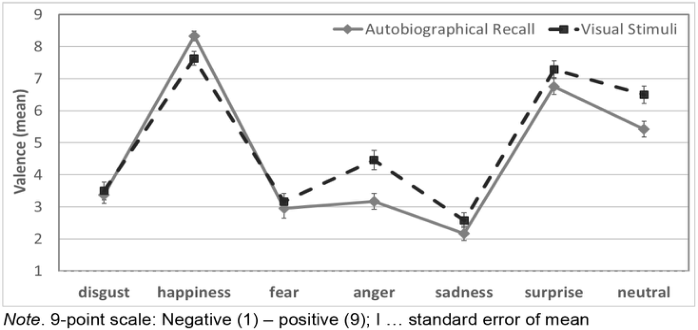
Subjective Measures Following, the results of the dimension valence (see also Fig. 1) a significant interaction induction method x emotional category, F(6, 18) = 6.36, p < .001, η2part. = .680, a significant main effect induction method, F(1, 23) = 6.23, p = .020, η2part. = .213, and a significant main effect emotional category, FGG(3.43, 78.94) = 138.07, p < .001, η2part. = .857, can be shown.
Figure 1: Valence of different emotional categories induced by different induction methods.
The results of post-hoc analyses (Sidak) for the interaction induction method x emotional category show, mainly significant differences regarding the valence of the different assessed emotional categories for both induction methods (p ≤.05) with the expectation of the following: Happiness and surprise (p < .001) as well as surprise and neutral (p = .012) only show a significant difference in the subjectively perceived valence for the indu- ction method autobiographical recall. In contrast, the perceived valence of anger and fear (p = .031) was assessed significant different for the induction method visual stimuli. For both induction methods, disgust compared to fear (visual stimuli - vs: p = 1.000; autobiographical recall - ar: p = .999) and
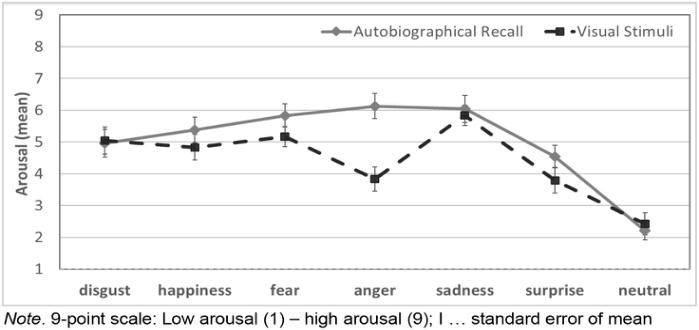
Figure 2: Arousal of different emotional categories induced by different induction methods.
compared to anger (vs: p = .066; ar: p = 1.000) as well as fear compared to sadness (vs: p = .146; ar: p = .065), were not rated significant different regar- ding their perceived valence. Furthermore, the emotion induction with visual stimuli was assessed significantly more positive for the emotion category anger (p = .003) as well as for the neutral category (p = .002) than indu- ction by autobiographical recall. On the other hand, the category happiness (p < .001) was assessed significantly more positive using the autobiographical recall method than the visual stimuli.
Regarding the dimension arousal a significant interaction induction method x emotional category, FGG(3.34, 76.70) = 4.94, p = .002, η2part. = .177, a significant main effect induction method, F(1, 23) = 22.32, p < .001, η2part. = .493, and a significant main effect emotional category, FGG(3.90, 89.69) = 17.92, p < .001, η2part. = .438, can be shown (see also Fig. 2).
Following the results of post-hoc analyses (Sidak) for the interaction induction method x emotional category, the emotion category sadness was subjectively perceived as significantly more arousing than anger (p = .034) and surprise (p = .015), as well as happiness was significantly more arou- sing than surprise (p = .023) when inducing with visual stimuli. Using the induction method autobiographical recall results in subjectively percei- ved significant more arousal for the emotion category anger than surprise (p = .025). In addition, the subjectively perceived arousal of the neutral category was assessed as significantly less arousing than all other emotio- nal categories (p < .001) when inducing by autobiographical recall. When inducing with visual stimuli, the neutral category was also assessed as signifi- cantly less arousing than all other emotional categories (p < .010), except the emotion category anger (p = .203). Additionally, it is shown that the emotion induction by autobiographical recall reveals significantly higher arousal for the emotion categories happiness (p = .025), anger (p < .001) and surprise (p = .047) than emotion induction with visual stimuli.
Induction Method Influence on Emotion Recognition Based 325
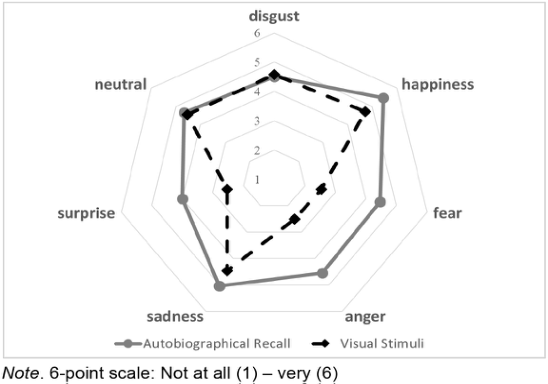
Figure 3: Subjective emotion characterization of different emotional categories indu- ced by different methods.
As described in the method section, the participants were further asked to what extent they felt one of the six basic emotions, other emotions or “neutral” during the different induced emotional categories. The results of these subjective emotion characterizations for the particular categories of both induction methods are shown in Figure 3.
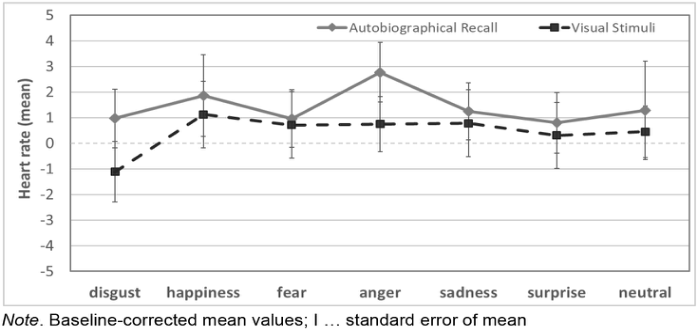
Psychophysiological Measures The psychophysiological results show significant differences of the cardiova- scular activity for the parameter heart rate (HR) regarding the different used induction methods, F(1, 22) = 5.44, p = .029, η2part. = .198 (see also Fig. 4).
Figure 4: Heart rate (HR) of different emotional categories induced by different methods.
Overall, the heart rate of the participants was significantly higher when indu- cing emotions with the induction method autobiographical recall than using visual stimuli. However, no significant interaction induction method x emo- tion category, FGG(3.52, 77.37) = .54, p = .684, η2part. = .024 and no significant main effect emotion category, FGG(3.54, 77.80) = .88, p = .468, η2part. = .039 can be shown. Furthermore, the results of the analyses of all other psychophysiological measures used within this study did not reach the level of significance.
DISCUSSION
The aim of the study was to investigate the two emotion induction meth- ods “visual stimuli” and “autobiographical recall” regarding the six basic emotions anger, disgust, fear, happiness, sadness, surprise, and an additio- nal neutral category. Therefore, a multidimensional measurement environ- ment combining subjective assessments and psychophysiological parameters was used. The results show a significant interaction induction method x emotional category for both subjective assessments valence and arousal. It was also shown that the emotion categories were, for the most part, assessed significantly different regarding their valence and significantly higher regarding their arousal compared to the neutral emotional category. Therefore, a successful emotion induction using the two induction methods visual stimuli and autobiographical recall can be concluded. Furthermore, the results of the subjectively perceived arousal of the participants show that the induction method autobiographical recall was significantly more arousing for the emotional categories happiness, anger and surprise than the visual stimuli. This is in line with the descriptive results of the emotion characteri- zation, which showed that the emotions were induced more strongly by the autobiographical recall method (except disgust). Also, the results regarding one psychophysiological parameter of the cardiovascular activity of the par- ticipants, the heart rate (HR), showed that the autobiographical recall was significantly more arousing than the visual stimuli. Interestingly, in addition, a tendency towards significance that supports this result can also be shown for one parameter of the electrodermal activity, the skin conductance level (SCL), F(1, 22) = 3.26, p = .085, η2part. = .129.
When inducing emotions with visual stimuli, only anger does not show significantly higher arousal in the subjective assessment than the neutral category. This is also consistent with the descriptive results of the emotion characterization, in which anger was the least matched emotion by the visual material used. Following the descriptive results of the emotion characteriza- tion, it can be assumed that the emotion categories disgust, happiness, sadness and the neutral category were adequately induced by both methods visual sti- muli and autobiographical recall, whereas the emotion categories fear, anger and surprise seem to be induced less well using visual stimuli than the method autobiographical recall. It is interesting to note that in contrast to the review of Siedlecka and Denson (2019), the emotional category surprise was induced effectively with autobiographical recall even better than with visual stimuli. This may also be influenced by the visual material used which was maybe not
Induction Method Influence on Emotion Recognition Based 327
strong enough to induce the targeted emotions. In addition, the visual mate- rial from the standardized databases is often labelled only with valence and arousal values, but not for specific emotions. Another explanation could be that inducing emotions by autobiographical recall may have the advantage that participants remember a situation in which they actually felt the intended emotion, whereas when inducing emotions with visual stimuli it is possible that the used visual material induces other emotions than those that were actually intended. For example, a picture of a wedding that targets happiness may also induce negative emotions due to the person’s previous experiences.
Another limitation of the presented study is that the visual stimuli method has been consistently performed before the autobiographical recall method. To avoid post-effects of the visual stimuli, the subjective assessments and a rest measurement were performed after each trial. Nevertheless, it cannot be excluded that the visual stimuli already immersed the participants more dee- ply in the emotion that was to be recalled afterwards and therefore evoked stronger emotional reactions in the autobiographical recall conditions. The- refore, in future research, a possible effect of the sequence of the induction method should be eliminated.
To sum it up, the results of the experimental study show an influe- nce of the induction method that is evident in both the subjective and the psychophysiological parameters.
ACKNOWLEDGMENT AND AUTHOR’S STATEMENT The authors would like to thank Katharina Gleichauf and Jonas Birkle for their support as well as all study participants. The authors state no conflict of interest. Informed consent has been provided from all participants. The study was approved by the ethics committee of the Furtwangen University.
REFERENCES
Arabian, H., Wagner-Hartl, V., Geoffrey Chase, J., Moller, K. (2021) Facial Emotion Recognition Focused on Descriptive Region Segmentation. Annual Internatio- nal Conference of the IEEE Engineering in Medicine and Biology Society 2021, 3415–3418. Arabian, H., Wagner-Hartl, V., Moeller, K. (2022) Transfer Learning in Facial
Emotion Recognition: Useful or Misleading? Current Directions in Biomedical Engineering 8 (2), 668–671. Baumgartner, T., Esslen, M., Jäncke, L. (2006) From emotion perception to emotion experience: Emotions evoked by pictures and classical music. International Journal of Psychophysiology 60 (1), 34–43. Birkle, J., Weber, R., Möller, K., Wagner-Hartl, V. (2022). “Psychophysiological
Parameters for Emotion recognition – Conception and first evaluation of a mea- surement environment”, in: Intelligent Human Systems Integration (IHSI 2022). AHFE International. Boucsein, W., Backs, R. W. (2000). “Engineering Psychophysiology as a Discipline: Historical and Theoretical Aspects”, in: Backs, R. W., Boucsein, W. (Eds.). Engi- neering psychophysiology: Issues and Applications. CRC Press, Taylor & Francis Group, Boca Raton, FL, pp. 3–30.
Boucsein, W., Schaefer, F. (2008). “Objective Emotional Assessment of Industrial Products”, in: Probing Experience. Springer, Dordrecht, pp. 69–76. Boucsein, W., Schaefer, F., Kefel, M., Busch, P., Eisfeld, W. (2002) Objective emotional
assessment of tactile hair properties and their modulation by different product worlds. International Journal of Cosmetic Science 24 (3), 135–150. Bradley, M. M., Lang, P. J. (1994) Measuring emotion: The self-assessment manikin and the semantic differential. J. Behav. Ther. Exp. Psychiatry 25 (1), 49–59. Dasgupta, N., DeSteno, D., Williams, L. A., Hunsinger, M. (2009) Fanning the flames
of prejudice: the influence of specific incidental emotions on implicit prejudice. Emotion 9 (4), 585–591. Ekman, P. (1970) Universal facial expressions of emotion. California Mental Health Research Digest 8 (4), 151–158. Ekman, P. (1992) Facial Expressions of Emotion: New Findings, New Questions.
Psychological Science 3 (1), 34–38. Ekman, P., Sorenson, E. R., Friesen, W. V. (1969) Pan-cultural elements in facial displays of emotion. Science 164 (3875), 86–88. Elfenbein, H. A., Foo, M. D., White, J., Tan, H. H., Aik, V. C. (2007) Reading your
Counterpart: The Benefit of Emotion Recognition Accuracy for Effectiveness in Negotiation. Journal of Nonverbal Behavior 31 (4), 205–223. Frenzel, A. C., Götz, T., Pekrun, R. (2009). “Emotionen” [“Emotions”], in: Wild, E., Möller, J. (Eds.). Pädagogische Psychologie. Springer, Berlin, Heidelberg, pp. 205–231. Golan, O., Ashwin, E., Granader, Y. et al. (2010) Enhancing emotion recognition in
children with autism spectrum conditions: an intervention using animated vehicles with real emotional faces. J Autism Dev Disord 40 (3), 269–279. Hartl, M. (2010) Emotionen und affektives Erleben bei Menschen mit Autismus [Emotions and affective experience in people with autism], 1st edn. VS Verlag für Sozialwissenschaften, Springer, Wiesbaden. Kandalaft, M. R., Didehbani, N., Krawczyk, D. C., Allen, T. T., Cha- pman, S. B. (2013) Virtual reality social cognition training for young adults with high-functioning autism. Journal of Autism and Developmental Disor- ders 43 (1), 34–44. Kurdi, B., Lozano, S., Banaji, M. R. (2017) Introducing the Open Affective
Standardized Image Set (OASIS). Behavior research methods 49 (2), 457–470. Lang, P. J., Bradley, M. M., Cuthbert, B. N. (1997) International Affective Picture System (IAPS): Technical Manual and Affective Ratings. NIMH Center for the Study of Emotion and Attention 1 (39-58), 3. Lyons, M. J., Kamachi, M., Gyoba, J. (2020) Coding Facial Expressions with Gabor
Wavelets (IVC Special Issue). arXiv, 2009.05938. Meléndez, J. C., Satorres, E., Reyes-Olmedo, M., Delhom, I., Real, E., Lora, Y.
(2020) Emotion recognition changes in a confinement situation due to COVID-19. Journal of Environmental Psychology 72, 101518. Movisens (2022a) EcgMove 4 – ECG and Activity Sensor. Movisens GmbH. Movisens (2022b) EdaMove 4 – EDA and Activity Sensor. Movisens GmbH. Ozawa, S. (2021) Emotions Induced by Recalling Memories About Interpersonal Stress. Frontiers in psychology 12, 618676. Schlegel, K., Hall, J. A. (2021) The Effects of Emotion Recognition Training
on Interpersonal Effectiveness. Basic and Applied Social Psychology 43 (2), 141–153.
Induction Method Influence on Emotion Recognition Based 329
Schmid, R., Braunmiller, L., Hansen, L., Schonert, C., Möller, K., Wagner-Hartl, V.
(2022). “Emotion recognition - Validation of a measurement environment based on psychophysiological parameters”, in: Intelligent Human Systems Integration (IHSI 2022). AHFE International. Siedlecka, E., Denson, T. F. (2019) Experimental Methods for Inducing Basic Emotions: A Qualitative Review. Emotion Review 11 (1), 87–97. Unipark (2022) Survey-Software. Tivian XI GmbH. Wessa, M., Kanske, P., Neumeister, P., Bode, K., Heissler, J., Schönfelder, S. (2010)
EmoPics: Subjektive und psychophysiologische Evaluation neuen Bildmaterials für die klinisch-bio-psychologische Forschung [EmoPics: Subjective and psych- ophysiological evaluation of new visual material for clinical-bio-psychological research]. Z Klin Psychol Psychother 39 (Suppl. 1/11), 77. Yuan, S. N. V., Ip, H. H. S. (2018) Using virtual reality to train emotional and social skills in children with autism spectrum disorder. Lond. J. Prim. Care 10 (4), 110–112.
LISTED IN THE AHFE DIGITAL BOOKSTORE CATALOGUE
Explore the complete digital volume
Intelligent Human Systems Integration (IHSI 2023): Integrating People and Intelligent Systems
Read this individual research paper free through the original publisher, or explore the full digital proceedings book.
ISBN 978-1-958651-45-2
Explore this ISBN in the AHFE Bookstore ↗Listed in the July 2026 bookstore catalogue; search by ISBN to confirm current availability · Digital book purchase optional