Hermann Prossinger, Nikola Geciova, Miroslav Horvath, Jakub Binter, Eliska Cempirkova (2023). How the Ones in Need Solve Financial Problems in Times of Crisis? The Implication for Government Support Programs. In: Human Interaction & Emerging Technologies (IHIET 2023): Artificial Intelligence & Future Applications. AHFE Open Access, vol. 111, pp. 893–901. https://doi.org/10.54941/ahfe1004098
After the COVID-19 pandemic ended the war between Ukraine and Russia resulted in further price increases and a decrease in the quality of living of many Europeans. Many groups of citizens must be able to survive on meagre resources — despite being located thousands of kilometers from the war-zone. The two most affected groups are senior citizens and single parents who oftentimes do not have sufficient savings. The government provides financial support (e.g. housing allowance) to those in need after their successfully filling out application forms and proving their crisis situations. These are reviewed for eligibility by the Labor Employment Office. There are several problems inherent in this bureaucratic procedure. Among these are: complex jurisdictional language, external reference requirements, and lengthy forms. All these force — willingly or unwillingly — the individuals to either avoid or fail the application process. In order to investigate statistics aspects of the avoidance aspect of this state of affairs, we collected data from Czech citizens via an online questionnaire at the end of 2022. The questions were specifically aimed at understanding the potential applicants' mechanisms of dealing with their financial crises. We queried respondents' ratings to nine queries about their financial strategies (taking out a loan, use of savings, etc.) and two about their income. All responses were categorical variables.We constructed a contingency matrix and performed a correspondence analysis. This method shows associations, replacing the often-times used erroneous approach of looking for correlations (which do not exist for categorical variables). Furthermore, we can find an a priori unknown number of associations and the fraction of statistical noise in the contingency matrix. We use a clustering algorithm ('spectral' clustering) to find the number of possible associations and construction of concave hulls to aid in analyzing these.We find: (a) the associations explain 91.9% of the square of the Frobenius norm of the contingency matrix; (b) nine queries associate (in four clusters) for certain response categories; (c) two queries do not associate (one is independent of response categories); and (d) one query associates with only one response query.The implications of these associations are as follows: (a) all respondents intend to decrease their outlays; (b) those who earn between 20 and 30 thousand CZK are hesitant to ask for government support; (c) the participants would rather not borrow money from family, bank, nor sell their valuables; (d) the rejection of possible non-bank loans associates with the rejection of selling a property; (e) reliance on savings does not associate with any other query, nor does total household income — nor does finding an extra job. Application of our findings are twofold. First, we see that the strongest statistical signal does not provide support for an association between personal or family income and the proffered solution of government support. Second, the associations we found indicate a crucial and ominous rejection of the Czech government's strategy and expectations. Specifically, we suggest a remedial strategy of matching the application process with the linguistic accessibility of low-income citizens.
Even after the COVID-19 pandemic (essentially) ended and while the war between Ukraine and Russia raged, price increases resulted in a decrease in the quality of living for many Europeans. Several groups of citizens must be able to survive on meagre resources — despite being located thousands of kilometers from the war-zone. The two most affected groups are senior citizens and single parents, who oftentimes do not have sufficient savings and limited possibilities to find other income sources (due to time constrains and their limited physical or mental abilities).
Further problems are language, numerical literacy, digital competence, and bureaucratic hurdles. As our research results show (below), illiteracies are highly predictive of low income but also of group members’ inabilities to
apply for government support, namely housing and child-rearing allowance (Döring; 2021).
The North Bohemia region — specifically, the city Usti nad Labem — is typical. It is characterized by the aforementioned difficulties: extremely low levels of both literacy and numeracy of many inhabitants. In 2022, the num- ber of citizens that were eligible for government support in this area increased by almost 20%, yet the number who applied for it did not. Granted, the capacity of the Employment Offices was insufficient long before the above described situation arose. The linguistic challenges posed by the application forms (written in legalese Czech) as well as the far from satisfactory interac- tions with the administrative personnel (underpaid and risking burnout) are two further reasons that lead these citizens to explore alternative ways to deal with their dire situation. They specifically complained that the application forms use precise, legal, but applicant-unfriendly language, require detailed descriptions, and request an inordinate multitude of information, some of it to be entered multiple times. As a result, most of these citizens have chosen to avoid the application process. Some alternatives include finding an extra job, applying for loans, or selling possessions (foremost personal valuables and/or property).
Furthermore, the online environment poses complications to digitally illit- erate individuals; much-needed help-lines are far-too-often occupied (‘busy’) and, when they are finally available, the help/advice is perceived by the help-seekers as inadequate.
We approached this convolute of problems by asking these citizens about their own perceptions and planned actions; we also used their scores equiv- alent to the end of primary school as proxies for their language competence and their (elementary-school-level) numeracy. This paper communicates some of our findings.
MATERIALS AND METHODS
We used the online data collection tool Qualtrics and online advertisements as well as several databases to contact prospective participants. Those who did not finish the query process were removed from the sample; our pilot data set comprises 47 completed questionnaires: 8 males, aged 31–70 years and 39 females, aged 20–77 years.
The queries and questions were specifically aimed at understanding the potential applicants’ plans for dealing with their financial crises. We collected respondents’ responses to nine queries about their financial strategies (taking out a loan, use of savings, etc.), two about their income, and two about their linguistic command of Czech and their numeracy (Table 1). The Czech liter- acy and (math) numeracy were indicators of elementary school proficiency and were tested online; the correctness of the responses resulted in a com- puted rating (corresponding to the mark awarded in elementary school). All responses are categorical variables, which cannot be mapped into cardinal (computable) integers (Bablock, 1960).
How Do Those in Need Solve Financial Problems in Times of Crisis? 895
Table 1. The response options for the different queries. the verbal ones were presented in Czech and are presented in translation here. The encodings and the corre- sponding queries are listed in Table 2. The response options for queries I and J are monthly incomes.
Table available in the original PDF paper.
Queries Response Options Queries Response Options a ≤10 × 103 CZK a I will definitely do that b 10.001 × 10³ −20 × 103 CZK AL, AM, AN, AO, AP, AQ, AR,AS,AT b I will consider doing that I c 20.001 × 10³ −30 × 103 CZK c I am undecided J d 30.001 × 10³ −40 × 103 CZK d I would like to avoid that e > 40 × 103 CZK e I will definitely not do that
Query Response Options Query Response Options a Excellent a Excellent b Very good b Very good BA c Good BB c Good d Sufficient d Sufficient
Study I We constructed a contingency matrix (Table 2, rows 1–11) of income and financial plans/strategies versus responses on a 5-point Likert scale. We per- formed a correspondence analysis (Greenacre, 2007; Beh & Lombardo, 2014), which shows associations, replacing the often-times used erroneous approach of looking for correlations (which do not exist for categorical variables). Furthermore, we can find the (a priori unknown) number of asso- ciations and the fraction of statistical noise in the contingency matrix. We use a clustering algorithm (‘spectral’ clustering) to find the number of possible associations and constructed concave hulls of the output to aid in analyzing these.
Table 2. The distribution of the response options chosen by the 47 participants, for each query. For the language and math skills, there are only four response options (Table 1).
Table available in the original PDF paper.
Code Label Response a
Response b
Response c
Response d
Response e I Personal Income Group 8 13 17 7 2 J Household Income Group 2 7 11 12 15 AL Lower Spending 25 11 5 4 2 AM Use Savings 12 9 5 12 9 AN Family Loan 5 5 5 14 18 AO Bank Loan 0 2 4 16 25 AP Non-Bank Loan 3 1 1 7 35 AQ Extra Job 3 12 11 7 14 AR Sell Valuables 2 9 6 7 23 AS Ask Government Support 11 12 16 5 3 AT Sell Property 2 2 1 7 35 BA Language Skills 15 22 10 0 BB Math Skills 17 12 17 1
Study II We looked for nonlinear relations between financial strategies, linguistic com- petence and numeracy (Table 2, rows 3–13). All responses are categorical variables (and the Likert scales are not all of equal length), so we constructed a feature vector (Murphy, 2012) for each participant by one-hot encoding his/her responses (Binter et al., 2020; Binter et al., 2022; Prossinger et al., 2022; Fritsch et al., 2023). We then dimension-reduced (Sun & Yeh, 2014) these 47 feature vectors using a neural network (specifically, an auto-encoder, described in Fritsch et al., 2023). We identified clusters of the dimension- reduced feature vectors using the DBSCAN algorithm and constructed heat maps in order to identify the distinguishing response features of each cluster.
RESULTS
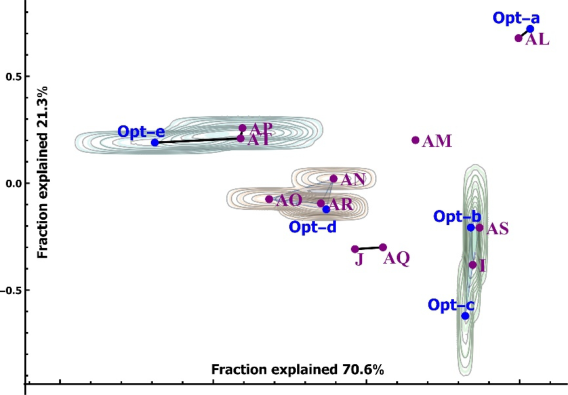
Study I We find (Fig. 1): (a) the associations explain 91.9% of the square of the Frobenius norm of the contingency matrix; (b) nine queries associate (in four clusters) for certain response options; (c) two queries do not associate (one is independent of response options); and (d) one query associates with only one response option.
Figure 1: The result of CA (correspondence analysis) of the contingency matrix and the spectral clustering algorithm. There are three clusters in which queries associate with response options, one cluster in which two queries (J and AQ) associate but not with a specific response option, and one cluster in which a query (AL) associates with one response (a). Only one query (AM) does not associate with any other query nor with any response option. The contour lines are those of the pdf (probability density function) of the KDE (kernel density estimation) using an Epanechnikov kernel for each cluster; contour lines are in steps of 1 20Lmax, where Lmax is the maximum of the pdf of the cluster. The sets of contour lines show that the clusters are significantly different at a significance level far below 5%.
How Do Those in Need Solve Financial Problems in Times of Crisis? 897
The summary implications of these associations are as follows: (a) all respondents intend to decrease their outlays; (b) those who earn between 20 and 30 thousand CZK are hesitant to ask for government support; (c) the participants would rather not borrow money from their family nor from a bank, nor sell their valuables; (d) the rejection of possible non-bank loans associates with the rejection of selling a property; (e) reliance on savings does not associate with any specific response option, nor does total house- hold income — nor does finding an extra job. Non-associations infer that the response options are distributed for a query.
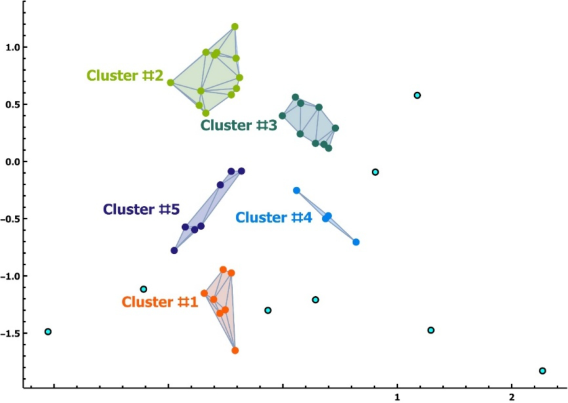
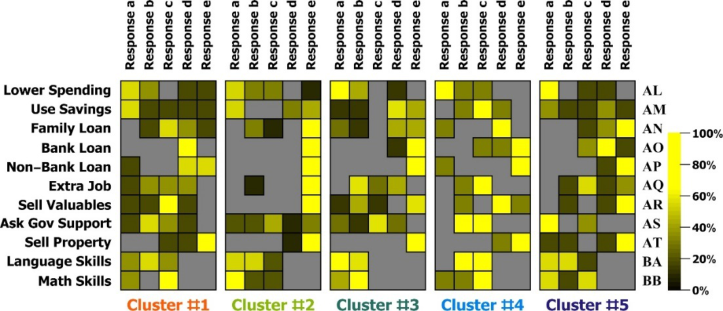
Study II The respondents cluster in five clusters and eight isolates (Fig. 2). We found (Fig. 3) that language and math skills at the end of the primary education (tested at the time the questionnaire was being taken) are predictive of future decisions regarding financial crisis solving. Even though members of all clus- ters aim to lower their spending, avoid selling the property, and avoid the non-bank institution loan, the members of clusters that reject to take any loans are mostly those who have had the higher language and math skills (of 15-year-olds). The low level of language and math skills is related to a higher willingness to sell valuables, find an extra job and — interestingly — to nonetheless ask for government support (Fig. 3; Cluster #3). Use of savings is especially related to poor (elementary school) math competence.
Figure 2: The five clusters and the eight isolates of the neural network analysis of attempted hardship mitigation. Cluster labels are color-coded, as are the rendered points of the dimension-reduced feature vectors (enclosed by convex hull meshes, likewise color-coded, to enhance readability). The DBSCAN algorithm detects the iso- lates that do not belong to a cluster; these are represented by cyan-colored disks with black rims. Clusters have { 7, 12, 9, 4, 7} members, respectively. The dimension axes have no direct interpretation.Figure 3: The heat maps of the five clusters of attempted hardship mitigation. We observe several trends. In Cluster #2, Response e (“definitely not”) is exclusively cho- sen for queries AO–AR and AT (there are negligible exceptions). Only in Cluster #5 is Response a (“definitely”) almost exclusively chosen for queries AL and AS (compare with Cluster #2). We note that the math and language skills are highest in Cluster #3 and second-highest in Cluster #2. In Cluster #4, Response e (“definitely not”) occurs almost exclusively for queries AO, AP, and AT. In all clusters, Response a (“definitely”) occurs with high probability for Query AL (‘Lower Spending’). The fractions (color-coded as %) are the fraction of individuals per response within each cluster. We note that the high rejection ratio (Response e for six queries) in Cluster #2 is for the cluster with the largest fraction of participants (namely 12, i.e. almost 1 4 of the complete sample of 47 respondents).
DISCUSSION AND CONCLUSION Outreach Difficulties
We face one challenge the government is also facing: how to reach the finan- cially disadvantaged citizens. As mentioned, they are not digitally affine, so collecting questionnaire responses is difficult. In fact, 47 completed question- naires can be considered quite a large sample, given the challenge(s) we had to overcome.
Necessity of Advanced Statistical Methods The advanced methods of statistical analysis are necessitated by the data set consisting of categorical variables. These may not be converted to cardinal numbers (Blalock, 1960). Therefore, computation of indices and of correla- tions is impossible. Rather than computing correlations, we compute associ- ations between the queries and the response options using the machinery of correspondence analysis, clustering algorithms and KDEs to quantify signif- icance (Fig. 1). A further approach, necessary when the number of response options is not the same for every query, is to construct feature vectors by one-hot encoding the responses. Further analysis then involves dimension- reduction of the feature vectors, application of a clustering algorithm (Fig. 2) and construction of heat maps (Fig. 3).
A second issue deals with sample size. Pavlov-conditioned reviewers request large sample sizes, inferring that findings with inadequately small
How Do Those in Need Solve Financial Problems in Times of Crisis? 899
sample sizes are not valid. This request is misguided. The first strategy for a reliable statistical analysis is to use methods that are sample-size independent (Bayesian methods are one option; others we present here). The second strat- egy relies on the observation that statistical inferences depend on whether members of the sample are drawn from not one but several statistical popu- lations. If the sample size is increased, then the sample consists, more often than not, of data points drawn from further statistical populations — increas- ing sample size risks increasing the number of statistical populations from which the sample is drawn. For these two reasons, modern statistical methods avoid relying on point estimators and parametric pdfs, but rather use dimen- sion reduction procedures and KDEs; then investigate whether more than one statistical population — detectable via cluster algorithms — is contained in the sample. For example, in Study II we found five clusters; increasing the sample size will not merge these clusters; we therefore found that there are at least six statistical populations (Fig. 3), which, if combined in a single sam- ple for traditional statistical analysis, would have produced meaningless (and erroneous) inferences
Study Findings Application of our findings are threefold. First, we see that the strongest sta- tistical signal does not provide support for an association between personal or household income and the proffered solution of government support. Those earning between 20 and 30 thousand CZK are least likely to apply for gov- ernment support (Fig. 3). This population is the most endangered by loss of income; for this very reason it needs support. These citizens have great dif- ficulty documenting their eligibility because of their low levels of language proficiency and numeracy (Table 2 and Fig. 3).
Second, the associations we found indicate a crucial and ominous rejec- tion of the Czech government’s strategy, its offers and its expectations — as discussed by Bˇreská et al., (2019). Consequently, we suggest a remedial strategy by matching the application process with the linguistic accessibility of low-income citizens and guidance for those with lower cognitive ability (Table 2).
Third, we see that the strategy of not successfully dealing with the situation is strongly associated with the math and language skills of the respondents acquired in their pre-productive age (up to the end of their primary school- ing). These participants are prone to adopting the riskiest strategies that lead to insufficient and short-lived solutions; they are also those who had lowest abilities regarding language and — especially — math skills (in concordance with findings by Duchhardt et al., 2017).
In these two studies, we did not include queries testing for the oft-expressed fears of digital technology, lack of confidence in data privacy, etc. We will do so in further refinements of the project. Suffice to say, however, that we have found indicators that the government’s inability to financially aid those most in need is strongly indicative that the ‘new’ world of digital- ization leaves those disadvantaged and financially in need precariously and ominously behind.
ACKNOWLEDGMENT
We thank L. Pˇríplatová, L. Pacovský, V. Zíka, and R. Sobˇehart (Labora- tory of Behavioral Studies, University of Jan Evangelista Purkynˇe) for their help with the data collection and project execution. Our thanks also go to all participants for taking part in the study. The project is funded by the Doctoral School: Applied and Behavioral Studies project (Grant Number CZ.02.2.69/0.0/0.0/16_018/000272).
ETHICS STATEMENT The Helsinki Convention was adhered to at all times, throughout the present- ing of the questionnaire and during the collection of responses. We abided by the wishes of those who did not agree with the terms and conditions (these were not allowed to proceed with the study). All data were anonymized. The study is part of a set of projects and has been approved by Institu- tional Review Board of the Faculty of Science, Charles University, Prague (#2018/08).
CONFLICT OF INTEREST The authors declare no conflict of interest.
REFERENCES
Bablock H. Jr. (1960) Social Statistics. McGraw-Hill Book Company Inc., New York, N. Y., USA. Beh, E. & Lombardo, R. (2014) Correspondence Analysis. Theory, Practice and New
Strategies. Chichester: Wiley. p. 120. Binter, J., ˇRíha, D., & Prossinger, H. (2020). A Warning: Potential Damages Induced by Playing XR Games. In HCI in Games: Second International Conference, HCI- Games 2020, Held as Part of the 22nd HCI International Conference, HCII 2020, Copenhagen, Denmark, July 19–24, 2020, Proceedings 22 (pp. 260–270). Springer International Publishing. Binter, J., Boschetti, S., Hladký, T., Prossinger, H., Wells, T. J., Jílková, J., & ˇRíha, D.
(2022, June). A ‘Serious Games’ Approach to Decisions of Environmental Impact of Energy Transformation. In: HCI in Games: 4th International Conference, HCI- Games 2022, Held as Part of the 24th HCI International Conference, HCII 2022, Virtual Event, June 26–July 1, 2022, Proceedings (pp. 487–495). Cham: Springer International Publishing. Bˇreská, N., Urban, T., & Vránová, L. (2019). Dávky pomoci v hmotné nouzi. ANAG. Döring, M. (2021). How-to bureaucracy: A concept of citizens’ administrative literacy. Administration & Society, 53(8), 1155–1177. Duchhardt, C., Jordan, A. K., & Ehmke, T. (2017). Adults’ use of mathematics and
its influence on mathematical competence. International Journal of Science and Mathematics Education, 15(1), 155–174. Fritsch G., Steltzer H., Oberladstaetter D., Zeller C., & Prossinger H. (2023) Artificial intelligence algorithms predict the efficacy of analgesic cocktails prescribed after orthopedic surgery. PLoS ONE 18(2): e0280995. https://doi.org/10.1371/jo urnal.pone.0280995 Greenacre, M. (2007) Correspondence Analysis in Practice. Boca Raton: CRC Press.
p. 204.
How Do Those in Need Solve Financial Problems in Times of Crisis? 901
Murphy K. P. (2012) Machine Learning — A Probabilistic Perspective. MIT Press. Prossinger, H., Binter, J., Machová, K., ˇRíha, D., & Boschetti, S. (2022). Machine Learning Detects Pairwise Associations between SOI and BIS/BAS Subscales, mak- ing Correlation Analyses Obsolete. Human Interaction & Emerging Technologies (IHIET-AI 2022): Artificial Intelligence & Future Applications. Sun L., Ji S. & Ye J. (2014) Multi-Label Dimensionality Reduction. Taylor & Francis,
Read this individual research paper free through the original publisher, or explore the full digital proceedings book.
ISBN 978-1-958651-87-2
Explore this ISBN in the AHFE Bookstore ↗Listed in the July 2026 bookstore catalogue; search by ISBN to confirm current availability · Digital book purchase optional