Rong Jiang, Huai Cao (2023). Human-machine Interface User Experience of intelligent Manufacturing Industrial Control Software. In: Usability and User Experience. AHFE Open Access, vol. 110, pp. 163–170. https://doi.org/10.54941/ahfe1003188
Industrial control software is software used for industrial production and manufacturing site control, which has a wide variety and powerful functions. The human-computer interaction experience of industrial control software should not only consider the basic cognition of users for operation but also consider the experience of each contact point from tasks and scenes. This paper analyses the characteristics of a human-machine interface of industrial control software. It also analyses the experience level of human-machine interface touchpoints of industrial control software based on the perspective of user experience, and finally makes an outlook on the future development path.
As digital intelligence in China’s manufacturing industry continues to deve- lop, intelligent manufacturing has become an important direction for the country’s manufacturing industry (Bo and Lan, 2020). Led by some of the industry’s top companies, intelligent manufacturing is driving significant changes in China’s traditional industries. As a critical component of intel- ligent manufacturing, the user experience of industrial control software is receiving increasing attention.
Software is a product that directly interacts with people, and therefore, industrial control software should aim to maximize the user experience for engineers and other relevant users. The human-machine interface helps ope- rators access the operational characteristics of various equipment, allowing them to control it effectively. In the past, the information structure of the human-machine interface was relatively simple, meeting only basic functio- nal requirements. However, with the emergence of concepts such as cloud computing and intelligence, the global manufacturing industry has entered a new phase, and internet companies have begun to emphasize the importance of user experience.
HUMAN-MACHINE INTERFACE (HMI) FEATURES OF INDUSTRIAL CONTROL SOFTWARE The human-machine interface of industrial control software is a critical part of the connection between equipment and people. It provides a visual display of information that enables users to access relevant data and make behavioral decisions. The accuracy and efficiency of user operation often depend on whether the human-machine interface is designed to meet the user’s cognitive habits.
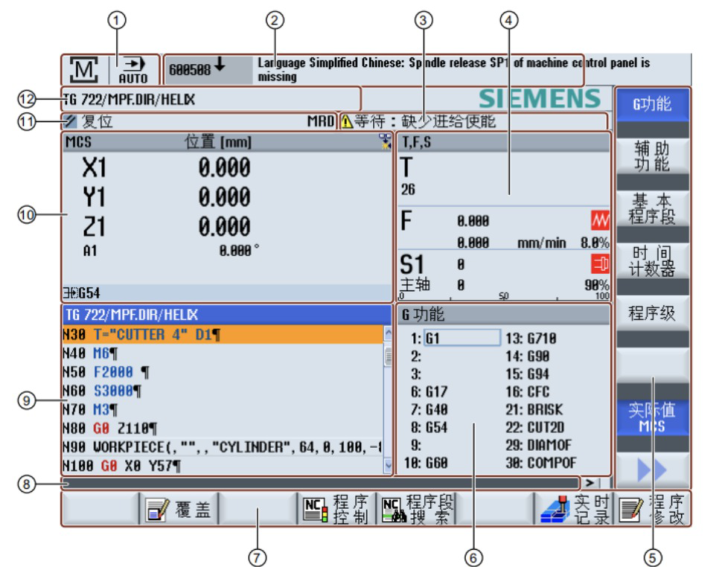
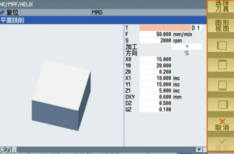
Information Display Features The information display of the human-machine interface of industrial control software has its unique characteristics. Figure 1 shows the functional parti- tion of the interface of Siemens’ industrial control software, SINUMERIK Operate. The interface is highly complex, and there are significant changes in the layout of interface information under different functions,as shown in Figure 2.
After analyzing several industrial control software interfaces, we can roughly summarize the following three characteristics of information display: (1) Amount of Information Due to the large amount of data processing required in the operation pro- cess and a wide range of functions, industrial control software interfaces
Figure 1: The functional partition of the interface of SINUMERIK Operate.
Research on Human-Machine Interface User Experience of Intelligent 165
Figure 2: The interfaces and navigation bars under different functions.
typically feature a large number of information windows, operating buttons, and various information combined into a vast information module. The high information content of the interface often causes a significant cognitive load for operators, particularly for industrial control software, a software system with a high level of information expertise and a high threshold, which often requires a large amount of learning time costs for the user.
(2) Complex information hierarchy Industrial control software has multiple functional modules, and many secondary functional modules exist below the first level. This multi-layered information is not always presented clearly and explicitly to the user, leading to operational inefficiencies, errors, and other problems.
(3) Variety of information types Industrial control software includes various information types. In addition to more basic visual information such as text, graphics, and symbols, it also contains critical industrial process diagrams and other professional informa- tion types. Different types of information are utilized in various industrial production scenarios, and how these information types are divided and com- bined plays a vital role in the user experience of the HMI of industrial control software.
Interface Interaction Features Although touchscreen interaction is currently the most mainstream intera- ction method, there are more problems with its use in industrial scenarios, such as no feedback after touching the screen, the screen being easily soiled by hands, and difficulties in character input. Therefore, the interaction of the interface needs to fully consider the actual usage scenarios and human factors, and it also needs to be in line with the user’s cognition in order to be easy to use. After summarizing the interaction characteristics of industrial control software, there are two points:
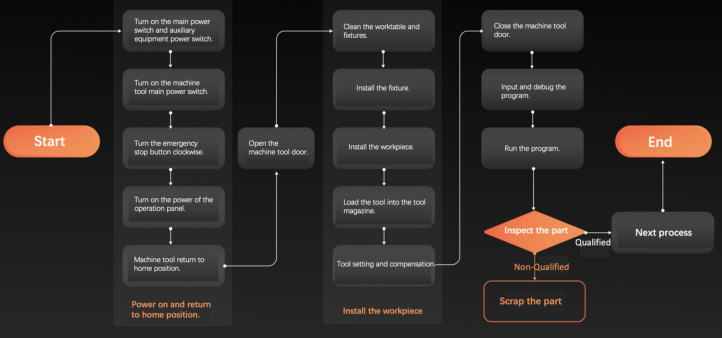
(1) Complex interaction process The interaction process of industrial control software is closely related to the production and manufacturing process. In different industrial scenarios, users may need to switch between multiple windows and systems. Taking CNC machine tools as an example, users need to perform a series of ope- rations on the machine tool through the industrial control system. Figure 3 shows the workflow diagram of CNC machine tools. Moreover, as integrated software, industrial control software involves interactions among multiple roles with different division of labor in the industrial process, leading to
166 Jiang and Cao
Figure 3: The workflow diagram of CNC machine tools.
significant differences in interaction processes. The human-machine inter- face of industrial control software attaches great importance to the user’s interaction efficiency, and interfaces with shorter paths can bring greater benefits.
(2) Diverse Interaction Methods Industrial control software involves diverse interaction methods that are suitable for different usage scenarios. The mouse is commonly used for clicking, moving, and hovering operations, while the touch screen is sui- table for more detailed operations such as zooming and clicking. The keyboard is used for character input. However, in industrial scenarios, it is important to further investigate the user’s usage needs to incorpo- rate more forms of interaction, such as voice commands and gesture recognition.
Visual Design Features (1) A wide range of icons and patterns
To optimize the efficiency and accuracy of information searches in intelli- gent production line control systems, it is essential to have a wide range of icons and patterns that correspond to the different functions of industrial con- trol software. When designing industrial information icons, it is important to consider the laws of visual cognition to ensure they are easily recogni- zable and understood by operators. This can ultimately lead to improved productivity and reduced errors in industrial processes.
(2) A wide range of colors In industrial scenes, there is a wide range of color applications, and it is important to consider the cultural attributes of the colors and the envi- ronment in which they are used when selecting colors. Different industrial statuses correspond to different colors, as shown in Table 1 with their corresponding meanings. For instance, the color red in industrial scenarios indicates faults or prohibition, while the color green means normal operation and safety. However, using too many colors can cause cognitive overload for
Research on Human-Machine Interface User Experience of Intelligent 167
Table 1. Colors and their meanings.
Table available in the original PDF paper.
Color Meaning Red Alarm, malfunction, hazardous situation, emergency stop Green Safe, normal, running Yellow Standby, warning, abnormal
the operator. Thus, the application of colors in industrial scenes should have a clear meaning and avoid using too many colors to maintain the sense of order and visual emphasis of the interface. Choosing the appropriate HMI color can help improve ergonomic performance through color.
USER EXPERIENCE In the 1990s, user experience was almost constantly valued but still lacked an official label, so in 1995, while still at Apple, cognitive scientist Donald Norman coined the term ‘user experience design’, which also encompassed all user experience The term also encompasses all approaches to user expe- rience (Norman et al., 1995). In 2010, the International Organization for Standardization (ISO) gave a more standard definition of the term ‘user expe- rience’ as ‘the feelings, attitudes, and thoughts that users develop when using or anticipating using a product, system, or service’ (International Standards Organization, 2010).
The term “user experience” has been repeatedly discussed, and its con- notation and content framework have been expanded, with more and more disciplines and fields integrating with user experience. According to Alben, “user experience” should encompass all aspects of human interaction with a product, such as the physical perception of the product, the level of under- standing of the product, the feeling of using the product, the purpose of using the product and the fit with the human-machine environment (1996).
Lucas Daniel defines user experience as the actions, thoughts, and feelings of the user when operating a product or service, summarising the rational and emotional components of value that a product or service provides (Daniel, 2000). Wikipedia includes user experience in terms of what the user achieves during and after using a product. User Experience Design (UCD) is a pro- duct design philosophy that emerged at the end of the 1980s and advocates that design should be based on the actual needs of the user, who is the key aspect of the design, and that products should be designed according to the user’s mental model. Famous universities, such as Carnegie Mellon Univer- sity and Stanford University, also put forward a series of theories around UCD, which largely promoted the development of UCD in the academic world.
The development of user experience in the human-machine interface of the industrial control software is still in the initial stage, and the system deve- lopment is mainly programmer-led, but the user-centered design principle is ignored. In the design process of the system, designers should grasp the
168 Jiang and Cao
characteristics of users, discover their needs, and design decisions should be combined with the users’ work and application environment.
USER EXPERIENCE HIERARCHY OF HMI IN INDUSTRIAL CONTROL SOFTWARE Basic Operation and Security
In the initial stage of industrial control software development, the user’s requirements for the HMI are “ workable”, which means that the core functions of the HMI can meet the most basic operational needs of the user. For users who are new to industrial control software, the human-machine interface can quickly help users establish basic knowledge through intuitive information. Safety requires that the system’s interface should be fault- tolerant and error-alerting to ensure the safety of operators and equipment in important decisions.
Pursuing Efficiency of Use Interaction design in the traditional industrial sector is driven by efficiency (Zhang, 2010). As a typical functional product in the industrial sector, indu- strial control products are more focused on operational efficiency. The core approach to improving efficiency is to “simplify the process”, ensuring that the user can complete the interaction task in less time and with fewer ope- rations, thus achieving the desired result. The more efficient the operators are in using the software, the better the economic benefits for the company. Efficiency is related to various aspects, such as the comprehensibility of infor- mation, the simplification of interaction paths, and the focus on visual effects, all of which can improve the user’s operational efficiency to a certain extent.
Focusing on Emotional Needs After a long period of development of software design, the technology tends to mature and the emotional dimension of user experience becomes more and more important. For example, in the task of human-machine interface interaction in industrial control software, the information display is complex and the visual forms are diverse. If the operator interacts for a long time, it is easy to cause negative emotions such as impatience and fatigue, and the negative emotions of the operator will also have a negative impact on manufacturing. Therefore, the user experience of industrial control software needs to fully consider the emotional needs of users in industrial high-pressure scenarios and provide positive emotions to operators.
THE FUTURE DEVELOPMENT PATH OF USER EXPERIENCE OF INDUSTRIAL CONTROL SOFTWARE HUMAN-MACHINE INTERFACE Deep Into the Industrial Manufacturing Process, Pay Attention to the Experience of Each Point
The human-machine interface design of industrial control software is never a visual beautification but should be considered by the users of the product and
Research on Human-Machine Interface User Experience of Intelligent 169
the use of the scenario. Designers need to go deep into the overall business line to observe and analyze the process and specific aspects of manufacturing. Sort out the factors that affect the experience of using industrial control sof- tware in the real manufacturing process, including software interface factors and human factors. From there, we will discover the pain points and design opportunities in the process, which can be applied to the interface design.
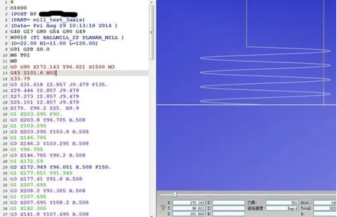
New Technologies to Help Immerse the Human-Machine Interface in Interaction Intelligent manufacturing has emerged as a key direction for the manufactu- ring industry, and the digital twin offers a promising solution for achieving intelligent manufacturing by bridging the physical and digital worlds. Howe- ver, most existing industrial control software is limited to a two-dimensional interface that only meets the basic operational needs, and falls short in provi- ding a realistic representation of the production scenario. Figure 4 shows the display of two-dimensional and three-dimensional machining trajectories in the numerical control system. Compared with two-dimensional information, three-dimensional information can help users understand the information of equipment in production more intuitively. By incorporating the digital twin concept into the human-machine interface, operators can have a more immer- sive experience and obtain a more accurate and realistic view of the real-time status of manufacturing. This can break the constraints of space and time, enabling operators to have greater control on the screen and make more pre- cise and informed decisions through multi-angle observation of the control object.
Establish a Better User Experience Evaluation System User experience evaluation refers to the process of assessing the quality of a product, system, or service based on the behavior or attitude of users during its use (Garcia et al., 2009). Evaluating user experience can help designers choose appropriate design solutions, ensure product functionality, and assess whether the design meets user needs (Tullis and Albert, 2008).
Figure 4: Machine tool path display in different dimensions. two-dimensional three- dimensional.
170 Jiang and Cao
As intelligent manufacturing continues to develop, many traditional enter- prises are undergoing transformation and upgrading. Industrial control sof- tware, as an essential element in the manufacturing process, is in increasing demand. However, with the accelerating development of domestic industrial control software, there is a proliferation of uneven products, and poorly designed software can impede productivity.
Despite this, there are few studies on the evaluation of human-machine interfaces for industrial control equipment, and the available evaluation methods lack guidance. By using user experience metrics, the experience of the human-machine interface of industrial control software can be quanti- fied, and the quality of the user experience can be evaluated through different dimensions and indicators. This approach can help designers better under- stand usage behavior of industrial control software, improve their design and gain new insights, and ultimately enhance the user experience of indu- strial control software and promote the development of user experience in the industry.
REFERENCES
Daniel L. Understanding User Experience [J]. WebTechniques, 2000, 5(8): 42 -43. Journal [J] Interactions Volume 3, Issue 3. 1996. PP. 11–15 Gao Bo, Zhu Lan. From “world factory” to industrial Internet powerhouse: building competitive advantages in the era of smart manufacturing [J]. Reform, 2020, (06): 30–43. Garcia M, Canovas A, Edo M, et al. A QoE management system for ubiquitous IPTV
devices [C]// IEEE. IEEE, 2009. International Standards Organization. Ergonomics of Human-System Interaction— Part 210: Human Centred Design for Interactive Systems, ISO 9241-210 [J]. 2010. Norman D, Miller J, Henderson A. What You see, Some of What’s in the future, and
how we go about doing it: HI at Apple Computer[C]//Conference companion on Human factors in computing systems. ACM, 1995:155. Tullist. Albertb. Measuring the user experience by collecting, analyzing, and presenting usability metrics [M]. San Francisco: Morgan Kaufmann, 2008. Zhang Ling-hao. Research on Design Methods of Smart- phone Interface Based on
Intelligent Systems [J]. Packaging Engineering, 2010, 31(24):58–61.
LISTED IN THE AHFE DIGITAL BOOKSTORE CATALOGUE
Explore the complete digital volume
Usability and User Experience
Read this individual research paper free through the original publisher, or explore the full digital proceedings book.
ISBN 978-1-958651-86-5
Explore this ISBN in the AHFE Bookstore ↗Listed in the July 2026 bookstore catalogue; search by ISBN to confirm current availability · Digital book purchase optional