Huai Cao, Kaixuan He, Xiuling Wang, Xinyue Gong (2022). Optimization of Online Vocabulary Learning Platform Based on Kano Model. In: Training, Education, and Learning Sciences. AHFE Open Access, vol. 59, pp. 213–220. https://doi.org/10.54941/ahfe1002403
In the case of a worldwide epidemic, a lot of vocabulary learning software and applications have shown up in the online app stores in China. The Study builds a demand system with 8 dimensions and 31 features from three aspects, including content, function and design. On such a basis, users of vocabulary learning platforms are taken as the objects of research. Then, with Kano Model theory and research methods, the statistic analysis of data is conducted to obtain the results of demand evaluation. The satisfaction and dissatisfaction coefficients are calculated as well. On this basis, users’ demands are classified into four-quadrant diagrams and obtain 8 Must-be attributes, 6 One-dimensional attributes, and 11 Attractive attributes. The research prioritizes the platform features and proposes corresponding design strategies. The purpose is to build more individualized online platforms for vocabulary learning and enhance learners’ motivations. Finally, some principles of designing online vocabulary learning platforms are summarized to offer reliable guidance and suggestions on subsequent studies and functional designs in this field.
Learning a new language is of great necessity in globalization, and vocabulary is the basis to learn a new language. In the case of a worldwide epidemic, online learning has gained widespread favor; a lot of vocabulary learning software and applications have shown up in the online app stores in China. However, with the constantly-changing in user demands, online vocabulary learning software has also encountered some challenges: (1) Online learning platforms have become somehow similar, making it hard to distinguish their respective features. (2) Online learners also differ in terms of motivations and preferences in learning. It is necessary to pay attention to learners’ particular preferences so as to stimulate their motivations for learning. (3) Various and chaotic functions and hierarchies of online learning platforms have perplexed users. Therefore, the emphasis of current researchers is to focus on users’ needs, provide them with valuable functions and meet their demands.
This study summarized the features provided by the major vocabulary online learning platforms and derived a functional system for online learning platforms. Through the analysis of the Kano model, the functional attribu- tes of the platform were prioritized to optimize the platform functions and improve user satisfaction.
LECTURE REVIEW Research Status of Online Learning Platform
Online learning refers to a learning method that uses wireless mobile commu- nication network technology and equipment to study. It has the advantages of trans-temporality, diversity, personalization. Currently, scholars have car- ried out comprehensive research from different perspectives. With regard to functional resources, it is possible to boost the effectiveness of online study in a pluralistic way by delivering rich resources and cooperation (Cai H and Zhang S, 2021); it is also feasible to promote users’ learning persistence via certain feedback and incentive mechanisms such as honor accomplishment experience, incentive mechanism (Tan Z and Jiang X, 2020). With regard to design, the conciseness of the website interface and the precision of page navi- gation can significantly impact the operational efficiency of the user platform (Zhang X et al., 2008).
Research Status of Vocabulary Learning Vocabulary learning plays a vital role in building students’ language structu- res and improving their language skills. Research on vocabulary study can be traced back to Wilkins (1974) noted that learners should grasp vocabulary and grammar in language learning.
This paper conducted research from the perspective of Chinese students learning English and sorted out the vocabulary learning approaches with two representative features. First and foremost, attention should be paid to the individualized differences of users. Some scholars have revealed that learners’ age, language level, and cultural context enable the adoption of different strategies for vocabulary learning (Schmitt and Mccarthy, 1997). Second, enriched learning approaches should be applied to reinforce voca- bulary memorization. A number of scholars have verified that examples, multimedia annotations (text, image, sound, animation.) (Chun and Plass, 1996), multimodal annotations (Li H and Li Y, 2007) and presentation (Liu L, 2014) are conducive to lexical acquisition and prolonged memorization of English vocabulary. Learning methods such as photo-video lectures and English-speaking communities have also been proven effective (Li R, 2014).
In conclusion, previous research tended to investigate the effectiveness of diverse functions from the viewpoint of researchers. This paper conducted functional interest research from the user’s perspective to complement this field.
RESEARCH METHODOLOGY This study collected original data by non-intrusive user interviews, in-depth interviews with 4 English students, 4 English teachers, 10 English learners and 2 design students via documentary and observational methods. Subsequently, the KJ method collated and categorized the key vocabulary from the intervi- ews. Meanwhile, the content of the online vocabulary learning platform was sorted out with respect to the research results of formerly related learning platforms. With the Delphi method, experts from the industry were invited to
Optimization of Online Vocabulary Learning Platform Based on Kano Model 215
Table 1. Feature list of vocabulary online learning platform.
Table available in the original PDF paper.
Dimension Features Introduction of the features Word information (A) A1 Spelling Spelling A2 Pronunciation Phonetic symbol and pronunciation A3 Meaning Chinese Meaning A4 Example sentences
Examples containing this word from dictionaries, classics, dramas, etc. A5 Synonyms Synonyms A6 Dictionaries Definitions of different dictionaries A7 Word roots Help users to memorize quickly Memory aid (B)
B1 Picture Create pictures associated with words to help users deepen their memory B2 Video Word-related videos, episode excerpts B3 Memorization tips
Jingle, homophonic, etc. to help users memorize more quickly Vocabulary learning (C)
C1 Collection Collect unfamiliar words for review C2 Familiarity check Determines the user’s familiarity with the word through the three grades of “memorized”, “impressed” and “don’t remember” C3 Dictation Dictate words C4 Word Guessing Guess the meaning of a word based on its spelling Study statistics (D)
Selection of teaching materials
D1 Learning curve Daily word memory statistics D2 Learning statistics Study time statistics D3 Status of check-in Status of check-in D4 Word volume Test of the word volume Planning (E) E1 Teaching materials E2 Target design The number of words to be recited E3 Forgetting Curve Scientific method of memory Interaction (F)
F1 Timely feedback Provide quick feedback to users F2 Common operation
Interoperability conforms to normal operating principles F3 Simple interaction Respect the user’s operating habits without violating the basic operating norms, F4 Immersion Users could concentrate on learning F5 A sense of control Be competent for the current learning task F6 Intuitive partition Intuitive partitioning of functions Cross-platform (G)
G1 Phone No time and place restrictions G2 IPAD Bigger screen G3 PC Shows more, but less flexibility visual design (H) H1 Reasonable Establish a good visual hierarchy
interface layout H2 Beautiful interface The interface color matching is reasonable and the key points are prominent H3 Dark mode Guaranteed readability in low light H4 Reasonable font
In order to improve reading comfort size
make modifications to the functions, and ultimately built a demand system with 8 dimensions and 31 functions from three aspects, including content, function and design. As shown in Table 1.
Table 2. Kano questionnaire sample form. “How would you feel if the online vocabulary learning platform offered a ‘word spelling’ feature” Positive question
Table available in the original PDF paper.
Negative question
Like it Expect it Don’t care Live With Dislike
“How would you feel if the online vocabulary learning platform did not offered a ‘word spelling’ feature”
Table 3. The Kano model evaluation table.
Table available in the original PDF paper.
Functional Dysfunctional Like it Expect it Don’t care Live with Dislike Like it Q A A A O Expect it R I I I M Don’t care R I I I M Live With R I I I M Dislike R R R R Q
Equation reproduced from the original PDF.
Questionnaire Collection and Validity Testing The questionnaire adopted a standardized form and was divided into two parts: The first part was the user’s basic information, which included the user’s gender, education, age, occupation, and the frequency of using English vocabulary app; The second part was the Kano questionnaire. The Kano questionnaire had 36 functional bidirectional questions: 16 positive questi- ons and 16 negative questions. There were five options for each question, as shown in Table 2.
Due to the impact of the epidemic, the study used a web-based questi- onnaire to conduct the research. The research targeted groups with English vocabulary learning needs, including students learning English, English teachers, UI designers, product managers, etc.
A total of 150 questionnaires were collected. Through the cleaning of inva- lid questionnaires, a total of 141 valid answers were obtained. The recovery rate of the questionnaire was 94%.
The reliability and validity of the questionnaire were tested using SPSS: the reliability coefficient value of this questionnaire was 0.923 which was greater than 0.8, indicating that this questionnaire has strong reliability. In the validity test, the KMO test value was 0.775, which was greater than 0.6, and the Bartlett’s sphere test statistical value of significant probability is 0.000, which is less than 0.01, which proves that the questionnaire has good validity.
Analysis According to the Kano model evaluation table (Table 3), the study organized the questionnaire results, and conducted statistical analysis on various online learning-related functions.
This study used the Better-Worse coefficient proposed by Bogle to measure the user satisfaction index and the calculation formula is as follows. The
Optimization of Online Vocabulary Learning Platform Based on Kano Model 217
Table 4. Kano questionnaire evaluation form.
Table available in the original PDF paper.
A(%) O(%) M(%) I(%) R(%) Q(%) KANO Catergories Better Worse A1 8.51 21.28 38.30 23.40 4.26 4.26 M 0.32 −0.65 A2 2.12 27.66 48.93 17.02 0.00 4.26 M 0.31 −0.80 A3 4.26 34.04 42.55 14.89 0.00 4.26 M 0.40 −0.80 A4 10.63 19.15 40.43 25.53 0.00 4.26 M 0.31 −0.62 A5 4.26 34.04 42.55 14.89 0.00 4.26 A 0.44 −0.34 A6 10.63 19.15 40.42 25.53 0.00 4.26 I 0.31 −0.46 A7 21.28 23.40 12.77 42.55 0.00 0.00 A 0.44 −0.36 B1 31.91 17.02 12.76 38.29 0.00 0.00 A 0.50 −0.30 B2 27.66 14.89 12.77 19.15 2.13 2.13 A 0.57 −0.37 B3 29.79 21.27 8.51 42.55 0.00 2.13 A 0.50 −0.29 C1 10.64 28.37 25.53 31.91 0.00 1.42 M 0.40 −0.55 C2 27.65 23.40 17.02 31.91 0.00 0.00 A 0.51 −0.40 C3 31.91 23.40 14.89 27.66 2.13 0.00 A 0.56 −0.39 C4 23.40 19.15 14.89 40.42 2.13 0.00 A 0.43 −0.34 D1 19.14 23.40 12.77 44.68 0.00 0.00 I 0.42 −0.36 D2 17.73 34.75 19.14 25.53 0.00 0.70 O 0.54 −0.55 D3 14.19 10.63 6.38 71.63 1.42 0.00 I 0.23 −0.17 D4 18.43 21.99 17.73 39.72 0.00 0.00 I 0.41 −0.40 E1 22.70 18.43 17.02 39.72 0.00 2.84 I 0.42 −0.36 E2 21.27 19.86 18.43 40.42 2.13 0.00 I 0.41 −0.38 E3 30.50 14.89 5.67 46.80 2.13 2.13 A 0.45 −0.21 F1 6.38 39.00 33.33 20.56 0.70 2.13 O 0.46 −0.73 F2 4.26 34.75 33.33 27.65 0.00 0.00 M 0.39 −0.68 F3 6.38 36.17 29.79 26.95 0.70 0.00 M 0.42 −0.66 F4 23.40 40.42 10.63 25.53 0.00 0.00 O 0.62 −0.50 F5 22.69 36.17 8.51 31.21 0.00 1.42 A 0.60 −0.45 F6 11.34 47.52 18.44 21.99 0.00 0.70 O 0.59 −0.66 G1 2.13 44.68 38.29 12.76 4.26 0.00 O 0.47 −0.84 G2 23.40 19.14 17.02 38.29 0.00 0.00 A 0.43 −0.36 G3 16.31 15.60 15.60 47.51 2.12 0.00 I 0.34 −0.31 H1 12.77 32.62 31.91 21.28 0.00 1.41 O 0.46 −0.65 H2 19.15 36.17 21.28 23.40 0.00 0.00 O 0.53 −0.55 H3 10.64 21.28 17.03 44.68 0.00 6.38 I 0.34 −0.39 H4 6.38 21.98 41.13 28.37 1.41 0.70 M 0.29 −0.64
Better value indicates how much user satisfaction is increased by providing quality elements, while the Worse value indicates how much user satisfaction is decreased by not providing the feature.
Better(SII) = (A + O)/(A + O + M + I) (1) Worse(DDI) = (−1)(O + M)/(A + O + M + I) (2)
In this way, the evaluation results of all functions of the platform were calculated, as shown in the Table 4.
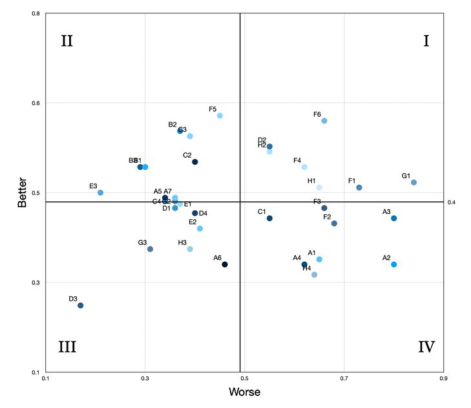
Taking the absolute value of the Worse coefficient of each function as the abscissa, the Better coefficient as the ordinate, and taking the average value of
Figure 1: The better-worse coefficient analysis quadrant graph.
the two coefficients (|−0.43|, 0.48) as the coordinate center, the coordinates were divided into four quadrants, as shown in Figure 1.
DESIGN PIONT According to the above figure, the basic design strategy of the online vocabulary learning platform was proposed:
On the Basis of Must-Be Features As for the features, a series of word-related features such as “spelling”, “pronunciation”, “meaning”, “example sentences”and “collection”are used as basic requirements, and all the features are comprehensively covered to guarantee the normal operation. As the basic learning elements of words, “pronunciation” and “meaning” shall keep the source of information tran- sparent and precisely labeled. As a tool to facilitate users’ comprehension and memorization, the “example sentences”should be representative and contain various uses of words. Regarding platform design and development, the plat- form should respect the user’s operating habits without violating the basic operating norms. It should be user-friendly so that the user does not con- sume too much energy in operation, thus affecting the learning efficiency. Moreover, a proper font size should be selected to match the display of the screen to improve the user’s reading comfort.
Enhancing User Satisfaction by Emphasizing Attractive Features The quality of attractive features directly impacts the satisfaction of learners regarding the support services. “Learning statistics” is the most gratifying feature for users, and the platform should ensure its investment. Presenting users’ learning process via data and charts enhances the understanding of
Optimization of Online Vocabulary Learning Platform Based on Kano Model 219
users’ learning process, thereby stimulating their learning motivation. Mea- nwhile, it is crucial to provide users with explicit learning feedback for every step. It allows users to have a clear picture of their current learning status, feeling a greater sense of control over the learning process. Concerning the operation of the platform, the focus should be placed on the intuitive partiti- oning of functions and the application of a logical interface layout to boost the user’s working experience. When it comes to design, it is essential to select color scheme and visual pattern that is more in line with the target users so as to attract a wider range of users. Besides, users tend to believe that a pleasing design is a practical one, and a neat interface will conceal certain usability defects for the product.
Boosting Market Competitiveness by One-Dimensional Features The One-dimensional features are categorized into three aspects. (1) Auxi- liary information for words, covering five contents such as “synonyms”, “word roots”, “images”, “videos” and “memorization tips”. Given suffi- cient funds and technical standards, it should make sure that services of this kind are available as much as possible to fulfill users’ advanced needs and raise the competitiveness of online vocabulary study platforms. (2) Consoli- dation and reinforcement of word acquisition, covering “word dictation”, “word guessing” and “Ebbinghaus Forgetting Curve”. Depending on the user’s acquisition of words, the platform should follow the memory rule of The Ebbinghaus Forgetting Curve and update the user’s word review plan accordingly. The flexible learning strategy is beneficial in helping learners to accomplish the current task effectively, resulting in improving learners’ con- trol over online learning and triggering motivation for online learning (Wang H, 2021). (3) Cross-device tool support. Users can choose the learning har- dware that fits their needs. The backup port should also be put into use in case of the failure of the original port, preventing the distraction of learning momentum caused by the tool.
Paying Attention to Indifferent Features The Better-Worse factors for “dictionary”, “dark mode”, “computer port”, and “target design of vocabulary” are quite low. Hence platforms may con- sider cutting down on these four requirements if capital is running low. For platforms that have not yet provided these four features, they can withh- old the provision of these three services.The Better coefficients of “learning curve”, “test of the word volume” and “selection of teaching materials” are relatively high, which are in the middle phase of charismatic and undiffe- rentiated demand. These features will undergo a type shift in the order of I-A-O-M over time in accordance with the Kano type.Therefore, these featu- res are of some potential, and the pivotal time for the transformation of these functions should be captured. These features and services should be added to the platform so as to increase user satisfaction.
CONCLUSION
This study prioritized the platform features and proposed corresponding design strategies through the analysis of the Kano model and the four- quadrant diagram. Then the study provided guiding suggestions for vocabu- lary online learning platforms and provided a basis for follow-up research. The availability of the must-be features determines whether users can use this platform, and the attractive features determine whether users choose this platform. The design of an online learning platform should pay attention to the arrangement of different features, so as to have its characteristics and improve user satisfaction.
ACKNOWLEDGMENT
The authors would like to express my gratitude to the supervisor, Prof. Cao, who provided valuable guidance at every stage of this research. The authors sincerely thank the students of Huazhong University of Science and Technology and the employees of Didi Chuxing for accepting my interview. The authors also thank the 150 users for their patience in filling out the questionnaire.
REFERENCES
Cavus, N. Uzunboylu, H and Ibrahim, D. (2008). Student opinion towards using an open source learning management system together with a collaborative tool. Cypriot Journal of Educational Sciences Volume 3 No. 2. Cai, H. Zhang, S. (2021). Research on the Current Situation and Influencing Factors
of College Students’ Online Learning, Innovative Entrepreneurship Theory Rese- arch and Practice Volume 4 No. 20. Chun, D. Plass, J. (1996). Effects of Multimedia Annotations on Vocabulary Acquisition, The Modern Language Journal Volume 80 No. 2. Ling, L. Qin, X. (2014). Empirical Study on the Presentation Models’effects on
English Vocabulary Learning, Foreign Language World No. 2. Li, H. Li, Y. (2007). The effect of media vocabulary annotation patterns on the learning and memorization of new word meanings in English, Foreign Languages and Their Teaching No. 7. Schmit, N. Mccarthy. (1997). Vocabulary Descriptive, Acquisition and Pedagogy:
Cambridge Language Teaching Library. Cambridge: Cambridge University Press. Tan, Z. Jang, X. (2020). Interaction Design of E-Learning Platform Based on Fogg’s Behavior Model, Packaging Engineering Volume 41 No. 4. Wilkins, D. A. (1972). Linguistics in language teaching. Edward Arnold. Zhang, X. (2008). The Research on the Interface and Color Design of Education
Websites. Agriculture Network Information No. 10.
LISTED IN THE AHFE DIGITAL BOOKSTORE CATALOGUE
Explore the complete digital volume
Training, Education, and Learning Sciences
Read this individual research paper free through the original publisher, or explore the full digital proceedings book.
ISBN 978-1-958651-35-3
Explore this ISBN in the AHFE Bookstore ↗Listed in the July 2026 bookstore catalogue; search by ISBN to confirm current availability · Digital book purchase optional