Lloyd Morris, Dunia Duque, Olga Jasmin Salazar De Morris, Homero Murzi, Sandra Milena Durán Omaña (2022). Student Motivation in Teaching Process during the COVID-19, a Significant Experience of International Exchange for Control Charts Learning. In: Training, Education, and Learning Sciences. AHFE Open Access, vol. 59, pp. 1–8. https://doi.org/10.54941/ahfe1002377
COVID-19 has generated changes in education systems that impact the main authors of the system: teachers and students. As an alternative, most of the university courses have been taught remotely (IESALC 2020). Using the contribution of industrial engineering teachers from the universities involved, opportunities are evident to strengthen the teaching-learning processes that were incorporated in the design of the process, since the academic motivation of the students depends to a large extent on the perceptions in relation to their experiences in class (Jones, 2015). Additionally, there are multiple learning options in open pedagogical practices (Paviotti et al 2020), and in open educational practices (Ehlers et al 2020), (Axe et al 2020), (Marchisio et al 2020), which corresponds to innovative and attractive pedagogies that incorporate open evaluation, open collaboration and in itself open teaching processes.Considering the concepts of open education, added to the international exchange policies of the universities: Universidad Austral de Chile and Universidad Tecnológica de Pereira, an experience international exchange is planned for control graphics students, incorporating pedagogical strategies with a pragmatic approach in the solution of international cases of control charts and where collaborative work between academic peers complement the academic experience.The objective of the research was to analyze the motivational beliefs of the students at the level of the control graph domain, using the “Expectations Value Model” (Eccles and Wigfield 2000), compared to two moments: the one before the academic exchange and after the same, in which pragmatic approaches are incorporated in the applications of statistical control, taking advantage of internationalization scenarios. Therefore, the purpose of the research is to determine if there are statistically significant differences in the beliefs of the students of the statistical control analyzed at the beginning and at the end of the academic exchange of the 2021 semester.The present study is an inferential statistical investigation on academic motivation in students of statistical process control, in remote exchange learning. For this reason, it was decided to use the two-sample hypothesis test for dependent samples suggested by (Lind et al 2019) and (Anderson et al 2020), an initial hypothesis was defined: the mean assessment of motivation after the international exchange should be superior to the initial evaluation of the control chart students.The results of the statistical analysis carried out confirm the initial general hypothesis raised and verify that the change in the didactic strategy in international exchange after COVID-19 has a significant influence on the motivational beliefs of the students, where the factors of academic motivation with better evolution after the academic exchange are in hierarchical order: utility value, followed by achievement value, closing with satisfaction value. As for the elements that were better valued and with greater evolution at the initial moment for the utility is having a solid formation in process control, and for the achievement, it is to carry out the graphic activities well; while for satisfaction or interest, the one with the highest value is the expectation of believing in what will be done well with the knowledge acquired, but the element with the greatest evolution with respect at the initial moment is the expectation of standing out in mathematics and statistics.The process of association of categories of the expectation value model was possible to establish the levels of relationship between the expectation of success, the value of achievement, and the value of utility that the students perceived as positive from the academic exchange process. Therefore, the design and facilitation of the course generated benefits in the observed motivational aspect, so that the work of teachers in remote learning situations in circumstances uncertain as COVID-19, will find in the design of international exchanges, significant experiences that can positively impact the motivation of students, which leads to scenarios with specific behaviors more favorable for learning.
COVID-19 has generated changes in education systems that impact the main authors of the system: teachers and students. As an alternative, most of the university courses have been taught remotely (Giannini, 2020). Using the contribution of industrial engineering teachers from the universities involved, opportunities are evident to strengthen the teaching-learning processes that were incorporated in the design of the process, since the academic motivation of the students depends to a large extent on the perceptions in relation to their experiences in class (Jones, 2015).
There is diverse research in the involve the expectations value model to motivation in transition for college engineering (Jones and Hite, 2020), to describe factors that influence computer science enrollments and careers for Korean School Students (Robinson et al., 2019), to explore aspects of moti- vation and engagement in inquiry-based learning in primary mathematics
(Fielding-Wells et al., 2017), or to designing undergraduate design experi- ences (Panchal et al., 2012). Then, the objective of the research was using the “Expectations Value Model” (Wigfield and Eccles, 2000), to analyze the motivational beliefs of the students in the teaching process during the Covid-19, at the level of the control graph domain.
On the other hand, there are multiple learning options in open peda- gogical practices (Paviotti et al., 2020), and in open educational practices (Ehlers, 2020; Axe et al., 2020; Marchisio et al., 2020), which corresponds to innovative and attractive pedagogies that incorporate open evaluation, open collaboration, and in itself open teaching processes. Considering these conce- pts of open education, added to the international exchange policies of the universities: Universidad Austral de Chile and Universidad Tecnológica de Pereira, an international exchange is planned for control graphics students, incorporating pedagogical strategies with a pragmatic approach in the solu- tion of international cases of control charts and where collaborative work between academic peers complement the academic experience.
The current study is an inferential statistical investigation on academic motivation in students of statistical process control, in remote exchange lear- ning. In this area (Symes and Putwain, 2016), postulates that individual evaluations in an activity are elements to predict values that are part of moti- vational constructs. Therefore, the purpose of the research is to determine if there are statistically significant differences in the beliefs of the students of the statistical control analyzed at the beginning and at the end of the academic exchange of the 2021 semester.
DEVELOPMENT
Methods
The population approached was 27 students during control graphics in academic exchange between the Austral University of Chile and the Tech- nological University of Pereira. Although the study subjects are enrolled in courses directed by the researchers, elements indicated by (Sil et al., 2017) were taken, research with voluntary participation was programmed, based on the principle of voluntary participation that requires that people not be coerced to participate in the investigation.
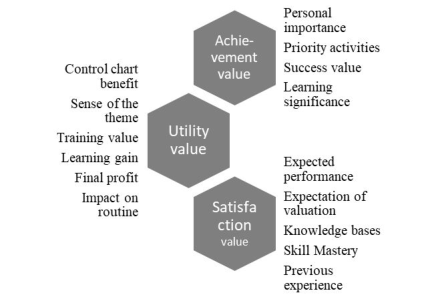
The validated instruments for experts, took aspects of studies prepared by Kosovich et al. (2015) and Østerlie et al. (2019). The procedural aspect of data collection consisted of applying two instruments at the beginning of the international exchange in the 2021.1 semester and at the end of it. The instru- ments have fifteen categories of constructs in relation to the items, sentences, or specific questions of the applied instruments and which are synthesized in the following content of the expectations value model (Figure 1).
Taking into consideration some general lines for the number of options on the Likert scale according to (Simms et al., 2019), a level of five options was taken, then, all items of the instruments used a five-level Likert scale accor- ding to: strongly disagree, disagree, neither agree nor disagree, agree, and totally agree; with whole quantitative evaluations from 1 to 5, respectively.
Student Motivation in Teaching Process during the COVID-19, a Significant Experience 3
Figure 1: Content of expectations value in instruments.
The longitudinal study is established in two moments: the one prior to the academic exchange and the subsequent one, in which pragmatic approa- ches are incorporated into statistical control applications, taking advantage of internationalization scenarios. For this reason, it is decided to use the two- sample hypothesis test for dependent samples suggested by Lind et al. (2019) and Anderson e al. (2020), an initial hypothesis is defined: the mean asses- sment of motivation after the international exchange must be higher than the initial assessment of the control chart students. Where the term motivation can be adjusted to the constructs and/or categories in constructs.
According to Lind et al. (2019) and Anderson e al. (2020), a significance level of 0.05 is selected, identifying the student’s t distribution as the test statistic in which the decision rule is: If p <0.05, the proposed hypothesis is rejected. This process is developed through the Jamovi software.
Results and Discussion
The participation of the students was voluntary, that is, the students could decide between participating and not participating in the evaluation moments through the instruments sent by email using Google forms for their respective completion.
From the data analysis, it was found that of the twenty-seven students who made up the international exchange group, 25 participated in the ini- tial assessment (before moment) and ten participated in the final assessment (after moment), therefore discarding the students who participated only in one of the evaluation moments, the final viable sample for the analyzed data corresponds to a total of eight students.
The voluntary participants were three female and five males, all enrolled in the control charts at the industrial engineering program of the Austral University of Chile.
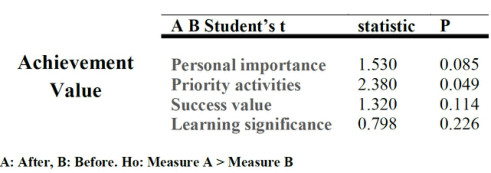
Figure 2 identifies the statistical results of the paired t-test for the achieve- ment value construct, which according to Jones and Hite (2020) and Wigfield and Cambria (2010) establishes a global measure of the level of identification in learning.
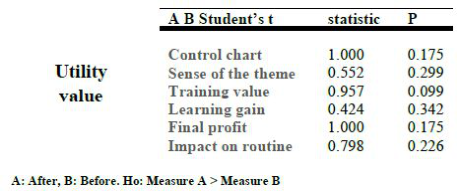
Figure 2: Paired t-test for achievement value.Figure 3: Paired t-test for utility value.
In this case, only the item associated with the priority activities whose phrase in the instrument: “Performing well the activities of the control chart to measure variables is very important to me” should reject the initial hypo- thesis, because p <0.05, that is, the average evaluation of motivation in the specific item associated with the priority activities, after the international exchange, is not higher than the initial evaluation of the control graph stu- dents. For all the other elements of Figure 2: personal importance, value of success and meaning of learning, the hypothesis is accepted. For example, regarding the significance of learning, the question in the instrument “I care how well I do in the control graphs of learning”, leads to affirm that the mean assessment of motivation in the significance of learning, after the internatio- nal exchange, is higher, to the initial evaluation of the students, therefore, the students, after the international exchange, care more significantly how well they do in learning the control charts.
According to Rosenzweig et al. (2020), the utility value construct generates connections between the material they are studying in a course and their own life, that is, its practical utility. The statistical results of the paired t-test for the utility value construct are shown in Figure 3. Then, the initial hypothesis must be accepted, since for each category of utility value, p> 0.05, that is, the average evaluation of motivation in each specific utility item, after the international exchange, is higher than the initial evaluation of the students of control charts. For example, since the hypothesis is valid for the specific category “learning gain” associated with the instrument item: “I have a lot to gain from learning control charts,” then the mean evaluation of learning gain after the international exchange is greater than the initial one.
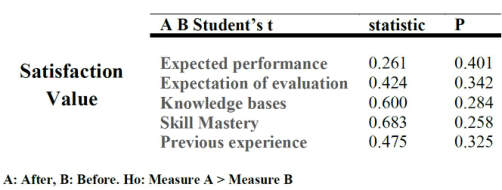
The statistical results of the paired t-test for the satisfaction value con- struct are shown in Figure 4. For the total of the five categories: expected
Student Motivation in Teaching Process during the COVID-19, a Significant Experience 5
Figure 4: Paired t-test for satisfaction value.Figure 5: Average evaluation at the previous time.
performance, the expectation of evaluation, knowledge bases, skill mastery, and previous experience the initial hypothesis is accepted, since in each one, p> 0.05, that is, the Average evaluation of motivation in each specific sati- sfaction item, after the international exchange, is higher than the initial evaluation of control charts students. To exemplify, evaluation expectation, associated with the instrument item: “I think I will do well in the evaluation of control charts”, having ultimately the mean evaluation of the learning gain after the international exchange is greater than the initial one.
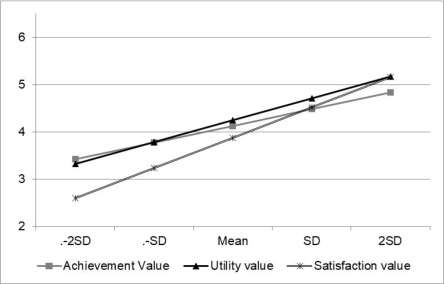
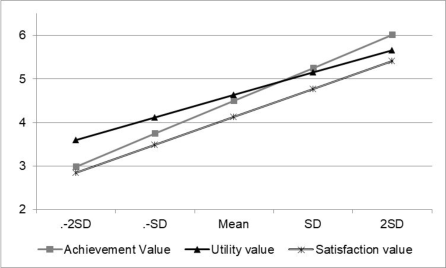
For a better understanding (Morris et al., 2019), they mention about the sensitivity analysis establishing gaps between the evaluation obtained and the maximum score. Figures 5 and 6 show the average evaluation calculated for each construct of the expectations value model at the previous time and at the later time, respectively, the academic exchange. In this sense, having as the maximum possible score on the Likert scale the value of 5, the gaps for the constructs in the previous moment are: 0.87 in achievement value, 0.75 in utility value and 1.12 in satisfaction value; while for the later moment they are: 0.5 87 in achievement value, 0.37 in utility value and 0.87 in satisfaction value.
Figures 5 and 6 also give us the possibility to review the extrapolation of data (Armstrong, 2001) in the possible variation of the results. For exam- ple, in the average evaluation at the previous time an error of one standard deviation it could give a coincidence between the achievement value and the satisfaction value and in two standard deviations it could give a coincidence between the utility value and the satisfaction value.
Figure 6: Average evaluation at the later time.Figure 7: Paired t-test for expectations value.
Performing an analysis of the calculated gap values, we have that the aca- demic motivation factors with the best evaluation both before the academic exchange and after it, in hierarchical order are: utility value, followed by achievement value, closing with value satisfaction, that is, utility is the best valued, followed by achievement and satisfaction value is third. From the perspective of academic exchange, it is observed that all the constructs of the value expectation model improved: the utility value went from 4.25 to 4.63, the achievement value went from 4.13 to 4.5 and the satisfaction value went from 3.88 to 4.13.
In Figure 7, identify the statistical results of the paired t-test for the set of constructs: achievement value, utility value, and satisfaction value. The incorporated data were obtained by taking the average of the mean evalu- ations of the categories of each construct. This leads to affirming that the average evaluation of motivation in all the constructs of the expectations value model, after the international exchange for learning, is higher than the initial evaluation of the students, therefore:
The average assessment of motivation in the achievement construct, after the international exchange, is higher than the initial evaluation of the students.
The average assessment of motivation in the construct of utility, after the international exchange, is higher than the initial assessment of the students.
The average evaluation of motivation in the satisfaction construct, after the international exchange, is higher than the initial evaluation of the students.
It is recommended to maintain the international exchange strategies used, to favor the categories that were better valued with the highest probability of acceptance (p> 0.2), these are:
Student Motivation in Teaching Process during the COVID-19, a Significant Experience 7
In the value of achievement: learning significance.
In the value of utility: the learning gain, sense of the theme and impact on routine.
In the satisfaction value: expected performance, expectation of evaluation, previous experience, knowledge bases and skill mastery.
It is recommended to complement the international change strategies used, to advance in favoring the categories that were well valued with probability of acceptance (p> 0.05) but (p≤0.20), these are:
In the value of achievement: success value and personal importance.
In the value of utility: control chart, final profit and training value.
Finally, it is recommended to design new pedagogical strategies, to adva- nce in favoring the category that was poorly valued with probability of acceptance (p≤0.05), that is:
In the value of achievement: priority activities.
CONCLUSION
The results of the statistical analysis carried out confirm the initial general hypothesis in which it is verified that the change in the didactic strategy in international exchange after COVID-19 has a significant influence on the motivational beliefs of the students, where the factors of the academic moti- vation with better evolution after the academic exchange are in hierarchical order: utility value, followed by achievement value, closing with satisfaction value.
Through the process of association of variables of the expectation value model, it is possible to establish that the levels of relationship between the expectation of success, the value of achievement and the value of utility that the students perceived from the academic exchange process were positive. Therefore, the design and facilitation of the course generated benefits in the observed motivational aspect, so that the work of teachers in remote lear- ning situations in circumstances such as COVID-19, find in the design of international exchanges, significant experiences that can positively impact the motivation of students that it represents to a great extent, which moves them to scenarios with specific behaviors more favorable for learning.
REFERENCES
Anderson, D. R., et al. (2020) Modern business statistics with Microsoft Excel.
Cengage Learning. Armstrong, J. S. (2001) “Extrapolation for time-series and cross-sectional data.”
Principles of forecasting. Springer, Boston, MA. 217–243. Axe, J., et al. (2020) “Student experiences of Open Educational Practices: a systematic literature review.” Journal of e-Learning and Knowledge Society 16.4: 67–75. Doménech-Betoret, F., Abellán-Roselló L., and Gómez-Artiga A. (2017) “Self-
efficacy, satisfaction, and academic achievement: the mediator role of Student- s⣙expectancy-value beliefs.” Frontiers in psychology 8: 1193. Ehlers, U.-D. (2020) “Making Open Educational Practices real. The case of “The Grand Challenge 2020⣞.” Journal of e-Learning and Knowledge Society 16.4: 56–66.
Fielding-Wells, J., O⣙Brien M., and Makar K. (2017) “Using expectancy-value theory to explore aspects of motivation and engagement in inquiry-based lear- ning in primary mathematics.” Mathematics Education Research Journal 29.2: 237–254. Giannini, S. (2020) “COVID-19 y educación superior: de los efectos inmediatos
Charleston, SC: CreateSpace. Jones, L. K. and Hite R. L. (2020) “Expectancy Value Theory as an Interpretive Lens to Describe Factors That Influence Computer Science Enrollments and Careers for Korean High School Students.” Electronic Journal for Research in Science & Mathematics Education 24.2: 86–118. Kosovich, Jeff J., et al. (2015) “A practical measure of student motivation: Establi-
shing validity evidence for the expectancy-value-cost scale in middle school.” The Journal of Early Adolescence 35.5-6: 790–816. Lind, D.A., Marchal W. G, and Wathen S. A. (2019) Basic statistics for business and economics. McGraw-Hill. Marchisio, M., Rabellino S., and Sacchet M. (2020) “Start@ unito as Open
Educational Practice in Higher Education.⣞: 46–55. Morris M., Lloyd H., Salazar O., and Barrientos E. (2019) “Análisis de sensibilidad para la toma de decisiones en el contexto de la producción.⣞. Østerlie, O., Audhild L., and Gørill H. (2019) “The expectancy-value question-
naire in physical education: A validation study among Norwegian adolescents.” Scandinavian Journal of Educational Research 63.6: 869–883. Panchal, J. H., Adesope, O. and Malak R. (2012) “Designing undergraduate design experiences⣔A framework based on the expectancy-value theory.” International journal of engineering education 28.4: 871. Paviotti, G., et al. (2020) “Open pedagogy practices: a case study in undergraduate
education.” Journal of e-Learning and Knowledge Society 16.4: 1–10. Robinson, K. A., et al. (2019) “Motivation in transition: Development and roles of expectancy, task values, and costs in early college engineering⣞. Journal of Educational Psychology 111.6: 1081. Rosenzweig, E.Q., Wigfield A., and Hulleman C. (2020) “More useful or not so bad?
Examining the effects of utility value and cost reduction interventions in college physics.” Journal of Educational Psychology 112.1: 166. Sil, Amrita, and Nilay K. D. (2017) “Informed consent process: Foundation of the researcher-participant bond.” Indian Journal of Dermatology 62.4: 380. Simms, L. J., et al. (2019) “Does the number of response options matter? Psychome-
tric perspectives using personality questionnaire data.” Psychological assessment 31.4: 557. Symes, W. and Putwain D. W. (2016) “The role of attainment value, academic self⣳efficacy, and message frame in the appraisal of value⣳promoting messages.” British Journal of Educational Psychology 86.3: 446–460. Wigfield, A., and Cambria J. (2010) “Expectancy-value theory: Retrospective and
prospective.” The decade ahead: Theoretical perspectives on motivation and achievement. Emerald Group Publishing Limited. Wigfield, A., and Eccles J. (2000) “Expectancy–value theory of achievement motivation.” Contemporary educational psychology 25.1: 68—81.
LISTED IN THE AHFE DIGITAL BOOKSTORE CATALOGUE
Explore the complete digital volume
Training, Education, and Learning Sciences
Read this individual research paper free through the original publisher, or explore the full digital proceedings book.
ISBN 978-1-958651-35-3
Explore this ISBN in the AHFE Bookstore ↗Listed in the July 2026 bookstore catalogue; search by ISBN to confirm current availability · Digital book purchase optional