Katarzyna Ragin-Skorecka, Daria Motała, Agnieszka Stachowiak, Hubert Wojciechowski (2023). Methods and tools in Remote Learning during the Covid-19 Pandemic - a case study. In: Training, Education, and Learning Sciences. AHFE Open Access, vol. 109, pp. 29–41. https://doi.org/10.54941/ahfe1003148
The goal of the paper was to identify which tools and methods were used by teachers for classes conducted in the remote mode during the pandemic. The study was conducted with the application of a survey questionnaire distributed among students and teachers. The survey for students aimed to find out about their perception of their teachers’ involvement and competence in using e-learning tools, as well as students’ preferences regarding individual tools and their usefulness. Teachers answered the questions on how they see their e-learning competence and which tools they found helpful or insufficient. By comparing both perspectives in findings of the surveys we were able to identify similarities and differences in preferences as to tools and methods used in remote learning. On this basis we selected the tools and methods with the highest potential for further, in-depth study. Element determining the proper and effective implementation of online classes is lecturers’ involvement. As the result of the teachers’ positive attitude, the problems that emerged during remote education could be overcome. It turned out that it was possible to master the principles of the use of platforms, both those dedicated by the university and others that the students found useful, even in the highly accelerated mode, where a shift from classroom to virtual teaching took only a few days.
The COVID-19 pandemic has changed the world in almost every aspect and sphere, affecting the way the society, economy and technology function. It also had an impact on the system of education on all levels, from primary sch- ools to university, forcing changes regarding the scope of the applied teaching methods and tools. Although these changes have undoubtedly contributed the extension of the range of instruments teachers have, they were not easy to implement as they required investing resources in the development of tech- nological infrastructure (hardware and software) and training teaching staff. Taking into consideration the heterogeneity of the system of education and differences between various levels and those arising from the educational pro- file, we carried out a study aimed at identifying methods and tools used in remote teaching during the COVID-19 pandemic. We also identified similar
problems on the side of students, who had to cope with the diversity of tools applied in online education.
The aim of the study was to identify which of the available methods and tools were actually and practically applied for conducting online classes. The paper presents the results against the background of the literature-based analysis of problems in online learning and the ways (methods and tools) which enabled eliminating or minimizing them. The designed methodology and the size and cross-section of the research sample allowed us to draw conclusions of a general and universal nature since the examined group was diverse in terms of the level and profile of education (the study of students) and of experience and the scientific profile (the study of teachers).
The authors of the publication are the members of e-learning teams, sup- porting the use of various distance learning solutions. Observing the changes taking place during the months of on-line teaching, a significant increase in the digital competences of lecturers can be noticed. Covid-19 had an impact on the development of these competences, also by accelerating the need for new e-learning solutions, tools and methods in e-learning. The research fin- dings may be useful in different contexts because they help to identify the tools that need particular attention and – due to their popularity and uni- versality – should be perfected. They will also indicate the tools that need support – training and guidance – and properly prepared methodological setting, which assists educators who use them in an online class.
The quality of teaching is influenced not only by a good knowledge of tools, but most of all by the ability to establish relationships with students (Johnston, McGarr, 2021). Education should focus more on supporting kno- wledge acquisition as a cognitive process, rather than improving the bundle of technological solutions used. In this context, the use of good practice in teaching, including remote teaching, as well as the use of well-selected peda- gogical solutions are of importance. These issues are the subject of separate studies, the publications on which are currently under preparation.
THE PROBLEMS RELATED WITH THE USE OF ONLINE PLATFORMS AND TOOLS - LITERATURE REVIEW Online Platforms and Tools Implementation Issues
The period of the pandemic and the resulting interruption of university edu- cation in the traditional form forced a number of changes in the way classes were taught and knowledge passed on. The changes were presented in the literature on the subject.
According to the studies published, the fundamental problem raised by the teachers was the pace of the introduction of the necessary changes in the mode of classes and instant adaptation to the new format, as well as the selection of appropriate tools (Pilkington, Hanif, 2021; Gangwani, Alfryan, 2020). While it was relatively easy to deliver online lectures, it turned out to be very difficult to conduct the other forms, such as classes or laboratories, in a proper and effective way (Pacheco et al., 2021), partly due to the fact that teachers had to learn operating platforms that were new to them (Bacon, Peacock, 2021). Consequently, they faced problems which they had never encountered before,
Methods and Tools in Remote Learning During the Covid-19 Pandemic 31
related both to pedagogical challenges, when the audience’s attention was strongly dispersed (Peper et al., 2021), and technical ones, when teachers had to select the tool and learn to use it in a short time (Sadid-Zadeh et al., 2021; Nelson et al., 2021). The problem of the availability of financial resources - universities which may be underinvested, or teachers and students who cannot afford equipment or software to effectively participate in the learning process – concerns all the stakeholders of the educational process. In many countries, higher education institutions were not prepared to online teaching and financial limitations did not allow them to support the participants of the learning process in the sufficient way (Coman et al., 2020). What may pose another problem is the lack of stable Internet connection. It is a technical aspect strictly connected with the accessibility of resources and there is no doubt that it may be an obstacle to active learning.
Impact on Education Process Although teachers attempted to conduct classes as effectively as possible, fully remote education brought worse results than traditional or hybrid forms (Valladares et al., 2010). It is assumed that this may stem from the fact that students have easier access to information online, at the same time taking advantage of direct interactions that they are accustomed to in the learning process. It was reported that the results obtained in the mixed mode were better than in traditional education (Elzainy et al., 2020). However, what is an important factor in the learning process are interactions with peers and teachers and participation in social media, which has a positive influence on active learning based on cooperation and students’ increased involvement, thus affecting their performance at school (Qureshi et al., 2021).
The crucial importance of human interactions was noticed in the case of problem learning, encouraging to cooperation with peers and teachers, deve- loping the skill of presentation and the use of brainstorm and phenomenon analysis. Such an approach to problems and real-case simulations, plays an increasing role in modern teaching. By devising more complex and realistic training practices, teachers can activate more students at the same time and learning by experience is implemented (Mingorance et al., 2017).
The building of students’ involvement should take into consideration their participation in decision-making in the role of partners both to teachers and universities supporting effective teaching methods (Heilporn, Lakhal, 2021). When teachers used techniques based on cooperation and focused on the audience, students were more involved in acquiring knowledge (Öncü, Bich- elmeyer, 2021). However, what remains the best determinant of students’ performance is the motivation (Santomil et al., 2016) of both themselves (they want to draw from the knowledge transferred to them) and of teachers, who are willing to use the available educational tools to pass on knowledge. Thus, to benefit from students’ involvement and stay in line with pandemic limitation universities have been differentiating their education composition by implementing hybrid mode.
Organization of Teaching Process The use of teaching methods and tools is also determined by the form of con- ducting classes – synchronic or asynchronous (Heilporn et al., 2021). In the case of the former, active learning (e.g., problem solving) or team learning (e.g., debate) bring better results because students’ behavioural and cognitive engagement increases. Teachers at online courses mainly relied on debates with students, where discussions in small and big groups and questionnaire applications were used alternately. In the asynchronous form, in turn, the strategies used include the application of auxiliary digital tools and proposing the final semester grade on the basis of only a few marks. Students’ behaviou- ral involvement may be targeted here through the selection of proper digital tools and frequent online testing.
The students for whom the synchronic form was the main way of remote learning showed more involvement and motivation. What is more, those who were taught with the use of active learning techniques, which are inherently more social, exhibit the significantly higher level of engagement, motivation, and pleasure in and satisfaction with learning (Nguyen et al., 2021).
One of the tools that are worth applying is a case study, which, suppor- ted with IT solutions, allows students to gain the extensive knowledge of the presented subject. What is the key is the participation of the teacher as a co-participant in the learning processes, facilitated by advanced information technologies (Garrison, 2000)? The findings of studies conducted in this field (Webb et al., 2005) indicate that the hybrid approach and the application of technologies in case study-based learning may prove more effective than exclusively online or classroom instruction. It is particularly recommendable to apply such solutions as a tool for monitoring attendance and gathering students’ responses to questions asked during real-time classes, including que- stionnaires and chats, to engage class participants directly (Garcia-Vedrenne et al., 2020).
In remote and hybrid learning, however, one has to take into account technical and technological limitations, and the effectiveness of classes is dependent on the use of different videoconferencing software and other digital tools (Moorhouse, Kohnke, 2021). Despite the fact that a lot of such solutions (synchronic and asynchronous) were developed and impro- ved during the pandemic, there are still some restrictions concerning their use, which is reflected in their evaluations and the large number of people who abandon them (Clarke, 2013). They indicate technical limitations as the most frequent obstacle to using them (Rodríguez-Rodríguez et al., 2020).
In teaching, particularly in its remote form, psychological limitations are raised as the most serious problem (especially difficulties in concentration). About 80% of 350 students under survey claimed that it was more diffi- cult for them to focus attention and remain present during online classes (Peper et al., 2021). What is more, new challenges emerge, especially at HyFlex (mixed) classes (Moorhouse, Kohnke, 2021). The students repor- ted that the feelings of isolation, anxiety and depression experienced while being in the virtual reality negatively affected the dynamics of relations betw- een them and teachers (because of the lack of body language) (Peper et al.,
Methods and Tools in Remote Learning During the Covid-19 Pandemic 33
2021). The teachers had neither technical skills nor the ability to adapt their professional tools to the specific nature of the online learning environment (Nelson et al., 2021). It is particularly evident in the case of the asynch- ronous form, which enhances this impression, making effective interaction impossible (Rodríguez-Rodríguez et al., 2020).
One of the forms which stimulates students’ creativity and teamwork is the synchronic virtual classroom, which, however, requires the application of attractive interfaces (De Castro et al., 2020), accurately combining the use of psychological and technical aspects, because the latter ones may hamper com- munication in some cases (Bower et al., 2020). It also happens that students are enthusiastic about online courses and believe that they are an interesting solution, but organizational and administrative issues hinder the implementa- tion of virtual, extended or HyFlex classes due to legal or financial limitations (Sarker et al., 2019).
RESEARCH METHODOLOGY The conducted research was of a case study and a pilot that was the starting point for the development of an international project, bringing together four European universities (Spanish, Polish, Slovenian and Italian). The presented results relate to the Polish university.
The study collected the opinions of students and teachers regarding methods and tools used for online learning during the COVID-19 pandemic.
Two main goals were assumed based on identified research gap and due to changes in environment and the emerging need for online teaching. The first was the evaluation of teaching by students, the second was evaluation the methods and tools of distance learning by teachers. Students were to assign notes to teachers’ commitment and their knowledge of the tools used for distance learning. These areas were treated as specific objectives. On the other hand, the lecturers, as part of the implementation of the main objective, which concerned their assessment, were asked to evaluate the tools used to transfer knowledge and separately to evaluate those intended to verify the knowledge of the students. This constituted two further specific objectives considered in the course of the works.
The research was carried out in two stages. They began with collecting information from students, and then a questionnaire addressed to teachers was developed on the basis of this information.
To reach to aims stated for the study, the research team posed the following research questions:
How was the teachers’ involvement in classes evaluated by the students?
How is the teachers’ competence evaluated by the students and the teachers themselves?
What tools were used in remote learning?
What tools were used for verifying learning effects?
The study referring to the methods and tools used in remote education consisted of two parts. The first stage was a questionnaire survey with the use of CAWI method of the students at the selected university in Pozna´n.
We received responses from 2,760 students of the 1st (finished with engineer title −7 semesters) and 2nd (finished with MSc title −3 semesters) cycle of studies, which makes about 25% of the entire students’ population. At the second stage, the employees of the same university were examined. We obtai- ned responses from 317 teachers, which makes about 40% of the population. The study of both groups was conducted at the end of the summer semester of 2020.
The research was conducted ethically, it was not obligatory, students and teachers were invited yet not obliged to answer, there were no consequences of answering or not answering the questions as the survey was anonymous. The authors as members of online-teaching support teams were entitled to conduct the research by the authorities of the university, as the results were supposed to support online and hybrid teaching during the pandemic and in post-pandemic times.
The information obtained from the students and teachers was analysed in four aspects related to the research questions: the teachers’ involvement in conducting online classes, their competence regarding the use of availa- ble tools, the spectrum of e-learning tools used and the scope of their use for verifying learning effects. On the basis of the information collected, not only did we present specific conclusions, but we also undertook to devise the scope and principles of supporting academic staff in the subsequent periods of remote education.
THE STUDY FINDINGS Teachers’ Involvement and Competence
What is one of the most important aspects of effective teaching in any con- ditions is teachers’ involvement. This is even more important for conducting remote classes because they often involve additional difficulties, both of the educational and technical nature.
Involvement is understood as devoting time and energy to performing specific tasks. Therefore, the question about the involvement of teachers pre- ceded the acquisition of information about their knowledge and the use of distance learning methods and tools. Getting to know the ways of using them required from the teachers a great effort, searching for optimal solutions and finding the ones that best meet both the requirements of the subject and the abilities of the students and the teacher.
That is why one of the first questions to students concerned their asses- sment of teachers’ engagement and inventiveness during online classes. The analysis of responses shows that most of them, i.e., almost 65% gave the good or very good mark to their teachers in this respect (n = 84). The students assessing teachers had some off-line and online experience with classes and that made their opinion important – they could see whether the involvement increased or decreased.
The recipients’ high evaluation is determined not only by the willingness to transfer knowledge in an interesting way, but also the teachers’ knowledge of the tools used and their comprehensive ability to use them. It allows them to
Methods and Tools in Remote Learning During the Covid-19 Pandemic 35
focus on the content they present because this process is not disturbed by the need to solve technical problems, which may appear if one cannot operate online teaching tools. The speed of the introduction of necessary changes in teaching forms and the necessity of mastering proper tools in a very short time were also highly evaluated by the respondents. As many as 65% of them assessed the teachers’ skills of operating e-learning platforms as very high, while 50% believed that their teachers could make full use of the functions offered by these platforms. These questions were answered by more teachers than the others, hence the sample is 407.
The students’ evaluations are reflected by the results of the study condu- cted among the teachers. More than 50% of them assess their competence regarding remote teaching as very high, while almost 40% as good, which is largely consistent with the students’ appraisal.
IT Solutions Applied in Remote Learning The IT tools in remote learning have a wide array of applications because, in the students’ opinion, more than a half of the teachers (about 55%) conduct more than 60% of their classes via platforms dedicated to remote commu- nication and education. Only 2% of the respondents report that they are occasionally used at less than 20% of the classes. The analysis of the detailed results shows that with respect to lectures, these values are even higher with almost a half of the academics delivering lectures exclusively in the remote form.
In the course of the research, not only did we undertake an attempt to evaluate the use of e-learning platforms as a universal tool for conducting online classes, but we also tried to find out which of the available solutions was the most often used by teachers. Consequently, another analysed ele- ment was the frequency of the use of a given tool which supports remote teaching. The results indicate that BBB (Big Blue Button), electronic mail and Moodle (e-courses) dominate at the selected university. The main reason behind these findings is the fact that these systems were proposed by the uni- versity. Apart from the platforms listed above, the respondents also indicated, among others: Ms Teams, Trello, YouTube, Cisco WebEx, Google Meet.
Not only were lectures, classes, laboratories and projects conducted in the remote form, but also consultations took place through online communi- cation tools. Among the tools used for online consultations, BBB platform, electronic mail and Moodle (e-courses) prevail. Skype and Facebook were also frequently used.
The responses given by the students were compared with those of the tea- chers. The analysis of the study findings concerning the use of remote learning tools in the teachers’ opinions reveals that the BBB system, electronic mail and Moodle (e-courses) were the most frequently used, which is consistent with the responses received from the students. The biggest discrepancy is observed as regards the application of Zoom and MS Teams. The teachers indicated them as the tools they relatively often use, while the students used them to a limited degree and MS Teams did not appear in their answers at all. Consul- tations are the form of interaction that students are not obliged to use. It is
thus possible that the teachers planned meetings on Zoom or MS Teams plat- forms, in which the students did not take part, which resulted in differences in the research findings.
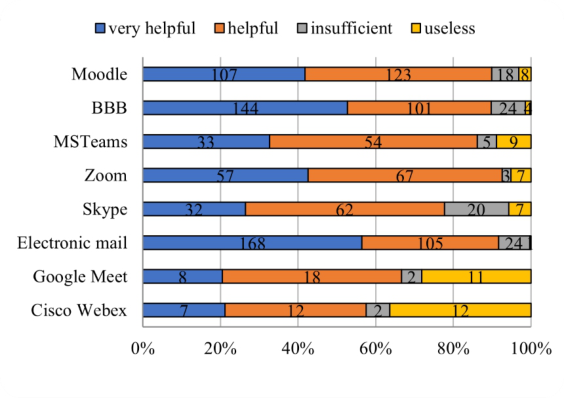
Having collected the information about the tools used, we also asked the teachers to evaluate a given tool in remote learning. Fig. 1 presents the data related to the usefulness of the most popular tools among the teachers. They find the three most frequently used tools (BBB, electronic mail and Moodle) to be helpful or very helpful. It should also be pointed out that Zoom, Skype and MS Teams received very high marks.
During classes and consultations, the teachers used a large number of tools, which proves their ability to respond to new circumstances on the one hand, but, on the other hand, may pose problems to the students, who also had to learn how to use them. We believe, however, that the diversity of tools for online learning at university is a positive aspect because it shows a wide spectrum of solutions applied for transferring knowledge in the remote form, which may make the future selection of communication tools by graduates more conscious and rational rather than driven by fashion.
The Verification of Learning Outcomes The process of transferring knowledge often ends with checking its level. Therefore, the last set of questions referred to the verification of learning outcomes. As one of the methods of testing it, the university where we colle- cted data proposed the use of the Moodle platform (e-courses). The students indicated that most teachers (almost 75%, n = 340) used its “test” function to verify the level and range of knowledge. It probably concerned mainly the evaluation of the knowledge of lecture content.
Figure 1: The usefulness of selected tools in remote learning in teachers’ opinions (the figure shows the number of indications). Source: authors’ own work (n = 317).
Methods and Tools in Remote Learning During the Covid-19 Pandemic 37
However, it was not the only form applied, which is reflected in the answ- ers to the question about the most often used methods of verifying learning outcomes within the framework of classes or laboratories. The respondents indicated short-term tasks, long-term projects and class reports as the domi- nant ones (the study was based on the multiple choice). All the activities mentioned by the students can and were implemented via Moodle platform (e-courses).
The wide use of Moodle (e-courses) for verifying the acquired knowledge and skills is supported by its evaluation by teachers, which ranks it the highest among other possible tools.
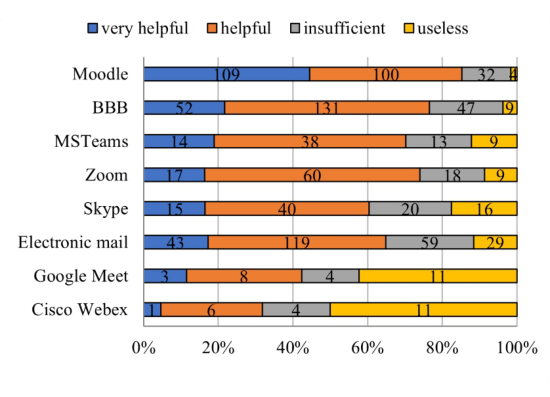
The last results refer to the evaluation made by the teachers regarding remote learning tools used for verifying students’ knowledge. According to the teachers, the tools they most often used were also the ones that helped them the most in verification (Fig. 2).
Discussion The research on online teaching and learning had been conducted even before the pandemic started as the concept and its implementation is not new. The early publications introduced various approaches to the online teach- ing implementation and one of the interesting ones is the two-step approach including (Shailendra et al., 2018):
1. implementation of learning strategy 2. selecting technology to implement the strategy In pandemic times the second step - of an operational nature - became more important - due to the time pressure. Teachers focused on selecting technologies.
Figure 2: The evaluation of tools regarding their use for verifying knowledge in teach- ers’ opinions (the figure shows the number of indications). Source: authors’ own work (n = 317).
It was BBB, Moodle (e-courses), Ms Teams, Zoom and Skype that were used in the analysed university. Their use was usually complementary, which stemmed from the limitations of the functionality of the particular tools and from the fact that both the teachers and class participants did not have the sufficient knowledge of them. It seems that it is Moodle (e-courses) that is the simplest method to pass on materials and verify knowledge in the form of tests or tasks performed by students. Meetings in the synchronic mode are, in turn, best implemented with the application of the other mentioned plat- forms (Pacheco et al., 2021; Sadid-Zadeh et al., 2021; Nelson et al., 2021). More than a half of the examined students believe that their teachers have the sufficient knowledge of these tools. The teachers also evaluate their own competence highly because over 50% of them declare that they can use them without any problems.
The scope of application of the particular platforms depends on the asses- sment of their functionality in specific activities. As regards transferring knowledge, it was – beginning from the biggest number of indications - BBB, Moodle, Zoom, Ms Teams and Skype that were found the most use- ful. What is interesting is the fact that electronic mail is the most frequently medium used for these purposes. It is due to the fact that teachers have maste- red it before and they do not need to learn any additional skills to operate it, which was the consequence of necessity of fast adaptation to pandemic terms (Pilkington, Hanif, 2021; Gangwani, Alfryan, 2020). Thus, before they have learned at least the basics of the tools dedicated to communication and transferring materials, the traditional ways of interacting with others were used.
In the post-pandemic era, the approach to online education implementa- tion has shifted to its original form and strategic issues are becoming of the higher importance again (Lockee, 2021).
CONCLUSION
Our study had at least two aims. The first of them was to gather informa- tion about the assessment of teaching in the first semester that was wholly conducted in the remote mode. Owing to the survey carried out among the students and teachers, we were able to gather sufficient data to perform such an evaluation.
What is the most significant determinant of the properly and effectively conducted class is teachers’ involvement? This element was highly assessed by the students. As the result of such a positive attitude, the difficulties that had to be faced in the course of remote education turned out to be sur- mountable, which have also affected students, especially in terms of their commitment and motivation (Santomil et al., 2016; Heilporn, Lakhal, 2021; Öncü, Bichelmeyer, 2021; Nguyen et al., 2021). The task of mastering the principles of operating the platforms, both dedicated by the university and others that were found useful, turned out to be possible to implement even in a very accelerated mode.
Two conclusions thus arise. The teachers showed a lot of involvement, trying to maintain contact with the students by all possible means. On the
Methods and Tools in Remote Learning During the Covid-19 Pandemic 39
other hand, they had to fill in the blanks in their knowledge of technical solutions concerning remote learning.
Here, the other aim of the survey appears. Namely, we attempted to iden- tify the gaps in the knowledge of online tools in order to define the necessary areas and methods of support to teachers. The effects of such activities, under- taken basically from the beginning of remote education, are evident in the results of the survey itself. Thanks to improved knowledge of tools, it is possible to adjust them to content provided, which affects their better under- standing by the students (Heilporn et al., 2021). Students’ knowledge was verified mainly on Moodle. It is usually done at the end of the semester, so the indication of this platform as the most useful one for evaluating the scope and level of knowledge reflects the relatively good knowledge of this tool after three months of online learning (Valladares et al., 2010; Elzainy et al., 2020). The information obtained in the course of the study allowed us to carry out the preliminary identification of the existing gaps in the knowledge of tools, which are helpful, or sometimes necessary, to conduct remote learning. In order to specify them, further study among the users of the particular platforms would have to be done and the problems they face while operating them would have to be monitored (Coman et al., 2020; Rodríguez-Rodríguez et al., 2020). The object of the study was a selected university but the research results are in line with those presented in the literature, which makes the need for improvement even more justified and allows some generalization (the study was a case, yet consistent with worldwide observations, though there were some differences arising specifically from availability of infrastructure (hardware and software), poor internet access and previously used/promoted teaching mode. These differences were mostly observed between countries at various level of economic development and social welfare (Webb et al., 2005; Garrison, 2000; Peper et al., 2021; Moorhouse, Kohnke, 2021).
The research is continued within the framework of an international pro- ject aimed at developing a system which would help teachers and students to properly choose (in pedagogical and technical terms) and learn to use the tools which are adapted to their needs. Hence, the further research directi- ons include aspects such as teacher involvement, competence and evaluation to student’s learning. This project is currently being implemented by all the authors of this publication.
REFERENCES
Bacon, K. L., Peacock, J. (2021). Sudden challenges in teaching ecology and aligned disciplines during a global pandemic: Reflections on the rapid move online and perspectives on moving forward. Ecology and Evolution, 11 (8), pp. 3551–3558. Bower M., DeWitt D., Lai J. W. M. (2020), Reasons associated with preservice tea-
chers’ intention to use immersive virtual reality in education, British Journal of Educational Technology Vol. 51 No. 6, pp. 2214–2232. Clarke T. (2013), The advance of the MOOCs (massive open online courses) The impending globalization of business education?, Education & Training Vol. 55 No. 4/5, pp. 403–413.
Coman C., Tîru L. G., Mesesan-Schmitz L., Stanciu C., Bularca M. C., 2020, Online Teaching and Learning in Higher Education during the Coronavirus Pandemic: Students’ Perspective, Sustainability 12 (24). De Castro P. A., Barros V. F. A., Leão C. P., Masa J. A. (2020), Diversity of metho-
dologies and of approaches in the education: when the whole is greater than the sum of the parts, Brazilian Journal of Education, Technology and Society, v. 13, n. 3, pp. 272–278. Elzainy, A., El Sadik, A., Al Abdulmonem, W. (2020). Experience of e-learning and online assessment during the COVID-19 pandemic at the College of Medi- cine, Qassim University. Journal of Taibah University Medical Sciences, 15 (6), pp. 456–462. Gangwani, S., Alfryan, L. H. (2020). Impact of online teaching strategies on student
engagement in higher education during global lockdown in Riyadh. Academy of Strategic Management Journal. 19 (6). Garcia-Vedrenne, A. E., Orland, C., Ballare, K. M., Shapiro, B., Wayne, R. K. (2020).
Ten strategies for a successful transition to remote learning: Lessons learned with a flipped course. Ecology and evolution, 10 (22), pp. 12620–12634. Garrison, R. (2000). Theoretical challenges for distance education in the 21st century: A shift from structural to transactional issues. International Review of Research in Open and Distance Learning, 1(1), pp. 1–17. Heilporn, G., Lakhal, S. (2021). Converting a graduate-level course into a HyFlex
modality: What are effective engagement strategies?. The International Journal of Management Education, 19 (1). Heilporn, G., Lakhal, S., Bélisle, M. (2021). An examination of teachers’ strategies to foster student engagement in blended learning in higher education. International Journal of Educational Technology in Higher Education, 18 (1), pp. 1–25. Johnston K., McGarr O. (2021), Digital education futures in Irish educational policy:
tempering commercial influence through an exploration of emerging ethical, envi- ronmental and educational realities, Irish Educational Studies, Vol. 41, No. 1, pp. 135–149. Lockee, B. B. (2021) Online education in the post-COVID era. Nat Electron 4, pp. 5–6. Mingorance, A. C.; Trujillo, J. M.; Cáceres, P.; Torres, C. (2017), Improvement of
academic performance through the flipped classroom methodology centered in the active learning of the university student od education sciences, Journal of Sport and Health Research, 9, pp. 129–136. Moorhouse B. L., Kohnke L. (2021), Thriving or Surviving Emergency Remote Teaching Necessitated by COVID-19: University Teachers’ Perspectives, The Asia-Pacific education researcher Vol. 30 (3), pp. 279–287. Nelson, T., Nelson, G., Rothen, M., Kim, A. (2021). Comparison of in-person and
remote pediatric dentistry lectures before and during the COVID-19 pandemic. Journal of Dental Education, pp. 1–3. Nguyen T., Netto C. L. M., Wilkins J. F., Bröker P., Vargas E. E., Sealfon C. D., Puthipiroj P., Li K. S., Bowler J. E., Hinson H. R., Pujar M. and Stein G. M. (2021), Insights Into Students’ Experiences and Perceptions of Remote Learning Meth- ods: From the COVID-19 Pandemic to Best Practice for the Future, Frontiers in Education, vol. 6 pp. 1–9. Öncü, S., Bichelmeyer, B. A. (2021) Instructional practices affecting learner engage-
ment in blended learning environments, Participatory Educational Research (PER) Vol. 8 (3), pp. 210–226.
Methods and Tools in Remote Learning During the Covid-19 Pandemic 41
Pacheco, L. F., Noll, M., Rodrigues Mendonça, C. (2021). Challenges in Teaching Human Anatomy to Students with Intellectual Disabilities During the Covid-19 Pandemic. Anatomical Sciences Education, 13, pp. 556–557. Palvia S., Aeron P., Gupta P., Mahapatra D., Parida R., Rosner R., Sindhi S. (2018)
Online Education: Worldwide Status, Challenges, Trends, and Implications, Journal of Global Information Technology Management, 21:4, pp. 233–241. Peper, E., Wilson, V., Martin, M., Rosegard, E., Harvey, R. (2021). Avoid Zoom Fatigue, Be Present and Learn. NeuroRegulation 8 (1), pp. 47–56. Pilkington, L. I., Hanif, M. (2021). An account of strategies and innovations for
teaching chemistry during the COVID-19 pandemic. Biochemistry and Molecular Biology Education, 49, pp. 320–322. Qureshi M. A.; Khaskheli A.; Qureshi J. A.; Raza S. A.; Yousufi S. Q. (2021), Factors affecting students’ learning performance through collaborative learning and enga- gement, Interactive Learning Environments 2021, Ahead-of-print, pp. 1–21. Rodríguez-Rodríguez E., Sánchez-Paniagua M., Sanz-Landaluze J., Moreno-Guzmán
M. (2020), Analytical Chemistry Teaching Adaptation in the COVID-19 Period: Experiences and Students’ Opinion, Journal of chemical education Vol. 97 (9), pp. 2556–2564. Sadid-Zadeh, R., Wee, A., Li, R., Somogyi-Ganss, E. (2021). Audience and Presenter Comparison of Live Web-Based Lectures and Traditional Classroom Lectures During the COVID-19 Pandemic. Journal of Prosthodontics, 30 (5), pp. 1–8. Santomil, P. D., Sanfiz, J. M. M., Pazos, D. R., Agra, S. C. (2016). Determinants Of
Students’ Performance In An Accounting Subject: The Case Of Students At USC. REDU-REVISTA DE DOCENCIA UNIVERSITARIA, 14(1), 151–178. Sarker M. F. H., Mahmud A. R., Islam M. S., Islam M. K. (2019), Use of e-learning at higher educational institutions in Bangladesh Opportunities and challenges, Journal of applied research in higher education Vol. 11 (2), pp. 210–223. Valladares, L. M., Cooper, K., Conejero, J. S., Castillo, L. C., Robledo, M. G. (2010).
Analysis of three educational modalities according to student profile and acade- mic performance. 2nd International Conference on Education and New Learning Technologies, pp. 1080–1086. Webb, H. W., Gill, G., Poe, G. (2005). Teaching with the case method online: Pure versus hybrid approaches. Decision sciences journal of innovative education, 3 (2), pp. 223–250.
LISTED IN THE AHFE DIGITAL BOOKSTORE CATALOGUE
Explore the complete digital volume
Training, Education, and Learning Sciences
Read this individual research paper free through the original publisher, or explore the full digital proceedings book.
ISBN 978-1-958651-85-8
Explore this ISBN in the AHFE Bookstore ↗Listed in the July 2026 bookstore catalogue; search by ISBN to confirm current availability · Digital book purchase optional