Carlos Albarrán Morillo, Micaela Demichela (2023). A Data-Driven Framework to Model Physical Fatigue in Industrial Environments Using Wearable Technologies. In: Neuroergonomics and Cognitive Engineering. AHFE Open Access, vol. 102, pp. 160–170. https://doi.org/10.54941/ahfe1003016
Industry 4.0 is the tendency towards automation and data exchange in manufacturing and the process sector. However, many manual material handling and repetitive operations can still cause the operators fatigue or exhaustion. Once the operator experiences physical fatigue, their performance decreases. The consequences may result in reduced production quality and efficiency and increased operational human errors that could give rise to incidents and accidents. Over time, physical fatigue can result in more adverse effects for the operators, such as Chronic Fatigue Syndrome (CFS) and Work-related Musculoskeletal Disorders (WSMD). For this reason, from an occupational health and safety point of view, the operator's physical fatigue must be managed. The increasing availability of wearable devices combined with health information can provide real-time measuring and monitoring of physical fatigue in the operational environment while minimally influencing the primary job. This paper presents a physiological signal-based approach using a non-intrusive wristband for continuous health monitoring to predict physical fatigue in industrial-related tasks. These data are used as input to classification algorithms to detect physical fatigue. Accurate and real-time physical fatigue detection helps to improve operator safety and prevent work accidents. Future work will deploy the model in a real-world environment in the industry.
INTRODUCTION, BACKGROUND AND LITERATURE REVIEW Industry 4.0 is the current trend of using advanced technologies such as IoT, AI, and robotics in industrial settings to improve automation, analysis, and maintenance efficiency (Rubmann et al. 2015). However, the human factor cannot be ignored as it directly impacts production and safety performance. For example, operators who have not trained adequately or are stressed or fatigued can make mistakes or errors that disrupt production, lead to delays and even accidents or injuries. Therefore, considering the human factor and implementing measures to minimize the risk of errors is essential to enhance the safety and effectiveness of production operations (Albarrán Morillo et al. 2022). Despite technological advancements and automation, much manual
A Data-Driven Framework to Model Physical Fatigue in Industrial Environments 161
material handling and repetitive operations, such as lifting, pushing, pulling, and carrying a load, can still cause operators fatigue or exhaustion. These tasks can be physically and mentally challenging and strain workers, leading to fatigue, harm, and other health problems. Fatigue is a decline in men- tal and/or physical performance caused by excessive working time or poorly designed shift patterns (Sharpe, 1991). There are two main types of fatigue, physical and mental. Physical fatigue is tiredness or exhaustion caused by physical efforts, such as lifting heavy objects or working long periods. Men- tal fatigue is a feeling of tiredness or exhaustion caused by mental exertion, such as solving complex problems or making decisions. Both physical and mental fatigue can have severe consequences for workers, affecting their per- formance, safety, and well-being (Yung et al. 2016). Therefore, it is essential to identify and manage workplace fatigue to prevent accidents and ensure workers perform at their best. The related work focuses on physical fatigue, a critical and common issue in industrial environments due to high-demand tasks and long duty times. Manufacturing, construction, or mining wor- kers must perform physically demanding tasks for long periods, leading to physical fatigue. Short-term effects of physical fatigue can result in distress, decreased physical capacity, and reduced motor control. These effects have a range of negative consequences, including increased accidents, reduced per- formance, and deficits in work quality (Cavuoto and Megahed, 2016). Over time physical fatigue effects can develop into more adverse health outcomes (Yung et al. 2016), such as Chronic Fatigue Syndrome (CFS), work-related musculoskeletal disorders (WMSD) and decreased immunological function. CFS is a medical condition characterized by severe and persistent fatigue that is not improved by rest and can have various physical and mental symptoms. WMSD are a group of conditions that affect the muscles, tendons, and other delicate tissues, caused by repetitive or harsh physical activities leading to pain, immobility and other symptoms. Chronic fatigue can also reduce immu- nological function, making the body more vulnerable to infections and other health problems (Yung et al. 2016).
Studies have shown that physical fatigue and related health issues such as WMSDs have high financial costs (Yung et al. 2014). These costs include lost productivity due to absenteeism and increased medical expenses for tre- ating injuries. These issues are estimated to cost billions of dollars annually worldwide.
Based on the overhead discussion, the researchers must study the conditi- ons that cause physical fatigue to develop strategies for detecting, measuring, and handling it (Kumar, 2001). Fatigue is a subjective feeling, and the level of fatigue an individual experiences differs depending on factors such as overall health and well-being, job demands, and circumstances. Researchers often rely on self-reported measures of fatigue, such as the “Rated Perceived Exer- tion (RPE)” or “Borg test,” which is a tool that measures an individual’s perception of their physical exertion (Borg, 1982). The scale ranges from 6 to 20, with 6 indicating no exertion and 20 indicating maximum exer- tion. This method is subjective and might be influenced by factors such as an individual’s mood or willingness to report fatigue accurately. Additionally,
162 Morillo and Demichela
these methods are typically limited to laboratory environments and may not provide real-time results in real-world settings.
There are alternative methods for measuring a person’s level of exer- tion, such as posture and musculoskeletal stress analysis. However, these methods have limitations, such as real-time feedback and the need for trai- ned personnel to perform the measurements accurately. Some examples of these strategies include the Posturegram, Ovako Working Postured Analyzing Systems (OWASA) and the Rapid Upper Limb Assessment (RULA).
Wearable technology has come a long way in recent years. It is now possi- ble to use devices like smartwatches and fitness trackers to monitor various physiological signals, such as heart rate, body temperature, and brain activity. Wearable technology is used in diverse industrial and professional settings to monitor the internal state of operators, such as in the aviation and health- care industries. In addition, the increasing availability of wearable devices that collect physiological responses has the potential to provide real-time monitoring and measuring of the consequences of physical fatigue in real- life environments (Kim and Nussbaum, 2013). This data-driven analysis uses sensors to collect the physiological signal changes in the body and estimate an individual’s level of fatigue via machine learning algorithms.
Despite the ample use of wearable devices in physical fatigue monitoring and prediction, the applications are restricted to three disciplines; monitoring athletes, driver sleepiness detection systems in transporting and sleep-induced exhaustion in mining. In other physically demanding domains, such as the manufacturing and process sector, the number of applications related to physical fatigue detection is limited. This is due to the need for precise guide- lines or regulations regarding their use in these settings. From an exhaustive literature examination on the use of wearable devices for physical fatigue detection in industrial environments, 574 papers were retrieved. Several databases, including Google Scholar, Web of Science, ScienceDirect, Scopus and PubMed, were examined using keywords such as physical fatigue, exh- austion, sensor, wearable, detection, manufacturing, process industry and chemical engineering. The final inclusion criteria were: studies related to phy- sical fatigue exclusively, forecasts or classifications that collect biometrical signals and the study’s publication in a peer-reviewed journal or conference proceedings after 2010.
Eleven articles were included in the review on physical fatigue detection in industrial environments (see Table 1).
The associated literature mainly utilizes pervasive sensors such as IMUs and heart rate monitors to understand an individual’s physical fatigue levels. They also employ EMG sensors and motion capture data to predict fatigue by analysing movement patterns and speed changes. Studies focus on three simulated industrial tasks involving manual material handling, supply picks up and insertion, and parts assembly, to provoke physical fatigue. Worker physical fatigue quantification is divided into two main groups, classifica- tion and forecasting. Classification studies aim to develop models that can accurately assign a fatigue level to a worker based on their physiological or behavioural data. In contrast, forecasting studies aim to predict future fatigue
A Data-Driven Framework to Model Physical Fatigue in Industrial Environments 163
Table 1. Physical fatigue quantification using wearable devices in industrial settings.
Table available in the original PDF paper.
Study Fatiguing Task Devices Input data Modeling approach RF, SVM (Nagahanumaiah et al. 2022)
HR, RES, EMG
Pick and Place task BioHarness (chest-strap), Myo armband (Sedighi Maman et al. 2020) Not stated IMUs, HR, Borg RPE
LogR, SVM, RF, RF with bagging, RF with boosting
Supply Pickup and Insertion Task (SPI), Manual Material Handling (MMH) (Nasirzadeh et al. 2020) Part Assembly Task (PA), SPI, MMH Polar CR800X Borg RPE, HR
KNN, NV, DT, RF, RI, NN, LR, LogR, LDA Borg RPE, 3D motion LSTM, GRU, PCA
(Hernandez et al. 2020) MMH Hexoskin ®Shirt, Hexoskin ®Smart Device, Qualisys cameras (Narteni et al. 2022) MMH 2 Borg RPE, IMUs, HR
(Escobar-Linero et al. 2021) (Sedighi Maman et al. 2017) PA, MMH, SPI Shimmer3, Polar CR800X
IMUs, HR, Borg RPE
LASSO model with RUS sampling SVM with RBF
(Baghdadi et al. 2018) MMH Shimmer3 IMU, Borg Rate (Lambay et al. 2021) 7 7 7 LSTM
(Lambay et al. 2022) MMH Not stated IMUs, HR, Borg RPE
DT, RF, GB, NB, KNN, LogR, SVM (Hajifar et al. 2021) MMH Not stated IMU, Borg RPE Naïve method, AR, VAR, VECM, ARIMA
HR, heart rate; RES, respiration; EMG, electromyography; IMUs, inertial measurement units; RPE, Rate of Perceived Exertion); RF, Random Forest; LLM, Logic Learning Machine; DT, Decision Tree; NN, Neuronal Network; SVM, support vector machines; XGBoost, eXtreme Gradient Boosting; KNN, k- nearest neighbors; NV, Naïve Bayes; RI, Rule Induction; LR, linear regression; LogR, logistic regression; LDA, linear discriminant analysis; LSTM Long Short-Term Memory; GRU, Gated Recurrent Unit; PCA, Principal component analysis; LASSO, Least Absolute Shrinkage and Selection Operator; RUS, Random Under Sampling; RBF, radial basis kernel function; GB, Gradient Boosting; AR, autoregressive; VAR, Vector autoregression; VECM, vector error correction model; ARIMA, autoregressive integrated moving average.
levels using historical data. There are several limitations to the studies that should be acknowledged:
Most of the tasks used to produce physical fatigue in participants may be perceived as uninteresting by some individuals, affecting experiment results and the accuracy of self-reported ratings of perceived exertion. To reduce this potential bias, researchers must consider looking for more pleasurable exercises for their experiments and keeping participants
164 Morillo and Demichela
motivated and engaged, providing more accurate and reliable data on physical fatigue.
Small datasets limit the training of a deep neural network by reducing variability in the data, making it hard to detect patterns and leading to biases in the analysis and conclusions. Depending on the dataset small sample size may also make it difficult for the model to generalize to new examples, resulting in poor performance on unseen data.
The conditions and variables in a controlled laboratory setting may dif- fer from those in a real-world environment. As a result, it is difficult to determine whether the differences observed in a study would be practically significant in field applications.
While several studies have shown that certain demographic factors, such as age and gender, can influence an individual’s likelihood of experiencing fatigue, it is unclear how these factors affect an industrial environment. In industrial conditions, many other aspects also contribute to fatigue, such as the type of work being conducted, the length of shifts, and the level of physical requests.
In binary classification, there are only two possible levels or categories (e.g., “fatigued” and “not fatigued”). However, this approach must be more complex and adequately capture the full range of fatigue levels. Contrastingly, a multi-level classification with 3 or 5 levels allows for a more granular and comprehensive assessment of fatigue. For example, a 3-level classification might include “low,” “moderate,” and “high” levels of fatigue, while a 5-level classification could include “very low,” “low,” “moderate,” “high,” and “very high” levels of fatigue.
Physical fatigue modelling often involves complex mathematical and stati- stical techniques that are difficult to implement and interpret, especially in industrial settings with restrictions on data availability, computing resou- rces, and personnel. As a result, some industries prioritize simplicity and ease of use over higher performance.
Across the board, classification models’ relative simplicity and flexibility make them a more practical and accessible choice for many organizations. This paper deploys a theoretical approach to classify worker physical fatigue employing multi-levels with three and five levels instead of binary classifica- tion. Binary classification increases detection accuracy but detects physical fatigue only after fatigue which could result in accidents or other adverse outcomes. The framework developed is based on subjective and objective measures as input for the classification algorithms.
The following sections of the article provide a comprehensive breakdown of the classification framework proposed. The methods and techniques uti- lized in the framework, along with any assumptions or limitations, are described in detail. Finally, the article includes examples of how the fra- mework can be implemented with various types of data and real-world scenarios, as well as an evaluation of the proposed approach’s strengths and weaknesses.
A Data-Driven Framework to Model Physical Fatigue in Industrial Environments 165
PROPOSED METHOD FOR PHYSICAL FATIGUE MANAGEMENT In this work, we developed an automatic physical fatigue detection frame- work that uses physiological signals from wrist-worn devices. The approach can be applied to daily life using unobtrusive devices that operators can wear in their regular tasks. The instrument does not interfere with the operator’s ability to perform their job in an industrial setting. Instead, the appro- ach extracts features from heart and breath activity, skin conductance and temperature, and accelerometer signals. Then, the framework classifies phy- sical fatigue with three and five levels from these features by employing classification algorithms. Our work addresses four major research issues:
The computing of multiple physiological signals features to indicate the correlation between data and internal physical fatigue.
The performance of multi-level fatigue classification of physical fatigue with three and five levels.
The performance of the system using different numbers of inputs and identifying the configuration that produces the best results.
The comparison of person-specific and general models.
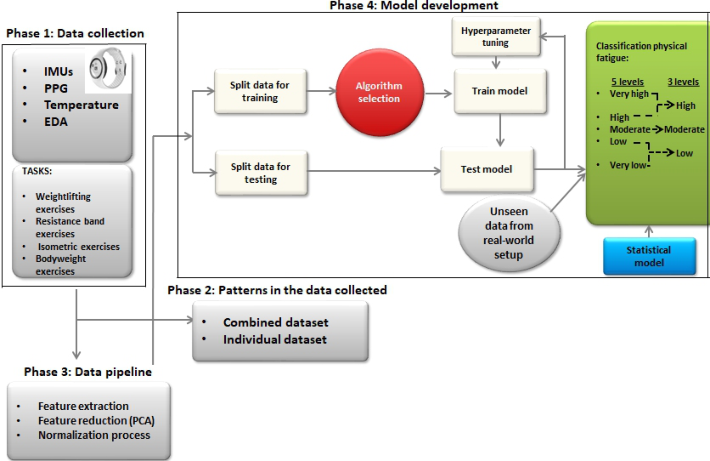
A conceptual framework was designed (see Figure 1) to explore these rese- arch hypotheses and explain how the analysis is expected to contribute to classifying physical fatigue.
Phase 1: Data Collection The device selected to collect real-time physiological data is the Empatica EmbracePlus, a smartwatch. It is generally considered a less intrusive weara- ble device in industrial environments than others because it is designed to be
Figure 1: Overall flowchart of the proposed model.
166 Morillo and Demichela
discreet and unobtrusive, with many featuring slim, sleek designs that are less likely to attract attention. The approach exploited heart and breath activity data from the PPG sensor, skin conductance data from the EDA sensor, and accelerometer and temperature data.
The model developed to classify physical fatigue will be first trained and tested using data that reflect the physical demands of the tasks being per- formed and the characteristics of the workers. In order to develop a robust physical fatigue classification model, it is crucial to have a comprehensive and representative dataset. To obtain such a dataset, we will set up a controlled environment in a gym specifically designed to mimic the repetitive motions commonly seen in various industrial settings. By collecting data on partici- pants performing these repetitive motions while wearing the wearable device, we will gather a large amount of data on various factors related to fatigue, such as physiological signals and self-reported fatigue levels. This dataset will then be used to train and evaluate the model, which will ultimately deploy in real-world industrial settings.
Phase 2: Patterns in the Data Collection Physiological data collected during physical activity can reveal patterns that change as the body fatigues. These changes can be used to understand the body’s response to fatigue and to monitor physical performance. Some changes that may be observed include heart rate, respiration rate and skin temperature increase. The specific changes observed in physiological data during physical fatigue will depend on the specific characteristics of the indi- vidual being monitored. Individuals have different physiological responses due to age, fitness level, and genetics. Weka software will apply Simple K-means clustering for combined and individual datasets to compare and interpret the results. Combined datasets will identify common trends and patterns that indicate physical fatigue.
Phase 3: Data Pipeline The physiological data is collected over time as a series of measurements taken at regular intervals. This type of data is known as time series data.
The data is preprocessed onboard the device. Any missing data will be imputed employing linear regression techniques.
As a first step in analyzing the data, employing feature extraction and reduction techniques is standard practice. These techniques extract mea- ningful information from large and complex datasets and simplify the data by reducing its dimensionality. This makes the data easier to analyze and understand Lastly, a normalization process is a practical step for handling the effect of different participants’ physiology on the absolute signal values in the lear- ning dataset. Normalization should typically only be applied to the training dataset, not the test or validation datasets.
Phase 4: Model Development We will divide the data into training and testing sets after collecting data in a controlled gym environment, including feature extraction and reduction
A Data-Driven Framework to Model Physical Fatigue in Industrial Environments 167
techniques. The training set is used to train the machine learning model, and the testing set is used to evaluate the model’s performance. Once the model is trained and tested on the gym dataset, it can be evaluated on unseen data from practical situations. This can be done by collecting data from real-world scenarios, such as an assembly line in a manufacturing plant, and using it to test the model. Metrics such as accuracy, precision, recall, and F1-score will be employed to evaluate the model’s performance on the different datasets. Hyperparameter tuning is used when training machine learning models to optimize their performance. To perform hyperparameter tuning, a range of possible values for each hyperparameter is defined, and then the model is trai- ned and evaluated using different combinations of these values. They include learning rate, number of hidden layers, and regularization strength.
One potential avenue of research involves training models using diffe- rent combinations of inputs and comparing their performance. It can help to identify which modalities (inputs) are most complementary and how they can be combined to achieve the best performance. For example, a single-factor analysis of variance (ANOVA) test will be run to understand the significance of using a single sensor (input) versus multiple sensors.
Another line of research includes comparing the model’s performance using different classification levels, such as binary, 3-level, and 5-level classi- fication. While a binary classification scheme may result in higher accuracy, a 3-level or 5-level classification scheme can represent the underlying physical fatigue state.
Algorithm Selection: Deep neural networks (DNNs) can be used with phy- siological data to classify physical fatigue. DNNs are particularly well-suited to time series data, such as physiological data, because they can learn tempo- ral patterns in the data. A combination of Convolutional Neural Networks (CNNs), Recurrent Neural Networks (RNNs), and fully connected layers will be selected. In practice, trying out a few different architectures and combi- nation layers is necessary to find the one that works best for this particular task. One novelty of the model is incorporating Bayesian inference into the deep learning structure to use them as a part of the architecture. It could use Bayesian variants of popular neural network architectures, such as Bayesian Recurrent Neural Networks or Bayesian Convolutional Neural Networks. These architectures would incorporate Bayesian methods, such as Markov Chain Monte Carlo sampling or Variational Inference, to learn the model parameters while incorporating prior knowledge or uncertainty in the predi- ctions. This approach leads to more robust and interpretable models that better handle uncertainty and missing data. Finally, we will compare the results using standard DNNs and DNNs with Bayesian networks with the same dataset.
POTENTIAL CASE STUDIES The machine learning model for physical fatigue detection can be utilized in a broad range of real-world situations, including:
Industrial environments: The model can be used to monitor the physi- cal exertion of workers in manufacturing and assembly line environments
168 Morillo and Demichela
and to predict and prevent injuries caused by repetitive motions or heavy lifting.
Construction sites: The model can be utilized to monitor the physical exertion of workers in construction sites.
Sports and fitness: The model can be exploited to monitor the physical exertion of athletes and fitness enthusiasts and to predict and prevent injuries caused by overtraining or improper exercise form.
The model’s performance might be affected by real-life scenarios, such as different lighting conditions, noise levels, and temperature, so it is required to continuously monitor and improve the model to account for these variations.
A potential case study for using the physical fatigue model in Iveco, an Italian industrial vehicle manufacturer, could involve monitoring the physical exertion of assembly line workers to predict and prevent injuries. Assembly lines in the automotive sector are a suitable choice for testing the physical fatigue detection model due to workers’ repetitive motions and heavy lifting, which can lead to physical fatigue and injuries. Also, assembly lines are a common and relevant scenario in many industries, not just the automotive sector. We will employ the physical fatigue model to analyze the data and predict the risk of injury for each operator. Based on the predicted risk of injury, match operators to workstations where their physical exertion levels are best suited. For example, operators with a lower predicted risk of injury would be matched to more physically demanding workstations. Operators with a higher predicted risk of injury would be matched to less demanding workstations.
CONCLUSION AND LIMITATIONS The proposed physical fatigue model opens up many future research and development possibilities. Some potential areas of future work include:
Real-world validation: Implementing the model in the different industrial sectors and case studies to demonstrate its practical value.
Improving generalizability: Addressing the model’s limitations by col- lecting a more diverse dataset representing the physical demands and population.
Combining with other data: Incorporating other data types such as phy- siological, biomechanical, and psychological data to improve the model’s accuracy and reliability.
Improving the Model: Experimenting with different Machine Learning algorithms and architectures to improve the model’s performance.
The proposed physical fatigue model has the potential to impact industrial safety and productivity significantly, but further research and development are needed to realize this potential fully. The approach has limitations and should be acknowledged. When evaluating the limitations in the model con- structed utilizing training data obtained from gym-goers, it is essential to
A Data-Driven Framework to Model Physical Fatigue in Industrial Environments 169
note that the model may only partially replicate the physical demands of real-world scenarios, showing limitations in the model’s ability to generalize to these scenarios. Another limitation is that the model is based on supervised learning, which requires labelled data. It is also crucial to consider the ethical implications of using data collected for this study. The data must be collected with informed consent and kept confidential and anonymous. Finally, the cost-benefit of implementing such a model should be considered, as the data collection and model training can be expensive. Therefore, it is indispensable to ensure that the benefits of the model, such as increased safety, productivity, and cost savings, outweigh the costs.
ACKNOWLEDGMENT
This work is funded by CISC project, which is part of the grant H2020- MSCA-ITN-2020 grant agreement no. 955901.
REFERENCES
Albarrán Morillo, C., Jawla, D., Kelleher, J. D., Demichela, M. (2022). Safety-critical systems in the automotive sector: pros and cons in the current state-of-the-art of human performance assessment. Proceedings of the 32nd European Safety and Reliability Conference (ESREL 2022) Baghdadi, A., Megahed, F. M., Esfahani, E. T., & Cavuoto, L. A. (2018). A mach-
ine learning approach to detect changes in gait parameters following a fatiguing occupational task. Ergonomics, 61(8), 1116–1129. Borg, G. (1982). Psychophysical bases of perceived exertion. Medicine and Science in Sports and Exercise, 14(5), 377–381 Cavuoto, L. A., Megahed, F., (2016). Understanding Fatigue and the Implications for
Worker Safety. ASSE Professional Development Conference and Exposition. Escobar-Linero, E., Domínguez-Morales, M., & Sevillano, J. L. (2022). Worker’s physical fatigue classification using neural networks. Expert Systems with Applications, 198(December 2021), 116784. Hajifar, S., Sun, H., Megahed, F. M., Jones-Farmer, L. A., Rashedi, E., & Cavuoto,
L. A. (2021). A forecasting framework for predicting perceived fatigue: Using time series methods to forecast ratings of perceived exertion with features from wearable sensors. Applied Ergonomics, 90(September 2020), 103262. Hernandez, G., Valles, D., Wierschem, D. C., Koldenhoven, R. M., Koutitas, G., Mendez, F. A., Aslan, S., & Jimenez, J. (2020). Machine Learning Techniques for Motion Analysis of Fatigue from Manual Material Handling Operations Using 3D Motion Capture Data. 2020 10th Annual Computing and Communication Workshop and Conference, CCWC 2020, 300–305. Kim, S., & Nussbaum, M. A. (2013). Performance evaluation of a wearable inertial
motion capture system for capturing physical exposures during manual material handling tasks. Ergonomics, 56(2), 314–326. Kumar, S. (2001). Theories of musculoskeletal injury causation. Ergonomics, 44(1), 17–47. Lambay, A., Liu, Y., Morgan, P., & Ji, Z. (2021). A Data-Driven Fatigue Predi-
ction using Recurrent Neural Networks. HORA 2021 - 3rd International Con- gress on Human-Computer Interaction, Optimization and Robotic Applications, Proceedings, 5–10.
170 Morillo and Demichela
Lambay, A., Liu, Y., Ji, Z., & Morgan, P. (2022). Effects of Demographic Factors for Fatigue Detection in Manufacturing. IFAC-PapersOnLine, 55(2), 528–533. Nagahanumaiah, L., Singh, S., & Heard, J. (2022). Diagnostic Human Fatigue
Classification using Wearable Sensors for Intelligent Systems. 2022 17th Annual System of Systems Engineering Conference, SOSE 2022, 424–429. Narteni, S., Orani, V., Cambiaso, E., Rucco, M., & Mongelli, M. (2022). On the Intersection of Explainable and Reliable AI for Physical Fatigue Prediction. IEEE Access, 10(July). Nasirzadeh, F., Mir, M., Hussain, S., Darbandy, M. T., Khosravi, A., Nahavandi, S.,
& Aisbett, B. (2020). Physical fatigue detection usingentropy analysis of heart rate signals. Sustainability. Rubmann, M., Lorenz, M., Gerbert, P., Waldner, M., Justus, J., Engel, P., & Harnisch, M. (2015). Industry 4.0: World Economic Forum. The Boston Con- sulting Group, 1–20. Sharpe, M. C. (1991). A report - Chronic fatigue syndrome: Guidelines for research.
Journal of the Royal Society of Medicine, 84(2), 118–121. Sedighi Maman, Z., Alamdar Yazdi, M. A., Cavuoto, L. A., & Megahed, F. M.
(2017). A data-driven approach to modeling physical fatigue in the workplace using wearable sensors. Applied Ergonomics, 65, 515–529. Sedighi Maman, Z., Chen, Y. J., Baghdadi, A., Lombardo, S., Cavuoto, L. A., & Megahed, F. M. (2020). A data analytic framework for physical fatigue management using wearable sensors. Expert Systems with Applications, 155, 113405. Yung, M., Bigelow, P. L., Hastings, D. M., & Wells, R. P. (2014). Detecting
within- and between-day manifestations of neuromuscular fatigue at work: an exploratory study. Ergonomics. Yung, M. (2016). Fatigue at the Workplace : Measurement and Temporal Development.
LISTED IN THE AHFE DIGITAL BOOKSTORE CATALOGUE
Explore the complete digital volume
Neuroergonomics and Cognitive Engineering
Read this individual research paper free through the original publisher, or explore the full digital proceedings book.
ISBN 978-1-958651-78-0
Explore this ISBN in the AHFE Bookstore ↗Listed in the July 2026 bookstore catalogue; search by ISBN to confirm current availability · Digital book purchase optional