Kristine Kursite Germane, Henrijs Kalkis (2026). Physio-Cognitive Fatigue Loop in Digital Office Work. In: Social and Occupational Ergonomics. AHFE Open Access, vol. 228, pp. 81–87. https://doi.org/10.54941/ahfe1007938
1 University of Latvia, Faculty of Medicine and Life Sciences, Department of Human, Factors and Work Environment, Jelgavas street 1, LV 1004, Riga, Latvia ↗
2 University of Latvia, Faculty of Medicine and Life Sciences, Department of Human Factors and Work Environment, Jelgavas street 1, LV 1004, Riga, Latvia ↗
Digital office work increasingly combines prolonged screen exposure with multitasking and time pressure, sustaining cognitive demand and enabling progressive cognitive fatigue. The objective of this article is to systematically analyze evidence on (a) digital office work characteristics and (b) cognitive fatigue indicators and mechanisms, and (c) to incorporate the analysis into a model “Physio-Cognitive Fatigue Loop in Digital Office Work” and its conceptualization. Scientific literature search has been done in Scopus, Web of Science and PubMed (2010 - 2026) databases and have been complemented by backward citation tracking. Studies of adult office/display-based work have been included if they reported behavioural or objective cognitive-fatigue indicators (e.g., reaction time, errors, executive-control measures) and/or explicit fatigue mechanisms. Following PRISMA 2020 guidelines, records have been screened and thematically synthesized. Across study designs, prolonged time-on-task, interruption load and task switching have been consistently associated with attention degradation, reduced executive control (conflict control/response inhibition) and increased performance variability. Within the article’s scope, the proposed model provides a clear evidence-based structure that links modifiable digital work characteristics to core cognitive fatigue indicators and emphasizes the practical value of combining exposure metrics (duration, interruptions/switching) with sensitive cognitive outcomes and brief state ratings to detect early fatigue escalation.
Digitally intensive office work increasingly requires sustained attention, rapid information processing and frequent switching between concurrent tasks and communication channels. Prolonged “time-on-task” under these conditions can elevate perceived workload and effort expenditure while progressively degrading cognitive control, which is central to safe and efficient human- technology interaction (Hockey, 2013; Behrens et al., 2023). In parallel, the modern “always-on” work culture intensifies continuous connectivity demands and reduces opportunities for natural recovery, thereby increasing vulnerability to cognitive fatigue during the workday (Mdhluli, 2025). Cognitive fatigue is commonly conceptualized as a state emerging when the energetic costs of sustained performance accumulate and the expected benefits Received March 6, 2026; Revised April 6, 2026; Accepted April 25, 2026; Available online July 20, 2026
82 Germane and Kalkis of continuing effort diminish, resulting in reduced motivation, altered control allocation and performance instability (Boksem and Tops, 2008; Hockey, 2013). Time-based resource-sharing accounts further suggest that extended engagement in demanding cognitive activity increases competition for shared processing resources, producing measurable declines in executive control and goal-directed performance over time (Borragán et al., 2017). Although fatigue in office work is often discussed either in cognitive-psychosocial terms or in physical-musculoskeletal terms, neuroergonomic evidence indicates that mental fatigue can influence motor output and effort regulation, highlighting the value of models that explicitly link cognitive mechanisms with broader performance consequences (Mehta and Parasuraman, 2014). At the same time, stress-mediating processes associated with sustained demands may contribute to allostatic load, reinforcing the importance of identifying modifiable work characteristics that precipitate fatigue and constrain recovery (McEwen, 1998). In office contexts, cognitive fatigue is not only a subjective experience, but also a measurable phenomenon expressed in task performance and cognitive outcomes. Laboratory and applied research commonly operationalize fatigue-related decrements through changes in reaction time, error propensity and attentional control in standardized paradigms, including variants of interference control tasks (e.g., Stroop-type measures) that are sensitive to reduced executive regulation under sustained demands (MacLeod, 1991). Recent evidence in office workers further demonstrates that mental workload and occupational fatigue relate to physiological responses and cognitive performance, supporting the need to systematically integrate task characteristics, fatigue mechanisms and measurable indicators when evaluating digital work exposures (Mahdavi et al., 2024).
Fatigue in office work is often discussed in either cognitive-psychosocial or physical-musculoskeletal terms, yet the evidence suggests coupled processes and an insufficient recovery throughout the workday. The present paper focuses on the research issue, reflecting how digital work characteristics shape cognitive fatigue mechanisms and measurable indicators relevant for human factors assessment and intervention. Hence the aim of this article is to systematically synthesize evidence on (a) digital office work characteristics and (b) cognitive fatigue indicators and mechanisms and (c) to incorporate the analysis into a model “Physio-Cognitive Fatigue Loop in Digital Office Work” and its conceptualization.
METHODS
The review was conducted and reported in line with PRISMA 2020 guidance (Page et al., 2021). Search strategy: Scopus, Web of Science and PubMed were searched for English-language publications between January 2010 and February 2026. Search concepts combined digital office/display-based work (e.g., computer work, screen time, knowledge work, interruptions, multitasking, task switching) with cognitive fatigue constructs (e.g., cognitive/mental fatigue, vigilance decrement, executive control, reaction time, error rate). Backward citation tracking was applied to included reviews and seminal empirical papers.
Physio-Cognitive Fatigue Loop in Digital Office Work 83 Eligibility criteria: (i) adult working-age samples; (ii) office or display- based digital work tasks, either field studies or laboratory analogues; (iii) outcomes included at least one behavioural/objective cognitive-fatigue indicator (reaction time, error rate, attention or executive-control measures) and/or explicit mechanistic interpretation; (iv) full text available.
Study selection and analysis: titles and abstracts were screened, followed by full-text eligibility checks. Screening decisions were resolved by discussion. Data were extracted on digital work characteristics, task paradigms, fatigue indicators (behavioural and self-report) and mechanistic interpretations. Evidence was synthesized thematically, prioritising convergent indicators across designs over single-study effects.
During the preparation of this manuscript, the authors utilized AI-based tools (Scopus AI, Gemini, Perplexity, and ChatGPT) to assist in literature findings and language refinement. All screening decisions, analysis, and final content were determined by the authors, who take full responsibility for the integrity and accuracy of this article.
RESULTS AND DISCUSSION
The literature analysis on a small set of digital work characteristics shows that reliably precede cognitive fatigue: prolonged time-on-task, high interruption frequency, multitasking/task switching demands and time pressure. These characteristics increase working-memory load, reduce opportunities for micro-recovery and promote performance variability. Cognitive fatigue was consistently reflected in slower reaction times and increased error susceptibility. Executive-control tasks were particularly sensitive to fatigue- related loss of conflict control and response inhibition, aligning with classic findings on interference costs (MacLeod, 1991). Vigilance research, similarly, demonstrates that sustained monitoring is mentally demanding and stressful, with decrements observable across behavioural and subjective measures (Warm et al., 2008).
The evidence supports models in which fatigue emerges from rising energetic and control costs during continued performance, interacting with perceived rewards and goal regulation (Boksem and Tops, 2008; Hockey, 2013). In real work settings, accumulated need for recovery functions as an intermediate state linking work demands to health complaints and reduced functioning (Sluiter et al., 2003).
Digital multitasking exposure is also linked to reduced resistance to distraction and weaker cognitive control in interference settings, which provides a plausible pathway from high-interruption environments to attentional instability during time-on-task (Ophir et al., 2009). At the organisational level, technostress research highlights Information – Communication - Technology (ICT) related stressors (e.g., overload, complexity, invasion) that can exacerbate role stress and impair perceived productivity, supporting the inclusion of psychosocial load descriptors alongside exposure metrics (Tarafdar et al., 2007). Interruption and task-switching evidence from office indicates that frequent context switches are associated with compensatory
84 Germane and Kalkis speed-up and higher perceived stress, consistent with a control-cost account of sustained cognitive demand (Mark et al., 2008).
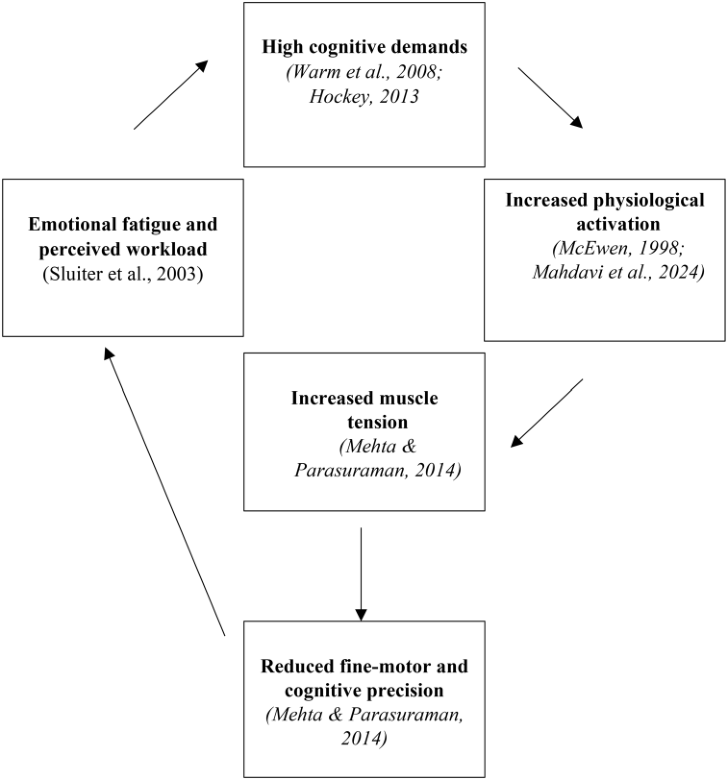
The analysis indicates that a practical loop model for digital office work can be built around measurable indicators: digital exposure and task-switching conditions increase cognitive control costs, producing reliable behavioural signatures (reaction time slowing and error susceptibility) and a growing need for recovery. These states promote compensatory strategies (e.g., working faster, skipping breaks, increased reliance on habitual responses), which can further elevate perceived workload and sustain exposure-closing the loop. Figure 1 summarises this as a model “Physio-Cognitive Fatigue Loop for digitally intensive office work”.
Figure 1: Model “Physio-Cognitive Fatigue Loop for digitally intensive office work”.
Physio-Cognitive Fatigue Loop in Digital Office Work 85 Model “Physio-Cognitive Fatigue Loop for digitally intensive office work” represents a self-reinforcing cognitive fatigue loop in which digitally intensive office work characteristics (e.g., prolonged screen-based time-on- task, frequent interruptions, and rapid task switching) progressively shift the balance between effort investment and control capacity, leading to measurable decrements in cognitive performance and increasing subjective fatigue. The loop is consistent with contemporary fatigue frameworks that treat fatigue not as a single symptom but as a dynamic state emerging from interacting cognitive and physiological processes and expressed across multiple indicator domains (Behrens et al., 2023; Hockey, 2013). The first segment of the loop captures how digital work design increases cognitive load: continuous information intake, sustained monitoring and ongoing goal management require persistent executive control. Under Hockey’s compensatory control view, individuals maintain performance by investing additional effort when task demands exceed preferred levels, but this compensation has a cost: it increases strain and accelerates fatigue development (Hockey, 2013). This is also consistent with office-based evidence showing that higher mental workload is associated with fatigue and measurable changes in physiological responses and cognitive performance (Mahdavi et al., 2024). The Model also emphasizes that cognitive fatigue becomes observable through performance variability rather than only changes of the means. As control weakens, reaction times may slow down, errors may rise and fine-grained “precision” (e.g., decision consistency, response accuracy) may deteriorate-especially, under interference or competing stimulus-response mappings. Stroop-type effects are widely used to index the efficiency of selective attention and cognitive control; reduced control is expected to amplify interference costs and increase error susceptibility under time pressure (MacLeod, 1991). Empirical evidence in office workers, similarly, indicates an association between mental workload, fatigue and cognitive performance outcomes, supporting the view that performance metrics are a core fatigue indicator rather than a peripheral correlate (Mahdavi et al., 2024).
In summary, model “Physio-Cognitive Fatigue Loop for digitally intensive office work” can be used in practice as a compact decision-and-measurement framework for cognitive fatigue in digital office work, alligned with this article’s scope: (a) digital work characteristics and (b) cognitive fatigue indicators and mechanisms. In applied contexts, the model enables the identification of key inputs that accelerate fatigue accumulation across the working day— prolonged time-on-task, high interruption frequency, repeated task switching, and persistent connectivity—and links them to a coherent mechanism characterized by increased effort demands and diminished executive control, ultimately resulting in performance instability. Operationally, the model supports a simple monitoring routine using a small set of indicators: exposure tracking (screen-time/task-block duration, interruption/switching density), cognitive outcomes (reaction time, error rate, performance variability from short checks or embedded work metrics) and brief state ratings of fatigue/ workload at fixed points. When rising interruptions and sustained task duration coincide with worsening cognitive outcomes and higher perceived
86 Germane and Kalkis fatigue, it signals that the loop is strengthening and that the work design is exceeding sustainable control capacity. The model also guides targeted “breakpoints” within the article’s scope: reduce unnecessary switching (single- task blocks), manage interruptions (for example, communication batching), limit excessive time-on-task (for example, micro-breaks) and adjust pacing of cognitively demanding tasks. Repeating the same indicators before and after these changes provides a practical way to evaluate whether the loop has weakened - i.e., whether cognitive control and performance stability recover under a less fatigue-inducing digital work pattern.
CONCLUSION
Systematic literature review proved that cognitively demanding digital office work-characterized primarily by prolonged time-on-task, frequent interruptions and high task-switching density-can be coherently explained through a fatigue loop in which escalating control demands increase perceived workload and effort, gradually degrading executive control and yielding measurable performance instability alongside rising subjective fatigue. Within the article’s scope, the proposed model provides a clear evidence-based structure that links modifiable digital work characteristics to core cognitive fatigue indicators and emphasizes the practical value of combining exposure metrics with sensitive cognitive outcomes and brief state ratings to detect early fatigue escalation. Future research is going to focus on moving from conceptual integration to empirical validation by testing the model longitudinally in real office environments, determining threshold effects for time-on-task and switching load, comparing indicator sensitivity across task types and individual differences.
ACKNOWLEDGMENT
This research has been supported by the project “Impact of fatigue as a multidimensional variable on the performance of office workers in relation with psycho-emotional risks at work”, Agreement No. lzp-2024/1-0098.
REFERENCES
Behrens, M., Gube, M., Chaabene, H., Prieske, O., Zenon, A., Broscheid, K.-C., Schega, L., Husmann, F. and Weippert, M. (2023) ‘Fatigue and human performance: An updated framework’, Sports Medicine, 53(1), pp. 7–31. Boksem, M.A.S. and Tops, M. (2008) ‘Mental fatigue: Costs and benefits’, Brain
Research Reviews, 59(1), pp. 125–139. Borragán, G., Slama, H., Bartolomei, M. and Peigneux, P. (2017) ‘Cognitive fatigue: A time-based resource-sharing account’, Cortex, 89, pp. 71–84. Hockey, G.R.J. (2013) The Psychology of Fatigue: Work, Effort and Control.
Cambridge: Cambridge University Press. MacLeod, C.M. (1991) ‘Half a century of research on the Stroop effect: An integrative review’, Psychological Bulletin, 109(2), pp. 163–203.
Physio-Cognitive Fatigue Loop in Digital Office Work 87 Mahdavi, N., Tapak, L., Darvishi, E., Doosti-Irani, A. and Shafiee Motlagh, M.
(2024) ‘Unraveling the interplay between mental workload, occupational fatigue, physiological responses and cognitive performance in office workers’, Scientific Reports, 14, 17866. Mark, G., Gudith, D. and Klocke, U. (2008) ‘The cost of interrupted work: More speed and stress’, in Proceedings of the SIGCHI Conference on Human Factors in Computing Systems (CHI ’08). New York: ACM, pp. 107–110. McEwen, B.S. (1998) ‘Protective and damaging effects of stress mediators’, New
England Journal of Medicine, 338(3), pp. 171–179. Mdhluli, N.I. (2025) ‘Perils of perpetual connectivity: Navigating the “always-on” culture in the modern workplace’, SA Journal of Human Resource Management, 23, a3019. Mehta, R.K. and Parasuraman, R. (2014) ‘Effects of mental fatigue on the
development of physical fatigue: A neuroergonomic approach’, Human Factors, 56(4), pp. 645–656. Ophir, E., Nass, C. and Wagner, A.D. (2009) ‘Cognitive control in media multitaskers’, Proceedings of the National Academy of Sciences of the United States of America, 106(37), pp. 15583–15587. Page, M.J., McKenzie, J.E., Bossuyt, P.M. et al. (2021) ‘The PRISMA 2020 statement:
An updated guideline for reporting systematic reviews’, BMJ, 372, n71. Sluiter, J.K., de Croon, E.M., Meijman, T.F. and Frings-Dresen, M.H.W. (2003) ‘Need for recovery from work related fatigue and its role in the development and prediction of subjective health complaints’, Occupational and Environmental Medicine, 60(Suppl 1), pp. i62–i70. Tarafdar, M., Tu, Q., Ragu-Nathan, B.S. and Ragu-Nathan, T.S. (2007) ‘The impact of
technostress on role stress and productivity’, Journal of Management Information Systems, 24(1), pp. 301–328. Warm, J.S., Parasuraman, R. and Matthews, G. (2008) ‘Vigilance requires hard mental work and is stressful’, Human Factors, 50(3), pp. 433–441.
LISTED IN THE AHFE DIGITAL BOOKSTORE CATALOGUE
Explore the complete digital volume
Social and Occupational Ergonomics
Read this individual research paper free through the original publisher, or explore the full digital proceedings book.
ISBN 979-8-950676-04-8
Explore this ISBN in the AHFE Bookstore ↗Listed in the July 2026 bookstore catalogue; search by ISBN to confirm current availability · Digital book purchase optional