Yi Zheng (2023). User-Oriented Definition of Smart Products: a "Body" Perspective. In: Interdisciplinary Practice in Industrial Design. AHFE Open Access, vol. 100, pp. 38–45. https://doi.org/10.54941/ahfe1002969
As more and more smart products appear in people's daily lives, designers begin to pay attention to smart product design. Industry and academia try to explain "what Smart Products are" in different fields. Although Smart Products are not a new term, there is no consensus on the definition of Smart Products. However, this is problematic for designers. Because the understanding of Smart Products directly affects how designers design smart products to bring users a better life. Smart products are quite different from previous products in terms of functions, interactions, and technologies. This not only affects designers but also poses challenges for users. This paper reviews the concept of Smart Products and Intelligence, constructs a user-oriented definition of smart products based upon the embodied cognition theory of cognitive science, proposes the characteristics of smart products, which provides designers with a new perspective for designing smart products.
In recent years, smart products can be seen everywhere, such as smart spe- akers, smartwatches, and smart toilets, and some smart products have even become an indispensable part of people’s lives, such as smartphones. Smart products have become a new consumption trend, and the term “Smart Pro- duct” has gradually become the focus of people’s attention and research. However, experts and scholars have not reached a consensus on the concept of smart products, especially designers. In the design process of products, designers need to design from the perspective of users because the design of smart products directly affects the consumption and use of users. Therefore, the user-oriented definition of smart products is particularly important for designers.
RELATED WORK
According to the existing literature, the term “Smart Product” is commonly used in different fields and has various definitions, such as computing, engi- neering, manufacturing, and design. Researchers have tried to propose an industry-applicable and consensus-based definition, but there is no real con- sensus on the concept of “smart products.” Back in 2007, Maass and Janzen
User-Oriented Definition of Smart Products: A “Body” Perspective 39
(Maass and Janzen, 2007) proposed three core requirements for smart produ- cts. Then Maass and Varshney (Maass and Varshney, 2008) argued (Sohn and Kwon, 2020) that smart products with digital representations could adapt to various situations and consumers. Mühlhäuser (Mühlhäuser, 2008) pro- posed an early definition of smart products: “A Smart Product is an entity (tangible object, software, or service) designed and made for self-organized embedding into different (smart) environments in the course of its lifecycle, providing improved simplicity and openness through improved p2u and p2p interaction by means of context-awareness, semantic self-description, pro- active behavior, multimodal natural interfaces, AI planning, and machine learning.” The SmartProducts consortium proposed the definition based on Mühlhäuser’s content (Sabou et al., 2009). In addition, some scholars tried to provide a more comprehensive concept, including definitions(Gutiérrez et al., 2013), classifications (Meyer et al., 2009), and frameworks (Raff et al., 2020). Although authors put forward the concept of “smart products” with diffe- rent research objectives (Raff et al., 2020), they solve problems arising from the dramatic changes brought about by the rapid development of disruptive technologies like information and communication technology (ICT) and arti- ficial intelligence technology (AIT) and build the concept of “smart products” in new research fields. The same is in the field of design. The focus of the literature is mainly on smart product-service systems (Valencia et al., 2015; Zheng et al., 2019), smart product development (Nunes et al., 2017), and smart product design process. There is little discussion on the definition of smart products, which can be roughly divided into two categories. One is that smart products can be defined as products embedded with information technologies (IT) (Rijsdijk and Hultink, 2009; Valencia et al., 2015), which can collect, process, and generate information. The other is that smart pro- ducts have human-like intelligence and respond more naturally and flexibly to changes in the environment and user needs.
Therefore, the core of the definitions of smart products is dominated by disruptive technologies, which are applied to smart products that make them different from traditional products. Technology is the main driver for fields involved in producing smart products, such as engineering, manufacturing, and industrial chains. For users, however, technology is a means and tool to meet their needs and realize product intelligence (Sohn and Kwon, 2020), which is not a primary consideration. In designing smart products, especially during the early process of idea generation, designers should start from the users’ perspective rather than be limited by technologies.
THE CONCEPT OF PRODUCT INTELLIGENCE The main difference between smart products and traditional products is that the capabilities of products have changed dramatically. Rijsdijk et al. (Rijs- dijk et al., 2007) propose that the capabilities of smart products are defined as product intelligence and argue that product intelligence consists of six dimen- sions: autonomy, ability to learn, reactivity, ability to cooperate, humanlike
40 Yi Zheng
interaction, and personality. In the artificial intelligence (AI) field that stu- dies how to reproduce human-level intelligence, traditional AI argues that intelligence is a high-level, abstract rational ability (e.g., logic and mathema- tics). And then, in order to solve the problems encountered by traditional AI, embodied AI states that intelligence is embodied, and it emerges when the agent interacts with the environment. Intelligence is no longer a symbo- lic operation in a physical, symbolic system by following various algorithms. Embodied AI broadens the boundaries of the notion of intelligence, which is produced through the body’s interaction with the environment. In the design field, the existing concepts of smart products less directly describe “what is intelligence” but mainly describe the manifestation of intelligence. Thus, the author elaborates on the concept of intelligence in smart products from the perspective of embodied AI, which is influenced by the theory of embodied cognition.
According to embodied AI, the intelligence of smart products is embodied, situated, and incremental. First, product intelligence requires a “body,” and smart products interact with users and the environment through their “body.” Embodiment is “a prerequisite for high-level cognition, and the mind origi- nates from our body and is shaped by it” (Pfeifer and Bongard, 2006). The agents emerge and evolve intelligence through the interaction between the “body” and the world. Second, product intelligence is situated. Brooks sug- gested that the agent regards the world as its own model (Brooks, 1991). The environment is not only the cognitive object of smart products but also influences intelligence construction. An example is the iPhone which is a smart product. This smartphone adopts the True Tone technology to adjust the display situation of the iPhone screen in time by continuously recogni- zing the color temperature of the surroundings, which provides users with a more natural screen. Third, product intelligence is incremental. Embodied AI believes that high-level intelligence is developed from low-level intelligence through continuous evolution and incrementation rather than rational design (Pfeifer and Bongard, 2006). For example, the Face ID of the iPhone is con- stantly deepening its understanding of the changes in the user’s face, which is the incremental intelligence of the smartphone. In addition, the composition of product intelligence is also influenced by society and culture. In fact, the environment in which human beings live is full of their ancestors’ culture and artificial objects. It is in this environment that human intelligence is develo- ped and constructed. As smart products gradually become an essential part of people’s lives, products influence and change people’s lives, and society and culture affect the composition and development of product intelligence. An example is Apple Watch, which adds a Handwashing function due to COVID-19.
THE CONCEPT OF SMART PRODUCTS BASED ON EMBODIED COGNITION THEORY Embodied Cognition Theory
Embodied cognition theory is the forefront theory of cognition science, ori- ginating from the discussion of mind and body in philosophy. Descartes
User-Oriented Definition of Smart Products: A “Body” Perspective 41
believed that the body and mind were independent, establishing the mind- body dualism and laying the theoretical foundation of modern epistemology. He stated that “I think therefore I am,” and “I” is a purely mental entity that does not depend on physical existence. The body is the object that carries the mind. Merleau-Ponty (Merleau-Ponty, 1962) then argued the traditio- nal mind-body relationship and proposed that the mind and body were one. He put forward a concept of embodied subjectivity, emphasizing that human beings use the body as a mediator to know the world and are intimately connected with the world through the body. The body is the subject of cogni- tion, not the object of cognition. Varela et al. (Varela et al., 1991) suggest that “cognition depends on the kinds of experience that come from having a body with various sensorimotor capacities. These individual sensorimo- tor capacities are themselves embedded in a more encompassing biological, psychological, and cultural context.”
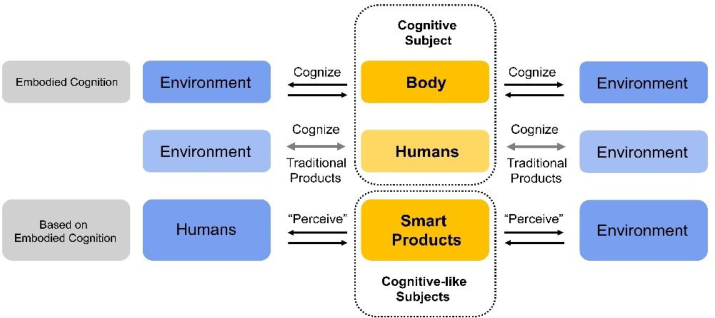
User-Oriented Definition of Smart Products For users, what does a smart product mean to them? According to embodied cognition theory, Merleau-Ponty understands that human beings expand the perception of the body through artificial objects, and explains the classic case of the cane for the blind. He believes that the cane is no longer recognized by users as a cane itself but becomes part of the user’s perception, acting as the user’s ‘eyes’ to explore the surrounding world. In order to survive in the world better, human beings expand their perceiving bodies through artificial objects. In other words, artificial objects are produced when humans perceive the world, whether it is all kinds of products from ancient times (e.g., coo- kers, hunting tools) or modern smart products. In this process, humans acting as cognitive subjects understand the world. Smart products are designed to have part of human perception and, to a certain extent, represent or be inde- pendent of human beings to perceive the world with disruptive technologies. Smart products exist as cognitive-like subjects in the world. While both tra- ditional and smart products can extend user perception, traditional products are only passively used by users and cannot “perceive” the world relatively independently. On the other hand, smart products can “know” the world actively, relatively independently, and on behalf of humans. Therefore, smart products act as cognitive-like subjects to perceive the world (Figure 1).
Smart products not only have part of human-like perception but also have a “body.” This “body”is an artificial body created and developed by humans, which needs to “know”not only itself but also other environments, including organisms (e.g., humans, other organisms), non-living things (e.g., traditional products, other smart products), and situations involving living things and non-living things. The artificial body thus “perceives”humans’ psychological situations and the natural, social, and cultural context.
To sum up, a smart product is an artificial body that perceives human psychology and the natural, social, and cultural environments of living and non-living things, including humans and smart products. Although smart products, as cognitive-like subjects, need to understand living and non-living
42 Yi Zheng
Figure 1: Diagram of the relationship between cognitive subject and cognitive-like subject.
things in the environment, smart products are still designed to be used by humans. The core of smart product design remains human-centered design.
THE CHARACTERISTICS OF SMART PRODUCTS When rethinking smart products from the perspective of the artificial body, smart products’ characteristics gradually become more apparent. The three basic characteristics of smart products are embodiment, situatedness, and intentionality.
Embodiment Embodiment is one of the fundamental characteristics of smart products. As a cognitive-like subject, the artificial body of a smart product contains the two sides of embodiment. One is the context of cognitive mechanisms consisting of sensors, various algorithms, etc. The other is the artificial body as a dyna- mic, experiential structure. Varela et al. (Varela et al., 1991) argue that “our bodies are seen as both physical structures and as lived.” In terms of physical structure, artificial bodies have a variety of sensors that give smart produ- cts the ability to “perceive” data from the surrounding environment, such as pressure sensors that can get pressure values and distribution. All kinds of algorithms are applied to artificial bodies with corresponding sensors so that these bodies have more advanced perception capabilities. For example, smart products are able to sense and recognize objects through cameras combi- ned with AI image recognition and object recognition algorithms. Regarding experiential structure, artificial bodies of smart products can be seen as dyna- mic, experiential structures because the context of artificial bodies is not static but dynamic. Smart products sense the dynamic environment through arti- ficial bodies as physical structures, forming the experience of the dynamic environment and building the corresponding dynamic, experiential structures of artificial bodies.
User-Oriented Definition of Smart Products: A “Body” Perspective 43
The double sense of embodiment about smart products is not in opposition to each other but forms a cycle between the two. As mentioned before, the example is the Face ID of the iPhone. The phone recognizes the user’s facial features through this artificial body as the physical structure. The dynamic changes in the face affect the experiential structures of the artificial body, which in turn affects the physical structure, such as the iPhone’s sensors, machine learning, and algorithms improvement. Embodiment is, therefore, the most fundamental and core feature of smart products. The artificial body of a smart product is the point of contact between the product and the user, the product and the world, and the user interacts with smart products through artificial bodies.
Situatedness Situatedness is the second characteristic of smart products. The context of smart products includes the natural, social, and cultural environments and the context of smart products and users. Being dependent on a particular situ- ation is a general characteristic of human activities (Varela et al., 1991). The environment that users experience, including smart products, is processed and designed for human purposes. User cognition depends on the situation, and users cannot perceive smart products outside of a particular situation. Thus, smart products cannot be separated not only from users but also from the context.
In addition to the physical constraints of the environment, smart products are also constrained by the social and cultural context because smart products and users are in the same situation, context, world. The perceptual activities of different users are formed in different social and cultural situations. The situatedness of smart products needs to match the social and cultural cogni- tion of different users and conform to the fundamental values and ethics of communities of practice.
The situation sensed by smart products also includes different smart pro- ducts and users. Smart products need to respond to dynamically changing contexts in a timely manner. For example, Google Home can identify diffe- rent users by their voices and make individual responses, meeting the needs of different users in the same context because Google Home is designed to be used in users’ homes. In many cases, multiple users are in the same context and use the same smart speaker.
Intentionality Regarding intentionality, the American philosopher Don Ihde (Ihde, 1990) was inspired by Heidegger and proposed technological intentionality. Tech- nology refers mainly to artificial objects or technological objects, which Ihde mentions. Although smart products are very different from previous techno- logical objects about intelligence, technological intentionality also influences smart products. There are three meanings of the intentionality of smart products.
The first is that smart products themselves have intentionality, which refers to the directionality of smart products towards a particular context. For
44 Yi Zheng
example, a smart sweeping robot is designed to avoid various obstacles to complete the cleaning task successfully. In this process, the artificial body of the smart sweeping robot is already an intentional artificial body, and this intentionality in the sweeping situation is given to the smart product by designers.
The second meaning is the intentionality of smart products during use, which includes the specific directionality of a smart product and its orienta- tion towards a particular user. The specific directionality refers to how smart products shape human behavior. During use, smart products build framew- orks for users’ behavior in which intentionality and product usage patterns are formed. For example, the iPhone adopts the sliding interaction method to browse photos. After a period of use, the user forms this particular behavior model for viewing photos. In addition to the specific directionality, smart products are also orientated towards particular users. For instance, when a customer uses an iPhone with a bionic chip, the iPhone learns about the beh- avior habits of the user, so it optimizes its functions and becomes somebody’s iPhone.
The third is that smart products are used as an intermediary when people use them. Smart products are in a generative, constructed context, and smart products and users constitute each other in an ontological sense, allowing both the user and the world to acquire new meanings. However, smart pro- ducts do not necessarily have intentionality as mediators for different users because this constitutive relationship between the user and the smart product is not necessarily formed in the processes. For instance, it is more difficult for older people to adapt to using smart products, and they may give up using them after a few days or a period. Smart products then do not have the intenti- onality to act as an intermediary for older people. Therefore, intentionality is one of the essential characteristics of smart products. In addition to the inten- tionality of the smart product itself, the intentionality during use is generated from interactions between humans, smart products, and the world.
CONCLUSION
This article reviews the notion of Smart Products and Intelligence and pro- poses the concept of smart products that have important implications for designers in the design field, including a user-oriented definition of smart products inspired by the embodied cognition theory, three characteristics of smart products (embodiment, situatedness, and intentionality). The per- spective of users can better help designers design smart products. Further research outcomes will apply this user-oriented notion of smart products to smart product design projects.
REFERENCES
Brooks, R. A. (1991) “Intelligence without representation,” Artificial Intelligence, 47(1⣓3), pp. 139⣓-159. Cardona, A. M. V. et al. (2015) “The Design of Smart Product-Service Systems (PSSs):
An Exploration of Design Characteristics,” International Journal of Design, 9(1), pp. 13–28.
User-Oriented Definition of Smart Products: A “Body” Perspective 45
Gutiérrez C. E. E. et al. (2013) Providing a Consensus Definition for the Term “Smart Product”. 2013 20th IEEE International Conference and Workshops on Engineering of Computer Based Systems (ECBS). Scottsdale, 203–211. Ihde D. (1990) Technology and the Lifeworld: From Garden to Earth. Indiana
University Press. Maass, W. and Janzen, S. (2007) Dynamic product interfaces: A key element for ambient shopping environments. 20th Bled eConference “eMergence: Merging and Emerging Technologies, Processes, and Institutions”. Slovenia, 457–470. Maass, W and Varshney, U. (2008) “Preface to the Focus Theme Section: ‘Smart
Products,”’. Electronic Markets, 18(3), pp. 211–215. Merleau-Ponty, M. (1962) Phenomenology of Perception, The Humanities Press. Meyer G. G., Främling, K. and Holmström, J. (2009) “Intelligent Products: A survey,” Computers in Industry, 60(3), pp. 137–148. Mühlhäuser M. (2008) “Smart products: An introduction,” Constructing Ambient
Intelligence. Springer, pp. 158–164. Nunes M.L., Pereira, A. V. and Alves, A. A (2017) “Smart products development approaches for Industry 4.0,” Procedia Manufacturing 13, pp. 1215–1222. Pfeifer, R. and Bongard, J. C. (2006) How the body shapes the way we think: a new
view of intelligence. MIT Press. Raff, S., Wentzel, D. and Obwegeser, N. (2020) “Smart Products: Conceptual Review, Synthesis, and Research Directions*,”Journal of Product Innovation Management 37(5), pp. 379–404. Rijsdijk S. A. and Hultink E. J. (2009) “How Today’s Consumers Perceive Tomor-
row’s Smart Products*,” Journal of Product Innovation Management 26(1), pp. 24–42. Rijsdijk S. A., Hultink E. J. and Diamantopoulos A. (2007) “Product intelligence: its conceptualization, measurement and impact on consumer satisfaction,”. Journal of the Academy of Marketing Science 35(3), pp. 340–356. Sabou, M. et al. (2009) “Position paper on realizing smart products: challenges for
Semantic Web technologies,” CEUR Workshop Proceedings, pp. 135–147. Sohn, K. and Kwon, O. (2020) “Technology acceptance theories and factors influencing artificial Intelligence-based intelligent products,” Telematics and Informa- tics, 47, p. 101324. Varela F. J., Thompson, E. and Rosch, E. (1991) The Embodied Mind: Cognitive
Science and Human Experience. MIT Press. Zheng P. et al. (2019)“ A survey of smart product-service systems: Key aspects, challenges and future perspectives,” Advanced Engineering Informatics 42, p. 100973.
LISTED IN THE AHFE DIGITAL BOOKSTORE CATALOGUE
Explore the complete digital volume
Interdisciplinary Practice in Industrial Design
Read this individual research paper free through the original publisher, or explore the full digital proceedings book.
ISBN 978-1-958651-76-6
Explore this ISBN in the AHFE Bookstore ↗Listed in the July 2026 bookstore catalogue; search by ISBN to confirm current availability · Digital book purchase optional