Kazuhiko Momose, Troy Weekes, Thomas Eskridge (2023). Simulation Study of Human Input Devices in a Variable Gravity Environment for Commercial Space Transportation. In: Human Factors in Transportation. AHFE Open Access, vol. 95, pp. 665–674. https://doi.org/10.54941/ahfe1003852
Commercial spaceflight is an exciting and rapidly growing segment of the space industry. Recent accomplishments by private companies taking non-professional astronauts into space have added additional momentum to the growth of the Commercial Space Transportation (CST) industry. It is expected that increasing numbers of private individuals will participate in commercial orbital and sub-orbital human spaceflight activities as Spaceflight Participants (SFPs). In several circumstances, the SFPs will be launched without the assistance and supervision of professional crew, requiring the SFPs to be able to manage their own safety and emergency procedures. To ensure SFPs’ safety, it is imperative to understand the unique effects of the spaceflight environment, particularly the effects of microgravity on the physio-cognitive capability of SFPs. The goal of this study is to develop general CST design guidelines for control input devices usable in variable gravity with or without a spacesuit. To accomplish this, we conducted an experiment to identify the best physio-cognitive control input logic and mechanisms for human operators in a variable gravity environment. The physiological effects of microgravity were produced by reclining participants in a Head-Down-Tilt (HDT) posture, using the Adaptive Spaceship Cockpit Simulator (ASCS). Participants were asked to perform a Fitt’s target selection task where the size and distance of a target were varied to produce different levels of target selection difficulty according to Fitt’s Law. We tested 27 participants in shirtsleeves in both the upright and HDT conditions using four input devices: (i) a touchpad, (ii) a touchscreen, (iii) a joystick, and (iv) a numpad. We investigated the accuracy of the target selection and response time across the four input devices in the two orientations. The experimental data indicated a significant difference in the target selection performance, and the touchscreen produced significantly more errors than the other devices. We conducted a regression analysis between the target width and the accuracy of target selection to determine the minimum target width required to ensure 95 percent selection accuracy for each type of input device. The approach used in this study allows for the inclusion of speed and accuracy in determining control input size and distance recommendations. This study paves the way for establishing an industry design guide in the growing CST domain.
Commercial human spaceflight is an emerging and exciting opportunity in the space industry. Accomplishments by commercial entities such as SpaceX and Blue Origin accelerated the growth of the Commercial Space Tran- sportation (CST) and more Spaceflight Participants (SFPs) are expected to participate in new commercial spaceflight activities to commercial space sta- tions currently under development, including Orbital Reef and the Axiom station. In order for the CST industry to be sustainable, SFPs’ safety must be ensured, and it is imperative to design cabin architectures and systems (e.g., user interfaces) and develop well-established training protocols that consider the unique effects of the spaceflight environment, particularly the effects of microgravity on the physio-cognitive capability of SFPs. This is more pronou- nced in some circumstances where SFPs are launched without the assistance and supervision of onboard professional crew and are required to manage their own safety and emergency procedures.
In this study, we aim to develop general CST design guidelines for control input devices usable in variable gravity with or without a spa- cesuit. This paper presents an experiment to investigate the best physio- cognitive control input logic and mechanisms for SFPs in a variable gravity environment. In the experiment, 27 participants performed a Fitts’ law target selecting task using four input devices while sitting in upright (Earth gravity) and Head-Down Tilt (HDT, microgravity) positions.
RELATED WORK
Ground-Based Analogs for Microgravity Simulation A microgravity environment presents challenges to the human body, and it is critical to better understand the mechanisms and countermeasures to ensure crew safety and mitigate associated physiological effects and health and operational risks. There are several ground-based analogs, including HDT simulations, which has been shown to be an effective simulation method (Pandiarajan & Hargens, 2020) by inducing an increase in Intraocular Pres- sure (IOP) that can lead to a potential visual degradation such as blurred vision (Seedhouse, 2015). Whereas 6
HDT bed rest is established as an inter- national standard angle (Smith et al., 2011), some literature has explored different angles, including 12
(Dayal et al., 2020) and 34
(Russomano et al., 2008). Results from two consecutive studies indicated that 15 minutes of 34
HDT treatment could be used to simulate the acute increase in IOP that occurs in microgravity (Russomano et al., 2008).
Effects of Microgravity on Fine-Motor and Cognitive Skills The research work has been done to investigate the effects of microgravity on human fine-motor capabilities by employing different types of tasks as well as experiment testbeds. (Holden et al., 2022) compared astronauts’ fine-motor skills in preflight, inflight, and postflight phases employing a touchscreen interface and four types of tasks, including a pointing task. (Ciofani et al.,
Simulation Study of Human Input Devices in a Variable Gravity Environment 667
2010) employed a Fitts’ pointing task with a parabolic flight testbed, sug- gesting how ergonomics could be changed in altered gravity conditions. In a study done by (Doule, 2018), human subjects conducted a docking task using several human input devices in several conditions: (i) shirt-sleeve or with spacesuit and (ii) upright-seating or 34
HDT.
EXPERIMENT Objectives
We conducted an experiment to test different human input devices employing an HDT environment and the Fitts’ law target selection task. The study aimed to produce comparable measures of the accuracy and efficiency of the human input devices and begin to establish CST industry guidelines in a safe and cost- effective fashion. Our research question is: What is the “best” control input device that allows users to exhibit high performance for a target selection task in Earth-Based (upright) and microgravity (HDT orientation) conditions?
Participants Due to some anticipated risks as well as the simulator architecture, we establi- shed a set of inclusion criteria for this experiment: (i) height above 152.4 cm and below 190.5 cm, (ii) weight below 127 kg, (iii) do not have altered intra- ocular pressure related eyesight conditions, (iv) are not taking medications which might cause drowsiness, (v) do not have blood circulation problems, and (vi) are not pregnant. Our study was reviewed and approved by the IRB at Florida Institute of Technology (IRB Number: 22-30).
Experiment Setting We employed the Adaptive Spaceship Cockpit Simulator (ASCS) (Doule, 2018), enabling us to run spaceflight simulations in different seat orienta- tions with or without a spacesuit. In the experiment, we employed the 34
HDT inclination angle suggested by (Russomano et al., 2008), allowing us to simulate the effects of microgravity with an acute increase in IOP on human physio-cognitive capabilities and to test different human input devices in a reasonable length of time. The ASCS is equipped with an adjustable input device platform and monitor arm, allowing us to easily test different types of control input devices in the upright and inclined orientations as well as accommodate a wide range of participants; the current ASCS architecture is designed to accommodate right-handed participants.
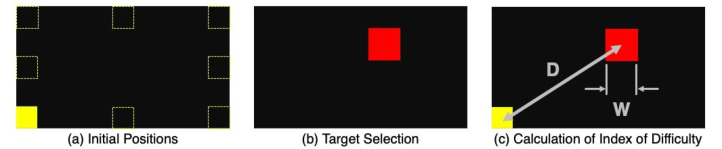
PsyToolkit was used to implement the Fitts’ target selecting task (Stoet, 2010; 2017), where the participant moved the cursor to the target and cli- cked, or touched it with their finger in the case of touchscreen input. The Fitts’ law (Fitts, 1954) states that the time it takes to move a cursor to an area and select it is a function of the distance to the target and the size of the target. The Fitts’ target selection task was presented via a touchscreen display (Raspberry Pi 10.1 inch Touchscreen Monitor), which was mounted on the adjustable monitor arm of the ASCS. Three distinct difficulty levels were introduced by manipulating the target width and distance; easy, medium, and hard. In the
Figure 1: Fitts’ target selection task used in the experiment.
beginning of each trial, a yellow square appeared from one of the eight possi- ble positions (Figure 1a), serving as a starting point. Once the participants hit (i.e., clicked or touched) the inside of the yellow square, a red target square appeared on the screen (Figure 1b; D is the distance to move, and W is the width of the target). The participants were instructed to hit the red square as quickly and accurately as possible. After the participants provided an input, the next yellow square was presented in the same manner. The time the par- ticipants took to hit the yellow square was not measured, and therefore they were allowed to pause a moment before hitting the yellow square. We emplo- yed yellow and red colors to ensure a good level of contrast to the black back screen.
One block contained 40 trials, consisting of 13 easy, 13 medium, and 14 hard trials. During the familiarization session, medium trials were con- sistently presented. The position of the initial target was randomly selected from the eight possible positions, and the target appeared with varied size and distance from the yellow square (Figure 1c). In the experiment, the participants did not receive any time or accuracy feedback on their perfor- mance, and the target square disappeared once one single input was provided regardless of it being inside or outside of the target square.
Four input devices were tested in this experiment: (i) touchpad, (ii) tou- chscreen, (iii) numpad, and (iv) joystick. The Apple Magic Trackpad was used as the touchpad, which was connected to the Raspberry Pi touchscreen display via Bluetooth. While presenting the Fitts’ target selection task, the Raspberry Pi touchscreen display served as the touchscreen input device in the experiment. A USB hub (Sabrent 4-Port USB Hub with Power Switches) allowed the numpad (Jelly Comb 2.4G Number Pad) and joystick (Logitech Freedom 2.4 Cordless Joystick) to connect to the Raspberry Pi touchscreen display wirelessly. Velcro tapes were applied to the control device platform of the ASCS and the base of the touchpad, numpad, and joystick, allowing us to easily adjust the input device configuration and ensure the stability of the input devices during the task in the upright seating and HDT orientations.
Design We employed a 2 (orientations: upright and HDT) x 4 (input devices: touch- pad, touchscreen, numpad, and joystick) x 3 (index of difficulty levels: easy, medium, and hard) within-subject experiment design.
The dependent variables included: (i) Response Time (RT) [ms], (ii) Accu- racy [%], and (iii) Throughput (TP) [bps]. We measured RT from the moment
Simulation Study of Human Input Devices in a Variable Gravity Environment 669
when the participants hit the yellow square until the next hit after the red squ- are appeared. Accuracy was calculated by counting successful trials in one block across the three difficulty levels. We computed TP using Equation (1):
Equation reproduced from the original PDF.
where MT is the mean RT, and We is obtained by:
We = 4.133 × SD (2) where SD is the standard deviation of the distance from the center of the red square to end point coordinates hit by the participants (MacKenzie, 1992). The numerator of the right term in Equation (1) is an effective Index of Difficulty (IDe).
METHOD
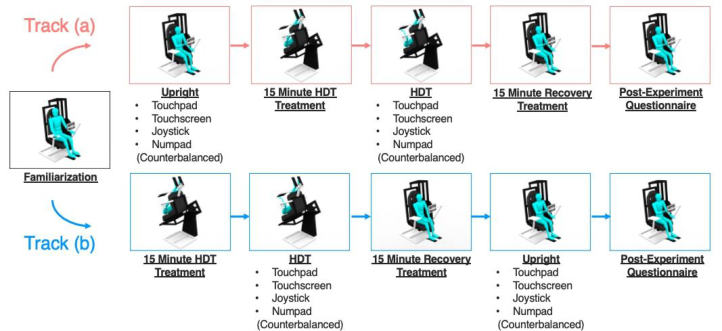
In the beginning of the experiment, the experimenters provided the partici- pants with an overview of the experiment using a 5–10 minute presentation. The presentation covered the objective of the study, experimental flow, and safety instructions. The participants were asked to sign an informed con- sent at the end of the briefing session. Then, the participants were asked to embark on the ASCS, check the configuration of the input device platform and the monitor, and fasten seatbelts with help from the experimenters. Upon the completion of the safety and comfort check, we turned off lighting in the simulation room and then initiated the familiarization session, where the par- ticipants familiarized themselves with the four input devices and a Fitts’ law target selection task. At the beginning of the familiarization session, the par- ticipants were asked to don a wearable brain sensing headband. Then, they conducted a series of Fitts’ target selection tasks in the upright seating orien- tation using all the four input devices, which took approximately 30 minutes. The familiarization session was followed by two sessions where the partici- pants were asked to conduct the Fitts’ target selection task using the four input devices in the two orientation conditions. There were two tracks: (a) upright orientation first and (b) HDT first (Figure 2). We counterbalanced the order of the two seat orientation conditions and the four input devices.
Track (a) asked the participants to conduct one block with 40 trials for each of the four input devices (i.e., 4 blocks with 160 trials in total; a 1-minute short break was presented between the blocks.) in the upright-seating orien- tation first. On completion of the first four blocks, the participants received a 15-minute 34
HDT treatment to simulate the acute increase of IOP. After the HDT treatment, they were asked to conduct another block with 40 trials for each of the four input devices in the HDT orientation. Once the four blo- cks in the HDT orientation were completed, the seat orientation returned to the upright-seating orientation.
In contrast, Track (b) provided the participants with the 15-minute 34
HDT treatment first. Then, they were asked to conduct the first four blocks in the HDT orientation. On the completion of the four blocks, the
Figure 2: Order of experiment trials.
participants were returned to the upright-seating orientation and received a 15-minute recovery treatment. We employed 15 minutes as the length of the recovery treatment under the assumption that the same amount of time was required for body fluid to turn back to its original state. After the 15-minute recovery treatment, the participants conducted another four blocks in the upright seating orientation.
The two sessions took approximately 90 minutes in total and were fol- lowed by the debriefing session. The participants were asked to share their subjective feedback by taking a post-experiment questionnaire, which was presented via the Raspberry Pi touchscreen monitor. The participants filled out the post-experiment questionnaire while seated in the upright orientation. On the completion of the post-experiment questionnaire, the participants disembarked from the ASCS and concluded the experiment.
RESULTS
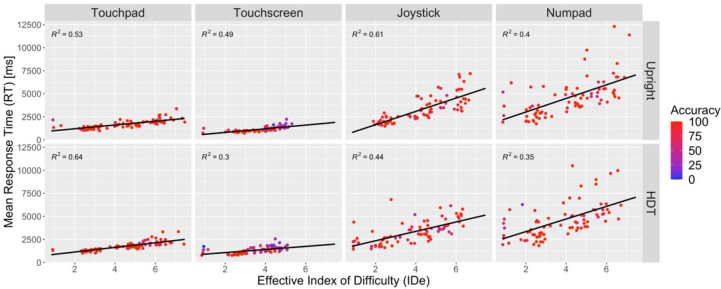
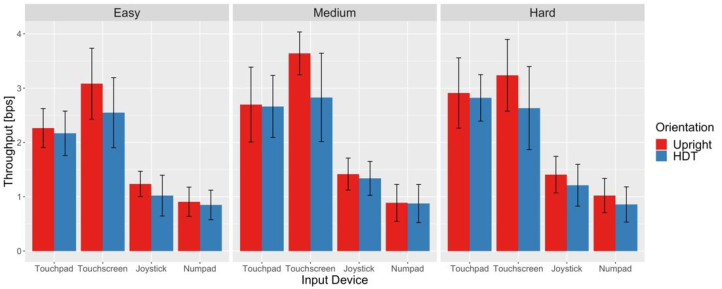
We carried out a three-way MANOVA using R (version 4.2.2) (Team et al., 2013). When appropriate, post-hoc pairwise comparisons were performed. We set the alpha level at 0.05. We analyzed the subjective responses to the post-experiment questionnaire to investigate whether the subjective measures supported the results of our statistical analysis. Due to a technical issue with the PsyToolkit server, we could not collect the Fitts’ performance data from one participant, resulting in a total of 26 right-handed participants (Female: 10, Male: 14, Non-binary/Prefer not to say: 2) aged from 18 to 37 years (M: 22.6, SD: 5.21). Figures 3 and 4 show the results of mean RT and TP respectively. We ran the three-way MANOVA test, suggesting significant interaction effects of orientations and input devices (F(9,225) = 5.39, p < .001), orientations and difficulty levels (F(6,98) = 2.99, p < .01), and input devices and diffi- culty levels (F(18,450) = 30.1, p < .001). Follow-up univariate analyses were carried out to further investigate the detected interaction effects of orientati- ons and devices. Aligned Ranks Transformation (ART) ANOVAs (Wobbrock
Simulation Study of Human Input Devices in a Variable Gravity Environment 671
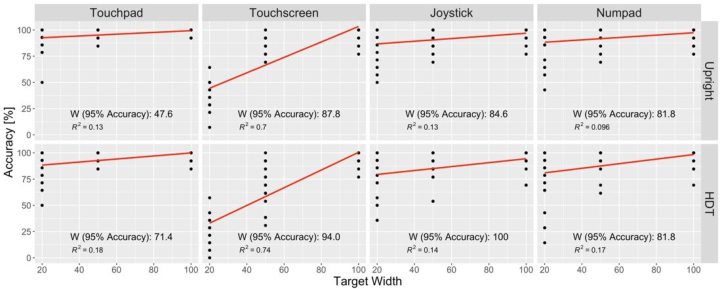
Figure 3: Effective index of difficulty vs. mean RT [ms] across all the conditions.Figure 4: Comparisons of TP [bps] across all the conditions.Figure 5: Preliminary regression analysis for determining the minimum target size.
et al., 2011) detected the interaction effect of orientations and devices on accuracy (F(3,575) = 4.90, p < .05, η2 = 0.0294) and TP (F(3,575) = 15.7, p < .001, η2 = 0.0758). Post-hoc pairwise comparisons (Elkin et al., 2021) were performed; as for TP, there were significant differences between orien- tations and input devices (p <.001) except for the following combinations:
joystick/upright vs. joystick/HDT (p = .0613), touchscreen/HDT vs. tou- chpad/HDT (p = .759), touchpad/upright vs. touchpad/HDT (p = .986), touchscreen/HDT vs. touchpad/upright (p = .997), and numpad/upright vs. numpad/HDT (p = .844). We also attempted to investigate the minimum tar- get size required to ensure 95 percent input accuracy for each type of input device via a regression analysis (Figure 5).
DISCUSSION
While the participants exhibited slightly faster RT values using the tou- chscreen, they produced less accurate inputs (Figure 3). In particular, the participants’ performance was significantly degraded in the HDT condition as the pairwise comparisons suggested a significant difference between tou- chscreen/upright vs. touchscreen/HDT. The touchscreen required a larger envelope of hand and arm motions, which was more pronounced in the HDT orientation where participants needed to reach forward against gravitational force. This gravity effect led to the potential physical fatigue in the course of trials, which could have resulted in the less accurate inputs. This seems to be supported by the post-experiment questionnaire: 19 participants indica- ted that the HDT orientation affected their physical ergonomics (“somewhat agree” and “strongly agree”). Although we acknowledge that this is one of the limitations of the current experiment setting as a microgravity simulation study, spaceflights involve different operational scenarios in varied gravity levels, including 1g or hypergravity conditions. Our observation of the higher error rates with the touchscreen highlights the importance of considering the envelope of motions when designing spaceship cabins and passenger seats.
Our results offered another input device design implication (Doule, 2018) conducted the input device evaluation with the ASCS employing the docking simulation task, reporting occasional directional-confusion with the joystick induced by aviation-oriented control. However, there was no significant effect of the orientation on the joystick, and no subjective comments on directional- confusion were reported by our participants. We believe that the difference between our observation and (Doule, 2018) is associated with the nature of task, meaning that the docking simulation task required a higher spatial reco- gnition capability than our Fitts’ target selection task. Therefore, it is critical to account for what kinds of tasks that SFPs undertake during a spaceflight, and input devices should be selected accordingly.
Our preliminary regression analysis suggested that the touchpad requires a smaller target size when compared to other input devices in both orienta- tions. The small envelope of hand and arm movement is less susceptible to orientation and gravity effects, contributing to the high accuracy. Another explanation is their familiarity with the touchpad control; their daily use of a laptop may have introduced a carryover effect. We should further investi- gate the learning curve and performance level plateau across the input device. Yet, we believe that a touchpad-oriented control would be promising given the performance and learnability as well as a limited time of SFP training (Peeters, 2021).
Simulation Study of Human Input Devices in a Variable Gravity Environment 673
The numpad exhibited slower response time than the other three devices, resulting in lower throughput values. However, it appears less susceptible to the effects of changes in the orientation, which is also associated with the small envelope of arm and hand movement. Some anecdotal comments indicated a situation where the participants accidentally pressed a wrong key due to the adjacency between the arrow keys. Therefore, it is important to mitigate such potential input errors while keeping a small envelope of arm and hand movement.
In the post-experiment questionnaire, five participants indicated that the HDT orientation had an effect on their cognition (“somewhat agree”) whe- reas the rest of the participants did not report any perceived effect (neither agree nor disagree: 6, somewhat disagree: 7, and strongly disagree: 8). Addi- tionally, we received an anecdote indicating that the participant experienced blurred vision during the trials in the HDT orientation. The subjective feed- back suggests that our future study should employ additional experiment protocols to enhance the fidelity of the simulation such as measuring IOP before/after the HDT treatment.
We also acknowledge our study limitation as to the participants’ demogra- phics, where our participants were primarily young and appear to possess a good level of physio-cognitive capabilities. We expect future CST activities to accommodate SFPs from a more diverse population (Peeters, 2021).
CONCLUSION
Given the recent successful commercial sub-orbital and orbital human spa- ceflights, rapid growth of the CST industry is expected. This requires well-established CST guidelines for cabin systems, including control devices and user interfaces. This study was intended to gain insights into the establi- shment of such design guidelines, and we tested the four input devices in the upright and HDT orientations employing the Fitts’ target selection task. The experimental data suggested that the touchpad is a promising input device for the target selection task as it exhibited fast response time with high accuracy, resulting in relatively high throughput in both gravity conditions. We found more input errors with the touchscreen in the HDT orientation. This is most likely because the participants were required to reach forward against gravity in the HDT orientation. Also, we did not observe any directional-confusion with the joystick contrary to Doule’s study (Doule, 2018) employing the docking simulation task, underscoring the importance of considering the types of tasks that SFPs undertake during a spaceflight. We also conducted the preliminary regression analysis aiming at determining the minimum tar- get size to ensure 95 percent accuracy across the input devices. The present study paves the way for establishing CST design guidelines, and we aim to extend our study by addressing the discussed considerations for our future work.
ACKNOWLEDGMENT
This study was supported by the Federal Aviation Administration (FAA) Cen- ter of Excellence (COE) for Commercial Space Transportation (CST) via FAA
Cooperative Agreement 15-C-CST-FIT-016. The authors would like to thank the FAA COE CST for funding. The opinions expressed in this paper are solely those of the authors and do not reflect the views of the FAA COE CST.
REFERENCES
Ciofani, G., Migliore, A., Mazzei, D., Carrozza, M. C. & Dario, P. (2010), ‘Modification of pointing performance in altered gravitational environments’, Microgravity Science and Technology 22(2), 123–128. Dayal, D., Jesudasen, S., Scott, R., Stevens, B., Hazel, R., Nasrini, J., Donoviel,
D. & Basner, M. (2020), ‘Effects of short-term- 12
head-down tilt on cognitive performance’, Acta Astronautica 175, 582–590. Doule, O. (2018), Adaptive Spaceship Cockpit Architecture, PhD thesis, Florida Tech. Elkin, L. A., Kay, M., Higgins, J. J. & Wobbrock, J. O. (2021), An aligned rank
transform procedure for multifactor contrast tests, in ‘The 34th annual ACM symposium on user interface software and technology’, pp. 754–768. Fitts, P. M. (1954), ‘The information capacity of the human motor system in controlling the amplitude of movement’, Journal of Experimental Psychology 47(6), 381–391. Holden, K., Greene, M., Vincent, E., S’andor, A., Thompson, S., Feiveson, A. &
Munson, B. (2022), ‘Effects of long-duration microgravity and gravitational transitions on fine motor skills’, Human Factors p. 00187208221084486. MacKenzie, I. S. (1992), ‘Fitts’ law as a research and design tool in human-computer interaction’, Human-computer interaction 7(1), 91–139. Pandiarajan, M. & Hargens, A. R. (2020), ‘Ground-based analogs for human
spaceflight’, Frontiers in Physiology p. 716. Peeters, W. (2021), ‘From space tourism to commercial suborbital travel’, Journal of Travel & Tourism Marketing 10. Russomano, T., Dalmarco, G. & Falcão, F. P. (2008), ‘The effects of hypergravity
and microgravity on biomedical experiments’, Synthesis lectures on biomedical engineering 3(1), 1–68. Seedhouse, E. et al. (2015), Microgravity and vision impairments in astronauts, Technical report, Springer. Smith, J. D., Cromwell, R. L., Kundrot, C. E. & Charles, J. B. (2011), Six-degree
head-down tilt bed rest: Forty years of development as a physiological analog for weightlessness, in ‘American Society for Gravitational and Space Biology Conference’, number ARC-E-DAA-TN4096. Stoet, G. (2010), ‘Psytoolkit: A software package for programming psychological experiments using linux’, Behavior research methods 42(4), 1096–1104. Stoet, G. (2017), ‘Psytoolkit: A novel web-based method for running online questi-
onnaires and reaction-time experiments’, Teaching of Psychology 44(1), 24–31. Team, R. C. et al. (2013), ‘R: A language and environment for statistical computing’. Wobbrock, J. O., Findlater, L., Gergle, D. & Higgins, J. J. (2011), The aligned rank transform for nonparametric factorial analyses using only anova procedures, in ‘Proceedings of the SIGCHI conference on human factors in computing systems’, pp. 143–146.
LISTED IN THE AHFE DIGITAL BOOKSTORE CATALOGUE
Explore the complete digital volume
Human Factors in Transportation
Read this individual research paper free through the original publisher, or explore the full digital proceedings book.
ISBN 978-1-958651-71-1
Explore this ISBN in the AHFE Bookstore ↗Listed in the July 2026 bookstore catalogue; search by ISBN to confirm current availability · Digital book purchase optional