Xuan He, Shuai Sun, Xiaoling Lin (2023). Building a Healthy Family Atmosphere: A Hybrid Toy System Based on the “Zone of Proximal Development”. In: Design for Inclusion. AHFE Open Access, vol. 75, pp. 61–69. https://doi.org/10.54941/ahfe1003327
The lack of family sex education is a major issue in the development of comprehensive sex education for Chinese children. Three significant obstacles stand in the path of the development of family sex education. The first is the lack of effective parent-child participation in the practice of the family; the second is the mismatch between the parent’s sexual knowledge reserve and the sex education required by the child; third, the lack of quality of parental sex education has led to difficulties in grasping the timing and depth of development. Therefore, children's family sex education requires effective design patterns to intervene. This study proposes a model of design theory for family sex education based on the " zone of proximal development " education theory. This paper also yields an interactive hybrid toy system based on Dida products to help parents teach children about sex and boundaries. The design prototype has been tested and received positive appraisal and feedback, indicating that the designed theoretical model is effective in the promotion of family sex education.
According to the “Girl Protection”Statistics on Child Sexual Assault Cases in 2020 and Child Sexual Assault Prevention Education Survey Report, a total of 332 cases of sexual assault on children (under 18) were reported in China in 2020, and 845 children were victimized. The analysis of the report shows that the lack of sex education exacerbates the disadvantaged status of young people and children, making them prone to abuse and subsequently entail issues such as depression, self-harm, early pregnancy, and increased gender inequality. The development of sex education should be promptly promoted to allow for the well-being of children and the young people.
The 2030 Sustainable Development Goals (SDGs) suggests the building of a just, fair, tolerant, open and inclusive world including traits such as quality education, good health and well-being, gender equality and human rights (UNESCO et al., 2018). The fourth article clearly states that “ ensure
that everyone is provided with inclusive and fair quality education and life- long learning opportunities.” However, current research on sex education is mainly steered towards the realms of sociology, pedagogy, and psychology, with only few studies delving into the educational practice and development of sex education. The sex education model instilled with top-down know- ledge is not conducive to current social sex education development. This paper aims to explore ways to design, so as to intervene in children’s family sex education, create a hybrid-toy system for family sex education, and pro- vide a reasonable medium for families to carry out sex education practices, so children can smoothly master the knowledge, skills and ethical values of comprehensive sex education.
BACKGROUND
The “United Nations International Sex Education Guidelines (Revised Edi- tion)” requires children to receive a comprehensive sex education of “discus- sion, cognition, emotion, body and society”, so that children and young people acquire a certain amount of knowledge, attitudes and values to ensure their personal health, well-being and dignity; and promote the well-being of the people in their vicinity(UNESCO et al., 2018; UNFPA; & UNESCO;, 2022). The purpose of children’s family sex education is to allow children to learn to obviate dangerous situations and to endow them with the correct set of values and outlook on life to create an inclusive world whereby everyone is equal and devoid of violence.
The development of sex education in China is currently thriving. On Octo- ber 17, 2020, the term “sex education” was formally written into the “Law on the Protection of Minors” and was promulgated on June 1, 2021. The implementation of children’s family sex education is a crucial step to popula- rize sex education(Walker*, 2004). It can promote parent-child relationships and create an open and inclusive family atmosphere so children readily seek help when facing difficulties. Chinese parents are reluctant to discuss sex kno- wledge due to taboos and cultural concerns, and fail to assume the role of dispenser of sex education knowledge(Binti Abdullah et al., 2020; Gao et al., 2001; Liu et al., 2015; Zhang et al., 2020). According to statistics, 56% of parents are aware of the significance of sex education but fail to implement it due to their own deficient knowledge. Numerous studies have been carried out and the core issue is the urgency and necessity of sex education. There are numerous studies on children’s sex education and the core issue of research is the urgency and necessity of sex education. By exploring the severe lack of sex education, the point of view of “sex education needs to be carried out” is put forward. Moreover, there is a lack of discussion on the practical methods and content of sex education.
Regarding the development form of sex education, the “Basic Sex Educa- tion Guide” published by Maris Putt China highlights five common practice methods of sex education: regular courses/special lectures, peer education, participatory training, participatory drama and picture book reading. Pre- sently, the main mode of family neutral education is picture book reading, and the main mode of school development is regular courses and special
Building a Healthy Family Atmosphere: A Hybrid Toy System 63
lectures. During the development process, sex education and pedagogical methods such as cartoons and children’s interactive games (such as body traf- fic lights) will be used. A number of design works on children’s sex education have also emerged at home and abroad, such as the board game “Dinging Doudou Curious Showdown”; children’s wearable Red Velcro using “body traffic lights”, team interactive toys Wise dialogue with the body; video games UnderControl (Guana et al., 2014), etc. It has been found that the design plan uses the theory of “ zone of proximal development”, and the design plan or teacher/parent plays the role of assistant to help children reach the “ zone of proximal development “ of sexual knowledge. However, the scope of design remains quite narrow. At the conceptual level, it reflects the methods and problems of design divorced from reality.
METHODOLOGY
The learning theory proposed by developmental psychologist Lev Vygotsky -the zone of proximal development, refers to the knowledge within the lear- ning ability of the learner but cannot be understood temporarily (Wertsch, 1984; Zaretskii, 2009). The performance of the theory of zone of proxi- mal development in sex education is to design the links of interventional sex education to play the role of assistant or provide help for human assistants for children to reach the proximal development zone of sexual knowledge (Doolittle, 1997; WANG, 2009).
The lack of the role of assistants is a key issue in the development of family sex education. For Chinese people, there is a traditional concept of that it is awkward and ungraceful to talk about sex in the daily life. Many parents have not received systematic sex education, so that they cannot help their children reach the zone of proximal development of sex education. Consequently, the design intervention allows parents to have the ability to provide children with knowledge, support and assist children to reach the zone of proximal develo- pment, acquire corresponding knowledge, skills, and possess the correct set of values.
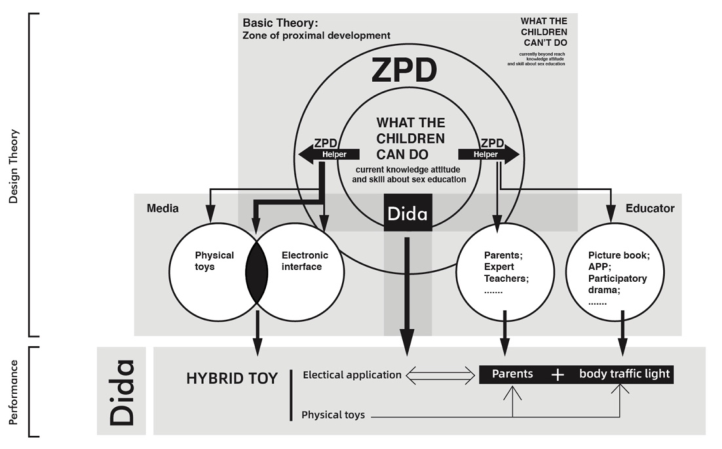
As the theoretical basis of family sex education practice, the “zone of pro- ximal development” theory requires appropriate sex education methods to act as a carrier (as shown in Figure 1). Body traffic lights are widely used in academic settings as a method of children’s sex education. The principle is to divide the body into three areas. The green light area represents the safe area of the body, which is an area that anyone can touch with their consent and will not feel embarrassed; the yellow light area represents the body’s warning area, The area that people close to you can touch after obtaining prior con- sent; the red-light area represents the forbidden area of the body, and only you can touch it.
The method of physical traffic light education can allow children to acquire self-protection concepts and also use the image of the “body” as a guide- line for sex education such as “relationship”, “family”, and “violence and safety”. Body traffic lights have advantages over other methods in the com- prehension of sex education. However, as a practical method, body traffic lights mostly exist in the form of paper models and physical touch. Its simple
Figure 1: Design interventional education practice model based on the “zone of proximal development” theory.
mechanism leads to a relatively single way of carrying information, which makes it impossible to independently become an “assistant” in the zone of proximal development. The “assistant”needs to provide enough information to the learner. Considering the usage scenarios, a single paper model cannot be reused in the family, children cannot maintain focus, and parents lack sufficient theoretical knowledge to interact with children. The behavior of physical touching occurs between children, and it is easy to experience sexual harassment in the teaching process, which defeats the purpose of education.
The combination of “physical traffic light + parents” requires parents to have a high level of sexual knowledge, and most parents do not possess the knowledge base of a trained teacher. The key to solving the problem is to carry out the specialized design of the “body traffic light” in the family scene, so that parents can act as competent assistants.
Hybrid toys refer to toys combining tangible physical toys with electronic interfaces. Children can interact with tangible physical toys while experie- ncing abundant digital content from the electronic interface. Through the case analysis of hybrid toys, it has been found that children’s robot playma- tes and toys that enhance the learning experience overlap throughout the six subdivisions of hybrid toys.
The “body” of the “body traffic light” can be used as the design source of physical toys, playing the role of children’s intelligent playmates, and enha- ncing the operability and maneuverability of this method. In principle, the “smart” function of the electronic interface provides unlimited opportuni- ties for the development of sex education. The digital information that the “smart” part can bring can provide children with more learning information, and also help parents quickly understand the required sexual knowledge text
Building a Healthy Family Atmosphere: A Hybrid Toy System 65
to become a competent supporter. Constructing hybrid toys based on body green light is an effective way to achieve children’s family sex education.
Design Definition The result of the preliminary conclusion is the introduction of physical toys for children and electronic applications for parents to help complete the deve- lopment of family sex education. The core idea of conducting user research is to provide parents with the text of instant knowledge displayed on the ele- ctronic application, and use paper question cards as the physical medium for children to face, so the board game “Dinging Doudou Curious Showdown” was chosen as the basis. The transformation was used as an experimen- tal material to allow families to conduct discussions on sex education, and conduct user research through field activities and semi-structured interviews.
The target users of the design users are children aged 5–8 and their parents, which has been recognized in the field of developmental psychology. The smallest particle size proposed in the “Outline” is 5–8 years old.
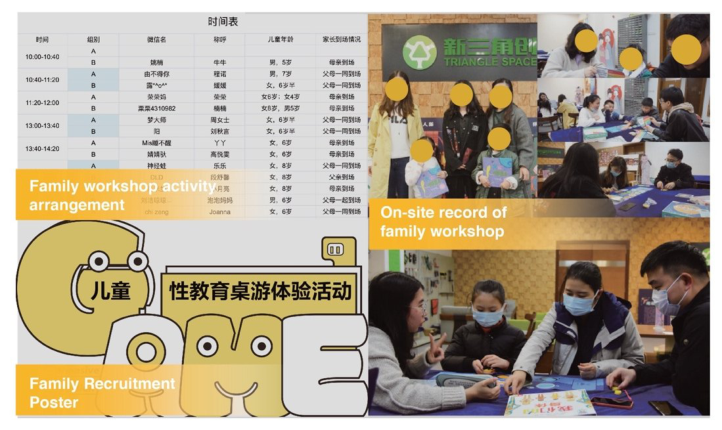
The research recruited 19 families, and the experiment carried out on-site activities with families as a unit (as shown in Figure 2). During the experi- ment, the researcher tried not to impede on the normal interaction process of the family. When the parents were unable to answer, the researcher would join in to assist the parents in answering. During the experiment, the family would spend 5 minutes to understand the rules of the experiment, 25 minutes to play games, and 15 minutes to conduct parent interviews. During the game, the researcher will observed the performance of the family across the following three aspects: the interaction between children and their parents; children’s attitudes towards sex education-related knowledge, and parents’ state and performance of sex education. After the research, a semi-structured interview was conducted with the parents to understand the parents’ experience and daily sex education during the research.
Through the experimental activities of 19 groups of families, the following five core problems have been identified and compiled. Curiosity drives chil- dren to desire new sexual knowledge; parents’ understanding and attitudes towards sex knowledge largely determine the extent to which sex education is carried out; children are more likely to learn knowledge from stories rela- ted to them; the daily relationship between parents and children influences the development of sex education; parents’ attitudes towards children’s sex education are mostly driven by black hats, which is the concern of harm to the child.
The elements that need to be incorporated in the physical toy and intera- ctive parts can be clarified by the identification of the core problems found. Physical toys need to pique children’s curiosity. Moreover, physical toys should not be too concrete, as children cannot handle concrete body informa- tion. Regarding the computer software children expect story-rich texts rather than obscure knowledge; parents There is a lack of ability to convert textbook knowledge into narrative text in addition to instant knowledge; Regardless of it being the development of sex education or the daily life of a harmonious
Figure 2: Recruitment of children’s family sex education workshops and experimental site image records. 19 sets of household data will be displayed soon.
family, parents and children are called on to maintain continuous communi- cation and exchanges, and to intervene. The design of family sex education should not allow design to completely replace the assistant roles of parents, but to liaise between parents and children, turning the top-down knowledge transfer process into a process of collective learning.
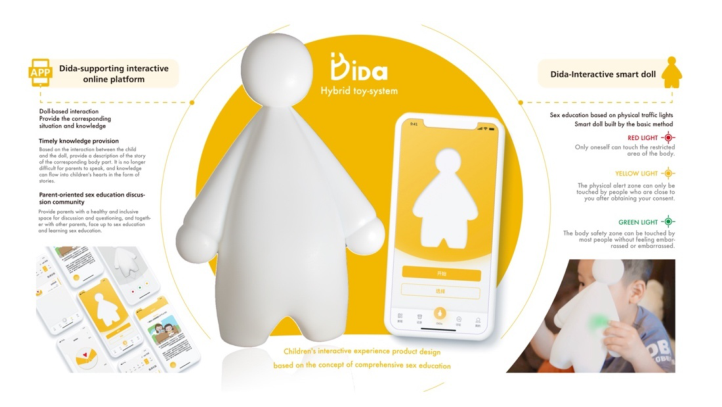
DESIGN Based on the previous theoretical model and the survey results of the user research workshop, Dida, an interactive hybrid toy system, is proposed. Dida aims to provide opportunities for the development of sex education in the family, so children can acquire knowledge of sex education during games (as shown in Figure 3). They can form the attitude respected by comprehensive sex education in the interaction with parents and gain daily life and the requi- res skill set to deal with issues. To this end, Dida provides children with smart dolls based on the rules of physical traffic lights. Children interact tangibly with them, and at the same time induce the Dida digital application to provide parents with storytelling text (i.e., corresponding knowledge) and electronic knowledge materials to boost the effectiveness of children’s sex education. The following part of this article will delineate the various parts of Dida and the use of products.
Dida is composed of two parts: a smart doll and an electronic plat- form. Children get differ-ent sound and light feedback by pressing the smart doll. Different results of pressing the same part will guide the child to the parent and ask the parent questions, and the child’s pressing feedback will be synchronized On the electronic interface, parents can see the sto-ries and
Building a Healthy Family Atmosphere: A Hybrid Toy System 67
Figure 3: Interactive hybrid toy system Dida product description. Dida is composed of an electronic platform and a smart doll.
knowledge points corresponding to the results, and parents can pass the kno- wledge points to the children in the form of storytelling, and watch additional animations and pic-ture explanations with the children; use the informa- tion provided in the electronic platform The situation is discussed on an equal basis with the child to understand whether the child’s mastery of the knowledge point can be transformed from knowledge to attitude and skills.
After completing the design and prototyping, two forms of verification were adopted: on-site activities (experimental family using Dida on site) and long-term activities (experimental family using Dida for a week). By filling out the knowledge questionnaire before and after the experiment, the diffe- rences in the level of sexual knowledge of the children in the experimental family before and after using Dida were evaluated. Through the questionnaire form in the long-term experiment, the difference in the frequency of family discussion about sex education topics before and after the experiment was obtained. The statistical results show that in the short-term experiment, 73% of children’s knowledge questionnaire scores (knowledge level) improved significantly after use. In the long-term experiment, 81% of children’s know- ledge questionnaire scores (knowledge level) improved significantly after use. The frequency of the experimental family sex education topic in the week of using Dida was higher than the frequency of the first week and the subsequent week of the experiment.
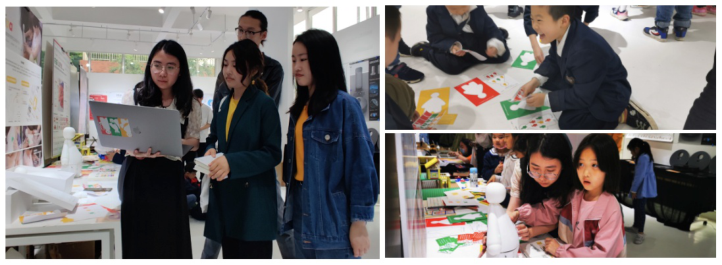
To better judge the rationality of the design in the use of sex education, the form of expert interviews was adopted to conduct research and opinion collection by the staff of sex education institutions on the front line of the children’s school sex education. It won widespread appraisal from experts and it is believed that Dida’s design can help families better carry out sex education, and it may also be used in school sex education (as shown in Figure 4). Practice has proved that Dida significantly promotes family sex education.
Figure 4: User survey site and expert interview site picture record.
CONCLUSION AND FUTURE POSSIBILITIES Child sex education is a challenging and sensitive topic, especially for Asian countries such as China. However, this issue cannot be avoided and extensive sex education is a requirement of the Sustainable Development Goals. The development of family sex education can help children ensure their well- being and dignity, and is also an opportunity to build a harmonious family. A harmonious family unit is synonymous of a harmonious society.
This paper provides information about “body traffic lights” through the Dida physical dolls, an interactive hybrid toy system. This system helps to educate and prevent sexual assaults. It is also supplemented by apps and allows parents to integrate sex education into children’s stories which is a sui- table opportunity for families to carry out sex education. A theoretical model of interventional education has been established through the “proximal deve- lopment interval” theory proposed in the previous article. This theoretical model is based on the theory of children’s education, combined with the sex education method “body traffic light”, explores the design expression of mixed toys, and implements the model. The feedback obtained in pra- ctice proves that the application of the model can promote the sex education in the family and the efficiency of children’s acquisition of sex knowledge. The future plan is to build a user-generation platform to enrich narrative texts through users; based on the previous theoretical model, explore the possibility of new forms of child sex education practice.
REFERENCES
Binti Abdullah, N. A. F., Muda, S. M., Mohd Zain, N., & Abdul Hamid, S. H. (2020).
The role of parents in providing sexuality education to their children. Makara Journal of Health Research, 24(3), 2. Doolittle, P. E. (1997). Vygotsky’s Zone of Proximal Development as a Theoretical Foundation for Cooperative Learning. Journal on Excellence in College Teaching, 8(1), 83–103. Gao, Y., Lu, Z., Shi, R., Sun, X., & Cai, Y. (2001). AIDS and sex education for young
people in China. Reproduction, Fertility and Development, 13(8), 729–737. Guana, V., Xiang, T., Zhang, H., Schepens, E., & Stroulia, E. (2014). Under Control an educational serious-game for reproductive health Proceedings of the first ACM
Building a Healthy Family Atmosphere: A Hybrid Toy System 69
SIGC HI annual symposium on Computer-human interaction in play, Toronto, Ontario, Canada. https://doi.org/10.1145/2658537.2662983 Liu, W., Dennis, J. M., & Edwards, C. P. (2015). Chinese parents’ involvement in sexuality education for adolescents. International Journal of Sexual Health, 27(4), 485–507. UNESCO, HIV/AIDS, J. U. N. P. o., Fund, U. N. P., Fund, U. N. C. s., Women, U. N. E.
f. G. E. a. t. E. o., & Organization, W. H. (2018). International technical guidance on sexuality education: an evidence-informed approach[book]. UNFPA;, & UNESCO;. (2022). Comprehensive Sexuality Education Technical Guideline - - Adaptation of Global Standards for Potential Use in China. https: //china.unfpa.org/zh-Hans/publications/22110701 Walker*, J. (2004). Parents and sex education—looking beyond ‘the birds and the
bees’. Sex Education, 4(3), 239–254. WANG, Y.-b. (2009). Impact of Lev Vygotsky on special education. Canadian Social Science, 5(5), 100–103. Wertsch, J. V. (1984). The zone of proximal development: Some conceptual issues.
New Directions for Child and Adolescent Development, 1984(23), 7–18. Zaretskii, V. K. (2009). The Zone of Proximal Development. Journal of Russian & East European Psychology, 47(6), 70–93. https://doi.org/10.2753/rpo1061- 0405470604 Zhang, W., Ren, P., Yin, G., Li, H., & Jin, Y. (2020). Sexual abuse prevention edu-
cation for preschool-aged children: Parents’ attitudes, knowledge and practices in Beijing, China. Journal of Child Sexual Abuse, 29(3), 295-311.
LISTED IN THE AHFE DIGITAL BOOKSTORE CATALOGUE
Explore the complete digital volume
Design for Inclusion
Read this individual research paper free through the original publisher, or explore the full digital proceedings book.
ISBN 978-1-958651-51-3
Explore this ISBN in the AHFE Bookstore ↗Listed in the July 2026 bookstore catalogue; search by ISBN to confirm current availability · Digital book purchase optional