Rochelne Barboza, Miguel Carvalho (2023). Contribution of Ergonomics and Anthropometry in the Design of Hospital Clothing for Prevention of Pressure Ulcers in Patients with Reduced Mobility. In: Design for Inclusion. AHFE Open Access, vol. 75, pp. 17–26. https://doi.org/10.54941/ahfe1003323
Patients with reduced mobility resulting from physical/motor impairments, or even as a result of prolonged stays in hospital beds, are prone to various changes in their human body systems, namely the development of wounds, which can quickly evolve into pressure ulcers. Clothing (pajamas) as an essential item for users, will be in direct contact with the skin, also for long periods. The posture adopted in the different resting positions will influence the interaction between body and clothing, which, consequently, will have an effect on the users’ bodies. Understanding these body changes, meaning the changes in anthropometric measurements according to the adopted posture, is relevant in the product development phase. The objective of this study is to investigate and develop a typology of functional hospital clothing for the prevention of pressure ulcers, adapted to users with reduced mobility, which is able to respond to needs in terms of anthropometry, ergonomics, comfort, and usability. Through the virtual simulation of the 3D CAD system CLO 3D, the behavior of the fabric in relation to the body and the forces of tension, compression, adjustment, and pressure points were evaluated using visual resources.
The movement of the human body is only possible through the joint and coordinated action of bones, muscles, and joints. The size of the muscle and its efficiency are directly related to its use or activity, therefore, in users with reduced mobility, there is a tendency to sarcopenia, with loss of strength and muscle mass and consequently a decrease in measurements (Cawthon et al. 2009). The body at rest for long periods enhances the action of clothing on the skin. Ergonomic and anthropometric studies have a major impact on the comfort of these people. The impact of body measurements from the postu- ral changes of users with reduced mobility will determine the distortions of clothing related to body movements, restricting or intensifying the comfort condition (Loker et al. 2005).
Based on the biomechanical, physiological, and anthropometric princi- ples on which ergonomics is based, posture and body movements assume an important role in understanding the interactions between human beings and other elements of a system (Dul and Weerdmeester, 2012). The physical laws of the mechanics of the human body, such as tension forces between muscles and joints, shear forces, pressure, and friction, characterize the acti- ons of biomechanics. The effort made by the body (muscle), which involves an energy demand to maintain a posture or perform certain movements, is related to physiological factors. Anthropometry, in turn, concerns characters of dimensions and proportions of the human body, considering individual differences, variations, and the scope of the movements (Iida, I., & Buarque 2016). In general, the construction of medical pajamas or hospital clothing takes place without considering the need of lying down or remaining in sitting positions for long periods, therefore, devoid of principles of efficiency, auto- nomy, wearability, comfort, privacy, and aesthetics (Carvalho, M., Duarte, F., Heinrich, D., & Woltz 2009; Carvalho et al. 2018). Anthropometric and ergonomic studies related to body changes to resting positions between decubitus are quite deficient or non-existent, with a vast field to be explored.
The knowledge of human anatomy is necessary, particularly to accurately identify the anthropometric points for a closer approximation of the dimen- sions of the studied body and, from there, design clothing with the collected data (Cichocka et al. 2014).
The entire methodological process was based on ergonomic methodolo- gies, with the process division into structuring, research, realization, and production (Flores 2001). For anthropometric measurements, the direct method was used, using a flexible measuring tape and a caliper; as well as the indirect method, where body shapes were obtained using 3D Body Scanning Systems (3D body scanner) and imported into a 3D CAD System for 3D pat- tern design, allowing various simulations, digitally identifying pressure and compression points.
RESEARCH AND DEVELOPMENT OF HOSPITAL CLOTHING Having patients as the starting point for the development of the product/clo- thing for hospital use, prioritizing users’ needs in an approach based on real facts, will best direct the user-centered design approach, to meet the demand in terms of comfort in different ways. In addition to such needs, it is also necessary to understand the limitations, mobility conditions, adopted postu- res, complications and implications of injuries, specifications of materials used, as well as the pattern design process, textile structures and technologies needed (Farao et al. 2020).
These parameters configure the problems to be addressed, and consequ- ently the identification of opportunities, considering the improvements to be implemented in the environment, where the end user’s environment is understood; in design, where objects related to the problem are created and evaluated; on the existing knowledge base within the problem space, until a satisfactory design is achieved (Hevner 2007).
Contribution of Ergonomics and Anthropometry in the Design of Hospital Clothing 19
Therefore, for the project proposal, concepts of design, structural system, and conception were inserted, to achieve the desired ergonomic comfort, in terms of ease of dressing, ease of taking off, ease of access for personal hygi- ene procedures and medical care, identification of the degree of effort for handling, identification of most common movements during use, identifica- tion of ease values to maximize ergonomic comfort and accommodation of necessary items, allowing easier access to specific parts of the body (Barboza et al. 2022).
The perceptive aspects of clothing, which characterize cognitive ergono- mics, were considered in terms of aesthetic quality, where the subjective perception of aesthetic evaluation becomes relevant for the user, with ele- ments that raise self-esteem, confidence, and satisfaction, in the context of social life, even in a hospital environment. Among the aesthetic qualities of the textile properties, some essential categories were listed, related to mate- rials, design, and influencing factors, which combined, will support issues associated with psychological comfort (Howard Gardner 1994; Iida, I., & Buarque 2016).
Research of Prototypes Obtained From Flat and Three-Dimensional Pattern Design From the anthropometric characterization of the target population using this type of clothing, through the use of 3D body scanning technology, as well as manually obtaining measurements of the variables defined for the study, the hospital clothing pattern design was developed.
The tasks selected for the pattern design process followed the criteria rela- ted to the ease needs for proper movement, avoiding excess fabric, so as not to develop folds and internal volumes. The functional analysis proposes to develop solutions for accommodation, for example, for the use of diapers, easily accessible openings for medical care, and access to certain parts of the body for personal hygiene procedures, through creative design tools and manipulation techniques.
Flat pattern design on paper (2D), moulage/3D pattern design on a manne- quin and 3D Computer Aided Design (CAD) pattern design techniques were used. The use of 3D CAD software allows for several simulations, digitally identifying pressure and compression points associated with the discomfort responsible for wound development, leading to the occurrence of pressure ulcers (CLO Virtual Fashion 2020). The simulation of 3D avatars in diffe- rent anatomical positions, namely representing the most common patient’s resting positions, will allow further validating of the developed flat pattern design for the standard static position, identifying the needs for adjustment to change the traditional pattern design, contributing to the prevention of pressure ulcers.
MATERIALS AND METHODS
The methodological process was based on ergonomics methodologies, with the process divided into four stages: structuring, investigation, realization, and production (Flores 2001). For the structuring stage, where the basis of
20 Barboza and Carvalho
the project is defined, the research strategy was based on exploratory and descriptive studies, characterized as action research, through the field survey method with the collection of data in loco and bibliographical research.
For the other stages, the study variables were selected first, with a total of seventeen measurements, considering the main lines and girths of the trunk and body members, with the most impact in the process of garments pattern design.
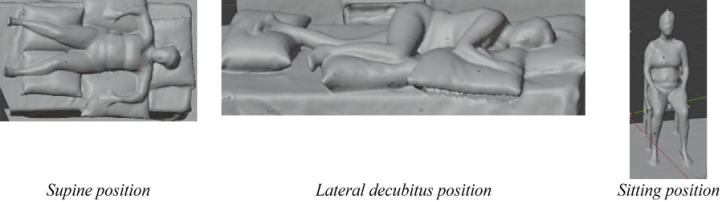
Furthermore, the main resting positions of the patients were identi- fied, considering the supine position, lateral decubitus position and sitting position. These postures are represented in Figure 1.
Figure 1: Main resting positions used to obtain body measurements.
For the direct method, where there is physical contact with the participant, measurements were obtained manually, using a flexible measuring tape and a caliper. As for the indirect method, where there is no direct physical contact, three-dimensional images were captured using the Structure 3D scanner and a photographic camera to record and study the resting positions.
From the 3D scanner images captured, in the selected positions, 3D avatars were created, similar to the participant’s body, using CLO 3D CAD system, obeying to the anthropometric measurements, for later simulation and inser- tion of virtual clothing, with analysis and identification of the behavior of the fabric materials close to the body and the resulting forces of tension, compression, adjustment, and pressure points.
The data analysis process was performed using IBM® SPSS Statistics sof- tware v27 and Microsoft® Excel 2016 spreadsheet. Data normality was verified using the Shapiro-Wilk test. For the variables that obeyed the nor- mal distribution, the average (Avg) and standard deviation (SD) values were used. On the other hand, for variables that showed a behavior not normally distributed, the median (Md) and the interquartile range (IQR) were used. For the variables that followed the normal distribution, the differences were obtained through the one-sample t-test (with a 95% confidence interval). In the case of variables that followed a non-normal distribution, the one-sample Wilcoxon test was used.
RESULTS AND DISCUSSION
The mean age for women was 83.25 ± 12.54 years and for men 78.00 ± 9.53 years. Table 1 shows the global results of the anthropometric data obtained in this study, including the average values (Avg) and the standard deviation (SD).
Contribution of Ergonomics and Anthropometry in the Design of Hospital Clothing 21
Table 1. Anthropometric dimensions considered and collected in this study (millimeters).
Table available in the original PDF paper.
Position Anthropometric Dimension Abbreviation Average SD 1 Neck base circumference NBC 407.67 47.33 2 Chest circumference CC 1027.00 127.00 3 Waist circumference WC 987.33 150.67 4 Abdomen circumference AC 1034.00 133.33 5 Hip circumference HC 1064.00 96.00 6 Upper thigh circumference UTC 520.00 99.67 7 Middle thigh circumference MTC 435.00 68.67 8 Knee circumference KN 406.33 42.67 9 Upper arm circumference UAC 306.67 54.00 10 Elbow circumference EC 277.33 23.67 11 Hand circumference HC 212.33 20.67 12 Shoulder breadth SB 109.00 10.33 13 Crotch height CH 606.33 65.67 14 Outside length (trousers length) OT 936.33 64.00 15 Hook height HH 329.67 59.00 16 Sleeve length SL 591.00 26.33 17 Total front length (Neck-Bust-Waist) TFL 355.00 45.00
From the evaluated body dimensions, five of them had a non-normal distri- bution, NBC_Dsupine, SB_Sitting, CH_Dlateral, HH_Sitting, and SL_Sitting. Regarding the difference between the body dimensions studied (n = 17) and the resting positions (n = 3), significant differences were observed between: HC_Dsupine and HC_Sitting; KN_Dsupine and KN_Sitting; EC_Dsupine and EC_Dlateral; EC_Dsupine and EC_Sitting; SB_Dsupine and SB_Dlateral; SB_Dsupine and SB_Sitting; SB_Dlateral and SB_Sitting; TFL_Dsupine and TFL_ Sitting; TFL_Dlateral and TFL_Sitting. Of the fifty-one measurements considered (17 dimensions and 3 positions), nine measurements (17.65%) showed changes due to the adopted position.
Table 2 displays more detailed anthropometric data organized by posi- tion (Supine, Lateral decubitus, and Sitting position) containing Min, Max, Avg, SD, Md (median) and IQR (interquartile range) values. Due to the lack of a significant number of males and females in this sample (males = 3, females = 8) the dimensions were not analyzed separately for men and women.
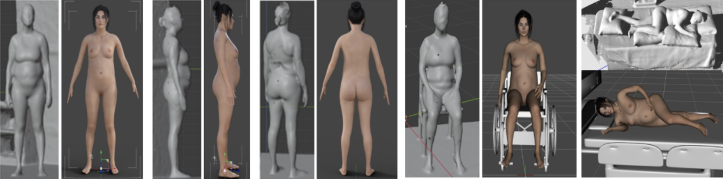
The images obtained by the 3D body scanner, in the selected positions, resulted in the creation of 3D avatars, like the participant’s body, obeying to the anthropometric measurements, for the simulations with the clothing.
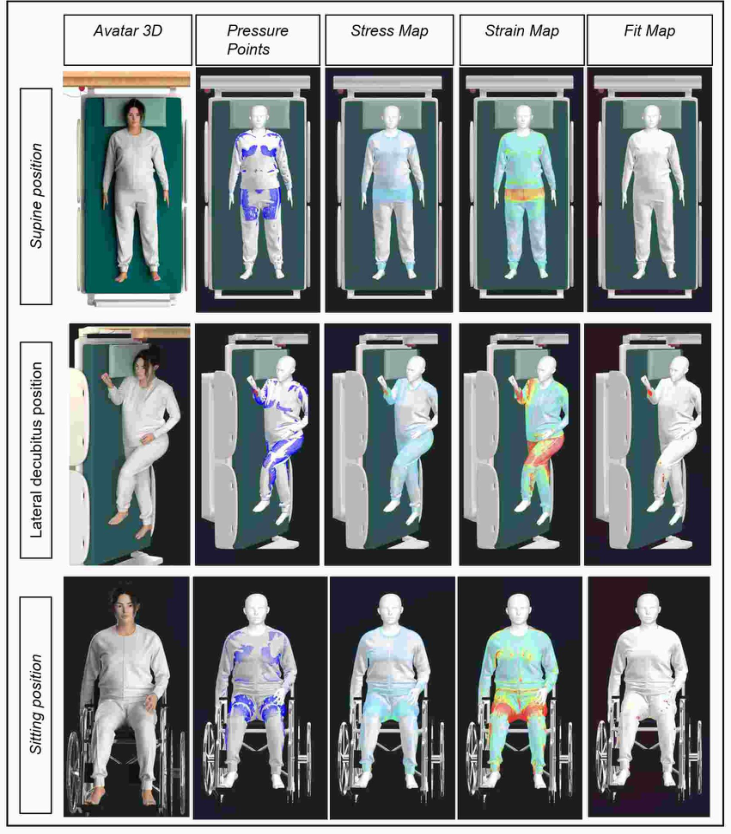
The 3D CAD system CLOD 3D includes visual resources capable of iden- tifying the behavior of the materials used in relation to the body, and the forces of tension, compression and adjustment, as well as the pressure points (CLO Virtual Fashion).
The Pressure Point Map displays the contact points between the avatar and the outfit. The Compression or Stress Map displays the force per unit area in kPa, applied to a garment by external stress and its indicator is shown in eight colors. Blue indicates zero stress (0.00kPa), while red indicates the
22 Barboza and Carvalho
Min Max Avg SD Md IQR Min Max Avg SD Md IQR Min Max Avg SD Md IQR
Table 2. Anthropometric dimensions for each main resting position (millimeters).
Table available in the original PDF paper.
Variables Supine position Lateral decubitus position Sitting position
Contribution of Ergonomics and Anthropometry in the Design of Hospital Clothing 23
Figure 2: Avatars of the main resting positions.Figure 3: CLOD 3D material behaviors simulations for the main resting positions.
strongest stress (100kPa). Intermediate numbers are expressed as a color gra- ding. The Tension Map indicates how much the clothing is stretched when
24 Barboza and Carvalho
being used, that is, it represents the tension suffered by the material when in use, according to the adopted position. Blue indicates a 100% distortion rate (no distortion), while red indicates a 120% distortion rate. Intermediate numbers are expressed as a color grading. The Fit Map displays how many sections of the garment have reached the material tension limit on the avatar. The Fit Map value is a percentage of how much the material has stretched about this maximum distortion. The colors show tight parts of the garment, too tight or not wearable.
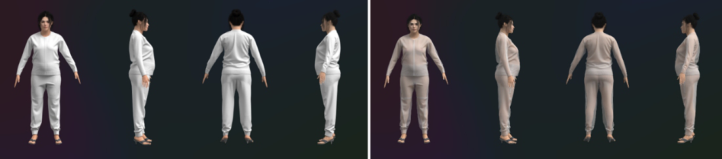
Through the use of CLO 3D visual resource, it was verified that between the clothing and the body, translucent surface (Figure 4), that the existing space was within the normal limits, allowing for adequate ease values to maximize the ergonomic comfort of patients, providing them, on the one hand, the necessary freedom of movements, and on the other hand, avoiding the excessive use of material, with consequent overlapping of layers, which would increase the pressure forces with the contact surface, increasing the risk of capillary occlusion.
Figure 4: Translucent surface – CLO 3D.
CONCLUSION
The results obtained demonstrate that when posture changes, significant vari- ations occur in the values of the main body measurements, with an impact on the clothing pattern design process. Some body measurements showed con- siderable differences between the sitting and lying resting positions, such as those related to shoulder length. This is due to the up or down positioning adopted by the arms while in the supine position, and the elbows flexed, while in the lateral decubitus position and in the sitting position, with rele- vant changes in their angular position, occurring a decrease in the width and distance of the shoulders.
Another notable variation occurred in the measurements of trunk girths, mainly in the hip and abdomen, with an increase in volume when the body assumes the sitting position.
The thigh girth (in the upper and middle positions) also showed higher measurement values for the seated position, with muscle mass redistribution by the interference of the support surface.
In the area of the knees and elbows, it was found that due to the flexion of both, required for the adopted resting positions, especially in the lateral decubitus position, there was an increase in the value of the measurements when compared to the other positions. The variable total length of the front,
Contribution of Ergonomics and Anthropometry in the Design of Hospital Clothing 25
which comprises the distance between the base of the neck and the waistline, showed a considerable change between the three assumed postures.
The behavior of clothing, given these changes in body measurements, depending on changes in posture, has a direct effect on the health condition of the users. It can be inferred that the simulation through the use of the 3D CAD software CLO 3D, provided a better perception of the clothing pattern design performance, volumetry, fabric drape, shape, and fit for the proposed design.
For the pants, in the hip and upper part of the leg, it was possible to visu- alize a greater concentration of pressure in the sitting position and lateral decubitus, due to knee flexion and interference from the support surface (sit- ting), causing the tissue to become more stretched due to the tension suffered, resulting from changes in body posture and, consequently, changes in mea- surements. The cuff of the pants also showed a slight tightening, which may lead to discomfort. The depth of the crotch was evidenced by the formation of creases and excess fabric, but this is because the space was intentionally created for the use of diapers or other medical devices, which is not represen- ted in the 3D avatar. For the remainder of the part, compression was exerted moderately.
For the shirt, it was possible to observe greater compression in the sleeve, while the arm is flexed, for the lateral decubitus position. If the two sleeves are compared, despite both being of equal dimensions, the stretching, and tightening of the fabric in the wrist, shoulder, and neck region is notorious, due to the postural change and alteration of measurements. For the other parts of the shirt, there was moderation in tension and compression.
One can also see the formation of wrinkles in the mesh, on the back and sides of the shirt, which can be better adapted by decreasing the length of the shirt, due to the participant’s height measuring less than 1.53 m, with characteristics of the non-elongated body, reflected in the decrease in the height of the total length of the body (neck, bust, waist), avoiding excess fabrics and the consequent overlapping of layers.
The significance of the quantified differences, demonstrated in this study, according to the changes in the users’ resting positions, and the need to be assumed for long periods, resulting from their reduced mobility, will have an impact on the interaction between clothing and the body, being directly related to comfort, especially to ergonomic comfort.
ACKNOWLEDGMENT
The authors would like to express appreciation for the support of 2C2T-Centre for Textile Science and Technology of the University of Minho. This work is financed by FEDER funds through the Competitive Factors Operational Program (COMPETE) POCI-01-0145-FEDER-007136 and Project 4 No Pressure, POCI-01-0247-FEDER-039869.
REFERENCES
Barboza R, Arruda LM, Carvalho M, et al (2022) Required attributes of a smart clothing for pressure ulcers prevention. Journal of Biomimetics, Biomaterials and Biomedical Engineering 57: 27–36. https://doi.org/10.4028/p-09elmg
26 Barboza and Carvalho
Carvalho M, Fontes L, Edelman E, Santos J (2018) Garment design and engineering for hospital use. Advances in Intelligent Systems and Computing 588: 939–950. https://doi.org/10.1007/978-3-319-60582-1_94 Carvalho, M., Duarte, F., Heinrich, D., & Woltz S (2009) We Adapt: Inclusive
clothing design proposal for product development. Cawthon PM, Fox KM, Gandra SR, et al (2009) Do muscle mass, muscle density, strength, and physical function similarly influence risk of hospitalization in older adults? J Am Geriatr Soc 57: 1411–1419. https://doi.org/10.1111/j.1532– 5415.2009.02366.x Cichocka A, Bruniaux P, Frydrych I (2014) 3D Garment Modelling-Creation of
a virtual mannequin of the human body. Fibres and Textilesin Eastern Europe 22: 123–131. CLO Virtual Fashion (2020) GARMENT FIT MAPS. CLO Virtual Fashion https://www.clo3d.com/en/company/clo-users. Dul J, Weerdmeester B Ergonomics for Beginners: A quick reference guide, Second edition. Farao J, Malila B, Conrad N, et al (2020) A user-centred design framework for
mHealth. PLoS One 15:. https://doi.org/10.1371/journal.pone.0237910 Flores C (2001) ergonomía para el diseño. Hevner AR (2007) A Three Cycle View of Design Science Research. Howard Gardner (1994) Estruturas da Mente A Teoria das Inteligências Múltiplas, Artmed Editora. Porto Alegre. Iida, I., & Buarque LIA (2016) Ergonomia: projeto e produção. Loker S, Ashdown S, Schoenfelder K (2005) Size-specific analysis of bodyscan data to
improve apparel fit. Journal of Textile and Apparel, Technology and Management 4: 1–15.
LISTED IN THE AHFE DIGITAL BOOKSTORE CATALOGUE
Explore the complete digital volume
Design for Inclusion
Read this individual research paper free through the original publisher, or explore the full digital proceedings book.
ISBN 978-1-958651-51-3
Explore this ISBN in the AHFE Bookstore ↗Listed in the July 2026 bookstore catalogue; search by ISBN to confirm current availability · Digital book purchase optional