Vesna Zegarac Leskovar, Vanja Skalicky Klemenčič (2023). Inclusive Design: Comparing Models of Living Environments for Older Adults. In: Design for Inclusion. AHFE Open Access, vol. 75, pp. 189–197. https://doi.org/10.54941/ahfe1003339
Many older adults who are no longer able to live independently due to a combination of impairments need to live in living environments that are adapted to their health conditions. Generally, these are various types of housing, such as nursing or retirement homes, skilled nursing facilities, assisted living facilities, residential care homes, palliative or rehabilitation centres, etc., which can be referred to as long-term care living environments. Although the recent trend in Europe has been to allow older adults to remain living at home as long as possible, the demand for institutionalised forms of long-term care living environments is quite high, and many older adults spend a significant portion of their lives in these settings. In general, the quality of the living environment has a significant impact on the physical and mental health of residents. Therefore, it is important to explore living environments for older adults that not only allow basic existential needs to be met, but also provide humane living conditions. Concepts of long-term care living environments vary from country to country and depend largely on the characteristics of each social and health care system. Among the various concepts of living environments for older adults, nursing homes house a relatively large proportion of the world's population aged 65 and older. The development of nursing home typologies has evolved from traditional to alternative forms which could be illustrated by five-generations model of nursing homes in Europe, whereby alternative types, fourth- and fifth-generation models provide residents with a higher quality of life due to specific architectural features and functional adaptations. The aim of this paper is to introduce some concepts of long-term care living environments in the U.S. and Europe and to analyse models of third-, fourth- and fifth-generation nursing homes, especially the architectural design features that can strongly influence the quality of life of older adults.
The world is currently facing the phenomenon of an ageing population. In 2021, more than one-fifth or 20.8 per cent of the EU population was aged 65 and over, while the proportion of older people continues to increase and will account for 31.3% of the EU population in 2100 (Eurostat). The proportion of people aged 65 and over will continue to increase in all countries, including the U.S., where it is expected to rise from 16.9 per cent in 2020 to about 22 per cent of the total U.S. population in 2050 (Americas Health Rankings). However, higher life expectancy does not equate to a high number of healthy
life years. Given the phenomenon of high average life expectancy, old age is generally associated with various comorbidities, which are often the reason why older people are no longer able to live completely independently in their own living environment. The need for assistance with daily activities or even the necessity to move to a new living environment usually represent a great burden for older adults, which can have an additional negative impact on their well-being. In addition to adequate quality of social and health care, it is therefore essential to provide older adults with a living environment that not only satisfies their basic existential and functional needs, but also offers living conditions that are human-oriented and enable a high quality of life.
This paper provides a brief overview of the basic residential models of long-term care in Europe and the United States, as well as a more detailed comparison between the nursing homes that exist in Central and Northern Europe. In this context, the architectural characteristics of the nursing homes are highlighted as one of the important conditions for achieving a high level of quality of life of older adults.
BASIC DESCRIPTION OF LONG-TERM CARE LIVING ENVIRONMENT CONCEPTS Worldwide, many older adults who are no longer able to live independen- tly due to a combination of various physical, mental, intellectual, or sensory impairments rely on a variety of long-term care services. Concepts of institu- tional care facilities vary from country to country, depending on national long-term care systems, policies, and social protection systems (Eskildsen & Price, 2009) Long-term care (LCT) can be provided either as home and community-based care, adult day care, or in institutional settings such as nursing or retirement homes, residential care homes, long-stay hospitals, etc. (Brodsky at al., 2003). Despite the recent trend in many countries to favor home care over institutional care, institutional care settings still constitute a large part of the living environment of older adults (Žegarac Leskovar & Skalicky Klemenˇciˇc, 2021). Table 1 provides a brief overview of the different types of long-term care living arrangements with their basic features.
The LTC living environment concepts listed above (Table 1) vary in terms of level of care, assistance, size, arrangement, and institutionalisation. The variety of existing concepts, adapted in EU and U.S., allows older adults to choose the one that best suits their needs. Unfortunately, different countries have generally developed only certain concepts. If countries could adapt more LTC living environment concepts, it would allow for a more gradual transi- tion of older adults from home environments to the most institutionalised living environments. Focusing on the EU region and the most institutionali- sed form of LTC living environment - nursing homes - numerous types can be distinguished in architectural design and typology, ranging from traditio- nal to alternative. Early traditional types of nursing homes were originally designed as shelters and provided only basic forms of care and nursing. Hospital-like models followed, and only later were traditional types intro- duced with various social activities to activate residents. Over time, however, alternative forms of nursing homes have emerged, such as the fourth- and
Inclusive Design: Comparing Models of Living Environments 191
Table 1. Overview LTC living environment concepts (Masi et al., 2019; Seniorval, Amanda et al., 2020; https://seniorval.se/bra-att-veta/boende; Hogeweyk, https://hogeweyk.dementiavillage.com).
Table available in the original PDF paper.
LCT living environment concepts Main features 1 Home care (U.S.) Remain (EU-Sweden) Care homes (EU-Netherlands) No regular service and nursing Supportive services and medical care if necessary No age limit 2 Senior apartments, Retirement communities (U.S.) Senior housing (EU-Sweden)
No regular nursing (usually) Age 55+ Senior-friendly amenities in apartments Functional and simple housing for community (in “age-qualified” communities) 3 Assisted living (U.S.) Security housing (EU-Sweden, Slovenia)
Assistance in day-to-day activities Supervision No regular nursing (usually) Age 70+ (for Sweden only) 4 Board and Care Homes (U.S.) Adult family houses (U.S.)
Higher degree of care 24/7 Medical assistance Max. 20–25 residents 5 Day care (EU) Residential care center (EU-Netherlands)
Residential apartments and inpatient facilities Care, living, and services separated Offering service or the surrounding neighbourhood 6 Retirement homes (U.S.) Nursing homes (EU)
Nursing care 24/7 Medical care Services provided (food, cleaning, etc.) Age 65 + Special LTC living environment concepts: Humanitas nursing homes (EU-Netherlands)
Secured village offering care for people with severe dementia
Students live rent-free alongside the older adults Students spend 30 hours/month with the older adults Services for older adults the same as in nursing homes Special LTC living environment concepts: Dementia villages (EU-Netherlands)
fifth-generation models (Michell-Auli & Sowinski, 2012), which focus on creating a home-like and therapeutic environment with smaller groups of residents while emphasising privacy, accessibility, and safety. In the following chapter, two case studies are going to be presented analysing nursing homes of third-, fourth- and fifth-generation models in terms of architectural featu- res. Two of them are located in Central Europe, Slovenia and one in Northern Europe – Sweden.
192 Leskovar and Klemenˇciˇc
METHODOLOGY
In the current chapter, two case studies are going to be presented analysing nursing homes of third-, fourth- and fifth-generation models in terms of arch- itectural features. Two of them are located in Central Europe, Slovenia and one in Northern Europe – Sweden.
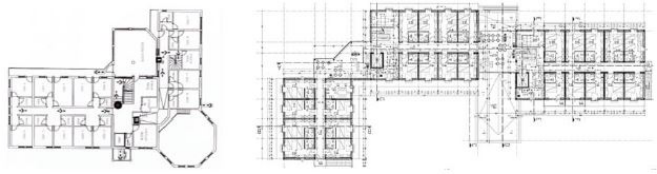
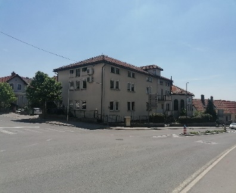
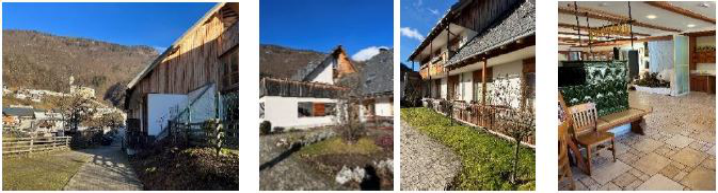
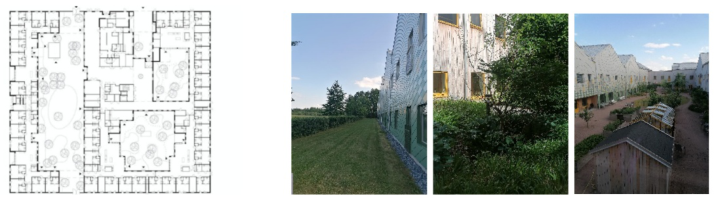
The Case of Slovenia In Slovenia, three size-capacity of 97 nursing homes (NHs) appear, i.e., small- scale capacity homes with up to 150 beds, medium-scale capacity homes with between 151 and 300 beds, and large-scale capacity homes with more than 300 beds (Breznik et al., 2020). NHs of all scale provide all categories of home care from I to IV. Small and medium-scale nursing homes account for 96% of all NHs in Slovenia. Therefore, two small-scale homes were selected for the study. NH_A1 is a representative of the third-generation and was originally built for non- nursing home use, while NH_B1 represents the fourth-generation of NHs and was built for nursing home use. Both NHs have a floor area of appro- ximately 3000 m2, with NH_A1 located in an urban area, but NH_B1 in a rural area. Typical floor plans of the two NHs and pictures are shown in Figures 1, 2 and 3.
Figure 1: Typical floor plans of NH_A1 (left) and NH_B1 (right). (Received from both NHs, 2021).Figure 2: NH_A1: urban context (left), outdoor area design (middle), interior design (right).
In addition, an OPQOL-35 survey on quality of life (Žegarac Leskovar & Skalicky Klemenˇciˇc, 2023) and a questionnaire1 on design quality in relation 1Is a room in a small household unit (up to twelve residents share a living room for socialising); do you live in a single room; do you have your own bathroom in your room; does your home have associated
Inclusive Design: Comparing Models of Living Environments 193
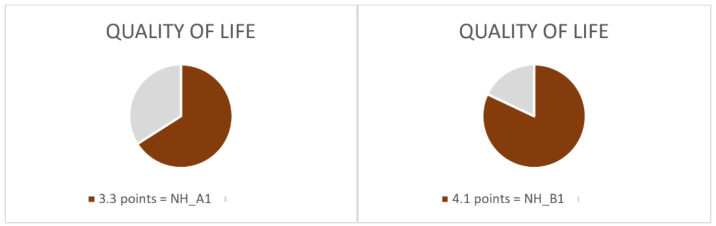
Figure 3: NH_B1: rural context (left), outdoor area design (middle), interior design (right).Figure 4: The average score for quality of life in shares: NH_A1 is 3.3 out of five points (left) and NH_B1 is 4.1 out of five points (right).
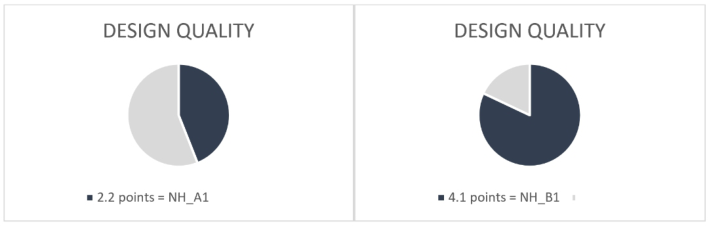
to the first and second fields of the Safe & Connected tool (Žegarac Leskovar & Skalicky Klemenˇciˇc, 2022) were conducted in the study for both NHs. The following results are presented in Figures 5 and 6. However, the average score for quality of life is shown in Figure 4: NH_A1 has an average quality of life score of 3.3 points, while NH_B1 has 4.1 points. The average score for design quality is shown in Figure 5: NH_A1 has an average design quality score of 2.2 points, while NH_B1 has 4.1. From the results, it can be seen that NH_B1 has a high score in both groups, while NH_A1 has a lower score in both groups. It follows that the design of a NH that follows the fourth-generation certainly provides a higher quality of life for the older adults and vice versa.
The Case of Sweden The design of nursing homes is based on recent research showing that the well-being of older adults is strongly correlated with attractive green outdoor spaces and social interaction (Artmann et al., 2017). Important parameters of the spatial concept of the NH, entitled The Gardens from Sweden, are therefore to create a comfortable NH for older adults with easy access to their own gardens, outdoor areas and community facilities, as shown in the typical floor plan in Figure 6 (left). With different landscape arrangements of
outdoor green areas; does your room have a balcony; do the common areas in front of the rooms have direct access to the outdoor terraces; do the common areas in front of the rooms that do not have access to the terraces have a nice view outside?
194 Leskovar and Klemenˇciˇc
Figure 5: The average score for design quality shown in the shares: NH_A1 is 2.2 out of five points (left) and NH_B1 is 4.1 out of five points (right).Figure 6: NH The Gardens: Typical floor plan of the NH (left) (Marge Arkitekter, 2018) and design elements that create the identity of the nursing home (right).
trees, water elements and vegetation in the courtyards, an intimate and subtle atmosphere is created. The NH thus has an exterior with a clear identity in a varied environment and a monastery-like interior organisation with sensitive atrium courtyards. The unique shape of the building in an ordinary everyday context makes the architectural design a symbol of a lively and safe living environment for older adults (Figure 6, right) (Marge Arkitekter, 2018).
The Gardens NH has been designed to be certified LEED at Gold level. The materials chosen are robust and sustainable, environmentally friendly, and low maintenance. Parts of the roof are planted with sedum - such green roofs are an efficient means of retaining and filtering rainwater, which is then directed into the courtyards. The vegetation together with the water, provides a natural habitat contributing to biodiversity in the region. The exterior of the building is clad in fibre cement patterns in different colours and shades that match the tones of the surrounding green spaces (Figure 6, right). The nursing home received the following awards: Winner of the Sveriges Arkite- kter Housing Prize (2017), Nominee for the Kasper Salin Prize (2017) (The gardens elderly center, 2020).
It is also well known that exercise is important for psychological well-being and longevity. An outdoor area of The Gardens NH not only encourages them to exercise, but also has a positive effect on their circadian rhythms and gives them a sense of independence and freedom - something that is often overlo- oked in institutions. There are few elements that are added in the design of the outdoor space to enhance the experience of the residents: Garden benches
Inclusive Design: Comparing Models of Living Environments 195
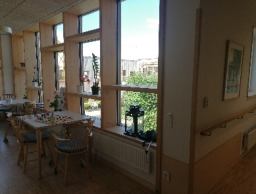
Figure 7: The Gardens NH: Design of the outdoor area (above), interior design of the common areas (below).
where residents and visitors can rest and relax, greenhouses that encourage residents to participate in calming planting activities, barbecue areas for soci- alising and gathering with other residents, and outdoor gym equipment such as stretching machines and bicycles for those who want to exercise. The vision for Gardens NH takes a unique approach to NH design. Rather than focu- sing on an indoor common area at the center of everything, this large-scale layout places a huge garden (divided into walkways, social areas and activity centres) as the centrepiece and builds the rooms around it (Magsino, 2022).
The housing typology of a block with green atriums and different types of common spaces within the building, as shown in Figure 7, encourages social interactions between residents. At the same time, residents have visual contact with the courtyard gardens from inside through windows, which increases the feeling of security. The outdoor areas differed significantly in their design, access and use. In addition, the small residential units with eight residents, who all live in single rooms with a spacious bathroom and their own kitche- nette, offer a high degree of privacy. The NH has an open kitchen that allows residents to gather and dine at a large table to create a home-like environ- ment. Compared to the fourth-generation models seen in the case study from Slovenia, the concept of the nursing home in Sweden puts even more emphasis on privacy and thus represents the fifth- generation model.
CONCLUSION
This paper gave a brief overview of the possibilities of living environments for older adults, going into detail about the model of NHs planned according to the third-, fourth- and fifth-generation concept. It can be concluded that the fourth- and fifth-generation models enable a higher quality of life, especially due to certain architectural features that aim at inclusive design and are a prerequisite for a high-quality living environment.
196 Leskovar and Klemenˇciˇc
ACKNOWLEDGMENT
Funding for this research was partly provided by the Slovenian Research Agency and the Ministry of Higher Education, Science and Technology of the Republic of Slovenia, National research program P2-0129.
REFERENCES
Amanda J. Lehning & Michael J. Austin (2010) Long-Term Care in the United States: Policy Themes and Promising Practices, Journal of Gerontological Social Work, 53:1, 43-63, DOI: 10.1080/01634370903361979. Americas Health Rankings, Public Health Impact: Population Ages 65+, https://ww
w.americashealthrankings.org/explore/senior/measure/pct_65plus/state/%20ALL (accessed 04.01.2022). Artmann, M., Chen, X., Ioj˘a, C., Hof, A., Onose, D., Poni˙zy, L., Lamovšek, A. Z., & Breuste, J. (2017). The role of urban green spaces in care facilities for elderly people across European cities. Urban Forestry & Urban Greening, 27, 203–213. https://doi.org/10.1016/j.ufug.2017.08.007. Breznik, J., Brezovar, Ž., Lampiˇc, B., Ocvirk, N., Šipelj, M., ZavodnikLamovšek, A.,
& Zidar, M. (2020). Dostopnost zelenih površin zaoskrbovance domov starejših obˇcanov v majhnih mestih Slovenije. Dela, (52), 61–91. doi: 10.4312/dela.52.61– 91. Brodsky, J., Habib, J. Hirschfeld, M. (2003). Long-term care strategies in industrialized countries: Case studies of insurance-based and non-insurance-based long-term care systems. Myers-JDC-Brookdale Institute and WHO. Eskildsen, M. Price, T. (2009) Nursing home care in the USA. Geriatrics & Geronto-
logy International, 9:1-6. https://doi.org/10.1111/j.1447–0594.2008.00513.x Eurostat, Statistics Expanded, https://ec.europa.eu/eurostat/statistics-explained/ind ex.php?title=Population_structure_and_ageing (accessed 04.01.2023). Hogeweyk, https://hogeweyk.dementiavillage.com (accessed04.08.2022). Magsino (2022)(https://www.fohlio.com/blog/best-nursing-home-designs-focus-se nior-health-wellness-part-1-general-areas). (accessed 07.08.2022). Masi Mohammadi, Maurice Dominicus, Leonie van Buuren, Kim Hamers, Coosje-
Hammink & Hüsnü Yegenoglu (2019) The Evolution of Housing Typologies for Older Adults in The Netherlands From 1945 to 2016: An Analysis in the Context of Policy, Societal, and Technological Developments, Journal of Housing For the Elderly, 33:3, 205-226, DOI: 10.1080/02763893.2018.1561590. Marge Arkitekter (2018) https://www.marge.se/projects/the-gardens (accessed 07.08.2022). Michell-Auli, P., Sowinksi, C. (2012). Die 5. generation: Kda-quartiershäuser: Ansätze zur Neuausrichtung von Alten- undpflegeheimen. Kuratorium Deutsche Altershilfe Köln. Seniorval, Housing for senior, https://seniorval.se/bra-att-veta/boende, accessed
07.06.2022). The gardens elderly center (2020) https://www.ace-cae.eu/activities/eu-funded-proj ects/connect-arch/20-projects-architectural-projects-against-climate-change/the -gardens-elderly-center/ (accessed 07.08.2022). Žegarac Leskovar, V., & Skalicky Klemenˇciˇc, V. (2021). Rethinking the architectural
design of vulnerable built environments: lessons learnt from the Covid-19 pande- mic, iNDiS 2021: proceedings, 15th International Scientific Conference [Planning, design, construction and building renewal]: Novi Sad, Srbija, 24–26. novembar 2021. = Novi Sad, Serbia, 24-26 November 2021. Novi Sad: Fakultet tehniˇckih nauka, Departman zagradevinarstvo i geodeziju.
Inclusive Design: Comparing Models of Living Environments 197
Žegarac Leskovar, V., & Skalicky Klemenˇciˇc, V. (2022). The Role of Nursing Homes Architectural Design in Mitigating the Risk of COVID-19 Pandemics: The Case of Slovenia. ATHENS JOURNAL OF ARCHITECTURE, 8(1), 51-66. doi: 10.30958/aja.8–1-3. Žegarac Leskovar, V., & Skalicky Klemenˇciˇc, V. (2023). Designing a Safe and
Inclusive Housing Environment for Older adults: Assessment of Nursing Home Preparedness for Post-COVID Era. Submitted to Journal of Housing and the Built Environment.
LISTED IN THE AHFE DIGITAL BOOKSTORE CATALOGUE
Explore the complete digital volume
Design for Inclusion
Read this individual research paper free through the original publisher, or explore the full digital proceedings book.
ISBN 978-1-958651-51-3
Explore this ISBN in the AHFE Bookstore ↗Listed in the July 2026 bookstore catalogue; search by ISBN to confirm current availability · Digital book purchase optional