Wataru Asaba, Kimi Ueda, Hirotake Ishii, Hiroshi Shimoda (2023). Evaluation of the Effect of VR Disaster Experience in Familiar Environment. In: Intelligent Human Systems Integration (IHSI 2023): Integrating People and Intelligent Systems. AHFE Open Access, vol. 69, pp. 667–676. https://doi.org/10.54941/ahfe1002889
The number of natural disasters has been increasing in recent decades, and the amount of damage becomes enormous. To reduce the damage, it is crucial that people become more aware of disaster prevention and takes action for disaster prevention and mitigation. As disaster education to raise awareness, a method using virtual reality (VR) has been attractive because the VR disaster experience is more realistic than a video showing the scene of a disaster and requires less equipment than a simulated experience using a quake simulator. It can also reproduce disasters that are difficult to experience in reality, such as fire. However, in conventional VR disaster experience systems, it is possible to experience only a specific environment that the designer has selected and created in advance. The environment is often different from that in which users spend their everyday lives. Therefore, it was difficult to feel a sense of reality and fear that a disaster might actually occur. In addition, from the viewpoint of reviewing disaster countermeasures, there were few points that could be used as references. In order to solve this problem, the authors have developed a system that automatically creates a VR space that enables users to experience a disaster based on images captured by cameras. This system makes it very easy to experience disasters in the environment, which they spend everyday lives in, constructed from pictures taken by them. Moreover, it may raise awareness of disaster prevention. It is not clear, however, to what extent the experience of a disaster in a familiar environment is effective, or how the psychology of the experiencers changes when they experience a disaster in a familiar environment.The purpose of this study is therefore to evaluate whether the users’ awareness of disaster prevention improve when they experience the VR disaster experience in a familiar environment like their own room. In this study, earthquake and fire are treated as disasters to be experienced.In the experiment, participants were asked to take pictures of the room in which the participant spend their most of everyday lives, and to experience virtual earthquake and fire in the room created from the pictures and in the non-familiar environment. After experiencing each disaster experience environment, they were asked to answer a questionnaire about their awareness of disaster prevention, which included a sense of reality, a sense of fear, a sense of familiar environment, communication intention, disaster risk perception, anxiety and disaster prevention behavioral intention. The results were used to compare the effects of each disaster experience environment on the awareness of disaster prevention.The results of the evaluation experiment showed the possibility that the familiar environment can trigger participants to imagine that a disaster will actually happen to them, and can increase their awareness of disaster prevention. On the other hand, the results also suggested the possibility that participants are more likely to notice unnatural places in the experience such as objects’ movement in earthquake and the origin of fire because it was very familiar environment for them.
The number of natural disasters has been increasing in recent decades, and the amount of damage becomes enormous. To reduce the damage, it is cru- cial that people become more aware of disaster prevention and take action for disaster prevention and mitigation. As disaster education to awareness, a method using virtual reality (VR) (Xiaoli et al. 2015) (Yamashita et al. 2017) has been attractive because the VR disaster experience is a cost-effective solu- tion and is easy to deploy. It can also reproduce disasters that are difficult to experience in reality, such as fire. However, in conventional VR disaster expe- rience systems, it is possible to experience only a specific environment that the designer has selected and created in advance. The environment is often dif- ferent from the environment in which the experiencer spend their daily lives. Therefore, it was difficult to feel a sense of reality and fear that a disaster might actually occur. In addition, from the viewpoint of reviewing disaster countermeasures, there were few points that could be used as references.
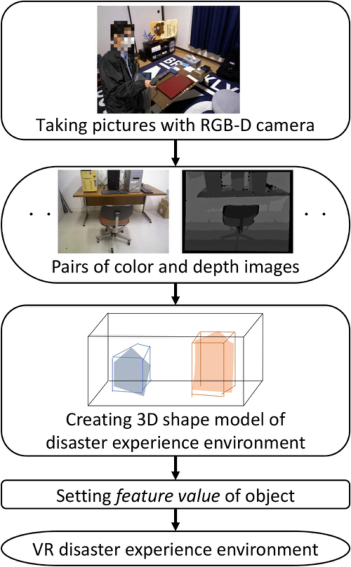
Figure 1: A flow of VR disaster experience environment construction.
In order to solve this problem, the authors have developed a system that automatically creates a VR space that enables users to experience disaster based on images captured by cameras with the 3D reconstruction method (Asaba et al. 2021). This system makes it very easy to experience disaster in the environment, which experiencers normally live in, constructed from pictures taken by them. It may raise awareness of disaster prevention because they can know how their room becomes in disaster. It is not clear, however, to what extent the experience of a disaster in a familiar environment is effective, or how the psychology of the experiencers changes when they experience a disaster in a familiar environment.
The purpose of this study is to evaluate how the experiencers’ awareness of disaster prevention improve when they experience the VR disaster in a familiar environment like their own room. In this study, earthquake and fire are treated as disasters to be experienced.
CONSTRUCTION OF VR DISASTER EXPERIENCE ENVIRONMENT
Figure 1 shows the flow of the construction of the VR disaster experience environment in this study. In this method, the indoor environment of the tar- get of the disaster experience is captured multiple times from various angles with RGB-D camera. Then, 3D shape models of the disaster experience envi- ronment, which are polygons representing the colour and shape of 3D objects, are created with pairs of colour and depth images. In this process, we utilize
Evaluation of the Effect of VR Disaster Experience in Familiar Environment 669
Table 1. A relation between feature values and object’s behaviours in VR disaster experience.
Table available in the original PDF paper.
Disaster Feature values Object’s behaviour Sound of collision and rupture Earthquake Proportion of material (glass/wood/metal/plastic)
Fire Flammability Proportion of material (glass)
Non-flammable, slowly flammable, well flammable and intensely flammable Sound of glass rupture
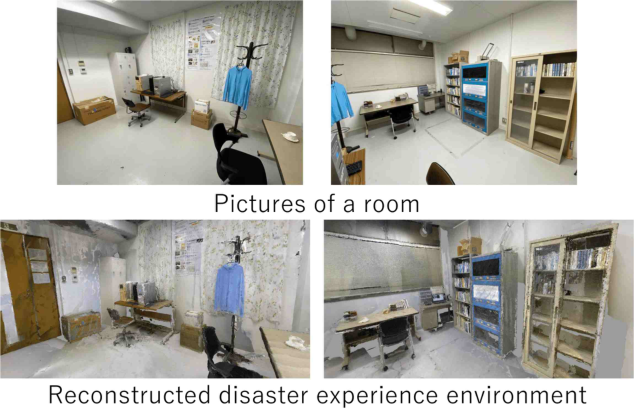
Figure 2: Pictures of a room (up) and reconstructed disaster experience environment (down).
our system (Asaba et al. 2021) for image denoising and creating 3D point cloud, Colmap (Lutz et al. 2016) for tracking and MeshLab (Cignoni et al. 2008) for converting 3D point cloud into 3D shape model. Next, we set fea- ture values that determine the behaviour of the object during the simulation. Feature values are the values that represent the physical behaviour features of an object, which consist of proportion of material and flammability (Asaba et al. 2021). Table 1 shows the relationship between feature values set for the earthquake and fire disaster experiences and the corresponding object beha- viour. In this study, we set feature values for each of objects manually based on the material and intended use of the object.
We described an example of the constructed disaster experience envi- ronment below. In this study, we used Unity version 2019.3.15f1 (Unity Technology), which can easily simulate flames, smoke, etc. that are necessary for constructing the disaster experience environment. And ASUS XtionPRO LIVE (ASUS) was used to photograph the indoor environment for the disaster experience. Figure 2 shows photographs of the actual room and the 3D shape models of disaster experience environment. As for the earthquake experience
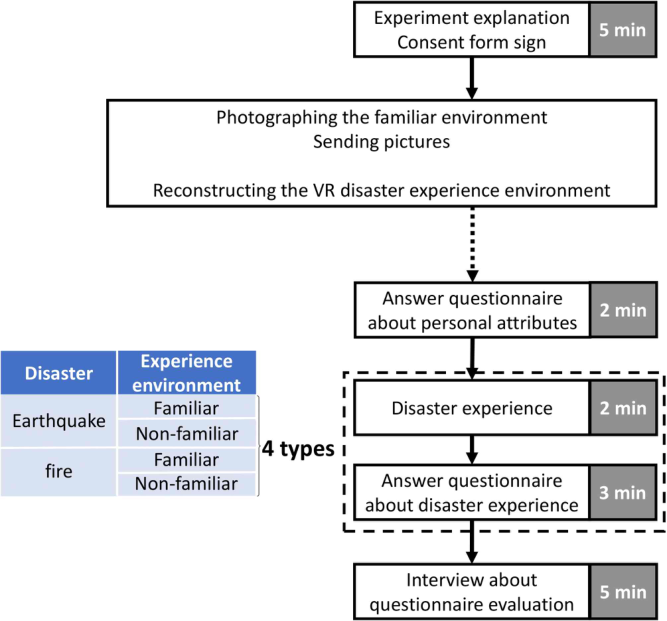
Figure 3: The procedure of the evaluation experiment.
environment, the earthquake shaking was reproduced by using the earthqu- ake acceleration data that was created by measuring the shaking of an actual earthquake as the acceleration of the 3D shape model of the object and the viewpoint. This system applied the acceleration data of Great East Japan ear- thquake, which is available from the National Research Institute for Earth Science and Disaster Resilience (NIED, 2019). As for the fire experience envi- ronment, smoke is generated to spread from a high place as time passed. In addition, by setting the source of the fire, the fire will ignite from that object and spread to objects placed nearby. The source of fire is based on the num- ber of fires by cause in the White Paper on Fire Service published by Fire and Disaster Management Agency (FDMA).
EVALUATION EXPERIMENT The purpose of this experiment is to evaluate how the participants can raise their awareness of disaster prevention by experiencing a VR disaster in a familiar environment. This experiment was conducted with the approval of the Research Ethics Committee for Human of the Graduate School of Energy Science, Kyoto University.
The procedure of this experiment is shown in Figure 3 and described in detail below. In the experiment, the experimenter first explained the outline
Evaluation of the Effect of VR Disaster Experience in Familiar Environment 671
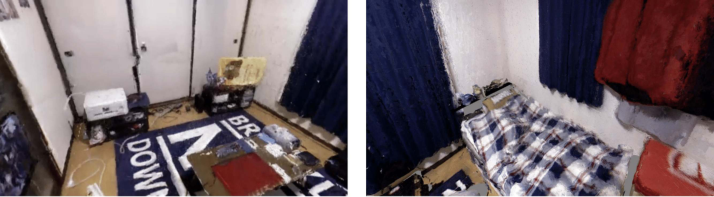
Figure 4: Pictures of a room (up) and reconstructed disaster experience environment (down).
of the experiment to the participants and that the participation in this expe- riment was voluntary, and they signed a consent form confirming their cooperation in the experiment room. Then, they were asked to take pictu- res of the environment in which they normally live and to send pictures to experimenter. On another date, they were asked to come to the experiment room again and to answer questionnaires regarding their personal attribu- tes, such as gender, age, whether or not they have experienced earthquakes or fires, and whether or not they have suffered psychological trauma as a result of these disasters. Next, they were asked to wear HMD (Oculus Rift) and to experience virtual earthquake and fire in the familiar environment created from the pictures and in the non-familiar environment. After expe- riencing each disaster experience environment, they were asked to answer orally questionnaires about their awareness of disaster prevention displayed in the VR space with HMD on. The time required to experience one disa- ster experience environment was about 2 minutes, and the time required to answer questionnaires was about 3 minutes. This process was repeated for two types of disasters, earthquake and fire, and they experienced all of the disaster experience environments and responded to the questionnaires. After all the questionnaires were completed, if there was a difference between the responses to each item in the first and second questionnaires for each disa- ster, an interview was conducted to find out the reasons for the difference. In order to prevent the order effect of the experimental conditions from influ- encing the results, the order of experiences of earthquake and fire, familiar and unfamiliar disaster experience environments were counterbalanced.
We prepared the non-familiar disaster experience environment. In order to properly evaluate the effect of the familiar environment, which is the purpose of this experiment, it is necessary to minimize the difference in phy- sical characteristics such as room size between the familiar and non-familiar environments, which may affect the results. Therefore, through a prelimi- nary experiment, we set up the room shown in Figure 4 as the non-familiar environment with similar characteristics such as room size to the familiar environment.
Questionnaires About the Awareness of Disaster Prevention We prepared the questionnaires about the awareness of disaster prevention below. The participants were asked to answer on a 7-point scale from “1: I
Table 2. Questionnaires of each disaster experience and evaluation targets.
Table available in the original PDF paper.
Disaster No Question item Evaluation target A sense of reality Earthquake 1-1 The VR experience felt like a real earthquake
1-2 The VR experience made me feel fear A sense of fear 1-3 I felt like I was experiencing in a familiar environment
A sense of familiar environment 1-4 I would recommend this VR experience to others Disaster risk perception
Communication intention 1-5 Through this VR experience, I began to think that the possibility of major damage from earthquake was high Anxiety 1-6 Through this VR experience, I was very anxious about what would happen if earthquake occurred
Disaster prevention behavioural intention
1-7 Through this VR experience, I have come to want to take complete disaster prevention and mitigation measures on a daily basis Fire 2-1 The VR experience felt like a real fire A sense of reality 2-2 The VR experience made me feel fear A sense of fear 2-3 I felt like I was experiencing in a familiar environment
A sense of familiar environment 2-4 I would recommend this VR experience to others Disaster risk perception
Communication intention 2-5 Through this VR experience, I began to think that the possibility of major damage from fire was high Anxiety 2-6 Through this VR experience, I was very anxious about what would happen if fire occurred
Disaster prevention behavioural intention
2-7 Through this VR experience, I have come to want to take complete disaster prevention and mitigation measures on a daily basis
don’t agree at all” to “7: I agree very much” to the questionnaire items regar- ding the disaster experience environment. Table 2 shows the correspondence between the items in the earthquake and fire disaster experience question- naires and the items to be evaluated. As for the questionnaire items, the sense of reality and the sense of fear felt through the VR disaster expe- rience (hereafter, “a sense of reality” and “a sense of fear”, respectively) were set. The sense of familiar environment to confirm whether the partici- pants feel that they actually experience the disaster in a familiar environment (hereafter “a sense of familiar environment”) was also set. In addition, accor- ding to the previous research, it was shown that when people’s awareness of disaster prevention is raised through disaster education, they pass this information on to other people around them, such as family members, and
Evaluation of the Effect of VR Disaster Experience in Familiar Environment 673
their awareness of disaster prevention also improves (Toyosawa et al. 2010). Referring to this result, whether the participants want to spread this experi- ence (hereafter, “communication intention”) was set as for the questionnaire item about the awareness of disaster prevention. And, disaster risk perce- ption, anxiety about disaster and disaster prevention behavioural intention (hereafter, “disaster risk perception”, “anxiety” and “disaster prevention behavioural intention”, respectively), which Motoyoshi et al. identifies as deeply related to household disaster prevention (Motoyoshi et al. 2008), were set.
RESULTS AND DISCUSSION
In this experiment, 21 undergraduate and graduate students (11 males and 10 females) participated until now, while we planned 24 in total. They were from 18 to 27 years old (Mean = 22.1, SD = 2.24). A part of the interview responses is shown in Table 3, and a part of the free comments after the experiment is shown in Table 4.
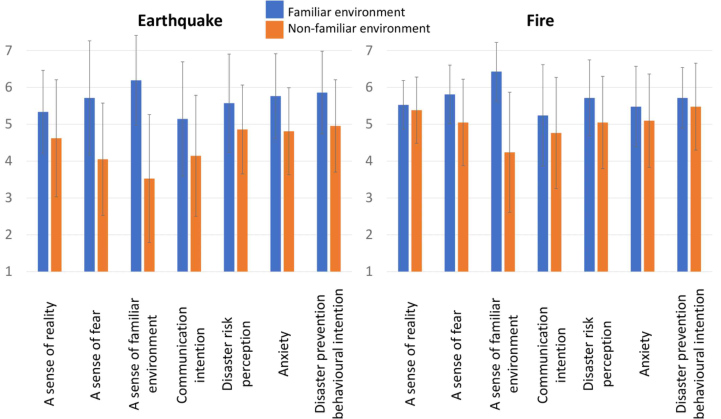
Earthquake We first discuss the responses of earthquake in Figure 5. The response of a sense of fear under the familiar environment is higher than that under the non-familiar one. As participate 16 stated, “I was terrified that familiar and thoughtful objects had fallen,” it was supposed that a sense of fear increased because the environment was familiar to the participants.
The response of disaster risk perception under the familiar environment is also higher than that under the non-familiar one. As stated by participant 17, “I felt dangerous in my room because there were many things moving and falling,” it was supposed that the participants could recognize the risk of disaster by experiencing a VR disaster in a familiar environment. However, as participant 16 stated, “Compared to when I actually experienced earthquake, I thought the way objects fell in my room was a little different,” a familiar environment could make it easier for participants to notice objects which behave in an unnatural way.
As for anxiety, the response under the familiar environment is higher than that under the non-familiar one. Participant 19 commented, “I felt in fear for my life because objects fell from a high place in my room,” while participant 9 mentioned, “I didn’t feel anxious because I knew where to escape in my room.”
The response of disaster prevention behavioural intention under the fami- liar environment is also higher. As stated in the interview, “I thought about what actions and countermeasures I would take if earthquake happened in my room” and “I was able to know areas in my room where counterme- asures are inadequate, and I decided to take action,” it was suggested that the damage by experiencing a VR disaster in a familiar environment can encourage people to take disaster-prevention measures.
Table 3. A part of answers of interview of participants.
Table available in the original PDF paper.
Answer of interview
Participant No.
Question No.
Response (familiar, non-familiar)
3 1–7 6,5 I thought that my room is full of flammable objects, so I decided to take countermeasures. 4 2–6 4,5 I felt anxiety about the power strip, which is a fire hazard in a non-familiar environment, because it’s also in my room and I don’t know the signs of ignition. 5 1–7 6,2 I thought about what actions and countermeasures I would take if earthquake happened in my room. 9 1–6 4,5 I didn’t feel anxious because I knew where to escape in my room. 16 1-2
7,4 1-5 4,5
2-7
6,7
I was terrified that familiar and thoughtful objects had fallen. Compared to when I actually experienced ear- thquake, I thought the way objects fell in my room was a little different. In terms of thinking about countermeasures, I thought it might be better to be in a non-familiar environment where I could see things from a dispassionate point of view. 17 1-5
7,5 1-7 7,5
I felt dangerous in my room because there were many things moving and falling in my room. I was able to know areas in my room where countermeasures are inadequate, and I decided to take action. 19 1–6 7,4 I felt in fear for my life because objects fell from a high place in my room. 21 2–2 6,2 Seeing the disaster in VR made me image what it would be like if it actually happened, and it was terrifying.
Fire We discuss about the responses of fire in Figure 5. The response of a sense of fear under the familiar environment is higher than that under the non-familiar one. As participant 21 mentioned, “seeing the disaster in VR made me imagine what it would be like if it actually happened, and it was terrifying,” it was suggested that experiencing VR fire in a familiar environment may increase a sense of fear more. However, some partici- pants highly evaluated the VR experience in the non-familiar environment because of the fear of flames spreading around them and the source of fire.
In the responses of anxiety and disaster prevention behavioural intentions, there was not much difference between that the familiar and non-familiar environment. As stated by participant 3, “I thought that my room is full of
Evaluation of the Effect of VR Disaster Experience in Familiar Environment 675
Table 4. A part of free comments of participants.
Table available in the original PDF paper.
Participant No. Free comment 2 The weight of the objects in my room was a little different from my senses. 4 Smoke and alarms terrified me. It would be even better if the flames could jump on me. 11 It would be very scary if fire started in a power strip while I am sleeping. 12 Smoke terrified me. 13 Flames spreading terrified me. 17 The chair in my room has casters, so I thought it might move a little more. 19 It was realistic to see shelf moving in my room that I hadn’t taken countermeasures against. I think it would be more terrifying if I could actually feel the shaking.
Figure 5: The responses of each disaster experience.
flammable objects, so I decided to take countermeasures,” it was suggested that the awareness of disaster prevention could be improved by experiencing disaster in a familiar environment. However, as participant 4 and 16 men- tioned, “I felt anxiety about the power strip, which is a fire hazard in a non-familiar environment, because it’s also in my room and I don’t know the signs of ignition” and “in terms of thinking about countermeasures, I thought it might be better to be in a non-familiar environment where I could see things from a dispassionate point of view,” it was suggested that even VR experiences in a non-familiar environment could be helpful in disaster preparedness.
CONCLUSION
The results of the evaluation experiment showed that a familiar environment may trigger people to imagine that a disaster may actually happen to them, and may increase their awareness of disaster prevention. On the other hand, it is easy to notice unnatural behaviour of objects, which may reduce a sense of reality and lower the effectiveness, in the familiar environment than in the non-familiar one because they usually see the environment repeatedly.
Future work includes conducting evaluation experiments with up to 24 participants in total. In addition, we should construct the psychological model of the VR disaster experience in order to investigate how psychologi- cal factors such as a sense of reality and fear generated by the VR disaster experience relate to disaster preparedness.
REFERENCES
ASUS, Xtion PRO LIVE: https://www.asus.com/jp/3D-Sensor/Xtion_PRO_LIVE/spe cifications/, (Accessed on 11/14/2022). Facebook, Oculus: https://www.oculus.com/rift/?locale=ja_JP, (Accessed on 11/14/2022). FDMA, 2020 White Paper on Fire Service: https://www.fdma.go.jp/publication/hak
usho/r2/56707.html, (Accessed on 11/14/2022). J. Toyosawa, K. Karasawa and N. Fukuwa. (2010) “Effects of Disaster Education for Elementary School Children on Their Guardians’ Disaster Preparedness Action: Changes in Children’s Affect and Cognition”, Japanese Journal of Educational Psychology, Volume 58, pp. 480–490. National Research Institute for Earth Science and Disaster Resilience. (2019) “NIED
K-NET, KiK-net”, National Research Institute for Earth Science and Disa- ster Resikience, https://www.kyoshin.bosai.go.jp/kyoshin/quake/, (Accessed on 11/14/2022). P. Cignoni, M. Callieri, M. Corsini, M. Dellepiane, F. Ganovelli and G. Ranzuglia.
(2008) “MeshLab: an Open-Source Mesh Processing Tool”, Sixth Eurographics Italian Chapter Conference, pp. 129–136. Schoenberger Johannes Lutz, Frahm Jan Michael. (2016) “Structure-from-Motion Revisited”, Conference on Computer Vision and Pattern Recognition (CVPR). T. Motoyoshi, K. Takao and S. Ikeda. (2008) “Determinants of household- and
community-based disaster preparedness”, Japanese Journal of Social Psychology, Volume 23, pp. 209–220. T. Yamashita, Mahendra Kumar Pal, K. Matsuzaki and H. Tomozawa. (2017).
“Development of a Virtual Reality Experience System for Interior Damage Due to an Earthquake – Utilizing E-Defense Shake Table Test – “, Journal of Disaster Research, Volume 12, pp. 882–890. UnityTechnologies, Unity: https://unity.com/ja, (Accessed on 11/14/2022). W. Asaba, Y. Harazono, H. Ishii and H. Shimoda. (2021). “Development of a VR Disaster Experience Environment Construction System with Automatic Object Material Recognition”, International Symposium on Socially and Technically Symbiotic Systems (STSS). Okayama, Japan. Xiaoli GONG, Yanjun LIU, Yang JIAO, Baoji WANG, Jianchao ZHOU and Haiyang
YU. (2015). “A Novel Earthquake Education System Based on Virtual Reality”, IEICE Transactions on Information and Systems, Volume 12, pp. 2242–2249.
LISTED IN THE AHFE DIGITAL BOOKSTORE CATALOGUE
Explore the complete digital volume
Intelligent Human Systems Integration (IHSI 2023): Integrating People and Intelligent Systems
Read this individual research paper free through the original publisher, or explore the full digital proceedings book.
ISBN 978-1-958651-45-2
Explore this ISBN in the AHFE Bookstore ↗Listed in the July 2026 bookstore catalogue; search by ISBN to confirm current availability · Digital book purchase optional