Stephanie Brown, K. Blake Mitchell (2022). Development of a Fundamental and Operational Marksmanship Score based on Expert and Novice Marksmanship Data. In: Training, Education, and Learning Sciences. AHFE Open Access, vol. 59, pp. 380–389. https://doi.org/10.54941/ahfe1002425
Marksmanship is a primary contributor to the military’s quantification of Soldier lethality. Traditionally, Soldiers are graded using a standard marksmanship qualification task, assessing hit location and target distance. Additional components (e.g., weapon handling, timing) are not incorporated. This research developed a comprehensive marksmanship scoring method, focused on fundamental and operational marksmanship skills. A scoring index facilitates the understanding of the entire operational marksmanship process, from target detection to acquisition/engagement. Analysis of this tradespace helps improve training and can be utilized as a metric of performance for equipment evaluations. This novel scoring method includes all aspects of the marksmanship process divided into three components, including lethality (e.g., accuracy, precision, decision making), mobility (e.g., target acquisition time), and weapons handling (e.g., stability, trigger control). Utilizing marksmanship data from 16 Soldier volunteers (8 experts and 8 novices) on a static and dynamic shooting scenario, outcomes were normalized to distribute the variables’ two anchor scores. Weights were assigned to each metric that contributed to the combined scores. Weightings were determined utilizing a Student’s t-test pairwise comparison of means of the expert and novice scores for each metric. Components with highly statistically significant differences (p < .01) between the expert and novice were weighted more importantly and those with less difference (p < .05) were weighted less importantly. Weighted indices were applied to a marksmanship dataset of normally distributed skill level Infantry Soldiers (N = 46). This verification ensured that weightings created a normal distribution across the group, while assessing fundamentals and operational marksmanship skills. These new performance indices provide a single overarching score, representative of various aspects of marksmanship beyond simple shot coordinates, resulting in a performance metric that is easier for the end-user to comprehend. Future application of this scoring method are valuable for both training and acquisition test and evaluation performance assessments.
The quantification of a Soldier’s potential lethality and readiness for combat is of high importance to the Military as highlighted in the Army’s current modernization strategy (Headquarters DOA, 2019a). The primary way the military quantifies lethality for the purposes of training and readiness, as well as test and evaluation, is through marksmanship skills assessments (e.g., Adams, 2010; Bewley, Chung, & Girlie, 2003; Carbone et al., 2014; Garrett et al., 2006; Headquarters DOA, 2016; Johnson & Kobrick, 1997; Johnson, McMeney, & Dauphinee, 1990; Krueger & Banderet, 1997; Son, Xia, & Tochinhara, 2010; Taylor & Orlansky, 1991). During training, Soldiers are typically graded using a standard marksmanship qualification task, asses- sing hit location and target distance (Headquarters DOA, 2019b). Although additional components such as weapon handling are focused on in order to improve shot outcomes (Headquarters DOA, 2016), they are not quantified
Development of a Fundamental and Operational Marksmanship Score 381
or incorporated into the grading rubrix. Instrumentation, such as on-weapon sensors and smart targets, are needed to provide comprehensive assessment of performance and feedback during training. Even when these systems are available, an integrated look at the data outcomes is not utilized due to the inability to assess the lethality trade-space against a known gold stan- dard of expert level performance. In recent years with the modernization initiatives, the Army has stood up a variety of working groups and cross functional teams to define lethality and the trade-space within the associated areas of measure (South, 2019). However, the relationship between measures within the marksmanship process that encompasses lethality (i.e., mobility, stability, survivability) and resulting rounds on target locations are not fully understood.
This current research developed a comprehensive marksmanship scoring method, focused on fundamental and operational marksmanship skillsets derived from marksmanship data collected in previous studies (Brown et al., 2018, 2019). These scoring indices facilitates the understanding of the entire operational marksmanship process, from target detection to acquisition and engagement. Analysis of the trade-space between the different parts of the marksmanship process can potentially result in training improvements and can be utilized as a metric of performance for equipment evaluations. This novel scoring method includes all aspects of the marksmanship process divided into three components: lethality (e.g., accuracy, precision, decision making), mobility (e.g., target acquisition time), and weapons handling (e.g., stability, trigger control). These new performance indices provide overarch- ing scores, representative of the components of marksmanship beyond simple shot coordinates, resulting in easy to comprehend metrics for the end-users.
METHODS
Scoring Index Development The scoring index development began with examining the descriptive sta- tistics of marksmanship outcome measures across the expert and novice shooting groups in order to identify anchor score criterion for normalizing future marksmanship performance data. Once the anchor points were deter- mined for each underlying marksmanship measure utilizing group means, each measure was added into the overall performance score for each shooting style (i.e., static and dynamic). Next, the score components were weighted based on the degree of difference between the experts and novices. Student’s t-test pairwise comparisons of means between the expert and novice scores for each metric were conducted. Components with greater differences betw- een the two groups, where experts were performing significantly better, were weighted greater than those with a lesser degree of difference. The assum- ption was made that the experts will generally perform better across the entire marksmanship process, but they are able to assess each aspect of the pro- cess and can better manage the trade-space between speed and accuracy (i.e., stability, mobility and lethality), and therefore will put more effort into the components that are most influential for completing the mission or task.
382 Brown and Mitchell
Once the scoring indices were weighted, the equations were applied to a field-based marksmanship dataset to ensure that the distribution of scores was normal and aligned with the average skill level of the population. To do this, the raw measures from a field-based marksmanship dataset were nor- malized utilizing the established anchor point criterion. Next, the weightings were applied to the normalized data, producing the fundamental and operati- onal marksmanship output scores. Finally, distribution of the resulting index scores were verified to ensure normality.
Participants The scoring index development utilized data from a study assessing the dif- ferences between Expert and Novice marksman. A total of eighteen test participants (TPs) were recruited to take part in the study, nine expert sho- oters and nine novices. All eighteen were male active duty Soldiers, with a mean age of 25 (± 5 years). All of the expert shooters were volunteers sele- cted from the U.S. Army Marksmanship Unit (AMU) in Ft. Benning, GA. AMU consists of highly skilled elite shooters, tasked with winning national and international marksmanship competitions. The nine novice volunteers were all infantry Soldiers with less than 1 year of service and had comple- ted the basic entry level and infantry training courses, as well as the initial required rifle marksmanship courses. These novice Soldiers were screened to ensure that none had backgrounds in competition shooting or hunting.
The verification of the scoring index utilized data from a study assessing marksmanship performance of forty-six active duty Soldiers from an ave- rage infantry unit. These participants were predominantly males (4 females) between the ages of 18 to 37 years (M=24.5, SD=4.2). All were qualified “marksman” through the Army Basic Marksmanship qualification process using the M4 carbine. Three (6.5%) were Marksmen (score of 23-29 out of 40 on the standard marksmanship test), three (6.5%) were Sharpshooters (score of 30-35), and the additional forty (87%) were Experts (score of 36+ and is the most skilled category).
Test Procedures The development process utilized data from a study of expert and novice marksmen. This dynamic scenario consisted of three targets, one scaled at 150-meters and two at 75-meters when placed at an actual distance of 5-meters. The layout and procedures for this scenario is described by Brown et al. in their report on shooting stance differences between experts and novice shooters (2018). The verification of the scoring index utilized data from a study assessing marksmanship utilizing a similar scenario set up and output measurements in a field training setting, utilizing data from the study’s post- mission final time point after full recovery (Brown et al., 2019). Each of these testing scenarios combined static and dynamic shooting styles, with multiple engagements in quick succession across 2-5 trials. For the purposes of this development, only the data from the standing unsupported position trials were utilized, as that is the most difficult shooting position and resulted in the greatest variability for the novice shooters. In addition, these studies did
Development of a Fundamental and Operational Marksmanship Score 383
not include decision making (i.e., friend/foe target discrimination), however the decision making metric is included as a piece of the lethality component for future application and flexibility of this scoring method.
Test Apparatus and Measures All testing utilized the FN Expert simulator and NOS pro software and associ- ated paper ring targets with diamond-grade reflectors attached. These special targets reflect the infrared beam from the FN Expert optical unit, providing x, y coordinates for aiming points and shot locations to the NOS pro software. The system’s optical unit was mounted to the picatinny rail on the right side of the barrel of a de-militarized M4 carbine with an integrated carbon dio- xide recoil simulation system manufactured by LaserShot, Inc. A M68 close combat optic (CCO) sighting system was also utilized in this testing scenario. This system was mounted on the picatinny rail section on top of the weapon receiver. The FN Expert optical unit was mechanically zeroed to the CCO utilizing the standard procedures as laid out in the product manual.
The FN Expert sensor outputs x, y coordinate information on shot location and pre-shot aim trace data. From this data, a variety of measures have been developed to assess performance across the entire marksmanship process from target acquisition to engagement and transition. These underlying raw measures are described in table 1, grouped by their component measurement area. Table 1 also includes a description of the overarching novel funda- mental marksmanship score (FMS) and operational marksmanship score (OMS).
Statistical Analyses The expert and novice group comparisons for each dependent variable were analyzed using Student’s t-test pairwise comparison of means. Shapiro-Wilk tests were used per measurement area to determine normality during the field data verification process. Confidence intervals were set at 95% (alpha = .05).
RESULTS
Scoring Index Development Anchor points were first established per marksmanship measurement area. The means and ranges for the expert and novice groups were established on each marksmanship measurement. Next, either the mean plus or minus one standard deviation, or the allowable score threshold if a limit was already available (e.g., 500mm is the distance from the center of target to the outer ring, or lowest allowable score), was utilized for the minimum and maximum anchor score for each measurement. Raw scores were normalized utilizing the established minimum anchor scores as shown in formula (1).
Equation reproduced from the original PDF.
384 Brown and Mitchell
Table 1. Description of overarching marksmanship scores, component indices and underlying marksmanship measures.
Table available in the original PDF paper.
Measure Description FMS Weighted index of lethality, mobility, and stability measure outcomes during the static, slow-paced shooting task OMS Weighted index of lethality, mobility, and stability measure outcomes during the dynamic, fast-paced shooting task Lethality Index Mean of the normalized marksmanship lethality measures, including shot accuracy, shot group precision, and decision making Shot Group Precision (SGP)
Shot group dispersion, or cluster tightness (measured in millimeters) Shot Accuracy Distance of the shot to the target center (measured in millimeters) Decision Making (DM)
Decision to engage based on perceived target designation as friendly or enemy (measured as ratio of correct to incorrect decision) (dynamic only – included as option for future use) Mobility Index Mean of the normalized marksmanship mobility measures including target acquisition time, target engagement time, and aiming time prior to shot Target Acquisition Time (TAT)
Time required to move, detect, and position prior to target engagement (measured in seconds) (dynamic only) Target Engagement Time (TET) Time between each shot (measured in seconds) (static only)
Total time spent at the target, which includes aiming time for each shot and time between each shot in the shot group (measured in seconds) (dynamic only) Time Between Shots (TBS) Weapon Handling Stability Index Mean of the normalized marksmanship weapon handling stability measures including vertical and horizontal movement during the final 0.6 seconds of aiming, and trigger control Trigger Control (TC)
Distance from the last .2 seconds of aiming to the final shot coordinates (measured in millimeters) Horizontal Stability (HorzStab)
Barrel steadiness across the x-axis prior to shot, measured by the horizontal spread (range of aiming points across x-axis) during the last .6 to .2s of aiming (measured in millimeters) Vertical Stability (VertStab)
Barrel steadiness across the y-axis prior to shot, measured by the vertical spread (range of aiming points across the y-axis) during the last .6 to .2s of aiming (measured in millimeters)
Tables 2 and 3 summarizes the descriptive statistics per skill group and resulting minimum and maximum anchor scores for each measure area per shooting style.
Next, the component area index scores are the average of the subcom- ponent normalized scores. Weightings of the component index scores were determined utilizing a Student’s t-test pairwise comparison of means of the expert and novice scores for each component area. Components with highly statistically significant differences (p < .05) between the expert and novice were weighted as more important and those with less difference (p > .05) were weighted as less important (Tables 4 and 5). Stability had an inverse
Development of a Fundamental and Operational Marksmanship Score 385
Table 2. Descriptive statistics showing raw values and established minimum and maximum anchor values for each measurement outcome in the static style shooting.
Table 3. Descriptive statistics showing raw values and established minimum and maximum anchor values for each measurement outcome in the dynamic style shooting.
Table 4. Normalized scores, component indices, and comparative analysis outcomes for the static style shooting. Each * indicates significant difference at p < .05.
Table 5. Normalized scores, component indices, and comparative analysis outcomes for the dynamic style shooting. Each * indicates signifi- cant difference at p < .05. Decision making was equal for the groups due to lack of target discrimination in test data scenario (all targets presented were threats).
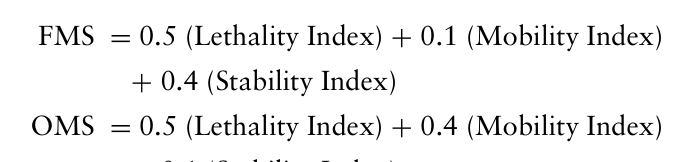
relationship for the dynamic shooting due to experts moving faster during shooting while still in the transition movement across targets. Based on the relationships and number of input values per component, equations 2 and 3 show the weightings for each component for the FMS and OMS. Lethality was weighted at 50% for each score due to the ultimate importance of get- ting shots on target (the final result of the marksmanship process) and the remaining 50% encompassed the mobility and stability components. Since the mobility component was not significantly different between experts and novices for the static shooting, it was weighted at a minimal level of 10% for the FMS. Similarly, since the stability component was not significantly different between experts and novices for the dynamic shooting, it was only weighted at 10% for the OMS.
Equation reproduced from the original PDF.
Field Verification The next step in the scoring index development was verification with raw field data. The weighted indices were applied to a marksmanship dataset of normally distributed skill level Infantry Soldiers from their fifth iteration of testing to ensure no individual differences in task learning influence the outcomes in the dataset. This verification ensured that weightings created a normal distribution across the group while assessing fundamental and opera- tional marksmanship skills. The traditional M4 qualification standard scores
Development of a Fundamental and Operational Marksmanship Score 387
Table 6. Weighted scoring indices output and traditional M4 Qualification scores for a representative infantry unit showing high likelihood of population normality for FMS and OMS but not for the M4 Qualification.
Table available in the original PDF paper.
M4 Qual (Score FMS (Score
OMS (Score
Range 0-40)
Range 0-1) Range 0-1)
Equation reproduced from the original PDF.
are also presented in Table 6, to show the skewed distribution that the current marksmanship assessments provided, lacking the ability to adequately discri- minate between those with high proficiency and those with lower proficiency shooting skills in an operational context. Note that the Shapiro-Wilk statistic tests the null hypothesis that the sample data are normally distributed, thus a large p-value indicates high likelihood of population normality.
DISCUSSION
This research developed a comprehensive marksmanship scoring method, focused on fundamental and operational marksmanship skills. A scoring index facilitates the understanding of the entire operational marksman- ship process, from target detection to acquisition/engagement. Analysis of this trade-space helps improve training and can be utilized as a metric of performance for equipment evaluations.
This novel scoring method includes all aspects of the marksmanship process divided into three components: lethality, mobility, and weapons handling. The use of expert and novice data helped to establish the areas of importance in the marksmanship process, and was able to weight those com- ponents appropriately. The verification process utilizing an average infantry unit’s marksmanship data ensured that the weightings were appropriate and provide a normal distribution of scores aligned to the distribution of skill level across the unit. The results showed that this new scoring method improved the distribution of skills to better represent the unit as compared to the stan- dard M4 marksmanship qualification scoring method. Future development of this scoring method will continue to evaluate the weightings for each mark- smanship component area against additional field data from a variety of unit types beyond infantry.
Some limitations of this development process include the use of a mark- smanship simulator system. This simulated weapon system utilizes a carbon dioxide chamber to provide the feeling of recoil and muzzle rise, but can only achieve approximately 30 percent of actual live-fire weapon dynamics (i.e., recoil). Because of this, the way our expert marksman allocated their attenti- onal resources during the marksmanship process may have shifted, spending less time on weapon handling stability between shots and more time on mobi- lity or time between shots. The next steps in this research is to conduct a live-fire verification process. Another limitation is the lack of target discrimi- nation requirements in these current datasets. The scoring index includes a
388 Brown and Mitchell
decision making measure within the lethality component for future go/no-go shooting tasks. In the current verification process, this number was 100% for every individual due to every target being considered a threat requiring enga- gement. Future application on a scenario with decision making will require reevaluation to ensure the weighting is still appropriate.
These new performance indices provide a single overarching score, repre- sentative of various aspects of marksmanship beyond simple shot coordi- nates, resulting in a performance metric that is easier for the end-user to comprehend. Future application of this scoring method are valuable for both training and acquisition test and evaluation performance assessments.
ACKNOWLEDGMENT
The authors would like to acknowledge the Soldier participants from the studies that were leveraged for this development work. Without their dedi- cation and willingness to participate in our studies, we would not be able to understand the “science behind the soldier”.
REFERENCES
Adams, A.A. (2010). Effects of extremity armor on metabolic cost and gait biomechanics. Master’s thesis, Worcester Polytechnic Institute, MA Bewley W.L., Chung, G.K., & Girlie, C. D. (2003). Research on USMC Mark-
smanship Training Assessment Tools, Instructional Simulations, and Qualitative Field-Based Research. UCLA CSE/CRESST N00014-02-1-0179. Los Angeles, CA Brown, S.A.T., Villa, J., Mitchell, K.B., Hussey, E.K., & Ramsay, J.W. (2019). Simulated marksmanship performance methodology: Assessing lethality, mobility and stability during a military field training exercise. In: Cassenti D. (eds) Advs in Hum Factors Sim, 958, Springer, Cham. Brown, S.A., Villa, J.D., Hancock, C.L. and Hasselquist, L. (2018) Stance and tran-
sition movement effects on marksmanship performance of expert shooters during a simulated multiple target engagement task. In Proceedings of the human factors and ergonomics society annual meeting (Vol. 62, No. 1, pp. 1444–1448). Sage CA: Los Angeles, CA: SAGE Publications. Carbone, P.D., Carlton, S.D., Stierli, M., & Orr, R.M. (2014). The impact of load carriage on the marksmanship of the tactical police officer: a pilot study. Journal of Australian Strength and Conditioning. 22(2), 50–57. Garrett, L., Jarboe, N., Patton, D.J., & Mullins, L.L. (2006). The effects of encapsu-
lation on dismounted warrior performance. Technical Report No. ARL-TR-3789. Aberdeen Proving Ground, M.D: U.S. ARL. Headquarters DOA. (2016). Rifle and Carbine. TC 3–22.9. Washington, DC. Headquarters DOA. (2019a). Army modernization strategy: investing in the future.
Washington, DC. Headquarters DOA. (2019b). Training and qualification – individual weapons. TC 3–20.4. Washington, DC. Johnson, R.F., & Kobrick, J.L.(1997). Effects of wearing chemical protective clothing
on rifle marksmanship and on sensory and psychomotor tasks. Mil Psychol, 9(4), 301–314. Johnson, R.F., McMenemy, D.J., & Dauphinee, D.T. (1990). Rifle marksmanship with three types of combat clothing. In Proc Hum Factors Ergon Soc 34th Annual Mtg, 1529–1532.
Development of a Fundamental and Operational Marksmanship Score 389
Krueger, G.P., & Banderet, L.E. (1997). Effects of chemical protective clothing on military performance. Mil Psychol, 9(4), 255–286. Son, S., Xia, Y., & Tochihara, Y. (2010). Evaluation of the effects of various clothing
conditions on firefighter mobility and the validity of those measurements made. Jnl of the Human-Environment Sys, 13(1), 15–24. South, T. (2019). How the soldier lethality team is equipping soldiers. Defense News website: https://www.defensenews.com/news/your-army/2019/10/18/how-the-so ldier-lethality-team-is-equipping-soldiers/ Retrieved on 11 Feb, 2021. Taylor, H.L., & Orlansky, J. (1991). The effects of wearing protective chemical war-
fare combat clothing on human performance. No. IDA Paper P-2433. Alexandria, VA: Institute for Defense Analysis.
LISTED IN THE AHFE DIGITAL BOOKSTORE CATALOGUE
Explore the complete digital volume
Training, Education, and Learning Sciences
Read this individual research paper free through the original publisher, or explore the full digital proceedings book.
ISBN 978-1-958651-35-3
Explore this ISBN in the AHFE Bookstore ↗Listed in the July 2026 bookstore catalogue; search by ISBN to confirm current availability · Digital book purchase optional