Hyegjoo Choi-Rokas, Todd Garlie, K. Blake Mitchell (2022). Theoretical Framework for the Sizing of Body Armor Plates to Optimize Fit. In: Digital Human Modeling and Applied Optimization. AHFE Open Access, vol. 46, pp. 43–52. https://doi.org/10.54941/ahfe1001898
The development of optimized fitting body armor is critical to the fightability and protection of our warfighters and first responders. Body armor systems generally worn by warfighters consists of three protective portions: rigid plates, a soft armor insert, and a carrier/vest. Rigid plates are inserted into the front, back, and sides of the body armor to provide a higher level of protection for the wearer, while the soft armor is positioned behind the plates and in areas of the body where a lower level of protection is acceptable or required for mobility and comfort. Previously, a comprehensive fit mapping study on the family of armor plates to investigate the relationship between the coverage, anthropometry and mobility relative to size specifications of torso and side plates was conducted (Choi et. al., 2017). There is a delicate tradeoff between covering more (i.e., a greater area of protection) while not degrading the wearer’s mission performance (primarily their mobility). However, some level of mobility degradation is unavoidable. Choi et. al. (2017)'s results quantitatively defined the impact of coverage on mobility, visualized the mobility degradation as coverage increase, and set the allowable mobility degradation to be 10%. The coverage corresponding to the allowable mobility degradation was then converted into anthropometric dimensions. Accommodation envelopes for the current U.S. Army torso plates, relative to the male and female US Army population, were reported. Final size tariffs were calculated using the front plate. A sizing system for the back plate and/or side plates were not developed.This current study explores a theoretical framework for ballistic rigid plate size optimization for the front, back and side plates. When the protection coverage is maximized with minimal mobility degradation, the system would be considered optimized. For this study, minimal mobility degradation was set to 10%. For the front plate, Choi et. al. was revisited to retrieve the maximum width and length while limiting the mobility degradation to 10%. Chest Breadth, was measured using the ANSUR II (Gordon et. al., 2014) procedure, and Suprasternale -Tenth Rib Length was used to derive the width and length of plates, respectively. Then, a specification of the front ballistic plate, given anthropometric characteristics of the current U.S. Army population was developed from a reverse engineering approach. Theoretical accommodation envelopes for each front plate size were then developed and plotted against the current ANSUR II data. Once the front plate sizing system was developed, anthropometric characteristics of cases within each accommodation envelope per size were investigated to develop the required size specifications for the back plate. The width of the back plate shares the width of the matching front plate, but the length takes into account the back length, from the Cervicale -Tenth Rib Length. Size specifications for the side plates were also developed. Given that the front and back plates are worn together; the maximum width of the side plate is defined by the surface availability at the location of the tenth rib level. The side plate length is defined using the distance between Tenth Rib and the Axilla. A theoretical size system for a family of rigid armor plates is presented in a series of tables as well as bivariate plots. A detailed process for plate size prediction and the interaction between the front, back and side plates is presented.
The development of optimal fitting body armor is critical to the fightability and protection of our warfighters and first responders. Body armor systems generally worn by warfighters consist of three protective portions: rigid pla- tes, soft armor inserts, and a carrier/vest. Rigid plates are inserted into the front, back, and/or sides of the body armor carrier to provide a higher level of protection for the wearer, while the soft armor is positioned behind the plates and in areas of the body where a lower level of protection is accepta- ble or required for mobility and comfort. There is a delicate tradeoff between covering more (i.e., greater protection) while not degrading a wearers’ mis- sion performance (primarily their mobility). However, some level of mobility degradation is unavoidable. When the protection coverage is maximized with minimal mobility degradation, the system is considered optimized.
Previously, a comprehensive fit mapping study conducted on the family of current U.S. Army armor plates investigated the relationship between the coverage, anthropometry and mobility relative to size specifications of the torso and side plates (Choi et al., 2017). The study results quantitatively defi- ned the impact of coverage on mobility, visualized the mobility degradation
relative to coverage increment, and set the allowable mobility degradation (AMD) at 10%. The maximum coverage corresponding to the AMD was then converted into anthropometric dimensions. Accommodation envelopes for the current U.S. Army torso plates, relative to the male and female U.S. Army population, were reported. Additionally, a new sizing system for the torso plate was proposed that predicted size tariffs for the proposed sizing system. The analysis from this study was only conducted on the front pla- tes, and separate sizing systems for the back plate and side plates were not developed.
This current study expands upon the previous one by exploring a theore- tical framework for body armor rigid plate size optimization. The primary focus of this study is to propose a size specification for hard armor plates when the three rigid pieces (front, back and side) are a set and sized toge- ther. For the front plate, Choi et al. (2017) was revisited to replicate the rationale of AMD, and maximum width and length of the front plate while restricting AMD to 10%. Chest Breadth1 was used to derive width of the plates, while Suprasternale Height, Tenth Rib Height, and Iliocristale Height were used for length of the plates. Then, the specifications of the front plate sizing system, given anthropometric characteristics of the current U.S. Army population, was developed using a reverse engineering approach. Theoretical accommodation envelopes for each front plate size were then developed and plotted against the current ANSUR II male and female databases. Once the front plate sizing system was developed, anthropometric characteristics of cases within each accommodation envelope per front plate size were investi- gated. Given that the width, i.e., Chest Breadth, of the back plate is identical to its matching front plate, the length for the back plate was predicted and calculated. Then, the width and length of the side plate were predicted and developed based on the surface availability at the lateral sides of the torso given that the front and back plates are worn together with the side plates. The final deliverable for this study was a theoretical size system for a family of rigid armor plates for U.S. Army male and female Soldiers.
FRONT PLATE Anecdotally, the minimum width of the rigid torso plate for acceptable coverage has been the width that covers between the two Thelions (apex), while the minimum length is expected to cover from between Suprasternale to 1” below (top) to Omphalion to 1” above (bottom). Bustpoint/Thelion- Bustpoint/Thelion Breadth2 (or Thelion to Thelion) is the measurement that
1Chest Breadth, measured using the U.S. Army Anthropometric Survey (ANSUR II, Gordon et. al., 2014) procedures, captures the maximum Ribcage Breadth. The width of back torso plate was matched to the corresponding size of the front plates because both torso plates share identical aims, that of protecting the vital organs within the ribcage with an allowable mobility degradation. However, the width of back torso plate could possibly be wider than the front plate without impacting mobility, however, that was not the aim of this study and needs to be quantified in future efforts. 2Bustpoint/Thelion-Bustpoint/Thelion Breadth was measured for the U.S. Army Anthropometric Survey in 1988 (ANSUR I, Gordon et al., 1989), but not included for the survey in 2012 (ANSUR II, Gordon et al., 2014). Therefore, averages of this measurement are based on this earlier dataset versus the 2012 data set, but are estimated based on secular differences to be acceptable for the 2012 population for analysis.
Theoretical Framework for the Sizing of Body Armor Plates to Optimize Fit 45
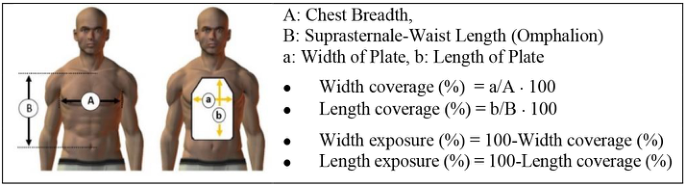
Figure 1: Visualization of plate coverage and exposure.
quantifies the minimum plate width; the average values for male and female U.S. Army Soldiers are 21.6 cm (8.5”) and 18.5cm (7.28”), respectively (Gor- don et al., 1989). For the minimum plate length, the average vertical distance of 1” below Suprasternale to 1” above Omphalion for male and female US Army Soldiers are 33.13 cm (13.04”) and 29.87cm (11.76”), respectively (Gordon et al., 2014). Hence, theoretically, a female with average torso leng- th/width could acceptably wear as small as 7.28” wide by 11.76” long torso plate, and for a male, 8.5” wide by 13” long.
Those minimum plate values can be converted into a minimum accepta- ble coverage if those dimensions are represented proportionally relative to the Chest Breadth and Suprasternale-Waist Length3. Figure 1 visualizes how percent coverage and exposure for width and length are computed in this study when the width and length of the plate values as well as wearer’s anthro- pometry are given. Bustpoint/Thelion–Bustpoint/Thelion Breadth is between 66.2% (female) and 67.2% (male) of Chest Breadth, on average. Similarly, the distance of 1” below Suprasternale to 1” above Omphalion is between 85.5% (female) and 86.7% (male) of the distance of Suprasternale-Waist Length, on average. In other words, the minimum width coverage of the mini- mum plate value that covers Thelion to Thelion distance is between 66.2% (female) and 67.2% (male), and minimum length coverage of minimum plate value that covers 1” below Suprasternale to 1” above Omphalion is between 85.5% (female) and 86.7% (male). Then, the exposure due to plate width at Chest Breadth is between 32.8% (male) and 33.8% (female), and exposure due to plate length at Suprasternale-Waist Length is between 13.7% (male) and 14.5% (female).
Maximum Width and AMD Following this “minimum size of the rigid armor plates”, the next question would be what impact of degradation in mobility do these rigid plates cause? Does wearing this minimum size guarantee the minimum mobility degrada- tion or whether any increment of plate size would still offer a similar mobility degradation. However, the most critical information required to develop an optimized sizing system for the rigid armor plate would be the maximum coverage that affords the minimal mobility degradation. An experiment to measure the mobility degradation with varied coverage would be one way
3A derived dimension, calculated by subtracting Waist Height at Omphalion from Suprasternale Height.
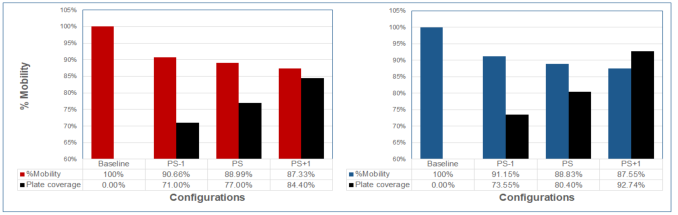
Figure 2: Mobility degradation (Cross Body Extension, seated) per configuration for male (right) and female (left) Soldiers (PS: Predicted Size, PS-1: one size smaller than predicted size, PS + 1: one size larger than predicted size, Baseline: no plate configuration).
to find out what the interaction of mobility degradation relative to coverage variation is.
Choi et al. (2017) measured standardized range of motion (ROM) mea- surements (from Mitchell, 2013) in four test configurations (predicted size, one size smaller, one size larger, and no plate) per test participant (TP) to investigate width and length variations of the torso plate. Cross Body Extension (Seated) was measured to assess the impact of the plate width on mobility, and Trunk Flexion (Seated) to assess plate length. The study computed the mobility degradation by comparing the ROM measurements from each configuration relative to those ROM measurements from the no plate configuration which was considered as a TPs’ 100% mobility capa- bility. The results were reviewed in two ways: 1) comparing the average mobility degradation per configuration (Figure 2) and 2) visualizing the rela- tionship between the mobility degradation relative to the coverage variation (Figure 3).
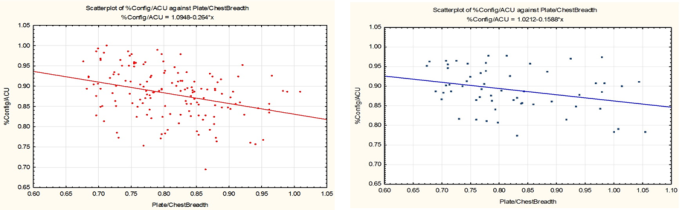
The results confirmed that mobility degrades as the plate width coverage increases; The mobility decreased to 89% with a predicted size plate and 91% with one size smaller than the predicted size plate for both male and female Soldiers (see Figure 2). The results also indicated that the coverage and mobility are negatively correlated and that mobility decreases when the coverage increases from approximately 67% to 100% (see Figure 3).
Because there was no clear observed plateau which would indicate a stabi- lized mobility degradation status, it was not feasible to define the minimum mobility degradation point from the graph. It was necessary to add a reasona- ble cut-off point to the mobility to define the AMD and find its corresponding maximum coverage. Table 1 represents the changes in mobility degradation from the coverage of male minimum coverage, 67%, up to the male coverage of the predicted size plate, 80%. Percent mobility values between 67% and 80% coverage were reviewed to determine the reasonable cut-off point at mobility since those percent coverage values in Table 1 are all acceptable.
Each percent mobility value was connected to its corresponding maximum percent coverage. For example, for males, when the percent coverage increa- ses from 67% to 73%, mobility stays at 91%, and for females, 91% mobility
Theoretical Framework for the Sizing of Body Armor Plates to Optimize Fit 47
Figure 3: Scatterplot of mobility degradation (Cross Body Extension, seated) against coverage variation (percent coverage of the testing plate) at Chest Breadth for male (right) and female (left) Soldiers (Choi et al., 2017).Table 1. Percent mobility relative to plate coverage variation.
was observed for the coverage ranges from 69% to 71%. Then, the maximum coverage corresponding to 91% mobility for males and females is 73% and 71%, respectively. In a similar way, when the maximum coverage is 90%, mobility would be 75% and 79% for females and males, respectively. Then, the other three mobility values, 92%, 89% and 88%, were excluded from the consideration because they do not have corresponding maximum cove- rage values for male. For the 89% mobility, it can be assumed that greater than 80% coverage would have 89% mobility given the range of coverage for 90% and 91% mobility for males.
For this study, the AMD was conservatively defined at 90% mobility, the midway mobility point between the predicted size (89%) and one size smal- ler configurations (91%). The corresponding maximum coverage was, then, identified as 75% for females and 79% for males relative to their Chest Bre- adth. Those two maximum coverage values for female and male are marked in red and blue, respectively, in Table 1. Hence, selected maximum coverage offers increased protection coverage relative to minimum acceptable coverage (66% for female, 67% for male) by 9% for female and 12% for males.
Length In a similar way, length of the plate was also assessed in Choi et al. (2017); however, no clear and simple trends between length coverage and mobility degradation was observed. For this current study, length coverage was not determined from mobility degradation, but the anthropometric characteri- stics of the torso instead. The top of the plate should be located between Suprasternale and 1” below. If it is located more than 1” below the Supra- sternale, then aortic arch will be exposed (Gordon, 1985). Then, the bottom
of the plate does not need to be higher than 10th Rib location to improve mobility. Because the human ribcage protects all the critical organs, but does not bend or flex easily during torso flexion, raising the plate above this loca- tion is not necessary and could jeopardize protection. The bottom of the plate, however, should not be lower than Iliocristale location as it will restrict the mobility. In fact, the pivotal location for the torso flexion is midway betw- een the 10th Rib and the Iliocristale. Hence, as long as the bottom of the plate is located between the 10th Rib and midway4 between 10th Rib and Ili- ocristale, the length should not prohibit generalized Soldier movement. Thus, length of the front plate was defined as the vertical distance between 1”below Suprasternale to midway between 10th rib and Iliocristale.
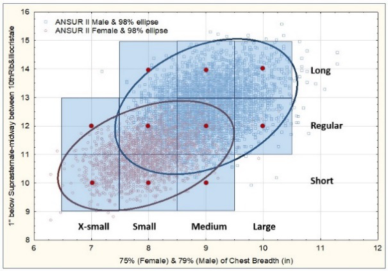
Size System Given the optimal front plate width and length are now defined, the next step was to determine the target accommodation rate and the interval between the adjacent sizes. For this study, 98% accommodation was applied because rigid plates are life critical components (Guerra, 2010). For the width interval, the acceptable ranges of width coverage, 9% for females and 12% males, were converted into inches, 0.95” and 1.36” for females and males, respectively. Conservatively, the narrower one was selected and rounded up to the closest integer, 1”. Similarly, the length interval was set to be 2”; this is based on the 1” flexibility at Suprasternale and based on the closest integer of the distance from the 10th rib and midway between 10th Rib and Iliocristale, 1”. Thus, each size is set to be defined by a 1” by 2” envelope. The distribution of 1” below Suprasternale to midway between the 10th rib and Iliocristale against maximum coverage Chest Breadth (75% for female & 79% for male) is visu- alized in Figure 4 along with the proposed plate sizing that accommodates up to 98% of the population. A theoretical size tariff of front plate sizes for male and female are listed in Table 2. Detailed specifications for the family of armor plates are represented in Table 3.
BACK PLATE Given the width of the back plate is identical to front plate, the length of back plate was investigated based on specific anatomical characteristics. Conven- tionally, front and back plates are aligned together and located at or 1”below Suprasternale. On average, the difference between Cervicale (C7) Height and Suprasternale Height is approximately 3”(3.1”for male and 2.6”for female). Since the back plate is aligned at 1” below Suprasternale, about 3.6” (female) - 4.1” (male) from the top edge of back plate to C7 is exposed. Theoreti- cally, C7 does not move during the neck flexion and extension (Shin et al., 2011; Póvoa et al., 2018), thus covering the exposed area by increasing the back plate length up to C7 should not restrict neck mobility. For each front
4The average difference between 10th Rib and Iliocristale Heights are 2.32”and 2.38”for male and female, respectively. So, midway between 10th Rib and Iliocristale is, on average, 1.16” and 1.19” from the 10th Rib for male and female, respectively.
Theoretical Framework for the Sizing of Body Armor Plates to Optimize Fit 49
Figure 4: The distribution of 1” below Suprasternale to midway between the 10th rib and Iliocristale against maximum coverage Chest Breadth (75% for female & 79% for male).Table 2. Size tariff of front plate for male and female U.S. Army personnel.
Table available in the original PDF paper.
Percentage (%) X-small Small Medium Large Total Short Female 14.90 33.18 4.58 -- 52.67 Male 0.07 1.10 1.15 -- 2.32
Regular Female 4.68 30.56 11.33 0.35 46.92 Male 0.20 14.97 38.66 9.58 63.41 Long Female -- 0.00 0.15 0.00 0.15 Male -- 3.80 21.36 8.15 33.34
Total Female 19.59 63.75 16.06 0.35 99.80 Male 0.27 19.87 61.17 17.76 99.07
Table 3. Specification of the family of armor plates.
Table available in the original PDF paper.
Plate Size (in)
Width X-Small (7”) Small (8”) Medium (9”) Large (10”) Length Short Regular Short Regular Long Short Regular Long Regular Long Front 10” 12” 10” 12” 14” 10” 12” 14” 12” 14” Back 12” 14” 12” 14” 16” 12” 14” 16.5” 14.5” 16.5” Side Plate 6”x 6” 7”x 6” 7”x 8” 8”x 6” 8”x 8” 9”x 8”
plate size, the average difference between Suprasternale Height and C7 Hei- ght was calculated, rounded up to closest 1/4” (i.e., 2.59” and 2.48” were rounded to 2.5”), and one 1/2” (soft armor width) was subtracted. Male and female dimensions were compared per size, and the smaller number was applied to the length of the back plate. All back plates were predicted to be 2” longer than the matching front plates, except for three sizes. Medium-Long, Large-Regular, and Large-Long which were 2.5” longer. Detailed width and length information of the back plate per corresponding front plate sizes are represented in Table 3.
SIDE PLATE The side plate was designed to protect vulnerable surfaces on the torso, out- side of the area where the front and back plates cover and protect. The size of the side plate, thus, was determined based on the open surface on the lateral sides of the body once front and back plates with soft armor were positioned on the body. The potential width for side plate specification was simply calcu- lated by subtracting the total width covered from two torso plates (the two torso plates width plus an additional 2” of soft armor (1/2” around front and back plates)) from the Waist Circumference at Omphalion and Chest Circumference, where the smaller width was selected. Since the value derived includes both sides of the body, it was divided by 2, and an additional 1” was subtracted for consideration of the soft armor width around the side plate. The final width of the side plate for each of the front plate sizes, male and female dimensions were compared per size, and the smaller number was applied to the width of side plate. It is because the surface on the torso needs to be wide enough when all four plates are donned together.
Side plate length was determined to cover the chest area from the lateral angle. Axilla Height, Chest Height and the bottom of the torso plate height were considered together so that when front, back and both side plates are donned at the same time, the bottom of the plates would align to each other so as not to constrain torso flexion in any direction. Detailed side plate width and length information is presented in Table 3.
LIMITATIONS AND FURTHER DIRECTIONS Plate Curviture and Shape
The current study is based on the legacy curvature of the torso plate and side plate. The curve of the back plate, with an increased length, should be investigated further to better understand it’s impact on comfort. The curve of the front plate for female Soldiers should also be investigated further to understand the impact to comfort and mobility and performance in general due to the fit of the plate and its interface with the breast apex, total breast volume and shape. Currently one of the objectives for this research effort is to better understand the curvature variation relative to female torso shape, which will leverage this plate sizing system to produce better fitting plates.
Another observation during the development of the side plate dimensions was that the open surface at Chest level tends to be greater than that at Waist level for males by 2” on average. This indicates that different shapes of side plates, other than rectangular, could be considered for male Soldiers for better protection. For female, the average difference was only about .5” Anthropometric and Proportional Differences Between Sex
Size differences between male and female Soldiers are well-known. In general, males are larger on all anthropometric dimensions relative to females, except for Hip Breadth. However, when it comes to proportional differences, spe- cifically for the fitting of rigid protective plates and/or body armor systems, no thorough documentation is presently available or dedicated to this topic.
Theoretical Framework for the Sizing of Body Armor Plates to Optimize Fit 51
Along with a full scale fit mapping of the proposed plate sizing, an investi- gation should be performed so that equivalent fitting quality control can be offered for both male and female Soldiers.
CONCLUSION
The current study explored the theoretical framework to design a rigid armor plate sizing system based on the AMD, anthropometric characteristics, and the surface availability for donning four plates together. Allowing for a sizing system that is rooted in anthropometry, while taking optimized mobility into account will allow our Soldiers to have the greatest level of protection with limited impacts on mobility and mission performance as well as ensuring that we are able to properly accommodate over 99% of our Soldiers within our sizing system. The primary focus of this study was to propose a size specification for hard armor plates when the three rigid pieces (front, back and side) are a set and sized together. By sizing plates together as a system, we allow for a reduced logistical burden, that will help compensate for the increased burden of issuing different sized front and back torso plates. A further, full scale fit mapping evaluation for both male and female Solders on the proposed family of plates is strongly recommended to confirm and validate the theoretical sizing system.
ACKNOWLEDGMENT
This research was funded by the U.S. Army DEVCOM Soldier Center. The authors would like to thank the Warfighters for the sacrifices they make every day for our country.
REFERENCES
Choi, HJ, Garlie, T.D., & Paquette, S.P (2017). Phase 1. Evaluation of existing ballistic hard armor plates (ESBI, ESAPI, and prototype plates). (MFR). Natick, MA: U.S. Army Natick Research, Development and Engineering Center. Gordon, C.C. (1985). Center front clearance for SARVIP inserts. (MFR). Natick,
MA: U.S. Army Natick Research, Development and Engineering Center. Gordon, C.C., Blackwell, C.L., Bradtmiller B., Parham, J.L., Barrientos, P., Paquette, S.P., Corner, B.D., Carson, J.M., Venezia, J.C, Rockwell, B., Mucher, M. and Kristensen, S. (2014). 2010-2012 Anthropometric survey of U.S. Army personnel (ANSUR II): Methods and summary statistics. (Technical Report (Natick/TR-15-007)). Natick, MA: U.S. Army Natick Research, Development and Engineering Center. Gordon, C.C., Bradtmiller, B., Clauser, C.E., Churchill, T., McConville, J.T.,
Tebbutt’s, I., & Walker, R.A. (1989). 1987-1988 Anthropometric Survey of U.S. Army Personnel: Methods and Summary Statistics. (Technical Report (TR-89- 044)). Natick, MA: U.S. Army Natick Research, Development and Engineering Center. Guerra, R. (2010). Chapter 9. Human Systems Integration, JPEO-CBD systems engineering Handbook V01.
Mitchell, K.B. (2013). Development of Standard Methodology for Assessment of Range of Motion While Wearing Body Armor. (Technical Report (Natick/TR- 13/033)). Natick, MA: US Army Natick Research, Development and Engineering Center. Póvoa, L. C., Ferreira, A., Zanier, J., & Silva, J. G. (2018). Accuracy of Motion
Palpation Flexion-Extension Test in Identifying the Seventh Cervical Spinal Pro- cess. Journal of chiropractic medicine, 17(1), 22–29. Shin S, Yoon D-M, & Yoon KB. (2011). Identification of the correct cervical level by palpation of spinous processes. Anesth Analg. 2011;112(5):1232–1235
LISTED IN THE AHFE DIGITAL BOOKSTORE CATALOGUE
Explore the complete digital volume
Digital Human Modeling and Applied Optimization
Read this individual research paper free through the original publisher, or explore the full digital proceedings book.
ISBN 978-1-958651-22-3
Explore this ISBN in the AHFE Bookstore ↗Listed in the July 2026 bookstore catalogue; search by ISBN to confirm current availability · Digital book purchase optional