Hyegjoo Choi-Rokas, Edward Hennessy, Stephanie Brown, Linda Desimone (2022). Assessment of Commercial Off the Shelf (COTS) Sports Brassieres for the U.S. Army Tactical Brassiere (ATB) Program. In: Digital Human Modeling and Applied Optimization. AHFE Open Access, vol. 46, pp. 141–149. https://doi.org/10.54941/ahfe1001910
In an effort to develop a U.S. Army tactical brassiere (ATB), a three-step study was designed and executed. Commercial off the shelf (COTS) sports brassieres were assessed to investigate the effects of different design features on fit, mobility (i.e., breast support, interference), and comfort (subjective rating) relative to the wearer’s anthropometric characteristics (Step 1). Based on the results from the first step of the study, an ATB sizing system was developed (Step 2). Then, the fit model was selected and the accommodation envelope was constructed to develop the brassiere pattern per size based on the ATB sizing system (Step 3). The current study summarizes the results of the first step of the study and includes the relationship between overall coverage, design features, anthropometric characteristics, and their pros and cons as they relate to Soldier mobility.A total of 19 test participants (TPs) volunteered. Data collection sessions were executed following COVID restriction guidelines. Seven configurations (six COTS brassieres and U.S. Army standard issue brassiere as a baseline) were assessed and compared to each other. The six COTS configurations were a combination of three brassiere cup designs (compression, encapsulation and hybrid (more than 1 configuration of cup design)) and two strap designs (straight and racer back). To capture the anthropometric characteristics, a total of 24 traditional dimensions were measured and seven derived dimensions were computed from traditional dimensions. Four additional dimensions were extracted from three-dimensional scan images captured by a Cyberware 3D whole-body scanner. For the mobility assessments, six tasks (Extend and Flex, The Rower, Windmill, Quadraplex, Mountain Climber, and High Jumper) were selected from an Army physical training guide. TPs’ subjective ratings (5-point Likert scale) for support, discomfort and interference on each mobility task were collected upon completion of each task for each test configuration. At the end of the mobility session, TPs provided overall ratings on the attributes of the test configuration. Once data collection on all seven configurations were completed, TPs ranked all test configurations, including their own personal preferred sport brassiere. A one-way repeated measures ANOVA along with Scheffé tests was performed on all applicable anthropometric dimensions. Correlation analyses between anthropometric dimensions and subjective ratings on mobility tasks were conducted to investigate the relationship between design features and mobility. Descriptive statistics, as well as graphical visualization, were produced to compare subjective ratings on mobility tasks between configurations. In all, different brassiere designs had an effect on all compared anthropometric measurements. Each configuration showed distinctive anthropometric characteristics, and those anthropometric differences were often correlated with TPs’ subjective ratings on discomfort and breast support. A detailed investigation for the metrics as well as the comparison of results are further discussed in this paper.
In an effort to develop an Army Tactical Brassiere (ATB), a three-phase study was designed and executed. As the first phase, commercial-off-the-shelf (COTS) sports brassieres were assessed to investigate the effects of different design features on fit, mobility, and comfort. Based on the results from the first phase of the study, along with a systematic review of brassiere sizing development methodologies, an ATB sizing system will be developed in the second phase. In the third phase, for each developed ATB size, a fit model will be selected and an accommodation envelope will be constructed to develop the brassiere pattern as the last phase.
The current paper summarizes a part of the results from the first phase where the overall purpose was to document the relationship between the design features, the anthropometric characteristics, and their pros and cons as they relate to Soldier mobility. During the design feature assessment, anth- ropometric measurements as well as subjective ratings on brassiere support, comfort/discomfort and interference during the mobility assessments were analyzed. Specific research questions for this paper are two-fold, 1) was there
Cup Design Baseline (A) & COTS (B-G) Hybrid Compression Encapsulation Straight B D F Racer/Cross Back C A, E G
Strap Design
a clear trend in brassiere design linked with discomfort, interference and sup- port? 2) if so, is it possible to objectively describe those design features in that configuration?
METHOD
Test Item Prior to selecting the test items, results from previous relevant studies on sport brassieres were reviewed. Measurement of breast movement reduction is often used as a critical index to represent breast support (Zhou et al. 2013, Scurr et al. 2011). This measure of breast movement reduction was compared relative to brassiere design features, such as cup design (Scurr et al. 2011), strap configuration (Zhou et al. 2013, Bowles and Steele, 2013, Coltman et al. 2015, Page and Steele 1999, Yu and Zhou, 2016), cup padding (Zhou et al. 2013, Page and Steele, 1999, Yu and Zhou, 2016), and cup underwire (Zhou et al. 2013, Page and Steele, 1999), etc.
Among identified design features, this study selected two primary features, cup design and strap type, because they are the two basic design characteri- stics relative to other sub-details such as cup padding or cup with underwire. The number of different types of cup and strap design was limited to three cup designs and two strap types. This total was designed to limit the data collection duration to approximately 4 hours to avoid need for a meal break in the middle of the assessment.
In all, seven configurations (six COTS brassieres and U.S. Army standard issue brassiere as a baseline) were selected for assessment and comparison. The six COTS configurations were a combination of three brassiere cup desi- gns (compression, encapsulation and hybrid (more than 1 configuration of cup design))1 and two strap designs (straight or parallel straps (I I) and racer back or cross straps (X)). The configuration matrix is represented in Table 1.
Brassiere Fitting Process Traditionally, in the United States, a brassiere size has two components, bra cup and band size, which are combined into the commercial brassiere size (e.g., 36C). Cup sizes are usually marked alphabetically with cup A having the smallest breast volume (i.e., A, B, C, etc.) while the band size is numbered in inches (i.e., 32, 34, 36, etc.). One unique feature in brassiere sizing is that the cup size interacts with band size. In other words, breast volume, denoted
1Pictures of selected COTS sport brassieres are not included to withheld the brand identity
Assessment of Commercial Off the Shelf (COTS) Sports Brassieres 143
Table 2. Measured anthropometric dimensions (mm).
Table available in the original PDF paper.
Dimensions Direct Measurements Derived Measurements Breadths Thelion to Thelion1
Circumferences Chest2, Underbust1, Chest at Scye1, Waist at Omphalion2
Height difference (Chest-Underbust)
Circumference difference (Chest-Underbust, Chest at scye-Underbust) Depths Chest2, Underbust3 Depth difference (Chest-Underbust) Heights Stature2, Suprasternale2, Axilla2, Chest2, Underbust3, Omphalion2 Waist Front Length difference (ANSUR I-ANSUR II), Side Neck to breast bottom, R&L Lengths Interscye I2, Strap1, Waist Front1, 2, Waist Back2, Chest cross3, Side Neck to Axilla level, R & L3, Axilla level to breast bottom, R& L3
Weight Body weight 1ANSUR I, 2ANSUR II, 3Developed for this study
by the same alphabetic character, is different relative to the band size, and increases (or decreases) as the band size increases (or decreases). For example, the breast volume accommodated by size 34C is greater than that by 32C.
Therefore, if predicted brassiere size is 34B, but the cup should be bigger or smaller, then adjacent sizes, such as 34C or 34A, should be tried. However, if the band should be longer or shorter than 34B with the same cup size, the trial size should be 36A to get a longer band with the same cup volume or 32C for a shorter band with the same cup volume. Sizes that share the identical cup volume (i.e., 34B with 36A and 32C) are called sister sizes.
Fitting trials for this study were all performed by Army clothing designers from DEVCOM Soldier Center, Design, Pattern, and Prototype Team (DPPT) and they started with the predicted size of each configuration. Following the predicted size, all needed adjacent and sister sizes were tried to identify the best-fit size brassiere for each configuration for each individual. This process was repeated for all test configurations.
Metrics: Anthropometric Dimensions To capture the anthropometric characteristics, a total of 24 traditional dimen- sions were measured following the methodology established for ANSUR I (Gordon et al. 1989) or ANSUR II (Hotzman et al. 2011) where applicable. Additionally, seven derived dimensions were computed from the traditional directly measured dimensions. Table 2 details the measurements. Four addi- tional dimensions were extracted from three-dimensional (3D) scan images captured by a Cyberware 3D whole-body scanner (see Table 3).
Metrics: Mobility Assessment (Subjective Rating) Exercises for the mobility measurements were selected based on two primary criteria: high impact on breast movement and producing a low amount of
Table 3. Scan extracted dimensions (mm).
Table available in the original PDF paper.
Scan Extracted Dimensions (Point-to-Point Distance) A. Shoulder Exposure: Side neck point, right, to inner edge of the strap on the right shoulder
B. Center Neck Drop: Suprasternale to the highest point of the brassiere on the center front line C. Exposure at Scye, R: Scye point, right, to the edge of brassiere on the right side at Scye level, parallel to the floor.
D. Chest coverage at Scye: between the edge of bras- siere on the right and left side at Scye level, parallel to the floor.
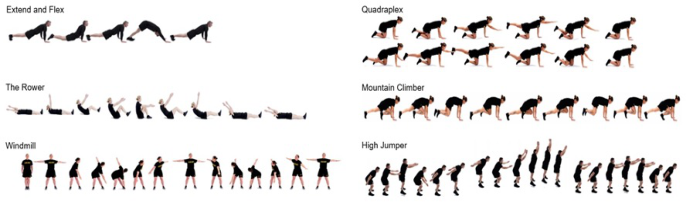
Figure 1: Selected six motions for the mobility assessment.
aerosol (due to Covid-19 safety precautions). The “Army pocket physical training guide” (U.S. Army, 2011) was the main reference from which all the exercise movements were selected so that Test Participants (TPs) could evaluate the brassiere performance based on common activities for female Soldiers.
A total of six exercise movements were selected that included: two low impact activities, Extend and Flex and The Rower; two medium impact exe- rcises, Windmill and Quadraplex; and two high impact exercises, Mountain Climber, and the High Jumper. Sequential pictures for those six activities are represented in Figure. 1. Except for “Extend and Flex” and “Quadraplex”, all exercise movements were repeated three times. TPs were told to perform “Extend and Flex” at their own pace, and to pause for 10 seconds per side for “Quadraplex”.
Upon completion of each mobility task for each test configuration, TPs subjectively rated (on a 5-point Likert scale) brassiere support, discomfort and interference. At the end of the mobility session, TPs provided overall ratings on the attributes of the test configuration. Once data collection on all seven configurations were completed, TPs ranked all test configurations, including their own personally preferred sport brassiere.
Assessment of Commercial Off the Shelf (COTS) Sports Brassieres 145
Table 4. Descriptive body size/shape statistics for TPs.
Table available in the original PDF paper.
Unit: mm, kg All TPs (n = 19) ANSUR II Female (N = 1986) Mean S.D. Mean S.D.
Analysis Descriptive statistics, as well as frequency tables, were produced to com- pare subjective ratings on mobility tasks between configurations. A one-way repeated measures ANOVA along with Scheffé tests was performed on all applicable anthropometric dimensions (α<.05).
RESULTS AND DISCUSSION
Test Participants (TPs) A total of 19 female TPs, 6 combat experienced personnel (5 active duty Soldiers & one veteran) and 13 civilian volunteers participated in the study. Ages ranged between 27 and 62 years old (M = 38.84, SD = 8.82). Personal information such as MOS and deployment history is withheld to maintain TP anonymity. Two (10.5%) TPs classified their race as Asian, one (5.3%) TP classified herself as Hispanic, two (10.5%) TPs did not answer, and the rest (n = 14, 73.7%) TPs classified themselves as White.
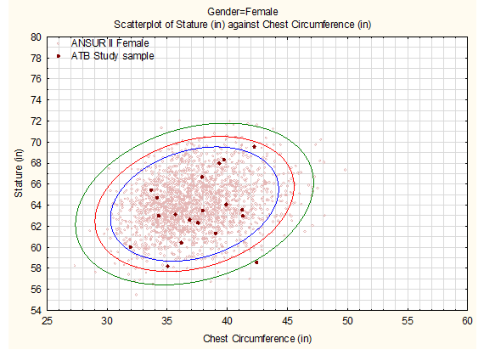
Test participants’ body size distributions were compared to the Anthropo- metric Survey of US Army Personnel data (Gordon et al. 2014). Summary descriptive statistics for TPs are provided in Table 4. The distribution of study sample relative to ANSUR II population with a 98% ellipse (1st to 99th percentiles), 96% ellipse (2nd to 98th percentiles) as well as a conventional 90% ellipse (5th to 95th percentiles) is represented in Figure 2. The study sample was shorter, heavier and broader at Waist Circumfere- nce relative to the ANSUR II parameters. The current study sample included relatively older participants, which explains the anthropometric differences: slightly heavier weight and broader Waist Circumference. Under the current unique circumstances (recruiting civilians and available military personnel on post), this was unavoidable. In all, it was concluded that the current study sample is adequate with more variability to elicit valid results.
Mobility Metrics Relative to Brassiere Design and Mobility Level The mobility metrics of Discomfort, Interference, and Support were rated on 5-point Likert scales. Frequencies of responses as well as mean ratings per motion by configuration were computed (Norman, 2010). Then, based on the means for each metric, the best and the worst configuration per motion was selected (See Table 5). If the means were identical, then the distribution
Figure 2: Stature and Chest Circumference distribution of participants relative to the U.S. Army population with 90% (blue), 96% (red) and 98% (green) ellipses.Table 5. Best and worst configuration per mobility metrics relative to six motions.
Table available in the original PDF paper.
Six Motions
Rower Windmill Quadra- Mountain
Low Medium High Extend & Flex plex Climber
High Jumper
Mobility Metrics Discomfort Best A A A A D D Worst C C C G C C
Interference Best A D D D D/F D Worst C C C C C C Support Best E D D C D D Worst A A A A A A
of frequencies was compared. The configuration with greater frequency of higher ratings was selected. If both mean values and the frequency count were identical, both configurations were listed.
Configuration C was listed 12 times; it was selected as the best supporting brassiere during Quadraplex motion, but listed as the most uncomfortable brassiere for almost all motions except for Quadraplex, and the most inter- fering brassiere to all motions. Configuration A was listed 11 times; it was selected as the most comfortable brassiere for low and medium level motions and the least interfering brassiere for Extend and Flex motion, but listed as the worst supporting brassiere on all six motions.
It is understandable that a brassiere with less (to no) adjustability and compression, Configuration A, would not support breasts during movement, but can be comfortable to wear without interfering with motion. Simi- larly, a brassiere with high compression with sufficient adjustment to tighten (Configuration C) would support the breasts but also cause discomfort and interference.
Thus, it was very interesting that Configuration D was listed 11 times as the best brassiere on all three mobility metrics; it was selected as the most
Assessment of Commercial Off the Shelf (COTS) Sports Brassieres 147
Table 6. Differences among configurations on selected anthropometric dimensions.
Circ. difference (Chest-Underbust) Center Neck Drop 89 136 114 85 122 119 112 111 **
**Significant at α =.01 (26 comparisons, adjusted α = .00038)
comfortable brassiere for the high level motions (Mountain Climber & High Jumper), the least interfering brassiere for all motions except for Extend & Flex motion, and the best supporting brassiere across all three levels of motions, specifically both high level motions.
Objective Description of Design Feature of Configuration D Circumferences and depths in bust and underbust areas are good indicators for the compression level of brassieres, where circumferences and depths tend to be smaller with high compression brassieres. Chest Height is a good indi- cator of breast support, as larger Chest Height indicates an elevated Thelion level, which represents a brassiere design with high breast support.
In looking at these dimensions across the test brassieres, Configuration D, a compression cup structure with straight strap, tended to be close to (or identical to) the mean values on all traditional anthropometric and derived dimensions relative to the other configurations. This indicates that Configu- ration D does not offer an extreme level of compression and breast support. Comparisons on the selected anthropometric dimensions are represented in Table 6.
One exception to this trend was the Center Neck Drop (refer to Figure 2), which quantified the exposure at the upper chest. Configuration D had the smallest Center Neck Drop value, indicating that it covered the most area on the upper chest relative to other configurations. Based on the mobility metrics as well as the exit interview with TPs, this design feature did pro- vide extra comfort and support during the mobility assessment with the least interference and discomfort.
CONCLUSION
The current paper summarizes selected results from the first phase of the ATB study with two specific research questions: 1) was there a clear trend in brassiere design linked with discomfort, interference and support? 2) if so, is it possible to objectively describe those design features?
Based on the metrics of support, discomfort, and interference, Configura- tion D, compression with straight strap, was the most supportive brassiere
with the least discomfort and interference. The design features of Configu- ration D were also documented in terms of anthropometric characteristics including coverage at chest area.
LIMITATION AND FUTURE DIRECTION Selection of Mobility Tasks
The biggest challenge in selecting the mobility tasks was to eliminate tasks that would generate a great amount of aerosol in order to follow COVID restrictions. All the mobility tasks selected for the current study did not take more than 60 seconds to complete to control the aerosol (breath) produced. The tasks were all adequate for the lab testing, however, the variability in the subjective ratings was limited. If the scope of the study can be expanded, repeating the study with additional exercises conducted for duration of time, such as jogging or 1-hour power yoga will be considered or issue to wear by the individuals for an extended wear period (e.g., 1 week – 4 months) as they conduct their normal exercise activities.
Metrics for Mobility Tasks For this study, the metrics to evaluate breast support were limited to sub- jective ratings. Subjective rating is an efficient scale; however, measuring consistency across configurations and quantifying the breast support or bre- ast movement reduction are not feasible. Recently, the authors acquired a 4D whole-body system that continuously captures the 3D images up to 2 minutes at 60 frames per second. By analyzing the skin deformation captured during mobility assessments, quantitative assessment on breast movement will be feasible and applicable to better understand brassiere support.
ACKNOWLEDGMENT
This research was funded by U.S. Army tactical brassiere (ATB) program at U.S. Army DEVCOM Soldier Center. The authors would like to thank those clothing designers at DPPT that took charge of the procurement pro- cess for the test items and fitting process for all test participants (TPs). We also would like to thank all those volunteers who participated in this study during COVID, especially those Warfighters for their time and effort, as well as for the sacrifices they make every day for our country.
REFERENCES
Bowles, K.-A., and Steele, J. R. (2013). “Effects of Strap Cushions and Strap Orientation on Comfort and Sports Bra Performance.” Medicine and Science in Sports and Exercise 45 (6): 1113–1119. Coltman, C. E., McGhee, D. E., and Steele, J. R. (2015). “Bra Strap Orientati-
ons and Designs to Minimize Bra Strap Discomfort and Pressure during Sport and Exercise in Women with Large Breasts.” Sports Medicine - Open 1: 21. doi:10.1186/s40798-015-0014-z.
Assessment of Commercial Off the Shelf (COTS) Sports Brassieres 149
Gordon, C.C., Blackwell, C.L., Bradtmiller B., Parham, J.L., Barrientos, P. Paquette, S.P., Corner, B.D., Carson, J.M., Venezia, J.C. Rockwell, B.M., Mucher, M, and Kristensen, S. (2014). 2012 Anthropometric survey of U.S. Army personnel (ANSUR II): Methods and summary statistics. (Technical Report (Natick/TR-15- 007)). Natick, MA: U.S. Army Natick Research, Development and Engineering Center. Gordon, C.C., Bradtmiller, B., Clauser, C.E., Churchill, T., McConville, J.T., Teb-
betts, I., & Walker, R.A. (1989). 1987-1988 Anthropometric Survey of U.S. Army Personnel: Methods and Summary Statistics. (Technical Report (TR-89-044)). Natick, MA: U.S. Army Natick Research, Development and Engineering Center. Hotzman J., Gordon, C.C., Bradtmiller, B., Corner, B.D., Mucher, M., Kristensen, S., Paquette, S., & Blackwell, C.L. (2011). Measurer’s handbook: US Army and Marine Corps anthropometric surveys, 2010–2011. (Technical Report (Natick/TR-11/017)). Natick, MA: U.S. Army Natick Research, Development and Engineering Center. Norman, G. (2010). Likert scales, levels of measurement and the “laws” of stati-
stics. Advances in health sciences education: theory and practice, 15(5), 625–632. https://doi.org/10.1007/s10459-010-9222-y Page, K., and Steele, J. (1999). “Breast Motion and Sports Brassiere Design.
Implications for Future Research.” Sports Medicine 27 (4): 205–211. Scurr, J., J. White, and Hedger, W. (2011). “Supported and Unsupported Breast Displacement in Three Dimensions across Treadmill Activity Levels.” Journal of Sports Sciences 29 (1): 55–61. U.S. Army. (2011). Army pocket physical training guide. United States Government
Printing Office: 2011 734-930. Yu, W., and Zhou, J. (2016). “Sports Bras and Breast Kinetics.” In Advances in Women’s Intimate Apparel Technology, edited by W. Yu, 135–146. Oxford: Woodhead Publishing. Zhou, J., Yu, W. and Ng, S. (2013). “Identifying Effective Design Features of
Commercial Sports Bras.” Textile Research Journal 83 (14) 1500–1513.
LISTED IN THE AHFE DIGITAL BOOKSTORE CATALOGUE
Explore the complete digital volume
Digital Human Modeling and Applied Optimization
Read this individual research paper free through the original publisher, or explore the full digital proceedings book.
ISBN 978-1-958651-22-3
Explore this ISBN in the AHFE Bookstore ↗Listed in the July 2026 bookstore catalogue; search by ISBN to confirm current availability · Digital book purchase optional