Madlen Günther, Josef Krems (2022). The Liveable City - How Effective Planning for Infrastructure and Personal Mobility Can Improve People’s Experiences of Urban Life. In: Human Factors in Architecture, Sustainable Urban Planning and Infrastructure. AHFE Open Access, vol. 58, pp. 354–361. https://doi.org/10.54941/ahfe1002372
Aim of this research was to better understand the impact of urban infrastructure design on people’s perceived environmental quality, perceived safety and the motivation for active mobility within the city. The requirements for walking and cycling infrastructure were first generated in face-to-face interviews (N = 82). Then, in a within-subject design, N = 74 participants rated six pairs of photos of urban spaces before (low infrastructure quality) and after an appropriate infrastructure redesign (high infrastructure quality). 85.1% of the participants were women. The sample had a mean age of M = 22.6 years (SD = 6.46 years, Min = 18 years, Max = 58 years). Results show that urban spaces with high-quality walking and cycling infrastructure were rated with a significantly higher perceived environmental quality (t(73) = 11.62, p < .001, d = 1.34), perceived safety (t(73) = 11.68, p < .001, d = 1.35) and motivation to walk and/or cycle (t(73) = 23.47, p < .001, d = 2.71). Although the study samples were not representative, the results suggest that human factors should be a fundamental part of transport and urban planning.
About half of the world’s population now lives in cities, and in Europe, the number is as high as 74% (United Nations, 2019). Although so many people live and move in urban areas, many places are designed in a way that is unfri- endly to people (Gehl, 2013). Since the Second World War, urban planning has been primarily focused on the car, to which more and more space in cities is devoted: Wide streets, narrow pavements, the priority of motorised traffic over other road users, and space for parking displacing pedestrians, cyclists and life in public space. In contrast, infrastructure for pedestrians and cycli- sts, for instance the presence of footpaths and cycle paths, is often considered as an important factor in ensuring perceived safety (Moudon et al., 2005; Southworth, 2005) and encouraging active mobility (i.e. walking, cycling), a widespread goal of our time.
The Liveable City - How Effective Planning for Infrastructure and Personal Mobility 355
However, public space design affects the liveability and people’s lives in significant ways: Environmental stressors such as noise, air pollution, high temperatures or crowding can have negative physical and psychological con- sequences, such as health problems, feelings of stress, social withdrawal, or the reduction of cognitive abilities (Bonnes et al., 2013). Positive impacts of urban spaces are associated with well-maintained green spaces, which can strengthen the health and well-being of residents (Bonnes et al., 2013). Accor- ding to Gehl (2013), there are twelve characteristics related to a liveable city: The most elementary conditions are the protection of people from (1) traffic and accidents, (2) crime, and (3) unpleasant sensory perceptions such as rain or sunlight. In addition, the spaces should invite people to use them, which is expressed in an offer for pedestrians, (5) places to stay, and (6) places to sit, (7) places to see, (8) a place for communication, and (9) a place for games and sports. Further, a place needs something pleasing, which is created by (10) human scale, (11) pleasant climatic conditions and (12) positive sensory impressions. According to Gehl (2013) and Ruth and Franklin (2014), in this paper we understand liveability as the cities’ environmental quality, defined by its biological and physical characteristics.
The overall aim of this research is to better understand the impact of urban infrastructure design on perceived environmental quality, perceived safety and the motivation for active mobility. A further aim is to generate requirements for a people-friendly urban infrastructure design and to develop and evaluate a measurement tool for assessing the perceived environmental quality and the motivation for active mobility in urban spaces.
METHODOLOGY
The studies reported in this paper were part of a research project to evo- lve a sustainable mobility awareness in urban areas (“NUMIC – new urban mobility awareness in Chemnitz”; https://numic.city) conducted from 2019 to 2022 in Chemnitz, Germany.
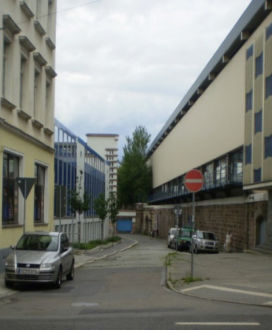
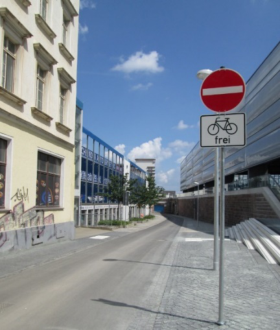
In the first study, user requirements for a user-friendly urban walking and cycling infrastructure were assessed based on face-to-face-interviews (N = 82). The interviews were conducted in February and March in 2020 in the inner city of Chemnitz. The resulting requirements were used to identify potential urban areas with low and high infrastructure quality for walking and cycling. Within the project, several urban areas as well as walking and cycling routes were redesigned. For study two, photos of the identified urban areas were taken before and after an appropriate infrastructure redesign (low vs. high walking and cycling infrastructure quality). They were used to evalu- ate the effectiveness of the urban infrastructure design on participants’ rating of environmental quality, perceived walking and cycling safety as well as par- ticipants’ motivation for active mobility (i.e., walking and/or cycling). For this propose, in a within-subject design, N = 74 participants rated six pairs of photos of urban spaces before (low infrastructure quality, for an example see Figure 1) and after an appropriate infrastructure redesign (high infrastructure quality, see Figure 2 for an example) in an online study in March 2021.
356 Günther and Krems
Figure 1: Example of a photo of the low infrastructure quality category.Figure 2: Example of a photo of the high infrastructure quality category.
Participants Interested study participants were recruited via press releases by the project partners, related newsletters and by the project homepage. The studies were carried out in accordance with the American Psychological Association Code of Ethics, as well as recommendations, regulations and consent templates of the Chemnitz University of Technology ethics commission. All subjects gave written informed consent.
Study 1 – Requirements for Urban Infrastructure Design The sample of study one (face-to-face-interviews) consisted of 44 women and 38 men ranging from 17 to 87 years (M = 47 years, SD = 21.2). 53.7% of the study participants were university educated. 32.9% were retired, 31.7% were students and 30.4% of the study participants were employed. The majority of the study participants reported a multimodal mobility behaviour; the modal
The Liveable City - How Effective Planning for Infrastructure and Personal Mobility 357
split of all reported trips consisted of 27.7% trips by public transport, 26.5% by bicycle, 24.7% trips made on foot, and 21.1% car trips.
Study 2 – Evaluation of Urban Infrastructure Design 85.1% of the study two participants were women, 14.9% were men. The sample had a mean age of M = 23 years (SD = 6.5, Min = 18 years, Max = 58 years). The majority of the study participants were students (93.2%), 2.7% were employed. 63.5% of the participants reported that, due to the Corona pandemic, they feel strongly restricted in their ability to be present in a public space, as well as in their walking and cycling mobility. Study participants reported having made at least one trip per week by public transport (52.7%), by bicycle (32.5%), on foot (93.3%) and by car (39.2%).
Measurements Study 1 – Requirements for Urban Infrastructure Design Five trained interviewers used a structured interview with open-ended que- stions. The questions analysed in the following study were (1) What does the ideal cycle path look like to you?, (2) What does the ideal footpath look like to you?, and (3) What are your requirements for urban walking and cycling infrastructure?. All answers were recoded and transcribed. The inte- rview data was analysed according to Mayring (2000) using the inductive category development methodology. Participants’ statements were coded by two independent coders and thus, a system of requirement categories was developed.
Study 2 – Evaluation of Urban Infrastructure Design Perceived urban environmental quality. To assess the perceived environ- mental quality a scale according to Gehls’ (2013) criteria of urban quality was developed. The scale consist of 12 items which were rated on a seven- point Likert scale from 1 = ”strongly disagree” to 7 = “strongly agree”. Item examples were “In this environment, people are protected from traffic.” and “People like to stay in this environment”. Cronbach’s alpha can be classified as excellent (αlow quality = .91, αhigh quality = .87). The scale was normally distributed according to Field (2013).
Perceived safety. Perceived safety was assess with two items according to Noland (1995). The first item asked about the perceived likelihood of having an accident at a given location while walking or cycling. The answer was given on a seven-point rating scale from 1 = “quite certain not to have an accident” to 7 = “quite certain to have an accident”. The second item asked about the expected severity of an accident at this location while walking or cycling. The answer was also given on a seven-point rating scale from 1 = “no injuries at all”to 7 = “accident resulting in death”. For a final score the values of both items were multiplied and root-drawn, which again resulted in the range from 1 to 7. Cronbach’s alpha can be classified as poor to acceptable (αlow quality = .67, αhigh quality = .35). According to Field (2013) the scale was normal distributed.
358 Günther and Krems
Motivation for active mobility. The motivation for active mobility was assessed with a five item scale, answered on a seven-point Likert scale from 1 = “strongly disagree” to 7 = “strongly agree”. An item example was “This environment motivates me to walk or cycle distances in the city more often.”. Cronbach’s alpha can be classified as good (αlow quality = .87, αhigh quality = .85). The scale shows a normal distribution according to Field (2013).
RESULTS
Study 1 – Requirements for Urban Infrastructure Design
Table 1 contains the developed requirement categories with examples of user friendly active mobility infrastructure.
In general, requirements regarding texture, such as a barrier-free access and a flat and clear footpath and cycling path, were the most reported infrastru- cture characteristics, followed by safety and accessory related requirements. Requirements for the connection of the footpath and cycle path network were reported less frequently. As can be seen, the importance of the reported requi- rements differs between walking and cycling infrastructure and should be taken into account in urban planning in order to meet the requirements of the different road user groups.
Table 1. Participants’ requirements for urban walking and cycling infrastructure.
Study 2 – Evaluation of Urban Infrastructure Design
Table 2 shows the descriptive statistics of the dependent variables perceived environmental quality, perceived safety and motivation for active mobility between low and high quality infrastructures.
The results show that urban spaces with a high-quality infrastructure for pedestrians and cyclists were rated with a significantly higher perceived envi- ronmental quality (t(73) = 11.62, p < .001, d = 1.34), perceived safety
The Liveable City - How Effective Planning for Infrastructure and Personal Mobility 359
(t(73) = 11.68, p < .001, d = 1.35) and a significantly higher motivation to walk and/or cycle (t(73) = 23.47, p < .001, d = 2.71). According to Cohen (1992), the effects can be interpreted as large.
None of the effects found were confounded by participants’ demographic characteristics or their reported perceived influence of the Corona pandemic (all p’s > .120).
Table 2. Descriptive statistics of the variables perceived environmental quality, perceived safety and motivation for active mobility between low and high quality infrastructures.
In the present research user requirements for the design of user-friendly walking and cycling infrastructures were assessed. The most important infra- structure characteristics were identified as being texture of the surface, safety criticality, equipment of the footpaths and cycling paths, as well as a conti- nuous connection within the path networks. Results revealed differences in the importance of the infrastructure characteristics between pedestrians and cyclists, and underlie the necessity to respect the requirements of different types of road users in urban planning.
Within study two reliable measurements to assess the perceived environ- mental quality and motivation for active mobility were developed. Urban spaces with high quality infrastructures according to Gehl (2013) were rated with a higher perceived environmental quality, perceived safety and with an increased motivation for active mobility, compared to urban spaces with a low quality infrastructure. As already assumed by Gehl (2013), spaces with a high infrastructure quality increased their attractiveness and are associated with an enhanced perceived environmental quality. This is also in line with the characteristics of high-quality urban spaces identified by Smith, Nelischer and Perkins (1997). The assumptions regarding the criteria for successful pedestrian networks (Southworth, 2005) could also be extended to safety, path quality and path environment. Thus, the results on safety perception can also support the findings of Götschi et al. (2018) and McNeil et al. (2015), showing that the use of cycling-specific infrastructure increases the perceived safety while cycling. Furthermore, high quality environments make walking and cycling more attractive. This shows that active mobility also benefits from features of the environment that are actually designed to promote the users’ presence.
However, some methodological limitations should be taken into account when extrapolating from the results to make broader claims. First, the
360 Günther and Krems
samples of both studies were not representative for the general population. In particular, individuals from study two were drawn from similar professi- onal and social backgrounds. Second, study two participants only evaluated visual material and did not directly experience the presented environments. There are also possible confounding variables associated with conducting an online study, such as not being able to control the survey situation. Third, it was unfortunately not possible to ensure that the photos contained the identical environmental conditions (i.e. vegetation, light incidence). Thus, for instance, the proportion of vegetation may also have had an influence on the participants’ assessment. Finally, no statement can be made about the importance of single infrastructure characteristics (e.g. physical barriers com- pared to vegetation) or quality characteristics (e.g. protection from traffic vs. pleasure at merely being in the environment) when compared to each other.
For future research, it would be interesting to investigate which elements of user-friendly design are associated with which parts of the perceived environ- mental quality, perceived safety and motivation for active mobility. Or, on the other hand, to explore the relationship between the presence of infrastructure characteristics, and user requirements and their perceived environmental qua- lity or user satisfaction with this environment. It would also be interesting to know whether there are infrastructural characteristics that only prevent dis- satisfaction, and factors that promote satisfaction (analogous to Herzberg’s two-factor theory, 1959).
Although some methodical limitations have to be considered, the results of the present research suggest that positive user related impacts could be expected if urban spaces are tailored to human needs and active mobility can be promoted through an appropriate infrastructure design. Therefore, human factors should be a fundamental part of transport and urban planning.
ACKNOWLEDGMENT
The study was funded by the Federal Ministry of Education and Research and the Social-Ecological Research (FONA). Any views expressed herein are those of the authors and do not necessarily reflect those of the funding bodies or partners involved in the project. The authors wish to thank Juliane Schmidt and all study participants.
REFERENCES
Bonnes, M., Scopelliti, M., Fornara, F., & Carrus, G. (2013). Urban environmental quality. In L. Steg, A. E. Van Den Berg, & J. I. M. De Groot (Eds.), Environmental Psychology. An Introduction (pp. 97–106). BPS Blackwell. Cohen, J. (1992). A power primer. Psychological Bulletin, 112(1), 155–159.
https://doi.org/10.1037/0033-2909.112.1.155. Field, A. (2013). Discovering statistics using IBM SPSS statistics (4th ed.). Sage. Gehl, J. (2013). Cities for people. Island press. Götschi, T., Castro, A., Deforth, M., Miranda-Moreno, L., & Zangenehpour, S.
(2018). Towards a comprehensive safety evaluation of cycling infrastructure inclu- ding objective and subjective measures. Journal of Transport and Health, 8, 44–54. https://doi.org/10.1016/j.jth.2017.12.003
The Liveable City - How Effective Planning for Infrastructure and Personal Mobility 361
Herzberg, F., Mausner, B., & Snydermann B. (1959). The motivation to work.
New York:Wiley. Mayring, P. (2000) Qualitative content analysis, Qualitative Methods in Various Disciplines I: Psychology, 1(2). http://www.nbn-resolving.de/urn:nbn:de:0114-fq s0002204 McNeil, N., Monsere, C. M., & Dill, J. (2015). Influence of Bike Lane Buffer Types
on Perceived Comfort and Safety of Bicyclists and Potential Bicyclists. Transpor- tation Research Record: Journal of the Transportation Research Board, 2520(1), 132–142. https://doi.org/10.3141/2520-15 Moudon, A. V., Lee, C., Cheadle, A. D., Collier, C. W., Johnson, D., Schmid, T. L., & Weather, R. D. (2005). Cycling and the built environment, a US perspective. Transportation Research Part D, 10, 245–261. Noland, R. B. (1995). Perceived risk and modal choice: Risk compensation in
transportation systems. Accident Analysis & Prevention, 27(4), 503–521. https: //doi.org/10.1016/0001-4575(94)00087-3 Ruth, M., & Franklin, R. S. (2014). Livability for all? Conceptual limits and practical implications. Applied Geography, 49, 18–23. Smith, T., Nelischer, M., & Perkins, N. (1997). Quality of an urban community:
a framework for understanding the relationship between quality and physical form. Landscape and Urban Planning, 39(2–3), 229–241. https://doi.org/10. 1016/S0169-2046(97)00055-8 Southworth, M. (2005). Designing the Walkable City. Journal of Urban Planning and Development, 131(4), 246–257. https://doi.org/10.1061/(ASCE)0733- 9488(2005)131:4(246) United Nations. (2019). World Urbanization Prospects. The 2018 Revision. https:
Human Factors in Architecture, Sustainable Urban Planning and Infrastructure
Read this individual research paper free through the original publisher, or explore the full digital proceedings book.
ISBN 978-1-958651-34-6
Explore this ISBN in the AHFE Bookstore ↗Listed in the July 2026 bookstore catalogue; search by ISBN to confirm current availability · Digital book purchase optional