Maria Kreusslein, Madlen Günther (2024). Power to the citizens: Factors fostering satisfaction with citizen participation in urban planning. In: Human Factors in Architecture, Sustainable Urban Planning and Infrastructure. AHFE Open Access, vol. 153, pp. 97–107. https://doi.org/10.54941/ahfe1005342
Urban planning constitutes a pivotal role in the daily routines of citizens, exerting a substantial influence on their overall quality of life. Consequently, the involvement of citizens in these planning processes is imperative. Citizen participation is a promising tool for bolstering acceptance of implemented urban planning measures. At the moment, considerable attention is directed toward the integration of virtual reality (VR) in the realm of urban planning and participation. However, the efficacy of this method seems contingent upon specific conditions or target user groups. Thus, it is crucial to differentiate the formats and methods suitable for approaching user groups at various stages to elicit a high level of satisfaction with participation, thereby ensuring enduring positive effects for future citizen engagement.This study aims to formulate a model of citizen participation in urban planning, elucidating the factors influencing satisfaction with participation and the subsequent willingness to engage in future planning processes. A comprehensive literature review identified the following factors impacting satisfaction and future willingness to participate: 1) Participation level, 2) Participation format, 3) Time of participation, and 4) Personal characteristics. In terms of participation level, informative procedures furnish participants with factual information but confer limited decision-making power. Deliberative processes, on the other hand, foster communication, discussion, and opinion formation, affording participants greater influence. Collaborative processes emphasize concrete cooperation and joint solution finding through activities such as research, analysis, and design. Regarding participation format, a dichotomy exists between analogue (e.g., citizen consultation hours, residents' meetings, face-to-face surveys) and digital (e.g., online meetings, virtual reality visualization, online voting) methods. Engagement can be initiated at different stages of the planning process, including the early planning stage, start, implementation phase, or project conclusion. Additionally, individual factors such as age, gender, norms, motives, and convictions have been identified in numerous studies as influencing participation satisfaction and willingness.This model, integrated into the NUMIC2.0 project funded by the German Federal Ministry of Education and Research, investigates determinants of citizen participation in urban and regional planning. The model incorporates the identified aspects and constructs from the literature review, offering insights into the factors influencing successful citizen participation. Advantages and disadvantages of diverse methods and approaches for specific user groups will be outlined within the paper. The model is intended to provide the municipalities with a basis for selecting suitable methods, engagement levels and participation times tailored to the respective target groups. Future research should focus on validating the model.
Urban planning plays a crucial role in shaping the daily lives of citizens (Baxter et al., 2022; Günther & Krems, 2022; Mannarini et al., 2010). As a result, involving citizens in these planning processes becomes essen- tial. Urban planning entails the systematic organization of cities and involves everything from street arrangements and building heights to the design of sewer and communication infrastructures. Given the complexity of modern cities, it requires the expertise of professionals well versed in the principles and dynamics of effective urban development (Gordon et al., 2011) and participation planning.
Definition of Citizen Participation and Related Behavioral Models Citizen participation (CP) is defined as the active involvement, engagement, and contribution of individuals in the decision-making processes and activi- ties that affect their communities, neighborhoods, or broader societal issues (Baum et al., 2001). It is a democratic principle that emphasizes the inclusion of citizens in the development, implementation, and evaluation of policies,
programs, and projects. CP involves a range of diverse activities to shape and influence decisions that affect the public.
As early as the 1970s, Arnstein (1969) proposed a model for different stages of CP: The participation ladder – which primarily refers to the degree of citizen involvement – consists of 10 levels. At the higher levels of the ladder, citizens have more power in the participation process. However, it is rarely used in current processes. Over the last few decades, the participation ladder has been the starting point for further adapted models (Box, 1998; Callahan, 2007; Epstein et al., 2011; Frecks, 2015; Thomas, 1995; Timney, 2011; Tim- ney, 1998; Rohr, 2014). These models serve to describe participation and demonstrate the roles performed by citizens and the administration. Never- theless, they do not provide any information on how satisfied citizens are with the participation, which in turn may affect the satisfaction with the out- come of the project (Jin et al., 2018) and the future willingness to participate in planning projects (Mannarini et al., 2013).
For instance, in the NUMIC New Urban Mobility awareness In Chemnitz project, citizens collaborated with the city administration and scientists from 2019 to 2022 to plan cycling and walking routes as well as green spaces, aiming for sustainable urban development. Through small-scale measures, awareness of sustainable mobility was raised while addressing major issues gradually. The project analyzed CP and mobility behavior. Results show satisfaction varied among participation formats, with on-site participation being most favored over online and postal options (Bienzeisler et al., 2022). Additionally, perceived ease of use, perceived usefulness, and participants’ knowledge predicted satisfaction with the CP (Günther et al., 2023).
Research Objective This work aims to identify further factors influencing citizens’ participa- tion satisfaction in the context of urban planning. Through a thorough literature review, we will develop a model applicable to policymakers and planners. This model is part of the NUMIC2.0 study (Günther & Kreußlein, 2023), investigating citizen involvement in urban planning. We will outline our research methodology, summarize relevant literature, and integrate these findings into a participation satisfaction model for CP in urban planning.
METHOD
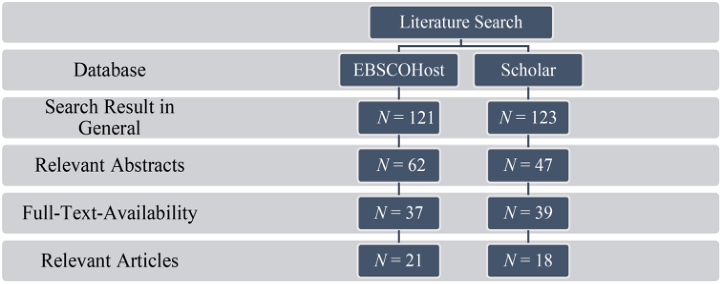
Various keywords were used in the database EBSCOhost to conduct the lit- erature review and to develop the model. For EBSCOhost published English peer-reviewed publications (scientific articles, dissertations) from the last 24 years (since 2000) were included in the literature review. Concerning the database, we have not made any restrictions, as the field of CP can span many areas. The keywords or phrases Citizen Participation or Public Participation and Urban Planning should be included in the title. The keyword Satisfac- tion should be at least included in the text. The literature search process is illustrated in Figure 1.
The abstracts of the resulting publications were then screened for content and rated as relevant or non-relevant. Relevant publications either contained
Power to the Citizens: Factors Fostering Satisfaction With Citizen Participation 99
possible models to explain CP or examined factors that had an effect on participation or satisfaction with CP. In addition, a digital library of relevant papers was compiled via Google Scholar throughout the NUMIC2.0 study period. This digital library contains 123 publications to date. The papers contained were also screened for relevance for the preparation of this paper. In the next step, all the publications (EBSCOHost & Scholar) were reviewed to eliminate redundant records.
Figure 1: Schematic illustration of the literature review process.
RESULTS
A total of 39 research papers were identified to address the research inquiry. Among these, ten publications were classified as literature reviews, offering insights into potential influencing factors, determinants, or previous models of CP. Of the 39 relevant publications, five utilized case studies to eluci- date the advantages and disadvantages of various participatory approaches. Notably, only one of these case studies specifically explored satisfaction within the context of neighborhood or housing satisfaction. Furthermore, 23 articles employed questionnaires and interview studies to investigate fac- tors affecting CP, willingness to participate, or the assessment of its quality. Additionally, one article provided recommendations for implementing public participation initiatives.
Factors Influencing CP Based on the conducted literature review different classification schemes of factors influencing citizens’ satisfaction with and willingness to take part in CP could be identified. For instance, Liu et al. (2018) differentiate between project, process, and public factors, which are relevant for suc- cessful outcomes. Ianniello et al. (2019) categorized context, organizational arrangements, and process factors influencing participatory effectiveness. On the other hand, Migchelbrink et al. (2022) identified personal characteristics, process characteristics, organizational structures, and contextual features as influential in participatory processes.
The subsequent section will organize the primary findings of the research outcomes and describe the identified factors in more detail.
100 Kreusslein and Günther
Participation Level A common classification of participation level addresses information, delib- eration, and collaboration (Rohr, 2014). Informative procedures furnish participants with information but confer limited decision-making power. Deliberative processes, on the other hand, foster communication, discussion, and opinion formation, affording participants greater influence. Collabo- rative processes emphasize concrete cooperation and joint solution-finding through activities such as research, analysis, and design. Brown et al. (2013) found that substantive planning decisions significantly influence participant satisfaction, overshadowing procedural aspects. Participants often perceived community consultation as tokenistic, doubting their ability to influence decisions and the incorporation of community values. Günther et al.’s (2023) real-world laboratory study revealed that citizens express more favorable attitudes towards participatory events offering opportunities for co-decision compared to those focused on collaborative solution development only. Nonetheless, the timing of involvement, as well as the interplay of timing, level, and format, might have been influential factors here. Hence, it is relevant to select the suitable level of participation based on contextual fac- tors, and the temporal aspects of participation as well as the demographic characteristics of users.
Time of Participation The implications drawn from prior research suggest that early involvement is advantageous and should be consistently prioritized (Baxter et al., 2022; Günther et al., 2023; Ianniello et al., 2019). However, we have not yet found a solid scientific basis or empirical studies that systematically and comprehensively compare the timing of participation.
Participation Format Flexible formats are recommended for CP to involve various stakeholders in the process of CP depending on the context, including public hear- ings, advisory committees, and immersive methods like web mapping and gaming (Baxter et al., 2022; Günther et al., 2023; Ianniello et al., 2019; Mayekiso et al., 2023). Evans-Cowley (2010) suggests leveraging the inter- net for CP, emphasizing hybrid approaches that combine online and in- person interactions for enhanced engagement. Combining multiple formats prevents negative influences on participation. In particular, immersive for- mats such as web mapping tools, virtual worlds, and gaming, compared to non-immersive ones possessing sensory (audiovisual), imaginative (role- playing), or challenge-based (problem-solving) characteristics, can empower citizens to better visualize urban planning content (Gibson et al., 2011). This can lead to citizens almost merging with planning ideas and promoting perspective-taking.
Accessibility of Information In some studies, the accessibility of information regarding planning pro- cesses has been identified as a significant influencing factor on CPs (Blanchet-Cohen, 2015; Raveau et al., 2022; Yani et al., 2017). The availabil- ity of project-related information is indispensable (Lou et al., 2022). Further,
Power to the Citizens: Factors Fostering Satisfaction With Citizen Participation 101
it is suggested to disseminate information across various media for trans- parency (Abas et al., 2023). The more transparency, the more satisfied the participants should be, in particular, concerning the level of co-determination, project progress and the distribution of project funds (Bryson et al., 2012; Luo et al., 2022; Mbithi et al., 2018; Naidoo et al., 2018, Yani et al., 2017). According to Lou et al. (2022), the most preferred communication approach was internet platforms due to their convenience and timesaving nature, suggesting the need to leverage these platforms and explore emerging technologies like virtual reality to encourage greater public participation.
Responsiveness and Involved Actors Jin et al. (2018) found that CP enhances neighborhood satisfaction, but meaningful impact requires power redistribution. To achieve this, institution- alizing participation teams (Ernest, 2023) and involving representatives, like steering committees, in planning is essential. Collaborative co-production processes, as advocated by Rosen et al. (2019), leverage the potential of CPs to address power dynamics and foster inclusive involvement. However, Morrison et al. (2016) note challenges due to a prevailing “experts know best” mentality, hampering CP when citizens lack awareness of their rights and information channels.
Sociodemographic Factors Sociodemographic factors such as age, occupation, and income were found to significantly influence levels of CP in infrastructure planning (Dai et al., 2022; Namano et al., 2015; Panyavaranant et al., 2023; Raveau et al., 2022). In fact, participation is highest among young adults and older men. Middle-aged adults (25–44) participate less frequently, presumably due to their life situation (i.e. parenthood, employment). In terms of gender, it can be seen that it is mainly men who take part, which is related to the “classic” distribution of roles. Further cultural differences concerning dif- ferent ethnic groups can be found (Bernstein et al., 2008; Naidoo et al., 2018). Panyavaranant et al. (2023) showed that residential location, age, occupation, and income significantly influenced high levels of participa- tion according to Arnsteins Ladder (1969; citizen power), while age and occupation affected medium-level participation (tokenism).
Norms and Control Beliefs Most commonly the norm activation model (NAM; Schwartz, 1977) and the theory of planned behavior (TPB; Ajzen, 1991) were used to explain par- ticipation (e.g. Lou et al., 2022; Ma et al., 2022; Yang et al., 2020). Ma et al. (2022) proposed a combination of both models: the integrated TPB NAM model. Personal and subjective norms were found to be influential in enhancing participation willingness. The more resources and opportuni- ties individuals perceive they have in the CP, the more elevated their sense of behavioral control becomes. Yang et al. (2020) also identified subjective norms alongside internal responsibility, external pressure, and private norms as influencers of public participation.
102 Kreusslein and Günther
Government Trust and Responsiveness Trust seems to play a central role in investments (Brown et al., 2013; Bryson et al. 2012; He et al., 2022; Ma et al., 2022; Mannarini et al., 2010). The more trust in the relevant bodies and actors involved, the more satisfied the participants are in the end with the result of the participation, regardless of the outcome of the participation. Further, the perceived governmental support is a significant influencing factor of CP (Raveau et al., 2022). In addition, trust and the accessibility or responsiveness of those responsible are linked. Rapid responsiveness in turn has a positive influence on participation in future participations (Mbithi et al., 2019; Sjoberg et al., 2007).
Perceived Benefits Multiple articles stress the importance of maintaining a favorable cost-benefit balance in investments, aiming for benefits to outweigh costs (Dai et al., 2022; Mannarini et al., 2013; Mannarini et al., 2010). These benefits extend beyond monetary gains to intellectual advancements. For instance, work- shops and deliberative sessions on urban planning processes can enhance knowledge acquisition. Moreover, studies show that CP in such initiatives fosters community cohesion and efficacy in decision-making (Foster-Fishman et al., 2008; Mannarini et al., 2013; Mannarini et al., 2010). Participa- tion facilitates connections with stakeholders and neighbors (Namano et al., 2015; Neidhart, 2005), underlining the significance of inclusive planning and stakeholder engagement.
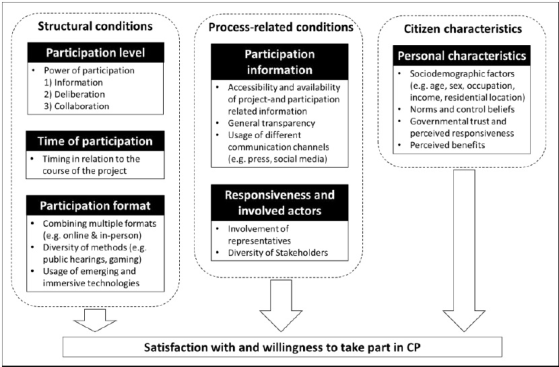
A Working Model to Investigate CP From the literature research, we identified and clustered the following factors affecting satisfaction with CP in 1) structural conditions including participa- tion level, time of participation, and participation format, 2) process-related conditions including participation information as well as responsiveness and involved actors, and 3) personal characteristics (see Figure 2).
Figure 2: Working model of determinants to investigate CP.
Power to the Citizens: Factors Fostering Satisfaction With Citizen Participation 103
In terms of participation level, we assume that citizen participation tran- scending mere informational dissemination, necessitating deliberation and collaboration, correlates with heightened levels of participation satisfaction. The literature shows that particularly early involvement in planning projects is desirable and can lead to more satisfaction. Thus, the timing has an impact on the level of involvement. Regarding participation format, a dichotomy exists between analogue (e.g. citizen consultation hours, residents’ meet- ings, face-to-face surveys) and digital (e.g. online meetings, virtual reality visualization, online voting) methods. Diverse flexible methodologies may enhance efficiency, while also facilitating benefits for various user groups. Particularly emphasized are formats that highlight planning visualization and actively engage citizens, prioritizing them over methods solely convey- ing informational content without visual aids. Immersive techniques, such as virtual reality, exhibit considerable potential to enhance participation and satisfaction.
Regarding to process-related factors, the level of satisfaction with citi- zen participation is expected to increase proportionally with the accessibility and availability of information as well as the transparency of opportunities for influence, access to resources, and understanding of the consequences of proposed changes. This requires a two-way exchange of feedback and communication between citizens and project managers. The responsiveness from project managers toward citizen input correlates with higher satisfac- tion levels and ensures that participation is not perceived merely as a “pro forma”-event.
Concerning personal characteristics of the citizens involved, it is estab- lished that well educated middle-aged men are notably predisposed to engage in CPs. This inclination is commonly attributed to the traditional allocation of roles. For the other individual attributes, the literature focused on norms, control beliefs, trust, and perceived benefits.
CONCLUSION
Urban planning significantly influences citizens’ quality of life, necessitat- ing their active involvement (Baxter et al., 2022; Mannarini et al., 2010). This study aims to identify factors affecting citizen satisfaction in urban planning participation, synthesizing literature to develop a model applicable. Various models have been proposed to describe CP. However, these mod- els often neglect citizen satisfaction with participation, which affects future participation willingness (Jin et al., 2018; Mannarini et al., 2013).
The following considerations stem from the conceptual framework. CP should ideally transcend a mere informational approach to foster sub- stantive participation, thereby diminishing the impression of “pro forma”- engagement. Early transparency mitigates distrust in the process and enhances citizen satisfaction. Engaging citizens from the beginning yields greater benefits and added value compared to involvement at later stages. Negative perceptions included failure to reduce conflict, enhance trust, and base decisions on consensus. While participants were satisfied with certain aspects like information accessibility, dissatisfaction often stemmed from plan
104 Kreusslein and Günther
outcomes. The content of CPs should be easily locatable, as the costs associ- ated with an extensive search for relevant information should be minimized. Therefore, it is imperative for administrations to keep their websites up-to- date and easily accessible without barriers. Additionally, social media plat- forms have gained importance in the past decade. Many citizens do not seek information separately on the city’s website but rather utilize embedded infor- mation on social media channels. This, in turn, facilitates accessibility. The integration of immersive technologies is recommended. Personal attributes continue to exert a significant influence on participation. It is imperative to consider established standards and anticipate advantages and disadvantages when engaging stakeholders. The implementation of all these considerations entails significant coordination and communication costs, which should not burden planners but rather be managed by external individuals possessing expertise in citizen participation. These experts play a mediating role in facilitating effective communication and coordination between citizens and project managers.
Although the empirical evaluation of the working model is still pend- ing, the proposed model serves as a foundation upon which planners within administrative bodies can determine the structure and the implementation of various participatory processes.
ACKNOWLEDGMENT
This paper is based on parts of the research project NUMIC2.0, which is being funded by the Federal Ministry of Education and Research. The authors alone are responsible for the content.
REFERENCES
Abas, A., Arifin, K., Ali, M. A. M., & Khairil, M. (2023). A systematic literature review on public participation in decision-making for local authority planning: A decade of progress and challenges. Environmental Development, 100853. Alexander, E. (2008). Public participation in planning—a multidimensional model:
The case of Israel. Planning Theory & Practice, 9(1), 57–80. Ajzen, I. (1991). The theory of planned behavior. Organizational behavior and human decision processes, 50(2), 179–211. Arnstein, S. R. (1969). A ladder of CP. Journal of the American Institute of planners,
35(4), 216–224. Baum, H. S., Neil, J. S., & Paul, B. B. (2001). CP International Encyclopedia of the Social & Behavioral Sciences Baxter, S., Barnes, A., Lee, C., Mead, R., & Clowes, M. (2023). Increasing public par-
ticipation and influence in local decision-making to address social determinants of health: A systematic review examining initiatives and theories. Local government studies, 49(5), 861–887. Bernstein, A. G., & Norwood, R. S. (2008). Ethnic differences in public participation: The role of conflict communication styles and sense of community. Journal of Intercultural Communication Research, 37(2), 119–138. Blanchet-Cohen, N. (2015). Igniting CP in creating healthy built environments:
The role of community organizations. Community Development Journal, 50(2), 264–279.
Power to the Citizens: Factors Fostering Satisfaction With Citizen Participation 105
Bienzeisler, B., Martinetz, S. & Günther, M. (Eds.). (2022). Was Bürgerinnen und Bürger bewegt – Handbuch für eine partizipative Mobilitätsgestaltung. Fraun- hofer IAO. Stuttgart, Deutschland. doi: 10.24406/publica-140. Box, R. (1998). Citizen governance: Leading American communities into the 21st
century. Thousand Oaks, CA: Sage Publications. Brown, G., & Chin, S. Y. W. (2013). Assessing the effectiveness of public participation in neighbourhood planning. Planning Practice and Research, 28(5), 563–588. Bryson, J. M., Quick, K. S., Slotterback, C. S., & Crosby, B. C. (2013). Designing
public participation processes. Public administration review, 73(1), 23–34. Callahan, K. (2007). CP: Models and methods. International Journal of Public Administration, 30(11), 1179–1196. Coglianese, C. (2003). Is satisfaction success? Evaluating public participation in reg-
ulatory policymaking. The Promise and Performance of Environmental Conflict Resolution. Rosemary O’Leary & Lisa Bingham Ed. Dai, L., Han, Q., de Vries, B., & Wang, Y. (2022). Exploring key determinants of willingness to participate in EIA decision-making on urban infrastructure projects. Sustainable Cities and Society, 76, 103400. Epstein, P., Coates, P. and Wray, L. (2006). Results that matter: Improving commu-
nities by engaging citizens, measuring performance, and getting things done. San Francisco, CA: John Wiley & Sons. Evans-Cowley, J., & Hollander, J. (2010). The new generation of public participation: Internet-based participation tools. Planning Practice & Research, 25(3), 397–408. Foster-Fishman, P. G., Pierce, S. J., & Van Egeren, L. A. (2009). Who participates
and why: Building a process model of CP. Health Education & Behavior, 36(3), 550–569. Frecks, L. (2015, May). CP in digital government: A new model identifying levels of expertise and responsibility in collaborations. In Proceedings of the 16th Annual International Conference on Digital Government Research (pp. 167–170). Gordon, E., Schirra, S., & Hollander, J. (2011). Immersive planning: a conceptual
model for designing public participation with new technologies. Environment and Planning B: Planning and Design, 38(3), 505–519. Günther, M., Krems, J. F. (2022). The Liveable City - How Effective Planning for Infrastructure and Personal Mobility Can Improve People’s Experiences of Urban Life. In: Alicja Maciejko (eds) Human Factors in Architecture, Sustainable Urban Planning and Infrastructure. AHFE (2022) International Conference. AHFE Open Access, vol. 58. AHFE International, USA. http://doi.org/10.54941/ahfe1002372 Günther, M., & Kreußlein, M. (2023). Nachhaltige Verkehrs-und Mobilitätsentwick-
lung im Reallabor: Erste Ergebnisse einer transformativen Straßenumgestaltung am Beispiel einer mittleren Großstadt. Journal für Mobilität und Verkehr, (19), 26–35. Günther, M., Martinetz, S., Krems, J. F., & Bienzeisler, B. (2023). Promoting sustainable mobility in communities with CP: Approaches, perspectives and results of a Living Lab in Germany. JCOM, 22(03), N01. https://doi.org/10.22323/2. 22030801. He, A.J., & Ma, L.(2021). CP, perceived public service performance, and trust in gov-
ernment: Evidence from health policy reforms in Hong Kong. Public performance & management review, 44(3), 471–493. Ianniello, M., Iacuzzi, S., Fedele, P., & Brusati, L. (2019). Obstacles and solutions on the ladder of CP: A systematic review. Public management review, 21(1), 21–46.
106 Kreusslein and Günther
Jin, E., Lee, W., & Kim, D. (2018). Does resident participation in an urban regeneration project improve neighborhood satisfaction: A case study of “Amichojang” in Busan, South Korea? Sustainability, 10(10), 3755. Layson, J. P., & Nankai, X. (2015). Public participation and satisfaction in urban
regeneration projects in Tanzania: The case of Kariakoo, Dar es Salaam. Urban, Planning and Transport Research, 3(1), 68–87. Liu, B., Hu, Y., Wang, A., Yu, Z., Yu, J., & Wu, X. (2018). Critical factors of effective public participation in sustainable energy projects. Journal of Management in Engineering, 34(5), 04018029. Luo, Z., Li, J., Wu, Z., Li, S., & Bi, G. (2022). Investigating the Driving Factors of
Public Participation in Public-Private Partnership (PPP) Projects—A Case Study of China. International journal of environmental research and public health, 19(9), 5192. Ma, X., Li, J., Guo, F., Cui, C., Chen, T., Xv, F., & Wang, W. (2022). Study on influence factors of public participation willingness in substation project based on integrated TPB-NAM model. Frontiers in Psychology, 13, 999229. Mannarini, T., Fedi, A., & Trippetti, S. (2010). Public involvement: How to encour-
age CP. Journal of Community & Applied Social Psychology, 20(4), 262–274. Mannarini, T., & Talò, C. (2013). Evaluating public participation: instruments and implications for citizen involvement. Community Development, 44(2), 239–256. Mayekiso, T., Taylor, D., & Maphazi, N. (2013). A public participation model for
enhanced local governance. Africa Insight, 42(4), 186–199. Mbithi, A., Ndambuki, D., & Juma, F. O. (2019). Determinants of public participation in Kenya county governments. Journal of Asian and African Studies, 54(1), 52–69. Migchelbrink, K., & Van de Walle, S. (2022). A systematic review of the literature
on determinants of public managers’ attitudes toward public participation. Local Government Studies, 48(1), 1–22. Miranda, D., Castillo, J. C., & Sandoval-Hernandez, A. (2020). Young citizen’s participation: Empirical testing of a conceptual model. Youth & Society, 52(2), 251–271. Morrison, N., & Xian, S. (2016). High mountains and the faraway emperor: Over-
coming barriers to CP in China’s urban planning practices. Habitat International, 57, 205–214. Naidoo, C., & Ramphal, R. R. (2018). The factors that affect public participation for effective municipal service delivery: A case of ward committees. South African Journal of Industrial Engineering, 29(4), 82–93. Namano, B. W. (2015). Factors influencing public participation in urban planning:
a case of Nairobi Central Ward (Doctoral dissertation, University of Nairobi). Neidhart, M. W. (2005). Participation: A model of individual willingness to participate in the transportation planning process. University of Central Florida. Panyavaranant, P., Lai Nguyen, T. P., San Santoso, D., Nitivattananon, V., & Tsusaka,
T. W. (2023). Analyzing Sociodemographic Factors Influencing CP: The Case of Infrastructure Planning in Khon Kaen, Thailand. Social Sciences, 12(4), 225. Raveau, M. P., Couyoumdjian, J. P., Fuentes-Bravo, C., Rodriguez-Sickert, C., & Candia, C. (2022). Citizens at the forefront of the constitutional debate: Voluntary CP determinants and emergent content in Chile. Plos one, 17(6), e0267443. Rohr, J. (2014, December 18th). Verfahren in der Partizipation. https://www.partizip
Power to the Citizens: Factors Fostering Satisfaction With Citizen Participation 107
Rosen, J., & Painter, G. (2019). From citizen control to co-production: Moving beyond a linear conception of CP. Journal of the American planning association, 85(3), 335–347. Schwartz, S. H. (1977). Normative influences on altruism. In Advances in experi-
mental social psychology (Vol. 10, pp. 221–279). Academic Press. Sjoberg, F. M., Mellon, J., & Peixoto, T. (2017). The effect of bureaucratic responsiveness on CP. Public Administration Review, 77(3), 340–351. Thomas, J. C. (1995). Public Participation in Public Decisions: New Skills and
Strategies for Public Managers. San Francisco: Jossey-Bass. Timney, M. (1998). Chapter titled “Overcoming administrative barriers to CP: Citizens as partners, not adversaries” in Government is Stivers, Camilla and us edited by King, Cheryl Simrell. SAGE Publications: Thousand Oakes, CA. pp. 88–101. Timney, M. (2011). Chapter titled “Models of CP: Measuring engagement and col-
laboration” in Government is us 2.0 edited by King, Cheryl Simrell. M. E. Sharpe: Armonk, NY. pp. 86–100. Wong, S. L., Liu, H. T., & Cheng, L. J. (2011). Elucidating the relationship between satisfaction and citizen involvement in public administration. Public Management Review, 13(4), 595–618. Wu, W. N., & Jung, K. (2016). A missing link between CP, satisfaction, and public
performance: Evidence from the city and county of San Francisco. International Journal of Public Sector Performance Management, 2(4), 392–410. Xu, H., & Zhu, W. (2021). Evaluating the impact mechanism of CP on citizen satisfaction in a smart city. Environment and Planning B: Urban Analytics and City Science, 48(8), 2466–2480. Yani, A. A., Hidayat, A. R., Hans, A., Yunus, A. Y., Tadjang, S., & Agam, A. N. (2017,
November). Measuring quality of citizens’ participation in local development. In International Conference on Administrative Science (ICAS 2017) (pp. 24–28). Atlantis Press. Yang, R., Wa, D., & Xu, K. (2022). Research on the Influence Mechanism of Public Participation in Environmental Governance in the Context of Big Data: Based on the Theory of Planned Behavior and the Norm Activation Model Integrated Analysis Framework. Polish Journal of Environmental Studies, 31(6).
LISTED IN THE AHFE DIGITAL BOOKSTORE CATALOGUE
Explore the complete digital volume
Human Factors in Architecture, Sustainable Urban Planning and Infrastructure
Read this individual research paper free through the original publisher, or explore the full digital proceedings book.
ISBN 978-1-964867-29-8
Explore this ISBN in the AHFE Bookstore ↗Listed in the July 2026 bookstore catalogue; search by ISBN to confirm current availability · Digital book purchase optional