Paulo Maldonado, Pedro Seiça, Ana Margarida Andr, Vera Matos (2023). Inspiration Mining: Exploring Design Research[ers] Strategies Part III. In: Creativity, Innovation and Entrepreneurship. AHFE Open Access, vol. 74, pp. 179–186. https://doi.org/10.54941/ahfe1003320
1 Universidade de Lisboa, Faculdade de Arquitetura, CIAUD – Centro de Investigação em Arquitetura, Urbanismo e Design, Lisboa, Portugal; Universidade de Évora, CHAIA – Centro de História de Arte e Investigação Avançada Évora, Portugal; Universidade de Évora, Escola de Artes, Departamento de Artes Visuais e Design Évora, Portugal ↗
2 Universidade de Évora, Escola de Artes, Departamento de Artes Visuais e Design Évora, Portugal ↗
We know the difficulties inherent to the discovery of a timely research topic, capable of becoming a significant contribution to knowledge and science in Design. The article describes and presents the results of an atypical process of Design research, tested in a Masters in Design. The objectives of the research process under analysis focus on the development of research skills and critical reflection in a collaborative environment of exploration of the (apparently) unknown (i.e. outside the areas of individual comfort), in search of new meanings. The starting point is the exploration of concepts, ideas and themes (inspiration mining) starting with a proposal for curation of reference titles, with the purpose of discovering, through the establishment of relations more or less (im)probable, relationships and conceptual leaps and flashes of inspiration through the ideas with the greatest potential (first in a perspective of divergence and expansion, then in a perspective of convergence and concentration), possible points of interception, new (disruptive) concepts, ideas and unexpected themes inspirers for the individual research project, going through the itinerary – discovery > interpretation > ideation > experimentation > transformation. Starting with a curation of 12 printed reference titles (some of the titles may be lateral to the scientific area of study) plus 2 key titles, the students select and use (for 60 minutes) 6 reference titles of their choice, identifying and registering, under the form of a mental map and on paper (A3), 18 concepts, ideas and themes (3 per title). They then elaborate an analytical index of the 18 concepts, ideas and themes and depart to relate and discuss 9 of the 18 concepts, ideas and themes. The process culminates in the construction of a distinctive narrative originating in the 9 concepts, ideas and themes (in the form of text and ideographic). The result of the process is translated into a document in the form of a scientific article that can use the new media as a communication support and can be supported by artifacts (images) that contextualize the discourse. The research environment is an incubator of possible futures for design research, testing innovation through content curation, collaboration and connectivity, supported by the inspirational collaborative and interactive intelligence platform - inspædia (www.inspaedia.com). Rapid prototyping of possible ideas for research topics among participants (inspired cultural provocateurs) coach, prepares and transforms educated thinkers into highly educated thinkers to be innovation. This article (Part 3) presents a synthesis of the selected works developed by the students in the current academic year (2022-2023).
We know the difficulties inherent to the discovery of a timely research topic, capable of becoming a significant contribution to knowledge and science in Design. The starting point is the exploration of concepts, ideas and themes - Inspiration Mining – starting with a proposal for curation of reference titles, with the purpose of discovering, through the establishment of relations more or less (im)probable, relationships and conceptual leaps and flashes of inspi- ration through the ideas with the greatest potential (first in a perspective of divergence and expansion, then in a perspective of convergence and concen- tration), possible points of interception, new (disruptive) concepts, ideas and unexpected themes inspirers for the individual research project. The research environment is an incubator of possible futures for design research, testing innovation through content curation, collaboration and connectivity. Rapid prototyping of possible ideas for research topics among participants (inspi- red cultural provocateurs) coach, prepares and transforms educated thinkers into highly educated thinkers to be innovation.
DESIGN AS LANGUAGE: AN INTERPRETATION OF DESIGN PROJECTS AS CULTURAL COMMUNICATORS BY PEDRO SEIÇA In the social imaginary, language is a set of spoken and written words; howe- ver, it is believed that the structure of a language goes beyond such definition, it being a set of signifiers and meanings present in a culture and accepted by those who belong to it. This text, in addition to breaking with an aforementi- oned idea, aims to interpret the design project as a set of signifiers accepted in a medium, and therefore, question whether it can be interpreted as non-verbal language.
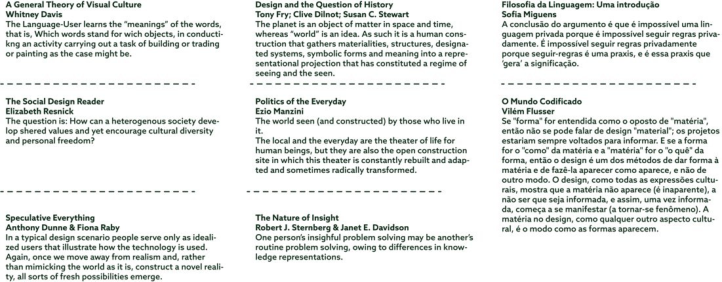
The author Whitney Davis, when outlining a theory of visual culture, makes use of the ideas of the philosopher Ludwig Wittgenstein to demon- strate how the meaning of signs is something socially constructed and an agreement between individuals “The Language-User learns the “meanings” of the words, that is, which words stand for which objects, in conducting an activity carrying out a task of building or trading or painting as the case might be.” (Davis, 2017). Therefore, it is seen that language is a collective and social construction. Thus - still based on Wittgenstein’s philosophy - it is stated that “a private language is impossible because it is impossible to follow rules pri- vately. It is impossible to follow rules privately because following rules is a praxis, and it is this praxis that ‘generates’ meaning.” (Miguens, 2007).
So, the collective acceptance of certain signs and their meanings build human communication and corroborate the construction of an artificial world where everyone from the same culture is inserted, and as the designer Ezio Manzini says: “The world seen (and constructed) by those who live in it. The local and the everyday are the theatre of life for human beings, but they are also the open construction site in which this theatre is constantly rebuilt and adapted and sometimes radically transformed.” (Manzini, 2019). By accepting that different signs communicate to the individual in a society, the role of the designer in its different instances is seen as central in non-verbal communication.
Inspiration Mining: Exploring Design Research[ers] Strategies Part III 181
Figure 1: Design as language: an interpretation of design projects as cultural commu- nicators. Books selection.
Philosopher Vilém Flusser says that the role of the designer is to inform matter, since “if form is the “how” of matter and “matter” is the “what” of form, then design is one of the methods of giving form to matter and making it appear as it appears, and not otherwise. Design, like all cultural expressions, shows that matter does not appear (it is inapparent), unless it is informed, and thus, once informed, it begins to manifest itself (to become a phenomenon). The matter in design, like any other cultural aspect, is the way shapes appears (Flusser, 2017). In other words, it is only through the work of the designer that amorphous matter comes to mean a collective of individuals.
In this way, the importance of the designer as a manipulator of signs in favour of communication can be noted. It is worth mentioning that such signs are not created by the professional, but perceived by him and reformulated in artificial representations, thus: “The planet is an object of matter in space and time, whereas “world” is an idea. As such it is a human construction that gathers materialities, structures, designated systems, symbolic forms and meaning into a representational projection that has constituted a regime of seeing and the seen.” (Fry et al., 2015).
Once the role of design as a language has already been discussed, it is also necessary to speculate about a projector that uses signs alien to the society for whom it communicates. Designers Dunne e Raby say that, when someone designs without t trying to mimic the world you are in “construct a novel reality, all sorts of fresh possibilities emerge.” (Dunne & Raby, 2013). Thus, when the designer looks beyond the visual language in which he is inserted, he can have innovative ideas at different stages of the project. In the words of psychologists Sternberg and Davidson: “One person’s insightful problem solving may be another’s routine problem solving, owing to differences in knowledge representations.” (Sternberg & Davidson, 1996).
Finally, it can be concluded that the designer has an important role in soci- ety as a communicator by manipulating the signs present in the artifacts, and such signs, once they are understood by a group of individuals, can be seen as non-verbal language. Experiences where one tries to break with the artificial world of signs are valid for awakening new ideas and enabling innovations,
however, the designer must always be careful with such a practice, due to the fact that other societies may already have such signs and interpret them as offensive or inappropriate. And so, he must always ask himself: “How can a heterogenous society develop shared values and yet encourage cultural diversity and personal freedom?” (Resnick, 2019).
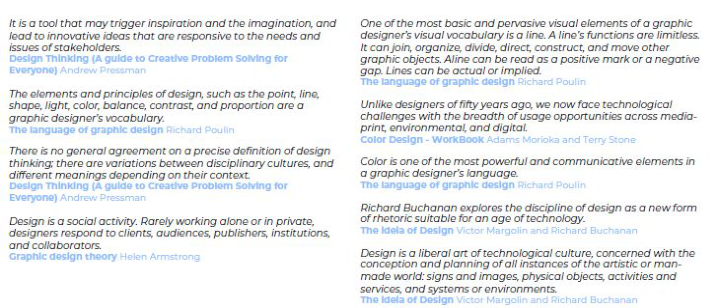
THE ERA OF TECHNOLOGY AND GRAPHIC DESIGN BY ANA MARGARIDA ANDRÉ Man’s first forms of dialogue were through visual elements. Before they developed the capacity to express themselves through spoken language, they used parts of their bodies to express their desires and concerns, which over time became models of communication. For many years, man has solved various problems, innovated, and modified means to adapt human life to technologies. Currently, design appears as a means of uniting distinct conce- pts, technology and art. “Design is a liberal art of technological culture, concerned with the conception and planning of all instances of the artistic or man-made world: signs and images, physical objects, activities and services, and systems or environments.” (Margolin & Buchanan, 1996), this way of thinking of design, was focused on identifying human problems and designing solutions efficiently of technology.
“Unlike designers of fifty years ago, we now face technological challenges with the breadth of usage opportunities across media-print, environmental, and digital.” (Adams, Stone, & Morioka, 2008). Designers as professionals use their skills in collaboration with others in order to achieve real ideas and to delineate the difference in a world that is constantly changing and evo- lving, and with the evolution of technologies, design no longer belongs only to the physical world, but also the digital world. “Richard Buchanan explo- res the discipline of design as a new form of rhetoric suitable for an age of technology.” (Margolin & Buchanan, 1996). The age of technology allowed for the evolution of graphic design, including the advancement of society and its needs, such as company, brand, and product identity. With these technological advances, design began to present indispensable and useful tools and fundamentals.
Figure 2: The era of technology and graphic design. Books and citations selection.
Inspiration Mining: Exploring Design Research[ers] Strategies Part III 183
In graphic design, having notions of the fundamentals is crucial. It com- municates through forms and functions, by intervention of relevant and appealing messages, with the goal of communicating ideas through visual resources. Although the concept of graphic design is closely associated with the visual identities of brands, it is also used in other contexts, including as a form of artistic expression.
The fundamentals of design are the basis of all visual media and graphic design. “The elements and principles of design, such as the point, line, shape, light, colour, balance, contrast, and proportion are a graphic designer’s voca- bulary.” (Poulin, 2012), they are always present in design, as in drawings, illustrations, and graphic elements such as textures and patterns.
Their communication is accomplished through the use of images, text and illustrations that are evenly distributed by applying the fundamentals of design. “One of the most basic and pervasive visual elements of a gra- phic designer’s visual vocabulary is a line. A line’s functions are limitless. It can join, organize, divide, direct, construct, and move other graphic objects. Aline can be read as a positive mark or a negative gap. Lines can be actual or implied. “ (Poulin, 2012).
In addition to line, “Color is one of the most powerful and communica- tive elements in a graphic designer’s language.” (Poulin, 2012). A designer visually communicates his products and to do this, it is necessary to gather knowledge about the languages, tools, processes, and concepts of design, designing functional solutions and aesthetic appeal through visual communi- cation. Knowledge of the fundamentals is important because, with a simple notion of the concept of line and colour, it is possible to transmit a concrete idea.
“Design is a social activity. Rarely working alone or in private, designers respond to clients, audiences, publishers, institutions, and collaborators” (Armstrong & Lupton, 2012), as tools rarely work alone to complete a pro- ject. Each person, regardless of area, can do their work and collaborate for the whole. In this way, everyone will be on the same page and willing to find innovative solutions for each project. By including this knowledge in our thinking, it improves substantially. Our critical sense and the way we look at design problems.
“There is no general agreement on a precise definition of design thinking; there are variations between disciplinary cultures, and different meanings depending on their context.” (Pressman, 2018), according to each language, its reinterpretation and reorganization.
Better saying, the evolution of technology, allowed design to become “It is a tool that may trigger inspiration and the imagination, and lead to innovative ideas that are responsive to the needs and issues of stakeholders.” (Pressman, 2018).
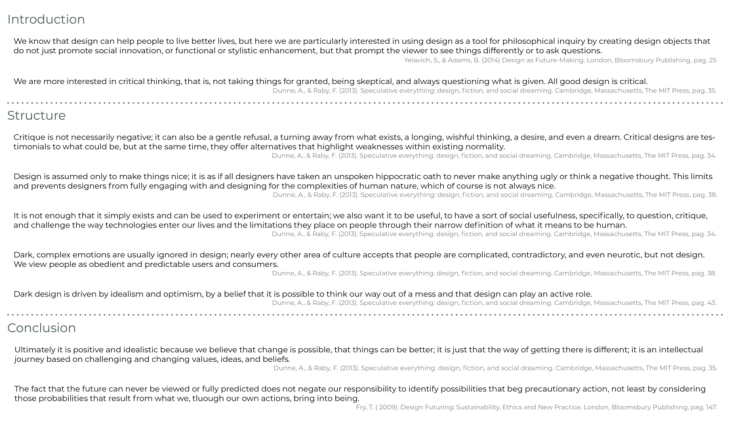
(UN)CRITICAL BY VERA MATOS “We know that design can help people to live better lives, but here we are particularly interested in using design as a tool for philosophical inquiry by creating design objects that do not just promote social innovation, or
Figure 3: (Un)Critical. Books selection and visual narrative structure.
functional or stylistic enhancement, but that prompt the viewer to see things differently or to ask questions.” (Yelavich & Adams, 2014). Asking questions and being interested in the deeper meaning of everyday life and how we inte- ract with the world makes us think about it critically, it’s not being sceptical or negative, it’s questioning everything in a reasonable way, trying to be and do better every day and doing so with empathy not only for those we have in mind but for everyone. “We are more interested in critical thinking, that is, not taking things for granted, being sceptical, and always questioning what is given. All good design is critical.” (Dunne & Raby, 2013).
Being critical of the Oxford Dictionary, citing the definitions that applies in this study, is either expressing adverse or disapproving comments or jud- gements; or expressing or involving an analysis of the merits and faults of a work or even our work. “Critique is not necessarily negative; it can also be a gentle refusal, a turning away from what exists, a longing, wishful thinking, a desire, and even a dream. Critical designs are testimonials to what could be, but at the same time, they offer alternatives that highlight weaknesses within existing normality.” (Dunne & Raby, 2013). Expressing adverse or disapproving comments does not need to be negative in any shape or form, it’s thinking externally, even about our work, about the points in which we need to improve, it’s thinking about the topic or work with an open mind not about approaching it with prior judgments that will limit our changes of growing those topics or works. It’s falling out of the trend of making things only beautiful or functional, it’s questioning the normality to start thinking about the extraordinary. “Design is assumed only to make things nice; it is as if all designers have taken an unspoken Hippocratic oath to never make anything ugly or think a negative thought. This limits and prevents designers from fully engaging with and designing for the complexities of human nature, which of course is not always nice.” (Dunne & Raby, 2013). Critical design
Inspiration Mining: Exploring Design Research[ers] Strategies Part III 185
it’s not only doing / creating something, but also thinking of how we can change the weaknesses of that same normality and trying to expose the flaws of that normality. We need to be critical to better the world, as designers it’s not only our job, but it should also be the way that we experience and interact with the world, our way of living.
As human beings, since the last century, we have grown not to adapt to technology, we have conformed to it. We diminished our capabilities as a society and started to think more individually. We, as society, have stopped thinking about our lives critically, we started to take what we were told as truth without thinking about the repercussions that our actions could cause; or worse, we haven’t thought about the repercussions those decisions could have for future generations and how they interact with the world. “It is not enough that it simply exists and can be used to experiment or entertain; we also want it to be useful, to have a sort of social usefulness, specifically, to question, critique, and challenge the way technologies enter our lives and the limitations they place on people through their narrow definition of what it means to be human.” (Dunne & Raby, 2013). The fact that most people have a narrow and subjective definition of what means to be human and don’t want to keep an open mind or think about their definition in a critical way, considering different hypothesis, makes us stagnate / settle in our ways. As individuals in a society, we can make and help those around and near us think critically through debates and conversations that instigate strong emotions, but as designers we can reach much larger groups. Emotions are the easy way to affect others and receive a reaction / comments / form of criticism from someone, although dark, negative, and complex emotions, or a mixture of both positive and negative emotions that instigate doubt are the best way to make someone deal with something and think about it in a critical way. “Dark, complex emotions are usually ignored in design; nearly every other area of culture accepts that people are complicated, contradictory, and even neurotic, but not design. We view people as obedient and predictable users and consumers.” (Dunne & Raby, 2013). As designers we try every day to look around a try to see it in the future, try to predict it, always cautious of our actions and its effects on society. Although, sometimes, trying to have a premeditated negative reaction making the viewer / user aware of something. That’s the reaction we want as designers, we want to create / reinvent something that instigates strong emotions so that it stays with the viewer / user, that way they don’t only buy it but also think about it, and then they start to talk about it with their friends, family and other people creating a debate. As designers we must stop thinking about people as obedient and predictable because that’s not our condition as human being, we are complex, everyone with different believes and ways of thought process, we are more complicated than most want to admit but at the same time we can be so simple, guided by our emotions and the same pursuits in life. That’s why designing with emotions, negative or not, is driven by a need of change, affect, and to have a specific effect on others, designing with emotions will often reach a way larger group of people independently of the initial emotion we wanted to cause. “Dark design is driven by idealism and optimism, by a belief
that it is possible to think our way out of a mess and that design can play an active role.” (Dunne & Raby, 2013).
“Ultimately it is positive and idealistic because we believe that change is possible, that things can be better; it is just that the way of getting there is different; it is an intellectual journey based on challenging and changing values, ideas, and beliefs.” (Dunne & Raby, 2013). As designers, creators and thinkers we need to believe and imagine, if we conform ourselves only to what society wants, be it a product or something else, we can never reach our full potential. In design, being that all good design is critical, we have the power to create change not only through the products we make but also through the way people think, searching in what we think / predict might be the future to do so. It’s part of our responsibility due to the change we want to generate. “The fact that the future can never be viewed or fully predicted does not negate our responsibility to identify possibilities that beg precautionary action, not least by considering those probabilities that result from what we, through our own actions, bring into being.” (Fry, 2009).
ACKNOWLEDGMENT
Our acknowledgements to CIAUD – Centro de Investigação em Arquitetura, Urbanismo e Design, CHAIA – Centro de História de Arte e Investigação Artística and Universidade de Évora, Portugal.
REFERENCES
Adams, S., Stone, T., & Morioka, N. (2008). Color Design Workbook: A Real World Guide to Using Color in Graphic Design (First Edition). Rockport Publishers. Armstrong, H., & Lupton, E. (2012). Graphic Design Theory: Readings from the
Field. Amsterdam University Press. Davis, W. (2017). A General Theory of Visual Culture. Princeton University Press. Dunne, A., & Raby, F. (2013). Speculative everything: design, fiction, and social dreaming. Cambridge, Massachusetts, The MIT Press. Flusser, V. (2017). O Mundo Codificado. Editora. Fry, T. (2009). Design Futuring: Sustainability, Ethics and New Practice. London,
Bloomsbury Publishing. Fry, T., Dilnot, C., & Stewart, S. (2015). Design and the Question of History.
Bloomsbury Publishing. Manzini, E. (2019). Politics of the Everyday. Bloomsbury Publishing. Margolin, V., & Buchanan, R. (1996). The Idea of Design (1st Edition). The MIT Press. Miguens, S. (2007). Filosofia da Linguagem: Uma introdução. Faculdade de Letras
da Universidade do Porto. Poulin, R. (2012). The Language of Graphic Design: An Illustrated Handbook for Understanding Fundamental Design Principles. Macmillan Publishers. Pressman, A. (2018). Design Thinking: A Guide to Creative Problem Solving for
Everyone. Routledge. Resnick, E. (2019). The Social Design Reader. Bloomsbury Publishing. Sternberg, R., & Davidson, J. (1996). The Nature of Insight. The MIT Press. Yelavich, S., & Adams, B. (2014) Design as Future-Making. London, Bloomsbury Publishing.
LISTED IN THE AHFE DIGITAL BOOKSTORE CATALOGUE
Explore the complete digital volume
Creativity, Innovation and Entrepreneurship
Read this individual research paper free through the original publisher, or explore the full digital proceedings book.
ISBN 978-1-958651-50-6
Explore this ISBN in the AHFE Bookstore ↗Listed in the July 2026 bookstore catalogue; search by ISBN to confirm current availability · Digital book purchase optional