Dorothea Liehr, Isabel Kreißig, Jakob Siegmund, Susanne Creutz, Hendrik Meißner, Josef Krems (2024). Do You Know What’s Going On? – Examining Situation Awareness for Different Communication Concepts of an E-Cargo Bike Autonomous Parking Function. In: Human Interaction and Emerging Technologies (IHIET-AI 2024): Artificial Intelligence and Future Applications. AHFE Open Access, vol. 120, pp. 325–335. https://doi.org/10.54941/ahfe1004583
Offering the opportunity to comfortably carry heavy load, e-cargo bikes are an environmentally friendly alternative to motor vehicles. Especially in urban areas, where e-cargo bikes contribute to resolve challenges like noise pollution and limited space, there is an increasing number of sharing-systems that offer users the option of renting powerful e-cargo bikes without having to buy them. In this context, an automation of the e-cargo bike return process might further enhance the convenience and time-efficiency of the rental process. However, for such a highly automated function, a need for communication between the autonomously operating vehicle and the user may arise, for instance for providing feedback about the successful completion of parking. Users moreover need to develop an accurate awareness of the situation to prevent misinterpretations and to ensure a safe interaction with the autonomous function. In this regard, research on automated cars has found external Human-Machine Interfaces (eHMIs) to be a possible solution to communicate relevant information between traffic participants in situations where implicit driving cues from the vehicle’s trajectory are not sufficient. The aim of the current study was to investigate the effects of three different communication concepts for an autonomously parking cargo e-bike in a one-factorial between-design laboratory study. A total of N = 26 participants were randomly assigned to 3 experimental groups and watched videos presenting either (1) a visual communication concept (via light bands on the handlebar), (2) an auditory communication concept (via signal tones), or (3) a concept without additional signals (via movements of the e-cargo bike). The videos demonstrated typical return situations at the rental station, where the e-cargo bike should transmit information to the user via the different signals. According to an adapted version of the Situation Awareness Global Assessment Technique (SAGAT), the videos were freezed at certain points in the parking process. During each freezing, participants were interviewed regarding their Situation Awareness based on the three levels (perception, comprehension, and prediction). For each level of Situation Awareness, participants’ statements were compared with the expectation of the correct interpretation of the parking situation. Results of the qualitative analysis reflected a better understanding of the situation for the communication concepts containing explicit communication cues, particularly concerning the second (comprehension) and third (prediction) level of situation awareness. The visual and auditory communication concepts were correctly interpreted by the participants. For the first level of Situation Awareness including the perception of objects, signals and movements, results did not considerably differ between communication concepts. However, the communication concepts incorporating additional cues (visual, auditory) achieved better results in terms of comprehending the situation (level 2) and predicting future states (level 3) compared to the condition without eHMI. Overall, participants’ answers regarding the visual communication concept was mostly consistent with the expectations. In sum, results imply that eHMIs have the potential to enhance users’ Situation Awareness of the autonomous parking of e-cargo bikes, whereas cues from the vehicle’s movements alone might be not sufficient. The results of this study suggest potential design options for eHMIs for autonomous e-cargo bike parking and identify the need for further research.
The e-cargo bike is an environmentally friendly alternative to motor vehi- cle usage, offering the user motorized assistance and expanded storage space. Especially in urban areas, its usage contributes to current challenges by reduc- ing noise pollution and saving space. In the “SteigtUM”-project, funded by the German Federal Ministry of Education and Research (grant num- ber 16SV8273), a sharing system involving e-cargo bikes is being developed. Users can rent the powerful e-cargo bikes and therefore could avoid the high acquisition costs. For a time-efficient and comfortable return, an autonomous parking function has been developed in the scope of the project. During the process of vehicle return, this function provides an autonomous drive of the e-cargo bike into the sharing box, manoeuvring in the right position for inductive charging, starting the charging process, and completing the pro- cess of return. For vehicle automation, also if only implemented for certain manoeuvres, it is important to develop communication concepts that ensure a safe and efficient interaction between the user and the autonomous vehi- cle (i.e. e-cargo bike; Rasouli and Tsotsos, 2018). In this regard, situations may arise in which an exchange of information between the e-cargo bike and other traffic participants is necessary. An inadequate communication could lead to critical situations for users or an impairment of road safety. A lot of research has been conducted about this issue in the field of automated cars in recent years (Dey et al., 2020b). For conventional traffic environments, com- munication between road users takes place via implicit (vehicle movements) and explicit signals (e.g. turn signals or hand gestures). Purely implicit signals cannot always be correctly interpreted by other road users (Oberfeld-Twistel et al., 2021). In research on automated cars, external Human-Machine Inter- faces (eHMIs) have been found to be a useable solution for such situations. Autonomous vehicles can communicate indications and messages to other road users via eHMIs (Baumann et al., 2021). Moreover, several studies showed a positive impact of eHMIs, for instance on trust or acceptance for automated cars (Faas et al., 2020, Hensch et al., 2022). However, so far, to our knowledge, there have been very few published research investi- gating the effects of eHMIs for automated functions of e-cargo bikes. For this reason, we examined three different communication concepts for the autonomously parking e-cargo bike: (1) a visual communication concept (via light bands on the handlebar), (2) an auditory communication concept (via signal tones), and (3) a concept without additional signals representing implicit communication (via movements of the e-cargo bike). For a suc- cessful interaction between users and autonomous e-cargo bike functions, the correct interpretation of the designed communication concepts and con- clusions for the immediate development of the traffic scene is of utmost importance. In traffic psychology, this issue is examined using the concept of Situation Awareness (SA, Endsley, 1988), which reflects the degree of users’ perception, understanding and anticipating future states of the traf- fic situation. In the current contribution, we investigated the three different communication concepts with regard to SA during autonomous e-cargo bike return.
Do You Know What’s Going On? 327
EXTERNAL HUMAN-MASCHINE INTERFACES In the design of human-machine interfaces, different sensory channels could be used for information exchange. Visual or auditory eHMIs are most suit- able for the autonomous parking process of the e-cargo bike (Kopka & Krause, 2021) and also most often used in the context of automated cars (Dey et al., 2020b). For visual eHMIs, a variety of design options could be implemented, for instance text messages, light bars, but also symbols or icons. Abstract eHMIs (especially light bands) are most frequently used in autonomous contexts with the advantage that no language skills are required (Schieben et al., 2018) and having been shown to be assessed as useful, trustworthy and acceptable in communicating between automated cars and pedestrians (e.g., Hensch et al., 2022; Faas et al., 2020). If AVs are to benefit from eHMIs, they must be consistent with movements (Hensch et al., 2022). Various studies of light perception, based on visibility, and uniqueness, found that turquoise, among other colours, is a suitable colour for the communi- cation of AVs in traffic, since this colour has no specific relevance in road traffic and is therefore considered neutral (Hensch et al., 2022). Auditory eHMIs can be divided into verbal and nonverbal auditory eHMIs (Schieben et al., 2018). Although verbal auditory eHMIs can convey concrete informa- tion, such as “stop” or “drive” to the receiver, they however require language skills and are hard to perceive over long distances (Dey et al., 2020b). Thus, nonverbal auditory cues, such as sounds and tones, seem to be more suitable in this regard (Schieben et al., 2018). There is some research comparing the effects of visual and acoustic eHMIs in different contexts leading to mixed results (Dey et al., 2020b). In the context of autonomous e-cargo bikes, a study by Kopka & Krause (2021) was conducted in which the e-cargo bike asks people for help. Here, the use of visual eHMIs had no influence on the willingness to help. For acoustic eHMIs, an electronically generated voice turned out to be recommendable. However, most of the studies are in the field of autonomous cars. Bindschädel et al. (2023) investigated acoustic eHMIs in the field of autonomous cars and pedestrians and found positive effects of eHMIs in terms of a higher sense of safety and a desired action. A study conducted by Avetisyan et al. (2022), in relation to automated vehicles found that purely visual signals are evaluated better compared to auditory ones. In sum, when designing auditory or visual signals, it is important that they are understandable and interpretable for the user (Dey et al., 2020b), and thus contribute to an appropriate SA When interacting with automated tech- nology. In this regard, the current study contributes by evaluating different communication concepts, involving a visual and an acoustic eHMI as well as a concept without additional cues.
SITUATION AWARENESS SA is a crucial construct, especially in humans’ interaction with automa- tion, which involves three stages establishing a correct understanding of the environment (Endsley, 1988): (1) perceiving relevant situation components from the immediate environment (SA level I), (2) understanding the per- ceived situation components (SA level II), and (3) predicting future events (SA level III). Thus, SA as an appropriate understanding and interpretation of
what is going on in the situation is an important precondition of a safe and efficient interaction with automated functions and systems. Inadequate or erroneous perception may occur when inadequate representation is present (Sen et al., 2020). Especially in the context of interacting with automated driving functions, the concept of SA is specifically relevant, enabling the user to understand and predict the current traffic situation and thus selecting adequate actions. Since implicit signals are not always sufficient for com- prehensible communication and to gain a high level of SA, eHMIs can help to develop an appropriate understanding of the situation in automated driv- ing (Faas et al., 2020). A lack of SA can lead to inappropriate actions or to refrain from necessary active actions (Lindner, 2016). In the study by Sen et al. (2020), subjects were shown different movements of robots and the individual SA was examined. The third SA level (prediction) showed signif- icant differences between the different movements of the robots. To date, research about the effects of eHMIs on SA in the field of automated driving is rather scares. In this context, the current study contributes to gain knowl- edge by exploring the effects of different communication concepts on users’ SA during autonomous e-cargo bike return.
METHODS
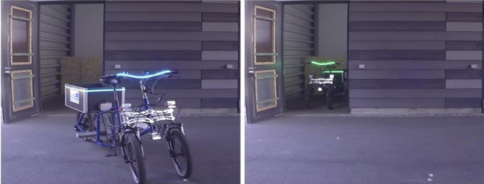
We conducted a laboratory study to investigate three communication con- cepts with regard to their effects on SA applying an adaptation of the Situation Awareness Global Assessment Technique (SAGAT). In order to pre- vent learning effects, we applied a one-factorial between design, dividing the sample into three groups with n = 12 participants, each group per commu- nication concepts. During the autonomous parking process, the e-cargo bike transmits relevant information to the user via the respective communication concept (visual, auditory, motion cues). Table 1 gives an overview about the investigated eHMIs, presented cues and the intended meaning (for further information see Kreißig et al., 2023). An illustration of the unobstructed parking process with the visual eHMI can be seen in Figure 1. After wel- coming, obtaining consent and first information about the procedure of the study, participants received information about the e-cargo bike sharing sys- tem, the app and the autonomous parking function. Afterwards, participants watched video sequences of the autonomously parking e-cargo bike and were instructed to answer questions about this sequence.
Figure 1: E-cargo bike with the visual communication concept in the begin parking process scenario with turquoise LED band (left) and end parking process with green signal (right).
Do You Know What’s Going On? 329
Table 1. Explanation of the three communication signals in the unified parking process (adapted from Kreißig et al., 2023).
Table available in the original PDF paper.
Action Without eHMI Without eHMI (e-cargo bike movement)
Auditory eHMI (signal tones via speakers)
Visual eHMI (LED strip at handle-bar & cargo box)
5 beep tones
Takeover from manual to autonomous mode
Standstill in front of the sharing station
flashes of the LED strip in turquoise
Standstill in the sharing station
3 flashes of the LED strip in green
Sound sequence (4 tones)
Successful completion of the autonomous parking
An adapted version of the SAGAT as a well-established method for assessing SA (Lindner, 2016) was applied for SA examination. SAGAT is a subjective self-rating technique and a tool to assess SA. For this purpose, the investigated process is interrupted at arbitrary points. In our study, we freezed the autonomous parking process at certain meaningful stages by paus- ing the video at defined points of the parking process. SA was evaluated using interview questions adapted from Sen et al. (2020) with a strong relation to the three levels of SA (Endsley, 1988). Participants’ answers in the inter- view were transcribed and categorized according to thematic analysis (Braun & Clarke, 2006). For the qualitative evaluation, we filtered peculiarities in the answers to the questions and included interpretations about the differ- ent communication signals. Based on the codings of participants’ answers in the interview, we calculated the SA score, which is the individual number of correct responses for each SA level based on the participants’ statements and their correspondence to the expected responses according to the presented situation (Table 2).
Table 2. Expected statements from the participants for each SA level.
Table available in the original PDF paper.
SA level Scenario start parking process I Perception of the e-cargo bike, the sharing station; for eHMIs additionally: the turquoise light bar (visual eHMI), the beeping (auditory eHMI). II Understanding that the parking process is about to begin and the e-cargo bike will start moving autonomously. III Prediction that the e- cargo bike is about to start driving. The user should keep distance and watch the parking process.
Scenario end parking process I Perception of the e-cargo bike stopping in the charging box; for eHMIs additionally: light bar changes from turquoise to green flashes (visual eHMI), sequence of tones (auditory eHMI). II Understanding that the parking process is completed. III Prediction that contactless charging process can begin. The user could move away from the sharing station.
Participants A total of n = 36 subjects participated in the study, amongst them n = 17 women, n = 18 men and n = 1 diverse. Subjects had a mean age of n = 26.5 years (SD = 6.4; Min = 18; Max = 48 years) and were mostly highly educated
(53% university degree, 36% abitur, 11% secondary school). Regarding visual and hearing impairment, 61.1 % (n = 22) of the subjects stated that they did not need a visual aid. Less than half of the subjects, 38.9% (n = 14), needed a visual aid. Of these, 8.3% (n = 3) used contact lenses and 30.6% (n = 11) used glasses. Only 4.6% (n = 2) stated that they had a hearing impairment, which was corrected by individual setting volume.
RESULTS
Participants’ SA scores for each scenario and communication concept are depicted in Table 3, exemplary statements from the qualitative content analy- sis can be seen in Table 4. In the scenario start parking process, the averaged SA score for the visual communication concept reached M = 87% repre- senting a rather good match with the expected statements. For the auditory communication concept, M = 85% of the statements and for the communica- tion concept without signals M = 79% matched. Thus, for the first scenario, the visual communication concept achieved on average the highest percent- age across all SA levels with highest scores for comprehension and prediction. When looking at the individual SA levels, differences get obvious. In SA level I (perception), all eHMIs achieved high scores, with the communication con- cept without signals producing the highest score (M = 92%). All participants described the visual and auditory signals. For SA level II (comprehension), we observed the highest scores for the visual and auditory eHMI (M = 92%) compared to a rather low score for the concept without eHMI (M = 62%). As can be seen in the statements in Table 4, the subjects were able to conclude from the signals that the e-cargo bike will begin to move autonomously. For the communication concept without signals, participants only stated that the e-cargo bike was in front of the garage.
Table 3. Averaged SA scores for the three communication concepts per SA levels (perceive, understand, predict) and for each communication concept.
Table available in the original PDF paper.
Scenario SA-level Without eHMI Visual eHMI Auditory eHMI M [%] SD M [%] SD M [%] SD
begin parking process I 92 19 90 21 89 22 II 83 39 92 28 92 39 III 62 13 79 20 73 25 total 79 15 87 7 85 10 End parking process I 83 19 81 18 83 22 II 75 45 85 38 83 39 III 31 24 46 29 38 27 total 63 28 71 10 68 26 Note. 12 participants per group
Interview data revealed that both eHMIs were interpreted correctly as “start signal”. In the case of the communication concept without signals, some subjects did not draw this conclusion (Table 4, P27b). SA level III (pre- diction) showed the highest value for the visual eHMI with M = 79%. In the condition without eHMI, the participants often required feedback and
Do You Know What’s Going On? 331
referred to the app, with which the autonomous parking progress was ini- tiated. For some participants, the misunderstanding arose that the parking process had not yet begun (P27b, Table 4). For the auditory communication concept, very few participants mentioned that they would maintain distance from the e-cargo bike, this statement was made more frequently in the visual eHMI. Overall, we observed rather high scores for SA levels I for all and for SA level II for both eHMI communication concepts. The concept with- out additional cues received the lowest scores in SA levels II and III due to misinterpretation in terms of incorrect start of the parking process.
In the second scenario (end parking process), the visual communication concept similarly reached the highest scores on average (M = 71%). For SA level I,all communication concepts achieved more or less equal SA scores. The visual eHMI (M = 85%), however, reached higher scores, followed closely by the auditory eHMI for SA level II. The explicit signals were correctly interpreted as the end signal of the parking process. This conclusion was drawn by less subjects in the communication concept without signals. For SA level III, scores were rather low in comparison to all reported scores. In this regard, interview data revealed that only very few participants predicted that the charging process was ended, and users could leave the charging station. Nevertheless, again the visual eHMI reached highest SA scores (M = 46%). Participants’ statements regarding the communication concept without addi- tional signals during the interviews revealed that many subjects required any kind of additional feedback from the system (Table 4).
Table 4. Subjects’ exemplary interview statements for each SA level (perception, comprehension and prediction) and communication concept.
Table available in the original PDF paper.
Visual eHMI Auditory eHMI Without eHMI Scenario start parking progress
“It will start to drive backwards, which I guess from the sound, and try to park in the sharing box.”(P5a)
“Next, it will move backwards with the aim of parking there.” (P9b) “It is in front of the garage.” (P27 b)
SA level II “By the fact that the lights are flashing, I assume that it is to indicate that it is now in autonomous state and will soon start the parking process.” (P22v)
“I think I would take a few steps away from the bike and wait and see.” (Interview 35a) “I guess it will start moving now and park.” (P14a)
SA level III “I would stand next to it and watch what happens, with a certain safe distance.” (Interview 25v) “Then I would guess it would pull into that little garage and park there to recharge.” (P13v)
“I would try it again if it would park again and would push it in the app, and see if it works and then, at some point, I would take the bike and just push it in.” (P27b)
Scenario end parking progress
“The e-cargo bike has driven a bit further into the station.” (P33b)
SA level I “This time the handlebars and the stripe on the pedelec flash green instead of blue and so like yes now I have arrived.” (P28v)
“When it is docked at the charging station it played a melodic sound, which should then certainly signal, I’m right in and I’m charging now.” (P20a)
Continued
Table 4. Continued Visual eHMI Auditory eHMI Without eHMI
Table available in the original PDF paper.
“The situation is driving backwards.” (P33b)
SA level II “It has just finished parking and I think it signaled that it was ready by flashing green.” (P31v)
“There was the signal, which sounded like okay, now it’s just ready, now it’s really parked.” (P23a)
“I would now still wait if I get any feedback.” (P24b)
SA level III “The fact that the signal is green tells me that everything is okay and it is probably in the charging state, I would go.” (P25v)
“I would have watched again but at the end there was this end signal again, so I would assume that it is the end signal and I would now think that you have now been informed that it has worked and that it is now at the charging station.” (P35a)
Note. P = participants
DISCUSSION AND CONCLUSION The objective of this study was to evaluate three different communication concepts (visual, auditory, and e-cargo bike movements) for the interaction between autonomous e-cargo bikes and the user with regards to SA. For this purpose, the autonomous parking process was presented to the participants as videos and SA was evaluated using an adaptation of the SAGAT method.
A basic result was that across all three SA levels, the visual communication concept was found to reach highest SA scores. Furthermore, the communi- cation concept without additional signals corresponds with lowest scores. Thus, obtained results point in the direction that SA benefits from added cues supplementary to the e-cargo bike’s movements, especially for higher SA levels representing the understanding of the actual situation and pre- dicting future states. In this regard, obtained results underline effects found by Avetisyan et al. (2022) in the automobile context. While participants in the condition without eHMI expressed their need for additional feedback, they were predominantly able to correctly interpret that the parking process had been successfully completed in conditions with eHMI. For visual signals, this result is in line with earlier findings revealing that based on experience and traffic education users associate “everything is okay” with green col- oring (Kopka & Krause, 2021), which might have been the case here, too. Observed results for the starting scenario were quite similar. Most partici- pants were able to deduce from the explicit signals that the e-cargo bike was beginning to drive autonomously and had successfully completed the parking process. Especially for the higher levels of SA (comprehension and predic- tion), the communication concept without signals resulted in lower scores. Statements throughout the interviews suggested that subjects misinterpreted the situation in terms of errors during the initiation of the parking process. This suggests that the movements of the e-cargo bike alone are not sufficient to convey information to the users and additional feedback (e.g., in terms of eHMIs) is needed. This is strongly supported by the fact that some subjects
Do You Know What’s Going On? 333
explicitly asked for additional signals in this condition. This picture is fur- thermore supported by Kreißig et al. (2023) who evaluated the same signals and scenarios of autonomously e-cargo parking regarding users’ assessments. Their results consistently revealed a clear ranking of the communication con- cepts with highest trust, acceptance, user experience and perceived safety for the visual followed by the auditory eHMI. Users’ ratings for the condition without additional concepts revealed considerable concerns implying a need for additional communication signals for the investigated scenarios. More- over, the observed higher values in the visual and auditory communication model for higher SA levels are consistent with the results of Fricke (2009), which showed that the use of additional cues has a beneficial effect on SA. An exception was SA stage I (perception), where the eHMI with motion was close to the other communication concepts. The similar results indicate that not all objects in the situation (e-cargo bike and garage) were not seen or not explicitly mentioned. For the third level of SA (predictions), the partici- pants generally showed rather clearly reduced values across communication concepts. This points in the direction that participants might had difficulties to predict future events on the basis of the presented situation. A possible explanation might be the fact that the higher levels of SA have a higher level of mental workload (Avetisyan et al., 2022).
For the interpretation of the results, certain limitations of the study have to be mentioned. In this regard, it is necessary to mention the study’s con- figuration involving an artificial video arrangement. Although this offers a safe and efficient opportunity for a first evaluation of the autonomously e-cargo bike parking situation, the external validity of the results is there- fore restricted and future research should investigate, how potential users evaluate communication concepts in a field study-setup. Besides, the SAGAT method as a subjective tool depends strongly on the design of the scenes and the concrete questions asked as well as on participants’ ability to verbalise their thoughts and interpretations, which is not an easy task. A combina- tion with behavioural measures, such as gaze data, might be valuable in this regard. Furthermore, the clips only partially depict the complexity and dynamics of the everyday, actual parking situation which might be reason why, for instance, a rarely mentioned subsequent action was to step back at the beginning of the parking process (SA level III). Since the focus of the present study was on the comparison of the different communication con- cepts, the experimental setup did not include a joint or combined presentation of the auditory and visual cues (Dey et al., 2020b). Such an implementation lends itself in the next step to an additional comparison of the combination of both communication concepts.
To conclude, in line with earlier research (Kreißig et al., 2023) results of the current study underline the need for additional cues for the investigated e-cargo bike parking scenario leading to higher SA and purely implicit sig- nals are not sufficient to create an appropriate level of situational awareness. With respect to rather low scores for the highest SA level representing the anticipation of future states, the concrete design of the investigated eHMIs might be revised.
ACKNOWLEDGMENT
This study was part of the BMBF-funded project SteigtUM (grand number: 16SV8273). We would like to thank our project partner Technische Univer- sität Bergakademie Freiberg, especially Norman Seyffer for programming the Wizard of Oz autonomous parking function as well as Thomas Fürstner, Jim Gerschler and Florian Tischner for preparing the e-cargo bike. We further like to thank Tina Morgenstern for her valuable support in the project.
REFERENCES
Avetisyan, L., Ayoub, J., & Zhou, F. (2022). Investigating explanations in conditional and highly automated driving: The effects of situation awareness and modal- ity. Transportation research part F: traffic psychology and behaviour Volume 89, pp. 456–466. Baumann, M., Helmer, M., & Neumann, C. (2021). Lichtbasierte Kommunikationss-
chnittstelle zwischen Fahrzeug und Fußgänger im automatisierten Straßenverkehr: Was muss sie leisten und wie könnte sie aussehen? 15. Internationales Forum für den lichttechnischen Nachwuchs, 04.–06. Juni 2021, Ilmenau: Tagungsband, pp. 9–22. Bindschädel, J., Weimann, P., & Kiesel, A. (2023). Using eHMI, acoustic signal, and pitch motion to communicate the intention of automated vehicles to pedestrians: A Wizard of Oz study. Transportation Research Part F: Traffic Psychology and Behaviour Volume 97, pp. 59–72. Braun, V., & Clarke, V. (2006). Using thematic analysis in psychology. Qualitative
Research in Psychology Volume 3 No. 2, pp. 77–101. Dey, Debargha. Habibovic, Azra. Löcken, Andreas. Wintersberger, Philipp. Pfleging, Bastian. Riener, Andreas. Martens, Marieke and Terken, Jaques. (2020). Taming the eHMI Jungle: A Classification Taxonomy to Guide, Compare, and Assess the Design Principles of Automated Vehicles’ External Human-Machine Interfaces, Transportation Research Interdisciplinary Perspectives Volume 7. Endsley, M. R. (1988). Design and evaluation fort situation awareness enhancement.
Human Factors Society annual meeting Volume 32 No. 2, pp. 97–101. Faas, Stefanie M. Mathis, Lesley-Ann and Baumann, Martin. (2020). External HMI for Self-Driving Vehicles: Which Information Shall Be Displayed? Transpor-Tation Research Part F: Traffic Psychology and Behaviour, 68. Fricke, N. (2009). Gestaltungzeit-und sicherheitskritischer Warnungen im Fahrzeug,
Doctoral dissertation, Institute of Psychology and Ergonomics. Hensch, A.-C., Kreißig, I., Beggiato, M., & Krems, J. (2022). The Effect of eHMI Malfunctions on Younger and Elderly Pedestrians’ Trust and Acceptance of Automated Vehicle Communication Signals. Frontiers in Psychology Volume 13, p. 272. doi: 10.3389/fpsyg.2022.866475. Kreißig, I., Morgenstern, T., Krems, J. F. (2023). Blinking, Beeping or Just Driving?
Investigating Different Communication Concepts for an Autonomously Park- ing E-Cargo Bike From a User Perspective. Human Interaction and Emerging Technologies 2023 Volume 70, pp. 57–67. Kopka, M., & Krause, K. (2021). Can You Help Me? Testing HMI Designs and Psychological Influences on Intended Helping Behavior Towards Autonomous Cargo Bikes. Mensch und Computer 2021, pp. 64–68. Lindner, T. (2016). Entwicklung einer Methodik zur Erfassung des Situationsbe-
wusstseins an Arbeitsplätzen in elektronischen Stellwerken und Betriebszentralen, Doctoral dissertation, Technical University Braunschweig.
Do You Know What’s Going On? 335
Oberfeld-Twistel, D., Wessels, M., Kröling, S. (2021) Risiko hohe Beschleunigung?
Straßenquerungsverhalten von Fußgänger: innen in Interaktion mit E-Fahrzeugen (mit und ohne AVAS) im Vergleich zu Verbrennern. Gesamtverband der Deutschen Versicherungswirtschaft e. V. Rasouli, Amir and Tsotsos, John K. (2018). Joint Attention in Driver-Pedestrian Interaction: Theory to Practice. 2018, arXiv:1802.02522. Schieben, Anna. Wilbrink, Marc. Kettwich, Carmen. Madigan, Ruth. Louw, Tyron
and Merat, Natasha. (2018). Designing the Interaction of Automated Vehicles with Other Traffic Participants: Design Considerations Based on Human Needs and Expectations, Cognition, Technology & Work, 21. Sen, S., Buxbaum, H. J., & Kremer, L. (2020). The Effects of Different Robot Trajectories on Situational Awareness in Human-Robot Collaboration. International Conference on Human-Computer Interaction, pp. 719–729.
LISTED IN THE AHFE DIGITAL BOOKSTORE CATALOGUE
Explore the complete digital volume
Human Interaction and Emerging Technologies (IHIET-AI 2024): Artificial Intelligence and Future Applications
Read this individual research paper free through the original publisher, or explore the full digital proceedings book.
ISBN 978-1-958651-96-4
Explore this ISBN in the AHFE Bookstore ↗Listed in the July 2026 bookstore catalogue; search by ISBN to confirm current availability · Digital book purchase optional