Ann-Christin Hensch, Matthias Beggiato, Sarah Mandl, Anja Strobel, Josef Krems (2022). The interplay of personality traits with drivers’ gap acceptance. In: Human Factors in Transportation. AHFE Open Access, vol. 60, pp. 329–337. https://doi.org/10.54941/ahfe1002464
1 Chemnitz University of Technology, Department of Psychology, Cognitive and Engineering Psychology, Wilhelm-Raabe-Strasse 43, 09107 Chemnitz, Germany ↗
2 Chemnitz University of Technology, Department of Psychology, Personality, Psychology and Assessment, Wilhelm-Raabe-Strasse 43, 09107 Chemnitz, Germany ↗
3 Chemnitz University of Technology, Department of Psychology, Personality Psychology and Assessment, Wilhelm-Raabe-Strasse 43, 09107 Chemnitz, Germany ↗
To support road safety and user acceptance, the interaction capabilities of automated vehicles (AVs) need to be intuitive and transparent. Therefore, established interaction capabilities of manual drivers need to be implemented in AVs. In manual driving, accepted time gaps (gap acceptance, GA) are frequently applied to coordinate interactions between traffic participants. Various driver characteristics, such as age, were shown to influence GA. However, little research considered the influence of driver personality traits on GA. Therefore, the current online study investigated the effect of drivers’ sensation seeking and big five personality traits (i.e., agreeableness, extraversion, conscientiousness, openness, and neuroticism) on GA. The applied video material displayed an intersection scenario with approaching interaction partners encountering from the left of the drivers’ perspective. A total of 121 participants contributed to the study. The findings showed a significant effect for participants’ sensation seeking on GA. Participants scoring higher in sensation seeking accepted smaller time gaps resulting in riskier decisions for the turning maneuvers than participants scoring lower in sensation seeking. Moreover, the results revealed a significant difference in GA regarding participants’ agreeableness. Participants scoring higher in agreeableness indicated larger time gaps to initiate turning maneuvers (i.e., more cooperative interactions) than participants scoring lower in agreeableness. There was no effect for extraversion, conscientiousness, openness, and neuroticism on GA. To support the user acceptance of automated driving functions, differences in driving style preferences related to personal characteristics should be considered in AVs (e.g., by offering selectable driving style profiles).
Automated driving is supposed to increase road safety as well as traffic effici- ency and driving comfort (SAE 2018). However, automated driving functions need to be applied by human drivers to fully exploit the benefits of automated vehicles (AVs; SAE Level 3 or higher; SAE 2018). To support the accepta- nce of AVs and provide smooth encounters with manual traffic participants, the human-machine interaction should be of particular interest in automated
driving. Therefore, established communication capabilities of manual traf- fic participants could serve as a common ground in AVs (Markkula et al. 2020). A common ground could simplify and smoothen the interactions between traffic participants by enhancing the transparency and predictabi- lity of prospective movements (Clark and Brennan 1991). In manual driving, traffic participants use explicit (e.g., turn indicator) and implicit (e.g., vehi- cles’ trajectory) communication cues to interact (Schieben et al. 2019). These interactions are coordinated by accepted time gaps to surrounding traffic par- ticipants (e.g., to initiate a driving maneuver; Summala 2007). Accepted time gaps (i.e., gap acceptance; GA) are influenced by situational factors (e.g., approaching speed; Petzoldt et al. 2017) but also by personal characteristics (e.g., age; Beggiato et al. 2018). Therefore, GA can be seen as one parame- ter of individually varying driving styles (Summala 2007). Driving styles can be described as a stable aspect of behavior that is shown while driving and varies between individuals. The concept comprises individual preferences for speeds, headway distances, or headway times (for an overview see Sagberg et al. 2015) and should also be considered in AVs’ driving styles to support the users’ acceptance of automated driving functions (Hartwich et al. 2018).
With regard to individual driving styles, sensation seeking is a frequ- ently investigated personality trait in manual driving (for an overview see Jonah 1997). The concept can be described as the willingness for taking risks and the need for new, varying, and complex experiences and sensations (Zuckerman 1994). In the driving context, sensation seeking is associated with a risky driving behavior such as high velocities or shorter headway distances to surrounding traffic participants compared to non-sensation see- kers (Jonah 1997). For instance, sensation seekers preferred shorter headway distances when following lead traffic in manual driving than non-sensation seekers (Heino et al. 1996). Moreover, the big five personality traits (i.e., agreeableness, extraversion, conscientiousness, openness, and neuroticism; McCrae and John 1992) were shown to be connected to diverse driving sty- les (e.g., agreeableness was shown to be related to a polite and calm driving style; Taubman-Ben-Ari and Yehiel 2012). In general, the personality trait agreeableness is related to being cooperative; the tendency to be careful is incorporated by the trait conscientiousness. While extraversion includes the tendency to be sociable; openness is related to being sensitive; and neuroti- cism refers to the tendency of being anxious and impulsive (McCrae and John 1992). The relation between the big five personality traits and pedestrians’ gap acceptance was investigated in a road-crossing scenario by Kalantarov et al. (2018). While the traits agreeableness, conscientiousness, and openness were related to larger accepted time gaps to the approaching traffic (i.e., a less risky crossing behavior), there was no significant relation between extra- version and accepted time gaps. However, neuroticism was related to smaller accepted time gaps leading to a riskier behavior while crossing (Kalantarov et al. 2018).
Since personality traits are related to different driving styles, these prefe- rences also need to be considered in AVs to support the users’ acceptance and intention to use automated driving functions (e.g., by selectable driving style profiles that include respective driving parameters, such as GA). So far,
The Interplay of Personality Traits with Drivers’ Gap Acceptance 331
only a small number of studies considered the influence of driver personality traits on GA. Therefore, the current study assessed the influence of drivers’ (a) sensation seeking and (b) big five personality traits on accepted time gaps to initiate left-turn maneuvers in front of different approaching interaction partners encountering with different speeds.
METHOD
Research Design A 4 x 4 within-subject design was applied in the current online study. The study used real-world video material that included four interaction partners (passenger car, motorcycle, scooter, and bicycle) that approached with four different speed levels respectively (10/ 15/ 20 and 25 km/h), which represent the within-subject factors (further details are reported in Hensch et al. 2021). To stabilize the results, each condition was presented twice to the participants in an overall randomized order resulting in a total of 32 trials. Participants’ sensation seeking and big five personality trait scores were applied as cova- riates. As dependent variable, participants’ last accepted time gaps to initiate left-turn maneuvers in front of the approaching interaction partners were assessed.
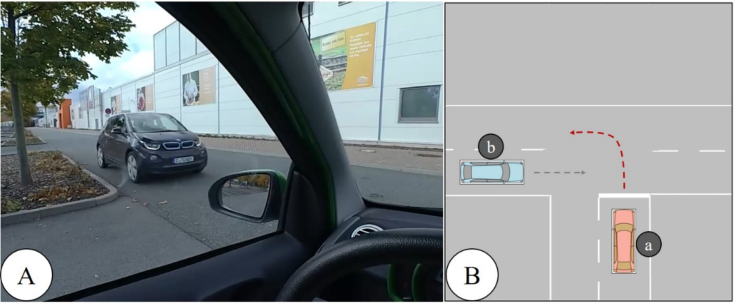
Apparatus and Material The study applied real-world video material from a driver’s perspective (Figure 1) that was recorded by a GARMIN VIRB Ultra 30 (1920 x 1080 pixel, 100 fps). The material displayed an intersection scenario that indica- ted a left-turn maneuver. Four different interaction partners were included in the material. The interaction partners approached from the left of the ego-vehicles’ perspective, thus resulting in a hypothetical overlap of the ego- vehicle’s and the interaction partners’ trajectory (Figure 1). The interaction partners were all driven by the same trained researcher to control for influe- ncing factors such as driving style. The video material exclusively displayed the interaction partners as moving objects that approached with a constant speed of about 15 km/h (i.e., no deceleration or acceleration). To determine the exact speed of the approaching interaction partners, synchronized pro- tocol cameras were placed at fixed distances. The speed of the approaching vehicles was modified afterwards by accelerating or reducing the playback rate of the video material. To achieve full experimental control, including specific instructions, presenting the video material in a randomized order and capture participants’ accepted time gaps precisely in an online format, a simulation environment was programmed in jspsych 6.1.0. The resolution of the video material was edited by Adobe Premiere Pro (1280 x 720 pixels, 30 fps) to present the material in an online format to the participants. In addition, an online questionnaire was applied.
To assess participants’ sensation seeking and big five personality traits (i.e., agreeableness, extraversion, conscientiousness, openness, and neuroticism) standardized questionnaires were applied. The Brief Sensation Seeking Scale
Figure 1: A) Example of the video material displaying the participants’ perspective and the passenger car as one of the investigated interaction partners. B) Recorded left-turn scenario of the study resulting in a hypothetical overlap of the ego-vehicle’s (a) and the approaching vehicles’ (b) trajectory.
(BSSS) by Hoyle et al. (2002) was applied to determine participants’ sensa- tion seeking. The participants indicated their agreement to the eight items on a 5-point Likert scale from [1] ”strongly disagree” to [5] ”strongly agree”. Afterwards, the items were averaged to an overall sensation seeking score (Cronbach’s α = .71). The NEO-FFI-30 (Körner et al. 2008) was used to collect participants’ big five personality traits. The overall scale consisted of 30 items including six items per subscale (5-point Likert scale; [1] ”strongly disagree” to [5] ”strongly agree”). Afterwards, the single items were avera- ged to the respective subscale scores (Cronbach’s α = .66-.86). Higher score values always correspond to a higher extent of the respective personality trait.
Procedure At the beginning of the online study, participants received information about the scope of the study, and informed consent was obtained. To contribute to the study, participants had to hold a valid drivers’ license. Moreover, a minimum screen resolution of 1280 x 720 pixel was required. Participants completed a questionnaire that collected sociodemographic information and personality variables (i.e., sensation seeking and big five personality traits). Afterwards, participants’ GA to initiate left-turn maneuvers at an interse- ction in front of different approaching interaction partners was collected. The participants were instructed to indicate the last time gap when they would initiate a left-turn maneuver by pressing the enter key. Four test trials were presented to the participants to become familiarized with the task. Partici- pants had the opportunity to repeat the test trials if required. Afterwards, 32 trials of data collection followed in a randomized order. The participants did not receive monetary compensation for contributing to the study that lasted about 25 minutes.
The Interplay of Personality Traits with Drivers’ Gap Acceptance 333
Participants A total of N = 127 participants contributed to the study. Due to extreme outliers in GA (i.e., ≥3 interquartile ranges over the third or under the first quartile), n = 6 participants had to be excluded from further analysis. The resulting final sample consisted of n = 121 participants (79 women, 42 men) with a mean age of M = 36 years (SD = 19.48). All of the participants held a valid drivers’ license, which was required for participating in the study.
RESULTS
Participants’ GA (in seconds) was analyzed using repeated measures ANCO- VAs applying the type of the approaching interaction partner and the vehicle speed as within-subject factors (Greenhouse-Geisser corrected F-values and degrees of freedom are reported due to violated assumptions of sphericity). Further results considering the influence of interaction partner and appro- aching speed on participants’ GA are reported in Hensch et al. (2021). Participants’ sensation seeking scores and the big five personality traits served as covariates in the analysis. An overview of the study’s results can be found in Table 1.
The ANCOVA results revealed a significant main effect regarding parti- cipants’ sensation seeking scores on accepted time gaps to initiate left-turn maneuvers in front of different approaching interaction partners (Table 1). To
Table 1. ANCOVA results showing the main and interaction effects across the investigated driver characteristics sensation seeking and big five personality traits and the factors interaction partner and approaching speed on GA.
Note. N = 121. Statistically significant results are highlighted in bold. aGreenhouse-Geisser-corrected F-values and degrees of freedom are reported.
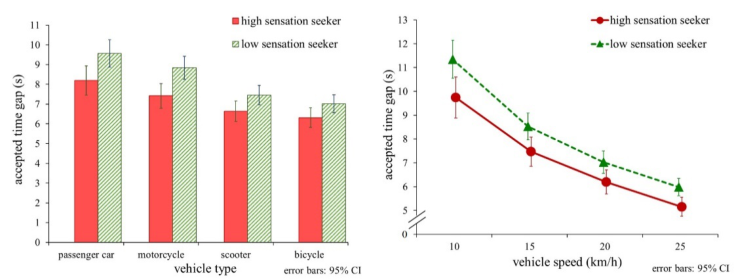
Figure 2: Accepted time gaps in seconds across sensation seeking scores and the type of interaction partners (left) and the speed of the approaching interaction partners (right).
visualize the differences, a median split (cut-off value = 2.88) was conducted on the sensation seeking scores to create two distinct groups of participants scoring higher (N = 56; M = 3.55, SD = 0.44) and participants scoring lower in sensation seeking (N = 65; M = 2.41, SD = 0.36). In detail, participants with higher sensation seeking scores accepted smaller time gaps resulting in riskier decisions to initiate left-turn maneuvers in front of the approach- ing interaction partners (MHigh BSSS = 7.14, SDHigh BSSS = 2.20) compared to participants with lower sensation seeking scores (MLow BSSS = 8.22, SDLow BSSS = 2.14; Figure 2). Moreover, the analysis revealed a significant interaction between participants’ sensation seeking scores and the type of interaction partner regarding GA (Table 1). As Figure 2 displays, the lar- gest differences between the groups in accepted time gaps were found for the passenger car. Whereas, the smallest differences in accepted time gaps between the sensation seeking groups were revealed for the bicycle as an interaction partner. In addition, a significant interaction of participants’ sen- sation seeking scores and vehicle speed was found (Table 1). The differences in GA between the groups decreased with increased speeds of the approaching interaction partner (Figure 2).
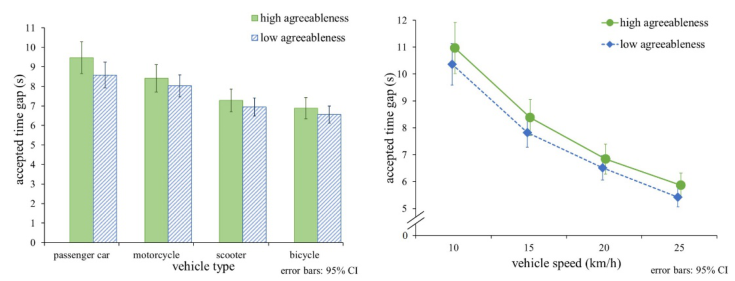
Considering the big five personality traits, a significant main effect was found for participants’ agreeableness scores on GA (Table 1). Again to visu- alize the differences, a median split was conducted to create two distinct groups (cut-off value = 4.00) of participants scoring higher in agreeable- ness (N = 48; M = 4.48, SD = 0.24) and participants scoring lower in agreeableness (N = 73; M = 3.52, SD = 0.42). Participants with higher agreeableness scores selected larger time gaps representing rather coopera- tive interactions (MHigh agree = 8.01, SDHigh agree = 2.15) in contrast to the time gaps that were selected by participants with lower agreeableness scores (MLow agree = 7.53, SDLow agree = 2.26; Figure 3). Moreover, a significant interaction between participants’ agreeableness scores, and interaction par- tner was found (Table 1). The largest differences between the two groups in GA were found for the passenger car, whereas the smallest differences were
The Interplay of Personality Traits with Drivers’ Gap Acceptance 335
Figure 3: Accepted time gaps in seconds across agreeableness scores and the type of interaction partners (left) and the speed of the approaching interaction partners (right).
revealed for both, the scooter and the bicycle (Figure 3). In addition, the analysis revealed a significant interaction effect between participants’ agreea- bleness scores and vehicles’ speed levels (Table 1). The differences in accepted time gaps decreased with higher speed levels up to a speed of 20 km/h of the approaching interaction partner and increased again when the interaction partner approached with a speed of 25 km/h (Figure 3). There were no signi- ficant main or interaction effects revealed for the remaining big five factors (i.e., extraversion, conscientiousness, openness, and neuroticism; Table 1).
CONCLUSION
The current study focused on the influence of drivers’ sensation seeking and big five personality traits on accepted time gaps to initiate left-turn maneuvers as a basis for intuitive interactions in AVs. Therefore, partici- pants indicated their GA to initiate left-turn maneuvers in front of different interaction partners approaching with different speed levels from a driver’s perspective. The findings revealed that drivers’ sensation seeking and agre- eableness as personality traits influenced accepted time gaps as a specific parameter of driving style. In detail, participants scoring higher in sensation seeking accepted smaller and thus riskier gaps to initiate left-turn maneuvers than participants scoring lower in sensation seeking. The results are in line with findings of a field study conducted by Heino et al. (1996), who repor- ted shorter headway distances during a free following task for participants scoring higher in sensation seeking compared to participants scoring lower in sensation seeking. Regarding the effect of the big five personality traits (i.e., agreeableness, extraversion, conscientiousness, openness, and neuroti- cism) on GA, drivers’ agreeableness was shown to influence selected time gaps to initiate left-turn maneuvers. In particular, drivers scoring higher in agreeableness selected larger and thus more cooperative time gaps to initiate left-turn maneuvers in front of the approaching interaction partners than drivers scoring lower in agreeableness. Driver agreeableness was generally shown to be related to an increased polite and calm driving style that com- prises, for instance, anticipating prospective movements of other traffic
participants (Taubman-Ben-Ari and Yehiel 2012). Thus, larger accepted time gaps might be interpreted as a result of increasingly anticipated movements of other traffic participants that allow for advanced proactive and cooperative driving actions such as larger GA. However, despite a statistically significant influence of drivers’ agreeableness scores on GA, the absolute time differe- nces are negligibly small for a practical implementation in AVs. Furthermore, no differences in accepted time gaps considering extraversion, conscientious- ness, openness, and neuroticism could be shown, which is contradicting to previous findings by Kalantarov et al. (2018). The different results might be explained by the different perspectives of the studies (Kalantarov et al. 2018: pedestrians’ perspective vs. current study: drivers’ perspective).
The current study’s findings imply that there is not one single time gap, which is selected as an appropriate gap, to initiate left-turn maneuvers. Rather, accepted time gaps are influenced by situational factors, such as the type or the speed of the approaching interaction partner, personal characteri- stics, such as drivers’ sensation seeking, and a combination of situational and personal factors. The identified time gaps could prospectively be implemen- ted in AVs to support intuitive encounters between AVs and manual traffic participants. To support the users’ acceptance, and thus the usage of auto- mated driving functions, different driving style preferences (i.e., GA as one specific parameter of individually varying driving styles) should be conside- red in AVs. Therefore, it appears advisable to implement selectable driving style profiles in AVs to meet the demands and personal preferences of diffe- rent user groups (e.g., a dynamic driving style that comprises smaller time gaps).
ACKNOWLEDGMENT
The research was funded by the Deutsche Forschungsgemeinschaft (DFG, German Research Foundation – [Project-ID 416228727 – SFB 1410]). We would like to thank Maike X. Schömann for supporting the data acquisition.
REFERENCES
Beggiato, M., Witzlack, C., Springer, S., and Krems, J. F. (2018). The right moment for braking as informal communication signal between automated vehicles and pedestrians in crossing situations. In Stanton, N., ed. Advances in Human Aspects of Transportation. AHFE 2017. Advances in Intelligent Systems and Computing, vol 597. Cham: Springer, pp. 1072–1081. doi: 10.1007/978-3-319-93885-1. Clark, H. H. and Brennan, S. E. (1991). Grounding in communication. In Resnick, L.
B., Levine, J. M., & Teasley, S. D., eds. Perspectives on socially shared cognition. Washington, DC, US: American Psychological Association, pp. 127–149. doi: ht tps://doi.org/10.1037/10096-006. Hartwich, F., Beggiato, M. and Krems, J. F. (2018). Driving comfort, enjoyment and acceptance of automated driving–effects of drivers’ age and driving style familia- rity. Ergonomics, 61(8), pp. 1017–1032. doi: 10.1080/00140139.2018.1441448. Heino, A., Van Der Molen, H. H. and Wilde, G. J. S. (1996). Differences in risk experi-
ence between sensation avoiders and sensation seekers. Personality and Individual Differences, 20(1), pp. 71–79. doi: 10.1016/0191-8869(95)00152-V.
The Interplay of Personality Traits with Drivers’ Gap Acceptance 337
Hensch, A.-C., Beggiato, M., Schömann, X., and Krems, J. F. (2021). Different types, different speeds – The effect of interaction partners and encountering speeds at intersections on drivers ‘ gap scceptance as an implicit communication signal in automated driving. In Krömker, H., ed. HCI in Mobility, Transport, and Automo- tive Systems. HCII 2021. Lecture Notes in Computer Science, vol 12791. Cham: Springer, pp. 517–528. doi: https://doi.org/10.1007/978-3-030-78358-7_36. Hoyle, R. H. Stephenson, M. T., Palmgreen, P., Lorch, E. P., and Donohew,
R. L. (2002). Reliability and validity of a brief measure of sensation seeking. Personality and Individual Differences, 32(3), pp. 401–414. doi: 10.1016/S0191- 8869(01)00032-0. Jonah, B. A. (1997). Sensation seeking and risky driving: A review and synthesis of the literature. Accident Analysis and Prevention, 29(5), pp. 651–665. doi: 10.1016/S0001-4575(97)00017-1. Kalantarov, S., Riemer, R. and Oron-Gilad, T. (2018). Pedestrians’ road crossing
decisions and body parts’ movements. Transportation Research Part F: Traffic Psychology and Behaviour, 53, pp. 155–171. doi: 10.1016/j.trf.2017.09.012. Körner, A., Geyer, M., Roth, M., Drapeau, M., Schmutzer, G., Albani, C., Schumann, S., and Brähler, E. (2008). Personality assessment with the NEO- Five-Factor Inventory: The 30-item-short-version (NEO-FFI-30). Psychosomatik Medizinische Psychologie, 58(6), pp. 238–245. doi: 10.1055/s-2007-986199. Markkula, G., Madigan, R., Nathanael, D., Portouli, E., Lee, Y. M., Dietrich, A., Bil-
lington, J., Schieben, A., and Merat, N. (2020). Defining interactions: a conceptual framework for understanding interactive behaviour in human and automated road traffic. Theoretical Issues in Ergonomics Science, 21(6), pp. 728–752. doi: 10.1080/1463922X.2020.1736686. McCrae, R. R. and John, O. P. (1992). An Introduction to the five-factor model and its applications. Journal of Personality, 60(2), pp. 175–215. doi: 10.1111/j. 1467– 6494.1992.tb00970.x. Petzoldt, T., Schleinitz, K., Krems, J. F., and Gehlert, T. (2017). Drivers’ gap accepta-
nce in front of approaching bicycles – Effects of bicycle speed and bicycle type. Safety Science, 92, pp. 283–289. doi: 10.1016/j.ssci.2015.07.021. SAE International’s new standard J3016. (2018). Levels of driving automation, SAE international. Available from: https://www.sae.org/news/2019/01/sae-upda tes-j3016-automated-driving-graphic. Sagberg, F., Selip, Bianchi Piccinini, G. F., and Engström, J. (2015). A review of
research on driving styles and road safety. Human Factors, 57(7), pp. 1248–1275. doi: 10.1177/0018720815591313. Schieben, A., Wilbrink, M., Kettwich, C., Madigan, R., Louw, T., and Merat, N.
(2019). Designing the interaction of automated vehicles with other traffic partici- pants: design considerations based on human needs and expectations. Cognition, Technology and Work, 21(1), pp. 69–85. doi: 10.1007/s10111-018-0521-z. Summala, H. (2007). Towards understanding motivational and emotional factors in driver behaviour: Comfort through satisficing. In Cacciabue, P. C., ed. Modelling driver behaviour in automotive environments: Critical issues in driver intera- ctions with intelligent transport systems. London: Springer, pp. 189–207. doi: 10.1007/978-1-84628-618-6. Taubman-Ben-Ari, O. and Yehiel, D. (2012). Driving styles and their associati-
ons with personality and motivation. Accident Analysis and Prevention, 45, pp. 416–422. doi: 10.1016/j.aap.2011.08.007. Zuckerman, M. (1994). Behavioral expressions and biosocial bases of sensation seeking. New York, NY, US: Cambridge University Press.
LISTED IN THE AHFE DIGITAL BOOKSTORE CATALOGUE
Explore the complete digital volume
Human Factors in Transportation
Read this individual research paper free through the original publisher, or explore the full digital proceedings book.
ISBN 978-1-958651-36-0
Explore this ISBN in the AHFE Bookstore ↗Listed in the July 2026 bookstore catalogue; search by ISBN to confirm current availability · Digital book purchase optional