Mariel Garcia-Hernandez, Fabiola Cortes Chavez, Alberto Rossa-Sierra, Marcela De Obaldia (2022). An Information Design Tool to Reduce Cognitive Load in Older Adults with Chronic Degenerative Diseases During the Anamnesis Exploration Phase in a General Medical Consultation. In: Design for Inclusion. AHFE Open Access, vol. 45, pp. 173–183. https://doi.org/10.54941/ahfe1001883
Publisher statistics will load when you open Metrics.
AHFE OPEN ACCESS OPEN ACCESS CONFERENCE PROCEEDINGS PAPER
An Information Design Tool to Reduce Cognitive Load in Older Adults with Chronic Degenerative Diseases During the Anamnesis Exploration Phase in a General Medical Consultation
During the general medical consultation protocol, there is a clinical exploration phase called anamnesis, which is carried out through an interrogation by the patient's treating physician, where information such as patient identification data, reason for consultation, family history is collected. , personal pathological history and psychosocial history, in order to obtain a retrospective of the patient and determine the relevant family, environmental and personal elements to generate an objective clinical history. However, breaking down the pathological history requires a great cognitive effort on the part of the patient, especially when it comes to older adults who suffer from one or more chronic diseases, which implies having extensive and permanent medical treatments, so it is imperative to generate an information design instrument that serves as a personal database where the patient can enter information about the medical treatment they carry out for their chronic diseases, with the aim of not losing any medication data related to their ailments and being able to transmit this information relevant to the physician during the anamnesis phase. Based on the above, this instrument was developed, taking into consideration the information needs of the doctor and the cognitive characteristics of the elderly, resulting in a type of control sheet to be filled out by the patient and easily delivered to the doctor. To evaluate the effectiveness of this piece of design, a perception test and a PSSUQ questionnaire were implemented for the elderly. This evaluation showed that using this tool reduces the stress of the patient during the consultation and solves the cognitive load that he had to do to transmit said information to his treating doctor.
MEDICAL CONSULTATION: PROTOCOL AND PROCESS FOR OBTAINING INFORMATION The medical consultation is considered as a complex and multidimensional process, focused on the doctor-patient relationship, which aims to provide support in terms of health-disease needs, suffering and uncertainty that a subject has when his or her health is affected. physical, human and/or emoti- onal integrity (Rodriguez, Jarillo and Casas, 2010). There is a protocol that is implemented to develop the medical consultation, which is based mainly on the work of the mental activity that the doctor develops during the execution of the process (f). According to Corona and Fonseca, the following stages can be distinguished in this process: “1) obtaining information, 2) interpreting information and 3) decision making, each of which has a specific objective based on the general objective of the general medical consultation”. Basi- cally, the treating physician obtains the necessary and possible data on the patient and the condition, interprets said data and makes decisions derived from this interpretation in order to be able to determine a diagnosis and a solution. Based on what Rodríguez and Rodríguez establish, during the first stage of the general medical consultation process, the anamnesis is found, which is conceptualized as a clinical examination procedure that is carried out through interrogation to personally identify the individual, know their current ailments, get a retrospective of it and determine the relevant family, environmental and personal elements. This phase is very important, since it is loaded with the collection of data that can establish a history of the dis- ease, as well as pharmacological treatments that the patient is following, in the same way, the time in which he has been in this treatment, for this rea- son , it is important that when questioning the patient, the treating physician must assess the reliability of the informant, the usefulness of the data they will provide and their validity (Besdine, 2019).
The Anamnesis Phase in Older Adults as Patients In the case of a general medical consultation for older adults in the anamnesis phase, it is vitally important to be able to obtain accurate data, since this type of user, according to Besdine (2019), presents “different health problems, often more complex, such as multiple diseases, which may require several drugs (polypharmacy) and a higher probability of prescription of a high- risk drug”. The points to consider according to Besine (2019), Rodriguez and Rodriguez (2019) during the anamnesis phase by the treating physi- cian are the following: previous diseases, pharmacological history, history of alcoholism, smoking and drug addiction, nutritional history, health history mental status, functional status, social history, allergies and intolerances, pre- vious hospitalizations, traumas, previous medical tests, blood transfusions, gynecological and obstetric history (if applicable) and use of prostheses.
Within the anamnesis phase, factors typical of the elderly should be con- sidered, which are: Sensory deficiencies (use of glasses, hearing aids or any device to solve the deficiency), underreporting of symptoms (the patient can confuse the conditions of their aging with symptoms typical of a disease, how- ever no symptoms should be attributed to normal aging according to Besdine
An Information Design Tool to Reduce Cognitive Load in Older Adults 175
(2019)), difficulties in remembering (the patient may not have clarity within their memories about a history of diseases, drug treatment, operations, etc. .), fear of being hospitalized and cognitive disorders (which are very common in patients in this age range, such as depression, poor retention and/or medium and long-term memory disorders.
Due to the conditions mentioned above and the great cognitive load that is for the older adult to remember and specify the information that arises as part of the anamnesis phase, it is not possible to successfully specify what is proposed as information is obtained. valuable to be able to be interpreted and therefore, that the treating doctor extends a diagnosis as accurate as possible. To reduce this margin of error, it is recommended that the elderly patient be accompanied by a close family member who is knowledgeable about said information or, failing that, the care provided by the patient (Rodriguez and Rodriguez, 2019).
INFORMATION DESIGN FOR OLDER ADULTS Based on what is stated in previous sections, it would be beneficial to be able to generate a tool that reduces the cognitive effort of the elderly patient and can give guidelines so that the treating physician can obtain the necessary information from him, in a precise and punctual manner in order to be able to give the best diagnosis of the condition that afflicts the elderly.
The information design aims, as Frascara (2011) puts it, to facilitate the processes of reading comprehension, memorization and use of the infor- mation that is presented. This discipline contemplates conditions such as cognitive and perceptual processes of the user, in addition to profiling the user for whom it is working, taking into account not only demographic and psychographic data, but also the reading situation of the artifact, the emoti- onal condition that it presents in user when interacting with the artifact, the expectations and needs that the user has about it. Information design focu- ses on using scientific knowledge about people’s capabilities and limitations to create designs capitalizing on strengths and capabilities while guarding against limitations. For this reason, it is considered that helping us with this discipline to create a tool that seeks to achieve the objectives that we set out in the previous paragraph could be useful.
When we talk about information design focused on adults, we refer to establishing parameters that focus on the following areas (Fisk et al., 2019): 1) Sensation: It has to do with what visual stimuli evoke in the user, 2) Perce- ption: Conception and classification of these stimuli, 3) Cognition: Process of interpretation and processing of these stimuli to information and, 4) Move- ment control: Coordination of muscular movements and the locomotor system.
For the purposes of this research work, we will focus on the parameters of sensation, perception and cognition. In order to reinforce the depth of these parameters, Fisk et al. (2009) proposes certain design characteristics that must be considered to refer to the effectiveness of the design artifact to be developed, these characteristics are: a) typography, b) color, c) visual elements and d) information. As for typography, a score of 12 should be
selected based on the x box, it is recommended to avoid the use of fancy or decorative fonts, instead typography such as Arial or Times New Roman can be implemented. Avoid writing all the text in capital letters, according to Morell and Etch (2001) it is suggested to use a medium or bold typogra- phic weight, the paragraph spacing is recommended to be double, the text should be aligned to the left. Regarding color, those that have good satu- ration and intensity should be implemented, marked contrasts between the color of the text and the background should be avoided, it is also recommen- ded that the background of the format being worked on be white, gradients of color as the background of the format and it should also be considered to avoid vibrant colors, the most appropriate is a white background and black text. With regard to graphic elements, it is recommended to implement icons or pictograms, since they are effective ways of transmitting information, the style of the images that can be used should be based on simple outli- nes. Lastly, the information that is handled must be clear and concise, the tone and the language used must be as simple as possible, technicalities must be avoided, the information must be divided into short paragraphs, nega- tive sentences or sentences that leave concepts to the reader’s assumption, it is recommended to use active voice instead of passive, it is recommen- ded to implement lists based on information that has some relationship between it.
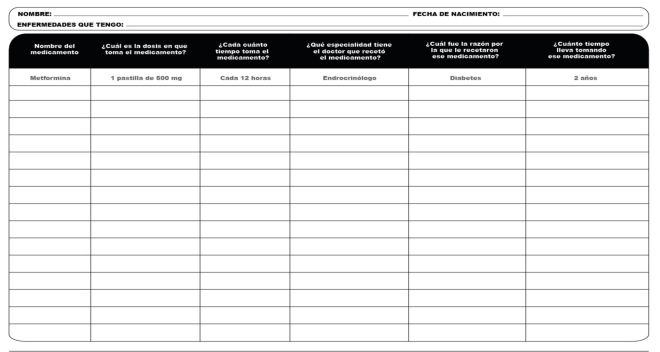
Evaluation Design Tool In the case of a general medical consultation for older adults in the anamnesis phase, it is vitally important to be able to obtain accurate data, since this type of user, according to Besdine (2019), presents “different health problems, often more complex, such as multiple diseases, which may require several drugs (polypharmacy) and a higher probability of prescription of a high-risk drug”. The points to consider according to Besine (2019), Rodriguez and Rodriguez (2019) during the anamnesis phase by the treating physician are the following: previous diseases, pharmacological history, history of alcoho- lism, smoking and drug addiction, nutritional history, health history mental status, functional status, social history, allergies and intolerances, previous hospitalizations, traumas, previous medical tests, blood transfusions, gyne- cological and obstetric history (if applicable) and use of prostheses. However, Besine (2019) points out that where he finds the most flaws in terms of the transmission and collection of data by the patient is when the subject of phar- macological history is addressed, this part covers: 1) drugs used, 2) dose, 3) dosage schedule, 4) prescribing physician, 5) reason for prescribing it, and 6) length of time the drugs have been taken. In order to reduce the error curve during this particular moment, the pre- sent research study involved developing a tool where the patient could write down this information, have it with him when he went to a medical consulta- tion and thus be able to provide the treating physician with this information. which is important for a correct diagnosis of it. This tool was developed based on the design and graphic composition guidelines established by Morell and Etch (2001) and Fisk et al. (2009), addressing the points that Besdine points
An Information Design Tool to Reduce Cognitive Load in Older Adults 177
Figure 1: Pharmacological treatment control tool. Own elaboration.
out as important and that are related to the patient’s pharmacological history. The format used was tabloid size (11 inches x 17 inches). The result was the following (Figure 1): Experiment
To establish the study sample, Nielsen (2012) stated that for a usability test, the number of users to be interviewed ranged between 20 and 30, therefore, this experiment was implemented in 30 older adults, where the gender with which they identified was indistinct, who live in Mexico, especially in the center of the country, in states such as Puebla and Mexico City, according to the National Institute of Statistics and Geography (2021). Said users to be evaluated suffered from some type of chronic degenerative disease, such as diabetes or hypertension, where chronic pharmacological treatment is requi- red and they lived alone, oversaw their health care and had to go to a doctor’s office alone.
What we wanted to know in this experiment is if the patient really consi- dered that this tool was really useful to be able to transmit the precise data to the treating doctor about their pharmacological treatment, for which we based ourselves on the Nielsen definition of usability ( 2012), where it says that an object is usable, it serves what it was made for, in the same way, to establish the evaluation indicators on whether this tool was usable or not, we use the definition proposed by Jordan (2012) in where it indicates that something is usable when it is easy to read (efficient), easy to understand (effective) and aesthetically pleasing (satisfying).
Based on these parameters, the evaluation tool was a PSSUQ questionnaire which measures the immediate usability of a design artifact after it has been used, according to Rosa et al. (2015). In this questionnaire, a Likert scale from 1 to 5 was implemented, where 1 corresponded to the value of “totally agree”and 5 to “totally disagree”, reagents were generated, which respond in the following way to each one of the usability parameters of Jordan (2001):
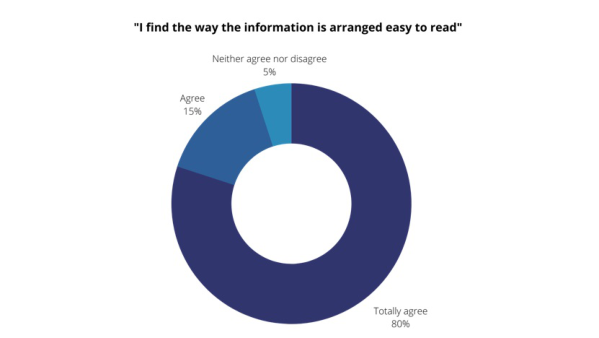
Figure 2: Results of Effiient indicator #1. Own elaboration.
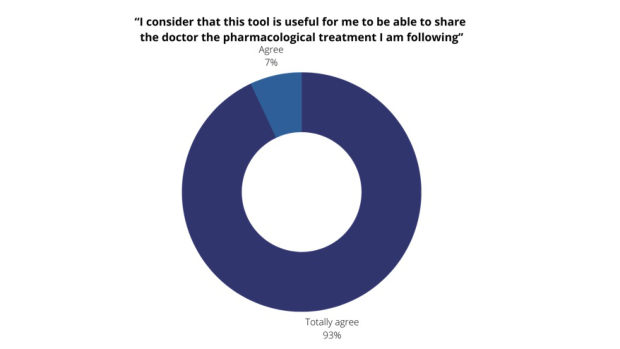
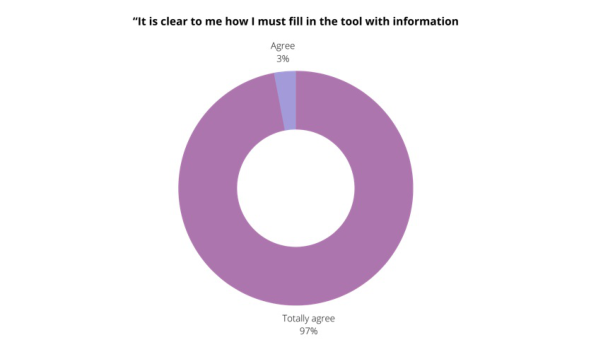
a) “Efficient”indicator: “The way in which the information is arranged seems easy to read”, “I consider that this tool is useful to me to be able to share with the doctor the pharmacological treatment that I am following”, b) “Effective” indicator: “It is clear to me the way in which I must fill the tool with infor- mation”, “The way in which the information is arranged is clear to me”, “Each section of information that this tool has I think it is adequate to be able to transmit the necessary information to the doctor” and c) “Satisfa- ctory” Indicator: “The way in which the information is arranged is attractive to me”. In addition to this, as mentioned, stress and confidence is something that is usually the patient’s mood when it comes to having a medical con- sultation, therefore, the “trust and security” indicator was added to know if the user felt safer and calmer when sharing information with the doctor based on the help of this tool, these premises are: “Having this type of tool makes me feel more confident when going to the doctor’s office.” “Having this type of tool makes me feel calmer when it comes to going to a doctor’s office.”
Findings The results obtained (Figures 2 and 3) were the following: a) “Efficient” indicator: 80% indicated that they “totally agree”, 15% “agree” and 5% “neither agree nor disagree” with the premise “ I find the way the informa- tion is arranged easy to read” and 93% said they felt “totally agree” and the remaining 7% “agree” with the sentence “I consider that this tool is useful for me to be able to share the doctor the pharmacological treatment I am following”
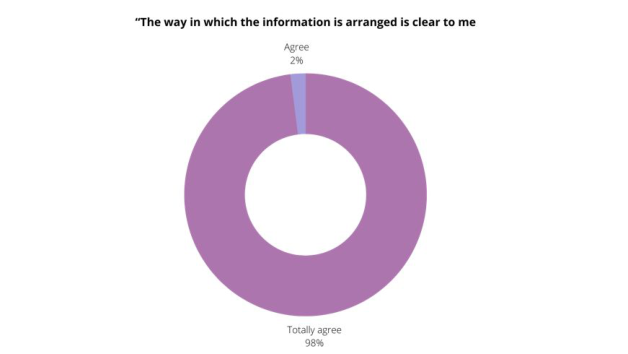
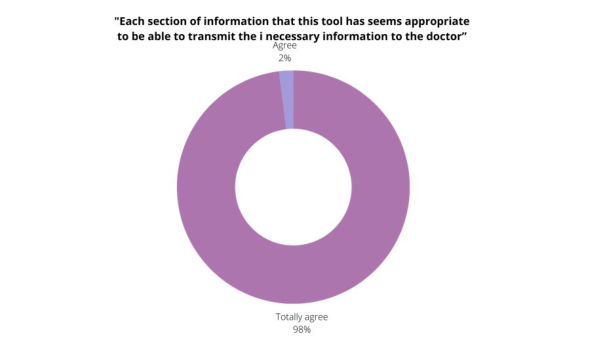
b) “Effective”indicator (Figures 4–6): 97% of the sample said they “totally agree” and 3% said they “agree” with the premise “It is clear to me how I must fill in the tool with information”, regarding “The way in which the information is arranged is clear to me”, 98% said they “totally agree”and the remaining 2% of the respondents said they “agree”, based on “Each section of information that this tool has seems appropriate to be able to transmit the
An Information Design Tool to Reduce Cognitive Load in Older Adults 179
Figure 3: Results of Effiient indicator #2. Own elaboration.Figure 4: Results of Effective indicator #1. Own elaboration.Figure 5: Results of Effective indicator #2. Own elaboration.
i necessary information to the doctor” 98% said they “totally agree” and the remaining 2% of those surveyed said they “agree”.
Figure 6: Results of Effective indicator #3. Own elaboration.Figure 7: Results of Satisfactory indicator #1. Own elaboration.Figure 8: Results of Satisfactory indicator #2. Own elaboration.
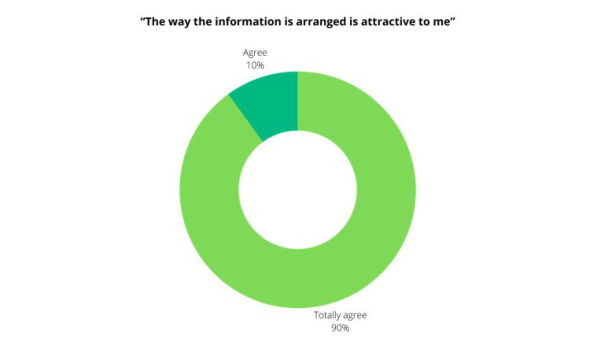
c) “Satisfactory” indicator (Figures 7–9): 90% of those surveyed said they “totally agree” and the remaining 10% “agree” with the sentence “The way
An Information Design Tool to Reduce Cognitive Load in Older Adults 181
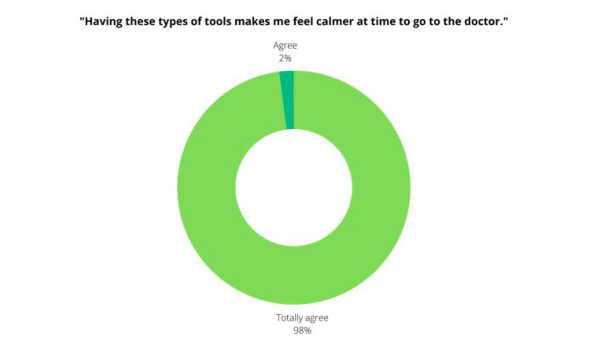
Figure 9: Results of Satisfactory indicator #3. Own elaboration.
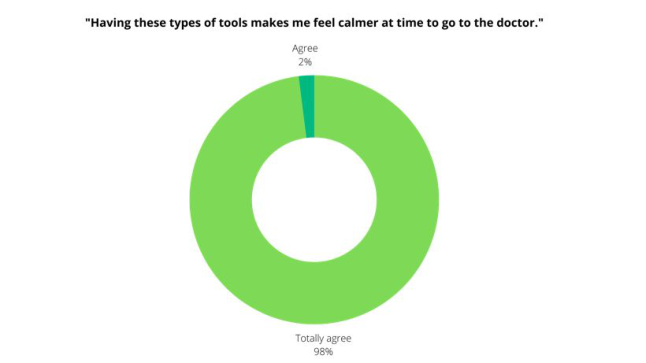
the information is arranged is attractive to me”. Regarding “trust and secu- rity”, 97% of those surveyed said they “totally agree” and the remaining 3% “agree” with the premise “Having these types of tools makes me feel more confident when it comes to go to a doctor”, finally, 98% of users said they felt “totally agree” and 2% “agree” with the sentence “Having these types of tools makes me feel calmer at time to go to the doctor.”
DISCUSSION
After having analyzed the results, we can notice that the elderly patient finds this tool useful as an auxiliary control sheet to be able to transmit all the information related to their pharmacological treatment to the treating phy- sician in a timely and effective manner during the medical consultation. In addition, the older adult patient finds relief and feels safer by being able to count on this type of tool that helps reduce their cognitive effort, especially when, in the conditions of their age, it could be forgetting data or somewhat common information.
Something also very interesting is that the patient had no stumbles during the reading action, since he pointed out that the visual composition allows him to read easily, in addition to the fact that he did not perceive any visual distractions that would reduce the process. As for the typographic and color strategy, it turned out to be the appropriate one, since they reinforced the differences between levels of information and the clarity that the tool was intended to present with respect to its efficiency and effectiveness. Similarly, posing as a direct question what was sought to know within the columns of information that the user must fill out, seemed easy to understand and timely to the user.
Finally, it is worth mentioning that for the user, having this tool made him feel safer and more confident when going to a medical consultation, especially when the transmission of information depends on it and he does not have the support of a third party.
CONCLUSIONS
The anamnesis phase is a very important part of the protocol of a medical consultation, since it is there where the treating physician will obtain all the information related to the pharmacological history that the patient may be having, trying first to avoid contraindications and harmful effects for the patient. health of the patient and so that the treating doctor can give the best diagnosis for the patient’s condition. For this reason and given the magnitude of the importance of being able to transmit this information in a precise and punctual manner, older adults are considered in a special way, since due to natural conditions at their age they may have some particular deficiency or condition that impairs this process. , or perhaps they do not have anyone to accompany them to the consultation and they find it necessary to attend alone, having to rely on their memory or some note they may have on hand.
In order to reduce the error curve in this process, we were able to obse- rve that the tool that serves as a control sheet is considered very useful by the elderly patient, since he considers that he will be able to transmit the informa- tion in a better way to the treating physician. Beyond the visual composition, which was appropriate for the user for whom it was being designed, it should be noted how information design can improve the way information is tran- smitted and also how the user feels, therefore We believe that it is extremely important to delve into this type of tool focused on the process of medical care for the elderly, but above all emphasizing how this discipline can have a positive impact on people’s lives.
Another important point to highlight is that, in addition to seeking to reduce the cognitive load as we have mentioned before, it is to create and design artifacts that welcome all these users who, in one way or another, are being left behind because they could represent certain minorities or users. that present very particular characteristics, that is, through the development of this type of projects, inclusion is alluded to, seeking to point to an awa- reness of the existence of these populations and through the development in the design of artifacts that satisfy the needs they make unique or parti- cular to this type of person. In this sense and with respect to the research work presented through these pages, we seek to recognize and understand the needs of older adults in their role as patients and thus be able to pay from the discipline of information design, their well-being and fulfillment of their needs and characteristics, both cognitive and emotional, generating a tool that makes them feel safer with a regular process that they face, due to their health and family conditions. Through this, we can demonstrate that the user and his recognition as an independent entity to the designer himself, leads to the generation of artifacts that take as a starting point these characteristics that have been mentioned previously, seeking a more inclusive and above all conscious design, where design is at the service of people.
REFERENCES
Besidne, R., (2019). “Evaluación del paciente anciano. MSD y los Manuales MSD [online]. Manual MDS. [Accessed February 1, 2022]. Available at: https: //www.msdmanuals.com/es-mx/professional/geriatría/abordaje-del-paciente -geriátrico/evaluación-del-paciente-anciano.
An Information Design Tool to Reduce Cognitive Load in Older Adults 183
Corona Martínez, L. and Fonseca Hernández, M., (2010). Un modelo simplificado del proceso de atención médica. Implicaciones asistenciales, docentes e investigativas. Revista Científica de las Ciencias Médicas en Cienfuegos. 8(2), 34–37. Fisk, AD, Rogers, WA, Charness, N, Czaja, SJ, Sharit, J, & Sharit, J 2009, Designing
for Older Adults: Principles and Creative Human Factors Approaches, Second Edition, CRC Press LLC, Baton Rouge. Available from: ProQuest Ebook Central. [24 May2 022]. INEGI, (2021). Estadísticas a propósito del día internacional de las personas adultas mayores [online]. [Accessed February 1, 2022]. Available at: https://www.inegi.or g.mx/contenidos/saladeprensa/aproposito/2021/EAP_ADULMAYOR_21.pdf Jordan, P. W. (2020). Introduction to Usability. Taylor & Francis Group. Nielsen, J. (2012). Usability 101: Introduction to Usability. Nielsen Norman Group.
[online] Accessed February 1, 2022]. Available at: https://www.nngroup.com/arti cles/usabilty-101-introduction-to-usability/ Roger W. Morrell & Katharina V. Echt (2001) Presenting Information to Older Adults, Journal of Museum Education, 26:1, 10–12, DOI: 10.1080/10598650. 2001.11510433 Rodríguez, A, Jarillo E., Casas, D. (2018) Medical consultation, time, and duration.
Medwave. [online] [Accessed February 1, 2022]. Available at: https://www.medw ave.cl/link.cgi/English/Features/Essays/7266.act?tab=ingles Rodríguez García, P. and Rodríguez, L. (2019) Princípios técnicos para realizar la anamnesis en el paciente adulto. Revista Cubana de Medicina General Integral, 15(4), 409–414. Rosa, A. F., Martins, A. I., Costa, V., Queiros, A., Silva, A. y Rocha, N. P., (2015).
European Portuguese validation of the Post-Study System Usability Questionnaire (PSSUQ). En: 2015 10th Iberian Conference on Information Systems and Techno- logies (CISTI), 17–20 de junio de 2015, Aveiro, Portugal [online]. IEEE. [Accessed February 1, 2022]. Available at: doi: 10.1109/cisti.2015.7170431
LISTED IN THE AHFE DIGITAL BOOKSTORE CATALOGUE
Explore the complete digital volume
Design for Inclusion
Read this individual research paper free through the original publisher, or explore the full digital proceedings book.
ISBN 978-1-958651-21-6
Explore this ISBN in the AHFE Bookstore ↗Listed in the July 2026 bookstore catalogue; search by ISBN to confirm current availability · Digital book purchase optional