Alberto Rossa-Sierra, Mariel Garcia-Hernandez, Gabriela Duran-Aguilar, Fabiola Cortes-Chavez, David Vidaña-Zavala (2026). Design and development of an electronic oral medication dispenser for older adults. In: Human Interaction and Emerging Technologies (IHIET-FS 2026): Future Systems and Design Applications. AHFE Open Access, vol. 235, pp. 157–166. https://doi.org/10.54941/ahfe1007271
1 Universidad Panamericana, Facultad de Ingeniería, Álvaro del Portillo 49, Zapopan Jalisco 45010, México ↗
2 Universidad de Monterrey, Departamento de Diseño y Multimedia, Av Ignacio Morones Prieto 4500 Poniente, Zona Valle Poniente, San Pedro Garza García, Nuevo León 66238 México ↗
3 Universidad Panamericana, Facultad de Ingeniería, Jose María Escrivá de Balaguer 101 Villas Bonaterra, Aguascalientes 20296, México ↗
This study presents the design and development of an electronic oral medication dispenser aimed at improving therapeutic adherence and reducing risks associated with polypharmacy in older adults. Polypharmacy, commonly defined as the concurrent use of three or more medications, increases the likelihood of adverse drug reactions, medication errors, and preventable hospitalizations, particularly among aging populations with chronic conditions.A user-centered design methodology was implemented, integrating ergonomic, cognitive, and functional considerations specific to older adults. The development process included contextual inquiry, requirement definition, system architecture design, iterative prototyping, and preliminary usability validation. Design priorities focused on minimizing operational complexity, enhancing perceptual feedback, and reducing the probability of dosing errors.The resulting prototype is capable of storing and dispensing up to three daily doses over 30 days. The system incorporates a programmable electronic controller for scheduled dispensing, a visual notification interface, and an adjustable auditory alarm to reinforce medication reminders. The modular architecture allows future integration of wireless connectivity for remote adherence monitoring by caregivers or healthcare professionals, as well as optional accessory expansion.This work demonstrates the feasibility of integrating user-centered product design with embedded electronic systems to support medication management in older adults. The proposed solution contributes to safer medication administration and represents a scalable platform for future telehealth-enabled applications in geriatric care.
Aging is a natural process that involves progressive changes in people’s physical, cognitive, and functional abilities, directly impacting their independence in daily life activities. In this context, therapeutic adherence becomes a significant challenge for the older adult population.
According to the World Health Organization (WHO), there are currently more than 1.2 billion people aged 60 and over worldwide. In Mexico, this population numbers approximately 17 million, representing a steadily growing demographic sector. The high prevalence of chronic and degenerative diseases in this age group increases medication use, particularly oral medications. It is estimated that around 65% of older adults regularly take more than three medications, and nearly 20% may take up to ten prescriptions in a single week.
The simultaneous use of multiple medications, defined by the WHO as polypharmacy (Homero, 2012; Rollason and Vogt, 2003) when three or more drugs are administered concurrently, constitutes one of the main health risks in this population. This practice increases the likelihood of adverse reactions (Rollason and Vogt, 2003), drug interactions, and administration errors, in addition to promoting the so-called “cascade effect,” in which an unidentified side effect is treated with a new medication, exacerbating the initial problem. In Mexico, polypharmacy is a determining factor in hospital admissions for drug poisoning. The National Institute of Geriatrics has identified it as one of the main health risks in older adults, especially those with chronic degenerative diseases (Allemann, Hersberger, and Arnet, 2015).
Given this situation, several studies have proposed electronic devices to improve therapeutic adherence in older adults, incorporating technologies such as automation, mobile notifications, and the Internet of Things (IoT) (Casciaro et al., 2020; Othman and Ek, 2016; Sahlab et al., 2019; Arora and Singh, 2018). Likewise, user-centered approaches have demonstrated the importance of designing accessible and understandable interfaces for this population (Sahlab et al., 2020; Reichelt et al., 2019; Dong and Vanns, 2009). However, many of these devices have limitations in terms of functional integration and adaptability.
Given this situation, a design and development proposal for an electronic oral medication dispenser for older adults is presented. This device, conceived from a user-centered approach (Sahlab et al., 2020; Reichelt et al., 2019; Dong and Vanns, 2009), is manufactured in the country. It is designed to store and dispense up to 3 doses daily for 30 days. It incorporates a programmable electronic control system that manages dose release, a visual interface that notifies the user when to administer the medication, and an audible alarm with adjustable intensity to reinforce the reminder.
In a later phase, network connectivity is planned, allowing remote monitoring by caregivers or healthcare professionals to verify treatment adherence (Sahlab et al., 2019; Arora and Singh, 2018). The design also allows for the optional incorporation of a water dispenser module.
The device’s development is based on an analysis of the functional, cognitive, and ergonomic needs of older adults, aiming to reduce medication errors, improve therapeutic adherence, and help prevent complications associated with polypharmacy.
PROPOSAL DEVELOPMENT Design Brief
The electronic dispenser design must meet certain specific requirements to prevent polypharmacy, including: A) Enabling the recording and monitoring of consumed medications, including
supplements and commonly used products with pharmacological effects (Homero, 2012). B) Ensuring adequate storage conditions (temperature, humidity, and light exposure control). C) Operating automatically, dispensing doses at programmed times. D) Promoting the correct intake of medications with water, considering the
specific requirements of certain drugs. E) Incorporating security mechanisms that restrict access to medications to authorized users only. Integrate user authentication systems to prevent misuse. F) Provide connectivity for remote monitoring by caregivers or healthcare
personnel. G) Feature an intuitive, accessible interface with low cognitive load. H) Maintain an aesthetic that inspires confidence and facilitates its integration into the home environment.
These criteria address needs identified among real users, who value security, ease of use, and control over treatment (Allemann, Hersberger, and Arnet, 2015).
Preliminary Specifications for Equipment Design Based on the initial briefing, we developed the equipment design specifications (Table 1) to define the constraints and conclusions highlighted in the initial research for this project, which served as a guide for subsequent development.
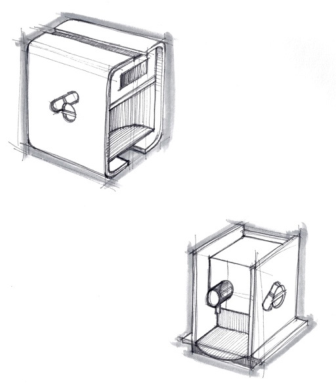
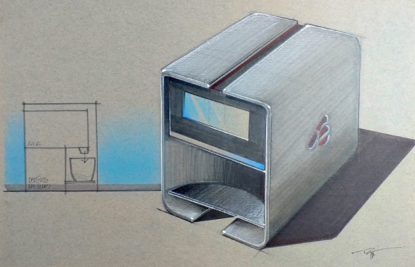
Concept Generation Based on the defined requirements, a conceptual exploration phase was developed using iterative sketching and interdisciplinary evaluation. Initially, integrating the device with existing household items, particularly kitchen appliances, was considered to facilitate its acceptance and everyday use. Subsequently, independent subsystems were defined, which improved the design’s flexibility. This approach aligns with user-centered design methodologies applied to medical devices (Reichelt et al., 2019; Dong and Vanns, 2009).
The conceptualization phase culminated in the creation of full-scale mock-ups, used to validate ergonomic, interaction, and spatial configuration aspects (Figures 1, 2).
Table 1: Equipment design specifications.
Table available in the original PDF paper.
Category Specification Required/ Desirable R
R
User Group Primary group: People over 70 years of age who live alone or spend a lot of time alone at home and require oral medication. Secondary group: Older adults (65 years and older) who take oral medication daily.
User Interface Easy-to-read indicator or screen with large, high-contrast
R D letters. It may include an audible reminder when the medication is taken
R R
R R
D D
D
Performance Dispense capsules or tablets with maximum dimensions of 12 mm in diameter x 3 mm in width. The tablets must not break during movement or dispensing of the medication. Possibility of dispensing up to three medications in a single dose. Doses will be administered 3 times a day (8 hours between doses). Possibility of providing “to-go” medications (in case the user leaves home). It must have a water dispenser. The electronic components should include the possibility of internet connectivity to notify the caregiver of the senior citizen regarding the equipment’s performance and the user’s doses R
D
Aesthetics The dispensing unit will be located in the dining room or kitchen; its design must be appropriate for this type of environment. It must not resemble medical or hospital equipment.
R
Maintenance Access to the medication dispenser cannot be directly accessed by the primary user. Water refilling should be as simple as possible.
D
Figure 1: The initial exploratory ideas sought a product that could blend into a kitchen appliance and, in a single form, contain both a pill dispenser and a water dispenser.Figure 2: The second stage of idea exploration began by defining the essential components and subsystems to be included in the final proposal. The image shows different concepts that, together, defined the final proposal.
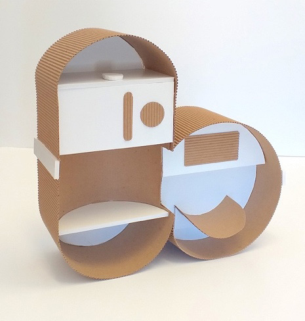
Once the conceptualization and sketching stage was completed, the development of several 1:1 scale mock-ups continued, with the intention of further defining the elements and details that make up the device (Figure 3).
Figure 3: Initial mock-ups of the options chosen in the conceptualization stage. The figure on the left is based on an ovoid shape that contains the water dispenser and medication storage. The proposal on the right separates these elements into two subsystems. It also includes electronic devices such as a fingerprint scanner for security, a digital display, and other features.
RESULT
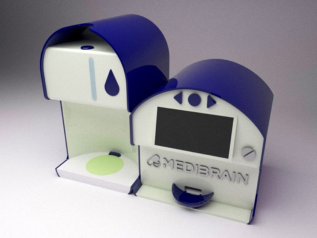
Final Design Proposal The final design consists of two main subsystems:
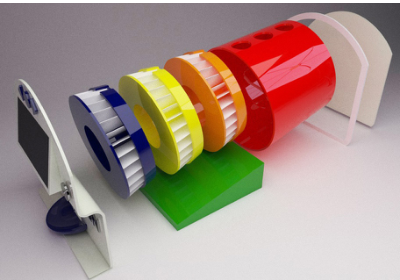
1. Drug Dispensing System 2. Water Dispensing System The drug dispensing system incorporates three motorized horizontal carousels that enable precise storage and dispensing of programmed doses. This type of solution has been previously explored in similar electronic devices (Fărcaş et al., 2015).
The system is protected by biometric authentication, restricting access to authorized users. The water module facilitates the correct administration of medication, aligning with pharmacological recommendations. It integrates a rear reservoir, level indicator, and pumping system, facilitating proper medication intake.
The device includes integrated lighting to improve visibility and usability in low-light conditions.
The final design proposal includes some relevant aspects described in the following images (Figures 4, 5).
Figure 4: Final representation of the selected model. The separation of the two main components (water dispenser and medication dispensing system) continues. A water reservoir is visible on the back. A water level indicator and a dispensing button are located on the front. The unit is illuminated for easy location and operation.Figure 5: The dispensing system consists of three horizontally aligned carousels that store medications (tablets and pills). These carousels rotate via a motor that selects the appropriate medication dose for each time of day. For security, this unit is sealed and accessible only by fingerprint scanning by the medication provider or the patient’s caregiver.
Design and Development of an Electronic Oral Medication Dispenser for Older Adults 163 Electronic Section
This section describes the components used to provide functionality to the previously selected design. Each component is described, followed by an explanation of how they interact to achieve the final objective.
Based on the dispenser’s target audience (senior citizens), a series of objectives was established for the electronics to meet.
A) Dispense the correct number of pills. B) Precision in the time intervals at which the pills are dispensed. C) Ensure that the medication is dispensed to the correct person. D) Detection of potential factors that could alter the quality of the pills. E) Sufficient indicators (visual and auditory) to signal pill administration.
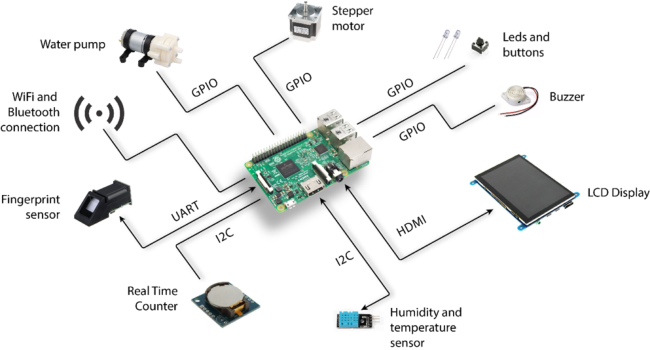
Considering the above points, Figure 6 shows a block diagram of the selected components.
Figure 6: Block diagram of the components of the electronic medication dispenser.
The following describes each of the components shown in the previous figure: Central board: This board reads the sensors, displays the menu on the screen, and controls alerts.
Water pump: The device has a water dispensing system. A small pump that meets the necessary sanitary requirements for contact with potable water is used for this purpose.
Stepper motor: This motor moves the system to dispense the tablets. It has 200 steps per revolution, or 1.8° per step, and can perform half-steps, achieving a precision of 0.9° per revolution.
Buttons, LED, and buzzer: The LEDs and buzzer function as alert devices when it is time to take the tablets. Therefore, there is both a visual and an audible alert. The button is used to dispense water.
LCD display: This touchscreen displays the menu for configuring the times when the pills will be dispensed, enabling fingerprint access so only the user can access the medication, and setting the permitted humidity and temperature ranges. This menu is password-protected, so only authorized personnel can access it.
Humidity and temperature sensor: Sensors indicate when the climate is unsuitable for storing the pills.
RTC: Since the central board lacks a timekeeping system, an external RTC is used that contains a battery to keep the time accurate at all times.
Fingerprint sensor: When it is time to dispense pills, they can be dispensed only if the older adult enters their fingerprint, to prevent someone else from taking the medication.
WiFi and Bluetooth: This option allows viewing the device’s current status via WiFi and sending alerts via Bluetooth. It is possible to add alert to the existing audible and visual alerts.
Therefore, the system’s general operation begins by setting the time to dispense the pills. A trained user does this via the touchscreen. At the same time, the maximum permissible temperature and humidity are entered, and fingerprint authentication is enabled (as recommended). The system saves this information and, thanks to the RTC (Remotely Tick Clock), can send a notification that it is time to take the pill, but it only dispenses them after the patient enters their fingerprint. If the humidity and temperature exceed the set limits, the information is sent to the device administrator for verification. In the case of water, the system dispenses water only when the user presses the corresponding button.
RESULTS
A functional prototype was developed using PMMA and 3D printing. Initial tests demonstrated proper functioning of the dosing and alerting system.
During the evaluation, it was identified that medication regimens in older adults can be more complex than anticipated, reaching up to six doses per day. This finding highlights the need for highly configurable systems.
The carousel-based design proved scalable, enabling the system’s capacity to be expanded without compromising functionality.
CONCLUSION
The development of the electronic dispenser demonstrated the technical and functional feasibility of a solution to improve therapeutic adherence in older adults. Initial tests with functional prototypes demonstrated proper performance in automated dispensing and the implemented alert systems.
One of the project’s main findings was the actual complexity of medication regimens in this population group. While the initial design considered three doses per day, in practice, cases with up to six administrations were identified,
Design and Development of an Electronic Oral Medication Dispenser for Older Adults 165 highlighting the need for highly configurable, adaptable systems. The modular, carousel-based design proved to be a scalable solution, allowing the system’s capacity to be expanded without compromising its functionality. This feature is key to its application in real-world polypharmacy settings.
From a user-centered design perspective, the device helps reduce cognitive load in medication management, improving safety and treatment control. These results are consistent with previous research highlighting the potential of electronic devices to improve therapeutic adherence (Casciaro et al., 2020; Karthikeyan et al., 2021; Allemann, Hersberger, and Arnet, 2015).
Future work includes longitudinal evaluations with real users, optimizing the interface for cognitive accessibility, and integrating the device with digital health systems.
Overall, this work demonstrates that user-centered, electronically supported product design can significantly help address challenges associated with an aging population.
REFERENCES
Allemann, S.S., Hersberger, K.E. and Arnet, I., 2015. Patient views on an electronic dispensing device for prepackaged polypharmacy: a qualitative assessment in an ambulatory setting. Integrated Pharmacy Research and Practice, pp. 167–174. Arora, K. and Singh, U., 2018. Smart pill dispenser using internet of things.
International Journal of Engineering Research and Technology (IJERT), 7(07). Buono, P., Cassano, F., Legretto, A. and Piccinno, A., 2017. A homemade pill dispenser prototype supporting elderly. In: International Conference on Web Engineering. Cham: Springer, pp. 120–124. Casciaro, S., Massa, L., Sergi, I. and Patrono, L., 2020. A smart pill dispenser to
support elderly people in medication adherence. In: 2020 5th International Conference on Smart and Sustainable Technologies (SpliTech). IEEE, pp. 1–6. Chavan, N., Chavan, I., Karkera, S., Samanta, R. and Birambole, A., 2022. Design and development of smart pill dispenser. In: 2022 Sardar Patel International Conference on Industry 4.0-Nascent Technologies and Sustainability. IEEE, pp. 1–5. Dong, H. and Vanns, N., 2009. Designing an innovative pill dispenser: An
undergraduate level case study of inclusive design. The Design Journal, 12(1), pp. 95–115. Fărcaş, C., Ciocan, I., Palaghiţă, N. and Fizeşan, R., 2015. Weekly electronic pills dispenser with circular containers. In: 2015 IEEE SIITME. IEEE, pp. 125–129. Homero, G.E., 2012. Polifarmacia y morbilidad en adultos mayores. Revista Médica
Clínica Las Condes, 23(1), pp. 31–35. Karthikeyan, K.R., Babu, E.D., Ranjith, S. and Arunkumar, S., 2021. Smart pill dispenser for aged patients. In: 2021 ICAECA. IEEE, pp. 1–5. Kumar, S.K., Manimegalai, R., Rajeswari, A., Deekshita, R., Dhineshkumar, M. and
Manikandan, G., 2021. A literature review: performance evaluation of wearable system with pill dispenser box. In: 2021 ICAC3N. IEEE, pp. 2008–2014. Minera, S.R., Nuerbiya, A., Espinoza, A., George, K. and Panangadan, A., 2023.
Smart cup for a smart pill dispenser for verification of pill consumption. In: 2023 IEEE CCWC. IEEE, pp. 994–998. Othman, N.B. and Ek, O.P., 2016. Pill dispenser with alarm via smart phone notification. In: 2016 IEEE GCCE. IEEE, pp. 1–2.
Reichelt, F., Schmid, P., Maier, T., Sahlab, N., Jazdi-Motlagh, N., Weyrich, M. and Matschke, M., 2019. User centered design of a pill dispenser for the elderly. In: International Conference on Human Systems Engineering and Design. Cham: Springer, pp. 699–704. Rollason, V. and Vogt, N., 2003. Reduction of polypharmacy in the elderly:
a systematic review of the role of the pharmacist. Drugs & Aging, 20(11), pp. 817–832. Sahlab, N., Jazdi, N., Weyrich, M., Schmid, P., Reichelt, F., Maier, T. and Kalka, G.,
2019. Development of an intelligent pill dispenser based on an IoT-approach. In: International Conference on Human Systems Engineering and Design. Cham: Springer, pp. 33–39. Sahlab, N., Wiebelitz, L., Schmid, P., Reichelt, F., Jazdi, N., Weyrich, M. and Maier, T., 2020. A user-centered interface design for a pill dispenser. In: 2020 IEEE GCCE. IEEE, pp. 761–764.
LISTED IN THE AHFE DIGITAL BOOKSTORE CATALOGUE
Explore the complete digital volume
Human Interaction and Emerging Technologies (IHIET-FS 2026): Future Systems and Design Applications
Read this individual research paper free through the original publisher, or explore the full digital proceedings book.
ISBN 979-8-950676-11-6
Explore this ISBN in the AHFE Bookstore ↗Listed in the July 2026 bookstore catalogue; search by ISBN to confirm current availability · Digital book purchase optional