Chun-Wen Chen, Kevin C. Tseng, Shaofu Chang (2022). Modeling a Tangible User Interface for Navigation in an Information Space. In: Advances in Ergonomics In Design, Usability & Special Populations: Part III. AHFE Open Access, vol. 20. https://doi.org/10.54941/ahfe1001296
The content elements and the connections between elements form an information space that is conceptually similar to a physical space. Navigation is a common problem in information space and in physical space. Using an appropriate metaphor is a key factor in transforming abstract information space into a tangible space that users can accept. This research proposes an interface design approach to navigate an information space, such as the contents of a website or a museum, with a tangible user interface (TUI). The goal of the TUI is to connect the digital and physical space with a visible and tangible form. Tangible objects are used as metaphors to manipulate the information space. Information finding tasks are given to the participants to test user performance and errors, and subjective satisfaction is evaluated with questionnaires. The effects of metaphors and the TUI/graphics user interface (GUI) are to be investigated. The results show that metaphors help users find information with better performance and lower error rates. Users also perceive more usability from interfaces with metaphors and think they can work better. The proposed TUI system can get similar errors and subjective usability as a GUI system, which users are more familiar with.
The content elements and the connections between elements form an information space that is conceptually similar to a physical space. Navigation is a common problem in information space and in physical space. It is concerned with making decisions and moving to the target in the space. The traditional graphics user interface (GUI) has helped users to navigate through information space for several decades. Due to a weak or unclear relationship between the user interface and the contents, GUIs cannot always solve problems related to the perception and understanding of abstract contents in an information space.
Any information system or information artifact consists of symbols, the structure between symbols, and the functions to operate symbols. Cyberspace, formed by computer networks, is an information space with which people are familiar. Using an appropriate metaphor is a key factor in transforming abstract information space into a tangible space that users can accept. The GUI has used different spatial metaphors to represent file systems, such as documents, files, and desktops and corresponding copy and delete functions.
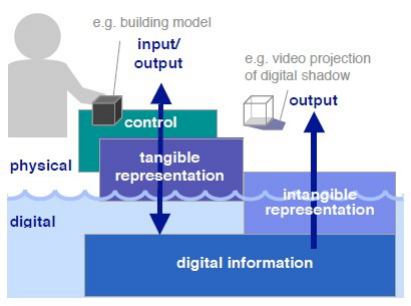
This research proposes an interface design approach to navigate an information space, such as the contents of a website or a history museum, with a tangible user interface (TUI). The goal of the TUI is to connect the digital and physical space with a visible and tangible form (Ishii & Ullmer, 1997; Ishii, 2008). It uses the foreground and background (environment) perceptual and representational abilities as an interactive interface between human and information space. The TUI utilizes physical objects as controls and representations as well as a digital screen or projection for representation (see Figure 1). The GUI also utilizes a physical device, such as a keyboard and/or mouse, as the control and a digital screen for the representation, but the physical devices of the GUI do not represent information.
(a) (b)
Figure 1. Schematic of a (a) graphic user interface (GUI) and (b) tangible user interface (TUI). (Adapted from Ishii, 2008)
Compared to the GUI, the TUI can help users more with its better spatial mapping. Sharlin et al. (2004) used a Cognitive Map Probe (CMP), which is a TUI system built with interactive physical models, to assess cognitive mapping ability. They found that the TUI system could assess cognitive mapping ability well because of its spatial mapping nature. Kim and Maher (2008) compared the performance of interior space designers with a TUI and a GUI and found that designers using a TUI could focus more on the tasks themselves and the spatial relationship among objects in the tasks. The TUI should thus improve the understanding and control of abstract information space.
Metaphor is an important approach for the GUI. The computer desktop environment is the most successful example of metaphor. It helps users easily understand a new concept from previous experience (Marcus, 1998). Metaphor is also essential to the TUI. The object meaning in a TUI can affect the affordance, the way the object is used (Underkoffler & Ishii, 1999; Fishkin, 2004). Using meaningful objects may result in various understandings of operation behavior.
This research has two stages. This paper mainly reports the results of the second stage. In the first stage, the website of a history museum that owns many precious objects is used to test an information space that does not have a tangible form. Cards of the museum’s objects are made to test a similar information space but with a tangible form. The aim of the second stage is to make and evaluate an interactive system of information space with a TUI. Information can be browsed and searched in the system. Tangible objects are used as metaphors to manipulate the information space. Information finding tasks are given to the participants to test user performance and errors, and subjective satisfaction is evaluated with questionnaires. The effects of metaphor and TUI/GUI are to be investigated.
METHODS
Participants Twenty-four participants, 12 male and 12 female, were given information-finding tasks to complete. All participants were college students aged 20–25 years with experience using digital maps. All participants tested both the TUI and the GUI in different orders to prevent learning effects.
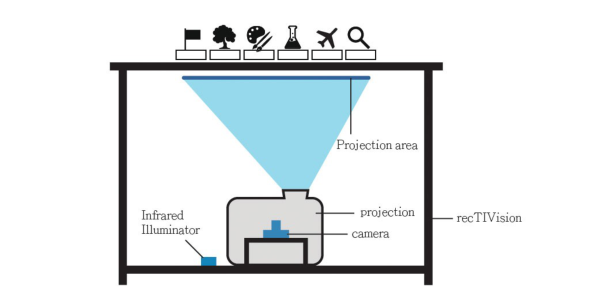
Materials and Design The information space system with the TUI consisted of a table surface for back projection, short-focus projector, computer display, webcam, and a computer running Unity3D, reacTIVision, and TUIO applications (see Figure 2).
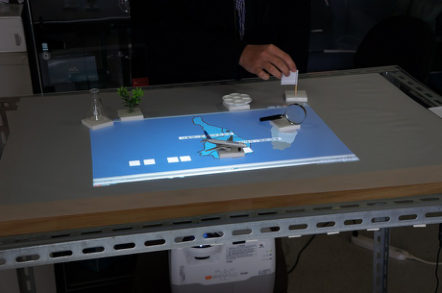
Small objects with or without metaphors were the controls and representation of the TUI. Objects with metaphors were designed from meaningful objects, such as a magnifying glass, airplane, bottle, brush, tree, and flag. Objects without metaphors were designed from meaningless geometric objects. The final image, rendered in Unity3D, was projected under a semitransparent table surface (see Figure 3).
Figure 2. Schematic of the information space system with the TUI.Figure 3. Installation of the information space system with the TUI.
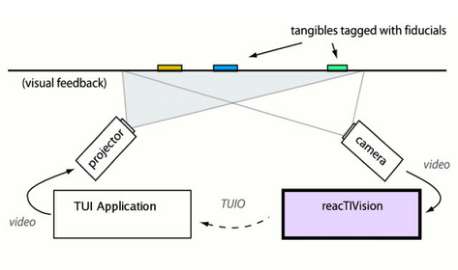
A fiducial marker attached below the small object can be detected in the camera image by reacTIVision technology, which determines the position and direction of the fiducial marker in the image (Kaltenbrunner & Bencina, 2007). The data were transmitted to the TUI application (Unity3D) via a TUIO application that transforms the data into a suitable form (see Figure 4).
Figure 4. System diagram of reacTIVision. (Adapted from Kaltenbrunner & Bencina, 2007)
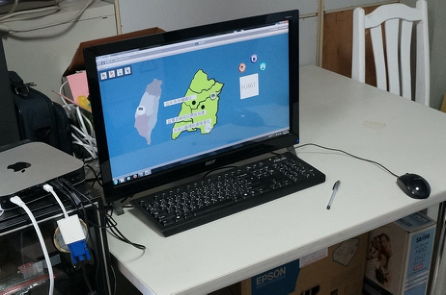
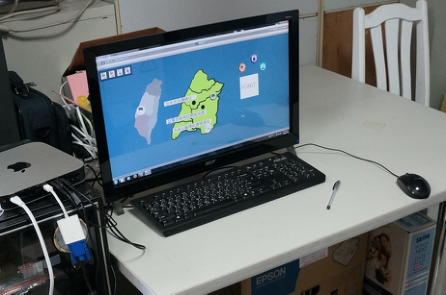
The GUI system is similar to the TUI system. The small objects were replaced with icons on the computer display (see Figure 5). Users could control the movement and rotation operations of the icons with a mouse. Icons with metaphors were designed from meaningful object shapes. Icons without metaphors were designed from meaningless geometric shapes (see Figure 6).
Figure 5. Installation of the information space system with GUI.
(a) (b)
Figure 6. Icons (a) with metaphors and (b) without metaphors.
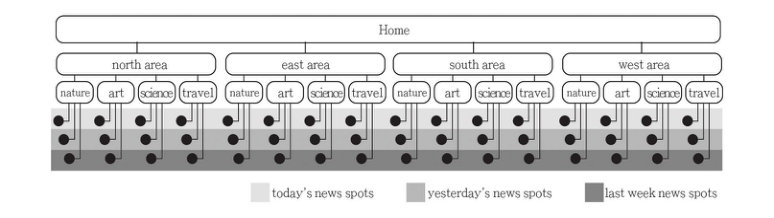
The information space was a tree structure and was simulated with local news items in Taiwan. The news items were classified into four geographic areas, four news categories, and three time sections (see Figure 7).
Figure 7. Structure of the information space system.
Tasks and Questionnaires The information finding tasks were to find target news items in the information space system. In a task with a combination of interfaces (TUI or GUI) and metaphors (with or without), six news items had to be found in different geographic areas, news categories, and time sections. The user operated a tangible or digital object to locate a geographic area, select a news category, and set a time section to search for the target item by its news title. The completion time and error number were then recorded.
A subjective evaluation on usability and satisfaction was conducted using the System Usability Scale (SUS)
(Brooke, 1996). SUS is a reliable, low-cost, usability scale that can be applied to global assessments of system usability. It provides broad general measures that can be used to compare usability across a range of contexts. It is a 10-item Likert scale with a score ranging from 0 to 100. Thus, it is a composite measurement of overall usability, meaning that the score of an individual item is not meaningful.
Procedure Tests were conducted in a laboratory setting. The tasks were information finding in an information space, with a combination of interfaces and metaphors to determine the effects on user performance and learning. The test procedure was as follows:
(1) Explanation: The research objective and test contents were described to the participant. (2) Learning interface/metaphor combination A: Browsing news items in the system. (3) Information locating task: Finding six target news items in the information space. (4) Learning interface/metaphor combination B: Browsing news items in the system. (5) Information locating task: Finding six target news items in the information space. (6) Questionnaire: Completing the SUS for both TUI and GUI. (7) Switching interface: After three days, repeating (2)–(6) with interface/metaphor combination C and D.
RESULTS
Performance Descriptive statistics of completion time show that the interfaces with metaphors could be more efficient than the interfaces without metaphors (see Table 1). The TUI does not seem to be better than the GUI for completion time. Further tests are necessary to confirm whether the difference is significant.
Table 1: Descriptive statistics of completion time _______________________________________________________________________ UI Metaphor N Mean SD _______________________________________________________________________ TUI Yes 24 20.26 15.34 No 24 32.60 9.23 GUI Yes 24 16.78 3.32 No 24 25.54 8.11 _______________________________________________________________________ Unit: second
Table available in the original PDF paper.
A two-way repeated measures ANOVA was used to test the differences of the UIs and metaphors in completion time (see Table 2). The difference between the two UIs is significant, and the difference between two metaphors is also significant. No interaction exists between the two factors of UI and metaphor. The results show that interfaces with metaphors are superior to interfaces without metaphors in completion time. Further, the GUI is superior to the TUI in completion time. The performance of the proposed TUI is not better than the GUI.
Table 2: Two-way repeated measures ANOVA of completion time _______________________________________________________________________
Errors The descriptive statistics of error number show that the interfaces with metaphors could have fewer errors than the interfaces without metaphors (see Table 3). The TUI does not seem to be better than the GUI in error number. Further tests are necessary to confirm whether the difference is significant.
Table 3: Descriptive statistics of error number _______________________________________________________________________ UI Metaphor N Mean SD _______________________________________________________________________ TUI Yes 24 0.38 0.58 No 24 3.96 2.46 GUI Yes 24 0.25 0.44 No 24 3.38 2.18 _______________________________________________________________________ Unit: error
Table available in the original PDF paper.
A two-way repeated measures ANOVA was used to test the differences of the UIs and metaphors in error number (see Table 4). The difference between the two UIs is not significant, but the difference between the two metaphors is significant. No interaction exists between the two factors of UI and metaphor. The results show that interfaces with metaphors are superior to interfaces without metaphors in error number. The TUI is similar to the GUI in error number. The errors of the proposed TUI are similar to those of the GUI.
Table 4: Two-way repeated measures ANOVA of error number _______________________________________________________________________
Subjective Usability The descriptive statistics of the SUS score show that the interfaces with metaphors could have a higher score than the interfaces without metaphors (see Table 5). The TUI does not seem to be better than the GUI in the SUS score. Further tests are necessary to confirm whether the difference is significant.
Table 5: Descriptive statistics of the SUS score _______________________________________________________________________ UI Metaphor N Mean SD _______________________________________________________________________ TUI Yes 24 63.40 14.62 No 24 53.08 15.99 GUI Yes 24 64.73 18.83 No 24 53.83 15.38 _______________________________________________________________________
Table available in the original PDF paper.
A two-way repeated measures ANOVA was used to test the differences of the UIs and metaphors in the SUS score (see Table 6). The difference between the two UIs is not significant, but the difference between the two metaphors is significant. No interaction exists between the two factors of UI and metaphor. The result shows that interfaces with metaphors are superior to interfaces without metaphors in the SUS score. By subjective usability, the proposed TUI is similar to the GUI.
Table 6: Two-way repeated measures ANOVA of the SUS score _______________________________________________________________________
The proposed TUI cannot provide better performance than the GUI. In previous literature, most TUI systems focus on intuitive manipulation and better understanding (Sharlin et al. 2004; Kim & Maher, 2008). Although it can be easier to learn how to use, the necessary effort to move the tangible objects may require more than a handy mouse. It is the same in the case of selecting a command in the menu bar with a mouse, which may need more cognitive and physical effort than pressing a keyboard shortcut. The easily understood way is not always so easy to do.
The proposed TUI is new to most participants, but the tangible form makes it easy to understand the spatial relationship in the system. Although users may have more experience using a GUI, the TUI system can get similar evaluation on errors and subjective usability as the GUI system. For the TUI, there is still a large space to develop and improve usability and user satisfaction.
Metaphor is important in the GUI and even more essential in the TUI. The pleasure of using a TUI mostly comes from manipulating the really meaningful objects. It is very different from grasping a mouse to move a cursor on a display. The TUI provides a richer sensation and more realistic details of the real world with dynamic contents from the digital world. The integration of tangible objects with a suitable digital environment makes the interactive quality of a TUI system. In previous literature, studies have shown how to classify metaphors by scale of abstract, but in many cases, fall short on how to use metaphors (Underkoffler & Ishii, 1999; Fishkin, 2004). The rules of designing TUIs are not easy to develop systematically. Methods for using metaphors can be the most important part.
CONCLUSIONS
The results show that metaphors help users find information with better performance and lower error numbers. Users also perceive more usability from interfaces with metaphors and think they can work better. The proposed TUI system can get similar errors and subjective usability as the GUI system that users are more familiar with. The design of the TUI needs further investigation to improve usability and user satisfaction.
ACKNOWLEDGMENTS
This research was partly sponsored by grants NSC 101-2410-H-182-014-MY2 from the National Science Council, Taiwan.
REFERENCES
Brooke, J. (1996). SUS: A “quick and dirty” usability scale. In P.W. Jordan, B. Thomas, B.A. Weerdmeester & I.L. McClelland (eds), Usability evaluation in industry (pp. 189-194). London: Taylor & Francis. Fishkin, K. P. (2004). A taxonomy for and analysis of tangible interfaces. Personal Ubiquitous Comput. 8(5), 347-358.
Ishii, H. (2008). Tangible bits: Beyond pixels. In Proceedings of the 2nd international conference on tangible and embedded interaction (pp. xv-xxv). Bonn, Germany: ACM. Ishii, H., & Ullmer, B. (1997). Tangible bits: Towards seamless interfaces between people, bits and atoms. In Proceedings of the
SIGCHI conference on human factors in computing systems (pp. 234-241). Atlanta, Georgia: ACM. Kim, M. J., & Maher, M. L. (2008). The impact of tangible user interfaces on designers' spatial cognition. Human-Computer Interaction, 23(2), 101-137. Marcus, A. (1998). Metaphor design for user interfaces. In Proceedings of CHI 98 conference on human factors in computing
systems (pp. 129-130). Los Angeles, CA: ACM. Sharlin, E., Watson, B., Kitamura, Y., Kishino, F., & Itoh, Y. (2004). On tangible user interfaces, humans and spatiality.
Personal and Ubiquitous Computing, 8(5), 338-346. Underkoffler, J., & Ishii, H. (1999). Urp: A luminous-tangible workbench for urban planning and design. In Proceedings of the SIGCHI conference on human factors in computing systems (pp. 386-393). Pittsburgh, Pennsylvania: ACM.
LISTED IN THE AHFE DIGITAL BOOKSTORE CATALOGUE
Explore the complete digital volume
Advances in Ergonomics In Design, Usability & Special Populations: Part III
Read this individual research paper free through the original publisher, or explore the full digital proceedings book.
ISBN 978-1-4951-2108-1
Explore this ISBN in the AHFE Bookstore ↗Listed in the July 2026 bookstore catalogue; search by ISBN to confirm current availability · Digital book purchase optional