Delna Shroff (2023). Distributed leadership and seafarers' emergency response in a simulated navigation environment. In: Human Factors in Transportation. AHFE Open Access, vol. 95, pp. 698–708. https://doi.org/10.54941/ahfe1003855
Merchant shipping is an occupation with a high rate of fatal injuries caused by accidents and maritime disasters. Human error plays a massive role in accidents; however, the shipping industry lacks substantial human factors research. A human factor, particularly leadership, has been implicated in numerous maritime disasters. However, there is a tendency for most research to focus on holders of formal positions. A lot of previous work on leadership has been carried out on the assumption that leadership rests with a single leader. The current study adopts a practice-based perspective to examine distributed leadership among seafarers. A simulation is used to investigate the relationship between one form of distributed leadership i.e., planfully aligned leadership, and the emergency response of the team members in a simulated navigation environment. The results showed that planfully aligned leadership was a positive and significant predictor of the team’s emergency response as compared to authoritarian leadership. This study makes a shift from the unitary view of the leader to a more practice-based perspective whereby leadership is conceived of as a collective social process emerging through the interactions of multiple actors seems to be the need of the hour. It would be worthwhile to study different configurations of distributed leadership and analyze the factors that facilitate distributed leadership.
Accidents at sea can have devastating effects on the lives of those who are involved. A maritime accident results in the loss of human lives, loss of pro- perty, and pollution. Between 2003 and 2012, the industry’s fatal accident rate was twelve times higher than that of the general workforce (Roberts et al., 2014). Maritime safety legislation and norms have seen significant advances, but accidents still occur (Schroder- Hinrichs et al., 2012; Kim et al., 2016). Human error plays a massive role in accidents; however, the shipping indu- stry lacks substantial human factors research. A human factor, particularly leadership, has been implicated in numerous maritime disasters (Kim et al., 2016). A recent study highlighted a lack of leadership as a contributory factor in many maritime accidents. Findings showed a lack of leadership behind the
Distributed Leadership and Seafarers’ Emergency Response 699
decision-making failures, poor judgment, and improper management of the crisis (Vineet Kaur Sandhu, V.K. Lata, K., 2021). It is evident from accident reports that leadership onboard the ship is very critical. The shipping indu- stry’s long-standing authoritarian leadership AL style has been one of the main obstacles to leadership growth. On board, a strict vertical structure is in place, with the ship’s Master wielding unquestionable authority and domi- nion. Hierarchical authority alone does not determine his ability to govern (Luke, T., 2017).
Recent research by Leithwood, K., Mascall, B., Strauss, T., Sacks, R., Memon, N., and Yashkina, A. (2007) has shown that different patterns of distributed leadership are critical in achieving organizational improve- ment and change. Their work reinforces the importance of planned, aligned, distributed leadership practice that is purposeful and focused. Distributed leadership practice is unique as it offers a way of rethinking the nature of leadership. While prior research has focused on styles of leadership such as transactional or transformational leadership styles, there is a need to examine leadership activity as a unit of analysis.
DISTRIBUTED LEADERSHIP It is difficult to define what is meant by the phrase “Distributed Leadership (DL).” This phrase has been conceptualized and interpreted in various ways (Harris, 2007). The notions of shared, collaborative, democratic, and parti- cipative leadership are all examples of distributed leadership. There is some competition and disagreement among the several meanings of this phrase. Distributed leadership has a wide range of literature supporting it (Bennet et al., 2003).
Distributed leadership implies that multiple individuals at different levels within an organization are involved in decision-making instead of a single lea- der at the top (Leithwood et al., 2009). Leadership practice will emerge based on the relationships among people rather than organizational boundaries (Harris 2009).
Leithwood et al.’s Framework of Distributed Leadership Recent research by Leithwood et al. (2007) has shown that different patterns of distributed leadership are critical in achieving organizational improvement and change. Leithwood and his colleagues (Leithwood et al. 2006b) conce- ptualized leadership distribution; they focused on the extent to which the performance of leadership functions is consciously aligned across the sources of leadership.
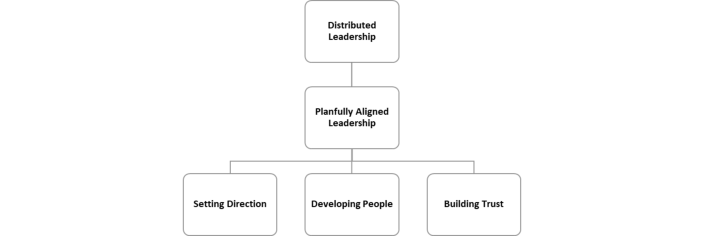
Planful Alignment In this configuration, the tasks or functions of those providing leadership have been given prior, planful thought by organizational members. Agree- ments have been worked out among the sources of leadership about which leadership practices or functions are best carried out by which source. Planfully aligned leadership (PAL) encompasses three distinct dimensions:
700 Shroff
1. Setting Direction (SD): Leading a team to a shared understanding of the actions and goals of the group is an important factor that can promote a feeling of purpose or vision (Hallinger & Heck 2002). 2. Developing People (DP): Individual assistance and intellectual stimula- tion, as well as setting an example for others, are all part of the process of cultivating others’ potential and increasing their sense of purpose and commitment to the team (Leithwood & Jantzi, 2006). 3. Building Trust (BT): Here trust is invested in role and status with a presumption of competence until proved otherwise (Bottery, 2002).
The below three dimensions of planfully aligned leadership were identified, measured, and validated as a part of a previous qualitative study, the purpose of which was to explore the phenomenon of distributed leadership among seafarers. Analysis of the transcripts revealed three distinct dimensions.
Figure 1 above depicts a framework for distributed leadership in the mari- time domain. Organizational members have given careful consideration to the roles and responsibilities of people in positions of authority. This agree- ment was reached among the sources of leadership about which source best carries out leadership practices or functions. Trust in one’s leadership colle- agues’ motives, well-founded assumptions about one’s leadership colleagues’ capabilities, and a preference for cooperation over competition as a way to increase productivity are some of the shared values and beliefs that seem likely to be associated with planful alignment.
Figure 1: Framework of distributed leadership.
AUTHORITARIAN LEADERSHIP Traditionally leadership has been understood and conceptualized as a pheno- menon that involves a single person taking the lead (Hunter, Bedell-Avers, & Mumford, 2007). Khan et al. (2015) reviewed the different leadership styles among project managers and their influence on team outcomes. Style may also be considered as the leader’s behaviour. Every leader has a unique style of leading others. One of the styles of leadership is what is called the authori- tarian style. There has been a lot of change in perception among management experts in how leadership is defined and understood from a very autocratic to a very participative approach. There is agreement among researchers that
Distributed Leadership and Seafarers’ Emergency Response 701
different styles are required in different situations, and a leader needs to adapt to the problem and understand when to (Khan et al., 2015).
The shipping industry’s long-standing authoritarian leadership (AL) style has been one of the main obstacles to leadership growth. On board, a strict vertical structure is in place, with the ship’s Master wielding unquestionable authority and dominion. The ship’s officer must adapt to the ship’s unique circumstances and inspire and motivate his crew. Hierarchical authority alone should not determine his ability to govern (Luke, T., 2017). Comperatore (2005) states that authoritarian leadership is one of the stressors that are prevalent in the maritime environment. This stressor combines with other stressors such as extreme temperatures, long working hours, mental and phy- sical workload, isolation, and other stressors. This system of stressors affects the ability of crew members to remain alert and perform.
EMERGENCY RESPONSE Emergency management was institutionalized in 1979 with the creation of the Federal Emergency Management Agency (FEMA). Emergency manage- ment involves four phases: mitigation, preparedness, response, and recovery. Table 1 below briefly describes each of these phases. (Bullock, J. A., Haddow, G. D., and Coppola, D. P., 2013).
Each step of emergency management is distinct, yet they frequently overlap in execution. Response is the second part of emergency management. During and immediately following an emergency, this phase calls for action to be taken. Put your plans into action in this phase. Whilst preparation is essential to all emergency management stages, the current study examines the second stage, i.e. “emergency response” (ER).
Table 1. The four phases of emergency management.
Table available in the original PDF paper.
PHASES Mitigation:
This involves taking action to prevent any emergency or reduce the chances of an emergency. It also includes actions taken to minimize the adverse effects of crises. Preparedness:
This involves planning and preparing to handle any emergency. Preparedness activities take place before an emergency occurs. Response:
This involves responding safely to an emergency. It includes taking actions to prevent damage and steps taken to save lives. Response activities take place during an emergency. Recovery:
This involves taking action to come back to a safer situation following the emergency.
METHOD
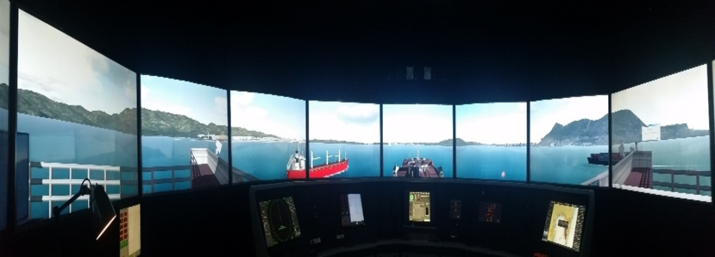
For the current study, a simulation was designed and conducted to exa- mine whether planfully aligned leadership predicts emergency response. The TRANSAS NT – PRO 5000 full mission bridge configuration consists of the complete range of navigational controls found on the ship’s bridge.
702 Shroff
Figure 2: Navigation simulator (TRANSAS NT- PRO 5000).
This includes radar displays, Electronic Chart Display Information System (ECDIS), Navigational aids, real vessel controls, and navigational sensors; all of these are built into consoles.
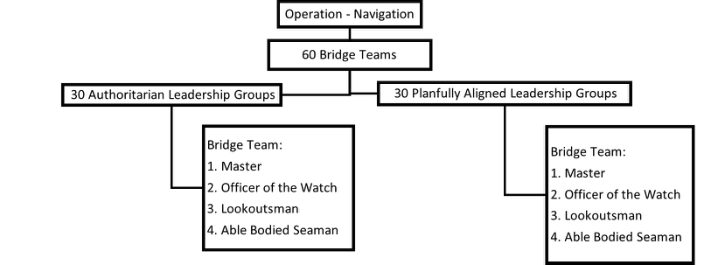
The Study Participants The study participants of this phase were sailing officers. A typical team of sailing officers called the Bridge Team (in Figure 3 below) consisted of the formal leader (Ship Master), Officer of the Watch (OOW), Lookouts man, and an Able Bodied Seaman (AB). 30 planfully aligned leadership groups and 30 authoritarian leadership groups participated in the simulation. The study employed a between-groups, independent measures design.
Research Procedure To better understand the relationship between the bridge team’s response to an emergency and their leadership, a simulation was conducted. Each partici- pant group was first given an explanation of the study’s scope and goals. They were also briefed about safety, potential risks/benefits, the expected duration of the research, and their role in the simulation.
On Day 1, a familiarization was carried out and took approximately 45 minutes. On Day 2, the simulation was carried out. The team members
Figure 3: Bridge team composition.
Distributed Leadership and Seafarers’ Emergency Response 703
were briefed. The Master was briefed separately and given a script. Doubts were clarified before entering the simulator. The Master in the authoritarian leadership group displayed authoritarian leadership, whereas the Master in the planfully aligned leadership group displayed planfully aligned leadership. The Master in every group was thoroughly briefed and was given a small card with simple scripted statements/actions which he had to say/do at specific intervals in the exercise.
Immediately after the simulation, the participants attempted a scale measu- ring planfully aligned leadership and its three dimensions – setting direction, developing people and building trust.
Event-Based Approach to Training and Assessment The Event-Based Approach to Training (EBAT) is a methodology used to assess individual and team performance (Rosen et al., 2008). In this approach, critical events are inserted into appropriate contextualized scenarios. Behavi- oural assessments were carried out in real-time. This methodology was used to develop an event-based checklist for measuring emergency response of the team.
Emergency response was measured at the team level using an event-based checklist. An event-based checklist was developed after the critical events were inserted sequentially into the scenario and the script was established. the checklist is used to assess the appropriate responses as they occur. The beha- vioral responses or acceptable behaviors were created by reviewing standard operating procedures and also interviewing nautical faculties/programme heads.
RESULTS
Quantitative analysis is presented in the tables below. This section addresses the research questions of the study. The results of each testing are presented below.
A manipulation check was used in this study. This check helps gauge whe- ther the manipulation has been effective in the experimental design. To check if the manipulation was successful, we conducted an Independent Samples T-test to observe the difference in perception of team behavior scores. From the scores on the planfully aligned leadership scale, it was found that the mean of the planfully aligned leadership group (M = 4.28, SD = .38) was signi- ficantly higher than that of the authoritarian leadership group (M = 3.35, SD = .42). The mean scores of all the dimensions viz. SD, DP, and BT of the planfully aligned leadership group were significantly higher than the authoritarian leadership group.
The T-test results thus indicated that team members’ responses to the two types of leadership prompts in the manipulation were triggered by the manipulation.
What is the strength and direction of the relationship between planfully aligned leadership (PAL) and emergency response (ER) of the team members?
704 Shroff
Table 2. T test for equality of means.
Table available in the original PDF paper.
t-test for Equality of Means 95% Confidence Interval of the Difference
Ordinary least square (OLS) regression was employed to determine if leadership contributed to the effective response of team members to the emer- gency. As Table 3 indicates, there is a positive and significant relationship between PAL and ER. Table 4 displays effect size measures (R2) and adju- sted R2 for the model, and Table 6 displays pooled unstandardized regression coefficients (B) and standardized regression coefficients (β). The Ezekiel adju- sted R2 value indicates that PAL predicted just 47.8 percent of the variability in ER.
What is the strength and direction of the relationship between the three dimensions of planfully aligned leadership viz. Setting Direction (SD), Deve- loping People (DP) and Building Trust (BT)?
Table 3. PAL as a predictor of emergency response from ordinary least squares regression.
Table available in the original PDF paper.
Model Summary
Change Statistics
Model R R Square
Adjusted R Square
Std. Error of the Estimate R Square Change
F Change
df1 df2 Sig. F Change 1 .698a .487 .478 .48502 .487 55.097 1 58 .000
a. Dependent Variable: ERM b. Predictors: (Constant), PAL Mean
Distributed Leadership and Seafarers’ Emergency Response 705
Table 5. Coefficients results.
Table available in the original PDF paper.
Unstandardized Coefficients
Standardized Coefficients
Model B Std. Error Beta t Sig.
1 (Constant) −.297 .261 −1.140 .259 PAL Mean .526 .071 .698 7.423 .000 a. Dependent Variable: ERM
Table 6. SD, DP, and BT - dimensions of planfully aligned leadership as a predictor of emergency response from ordinary least squares regression.
Table available in the original PDF paper.
Model Summary
Change Statistics
Model R R Square
Adjusted R Square
Std. Error of the Estimate R Square Change
F Change
df1 df2 Sig. F Change 1 .673a .453 .444 .50083 .453 48.072 1 58 .000
a. Predictors: (Constant), SD
Change Statistics
Model R R Square
Adjusted R Square
Std. Error of the Estimate R Square Change
F Change
df1 df2 Sig. F Change 2 .710a .504 .495 .47700 .504 58.936 1 58 .000
a. Predictors: (Constant), DP
Change Statistics
Model R R Square
Adjusted R Square
Std. Error of the Estimate R Square Change
F Change
df1 df2 Sig. F Change 3 .662a .438 .429 .50758 .438 45.269 1 58 .000
a. Predictors: (Constant), BT
When the three dimensions of PAL were examined individually (Table 6 to 8), each dimension was strongly linked to emergency response. Howe- ver, Developing People was the most potent contributor as it independently explained about 49.5% of predicted ER.
Is planfully aligned leadership a better predictor of emergency response among team members than authoritarian leadership?
We conducted an Independent Samples T-test to observe the mean diffe- rence in the emergency response of team members of the two experimental groups, i.e., PAL and AL. Tables 9 and 10 show that the mean of the PAL group (M = 2.15, SD = .31) is significantly higher than the AL group (M = 1.0, SD = .36). The p-values obtained from the independent sam- ples t-test, are statistically significant, p< 0.001. It indicates that distributed leadership or PAL is a better predictor of emergency response among team members than authoritarian leadership.
L N Mean Std. Deviation Std. Error Mean ERM 1.00 30 2.1567 .31479 .05747 2.00 30 1.0033 .36102 .06591
Note: ERM:
Distributed Leadership and Seafarers’ Emergency Response 707
Table 10. Independent samples test results.
Table available in the original PDF paper.
t-test for Equality of Means t Df Sig. (2-tailed) Mean Difference Std. Error Difference
95% Confidence Interval of the Difference Lower Upper
13.188 58 .000 1.15333 .08745 .97828 1.32838
ERM Equal variances assumed
13.188 56.944 .000 1.15333 .08745 .97821 1.32845
Equal variances not assumed Note: ERM:
CONCLUSION AND POINTERS FOR FUTURE RESEARCH This study was an attempt to examine the relationship between planfully aligned leadership and emergency response. Quantitative analysis of the findings showed a positive and significant relationship between planfully aligned leadership and emergency response. When the three dimensions of planfully aligned leadership i.e. setting direction, developing people and buil- ding trust were examined individually, each dimension was found to be strongly related to emergency response. Developing People was the most sub- stantial contributor as it independently explained about 49.5% of predicted ER. Lastly, the results showed that planfully aligned leadership was a better predictor of emergency response than authoritarian leadership.
This study analyses the relationship between planfully aligned leadership and emergency response and makes it worth further investigation and scru- tiny. Future research could delve into how leadership is distributed and an analysis of the factors that facilitate DL. Distributed leadership provides an interesting construct for safety leadership and should be implemented in leadership research within the maritime industry.
ACKNOWLEDGMENT
The author is deeply indebted to her research guide, Dr. Sasmita Palo, and members of the Doctoral Advisory Committee, Dr. Zubin Mulla and Dr. (Capt.) S. Bhardwaj for their guidance, mentoring, and support throughout the study. She would like to extend her gratitude to Anglo-Eastern for their encouragement, provision of expertise, and technical support throughout this study.
REFERENCES
Bennett, N., Wise, C., Woods, P., & Harvey, J. A. (2003). Distributed Leadership: A Review of Literature Other How to cite: A review of literature carried out for NCSL by Distributed Leadership. Bullock JA, Haddow GD, Coppola DP. Mitigation, Prevention, and Preparedness.
Comperatore, C. A., Rivera, P. K., & Kingsley, L. (2005). Enduring the shipboard stressor complex: A systems approach. Aviation, space, and environmental medicine, 76(6), B108-B118. Hallinger, P. (2003). Leading educational change: Reflections on the practice
of instructional and transformational leadership. Cambridge Journal of educa- tion, 33(3), 329–352. Harris, A. (2009). Distributed Leadership: What We Know. In Distributed Leadership (pp. 11–21). Springer The Netherlands. Hunter, S. T., Bedell-Avers, K. E., & Mumford, M. D. (2009). Impact of situatio-
nal framing and complexity on charismatic, ideological and pragmatic leaders: Investigation using a computer simulation. The Leadership Quarterly, 20(3), 383–404. Khan, M. S., Khan, I., Qureshi, Q. A., Ismail, H. M., Rauf, H., Latif, A., & Tahir, M. (2015). The styles of leadership: A critical review. Public Policy and Administration Research, 5(3), 87–92. Kim, T. eun, & Gausdal, A. H. (2017). Leading for safety: A weighted safety
leadership model in shipping. Reliability Engineering and System Safety, 165, 458–466. Leithwood, Kenneth & Jantzi, Doris & Earl, Lorna & Watson, Nancy & Levin, Ben & Fullan, Michael. (2004). Strategic leadership for large-scale reform: The case of England’s national literacy and numeracy strategy. School Leadership and Management. 24. 57–79. 10.1080/1363243042000172822. Leithwood, K., Mascall, B., Strauss, T., Sacks, R., Memon, N., & Yashkina, A.
(2007). Distributing leadership to make schools smarter. OISE: University of Toronto. Luke, Terry. (2017). An analysis of leadership competencies that are critical in the prevention of high consequence incidents in the maritime industry. Roberts, S. E., Nielsen, D., Kotłowski, A., & Jaremin, B. (2014). Fatal accidents
and injuries among merchant seafarers worldwide. Occupational Medicine, 64(4), 259–266. Rosen, M. A., Salas, E., Silvestri, S., Wu, T. S., & Lazzara, E. H. (2008). A measurement tool for simulation-based training in emergency medicine: The simu- lation module for assessment of resident targeted event responses (SMARTER) approach. Simulation in Healthcare, 3(3), 170–179. Schröder-Hinrichs, J. U., Hollnagel, E., & Baldauf, M. (2012). From Titanic to Costa
Concordia-a century of lessons not learned. WMU Journal of Maritime Affairs, 11(2), 151–167. Vineet Kaur Sandhu. A Transactional Approach of Occupational Stress and Behaviour Pivotal to Human Error and Leadership in Maritime. J Environ Occup Health. 2021; 11(2):9–17.
LISTED IN THE AHFE DIGITAL BOOKSTORE CATALOGUE
Explore the complete digital volume
Human Factors in Transportation
Read this individual research paper free through the original publisher, or explore the full digital proceedings book.
ISBN 978-1-958651-71-1
Explore this ISBN in the AHFE Bookstore ↗Listed in the July 2026 bookstore catalogue; search by ISBN to confirm current availability · Digital book purchase optional