Jérôme Dinet, Rui Nouchi (2022). Promoting Physical Activity for Elderly People with Immersive Virtual Reality (IVR). In: Human Factors in Aging and Special Needs. AHFE Open Access, vol. 38, pp. 206–211. https://doi.org/10.54941/ahfe1001682
Physical and social activities should be included in an efficient e-coaching for older adults and immersive virtual reality (IVR) is efficient if behavioral changes are transferred to the real physical world. In an experiment con-ducted with 42 older adults (63-85 years-old), participants were asked to interact with a specific immersive virtual reality (IVR) daily for 4 months in their homes, at least 15 minutes per day. Results demonstrate several positive impacts related to the use of the IVR (decrease of weight, decrease of waist circumference, number of steps outside) even if the time spent to use this IVR system decreases. So the transfer from the IVR to the real world is very encouraging.
As people generally live longer, maintaining physical autonomy of older adults, and thus their independence, is a key challenge that all modern socie- ties must face and succeed to ensure the economic and social wellbeing of the entire population. Moreover, loneliness is also a key challenge in the social domain related to aging. Nonetheless, the e-coaching literature does not (yet) reflect this trend. In this vein, we assume two ideas: (a) first, physical and social activities must be included in an efficient e-coaching; (2) second, an IVR is efficient if behavioral changes are transferred to the real physical world. Several studies confirmed that immersive virtual reality (IVR) can be relevant and acceptable for older people to promote and maintain physical and social activities (Appel et al., 2020; Baker et al., 2018, 2019; Dilanchian, Andringa & Boot, 2021; El Kamali et al., 2020; Kim, Darakjan & MacFinley, 2017). Moreover, several recent studies showed that the older adults repor- ted positive experiences and positive attitudes with immersive virtual reality (IVR; Abeele et al., 2021; Appel et al., 2020; Dinet et al., 2021).
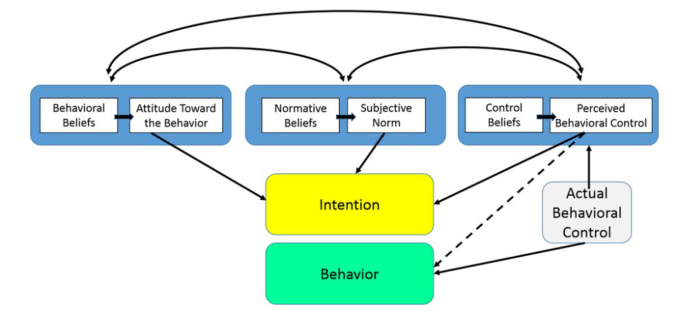
Contrary to many studies related to IVR where no theoretical back- ground exists (Armitage & Conner, 2000, 2001)], our experiment is based on the Theory of Planned Behavior (TPB) to describe and to predict the results. The Theory of Planned Behavior (TPB; Figure 1) is one of the most widely cited and applied behavior theories, by adopting a cognitive approach
Promoting Physical Activity for Elderly People with Immersive Virtual Reality (IVR) 207
Figure 1: The theory of planned behavior (TPB; Ajzen 1985, 1991).
to explaining behavior which centers on individuals’ attitudes and beliefs (Munro et al., 2007; Nisbet & Gick, 2008; Taylor et al., 2007; Terry, 1993). The TPB evolved from the theory of reasoned action which posi- ted intention to act as the best predictor of behavior (Ajzen, 1985, 1991; Ajzen & Madden, 1986; Bandura, 1997; Bandura, Freeman & Lightsey, 1999; Fishbein & Ajzen, 1975; Hardeman et al., 2002). Intention is itself an outcome of the combination of attitudes towards a behavior. The TPB sta- tes that behavioral achievement depends on both motivation (intention) and ability (behavior-al control). It distinguishes between three types of beliefs - behavioral, normative, and control. The TPB is comprised of six constru- cts that collectively represent a person’s actual control over the behavior: (1) Attitudes - This refers to the degree to which a person has a favorable or unfavorable evaluation of the behavior of interest; (2) Behavioral intention - This refers to the motivational factors that influence a given behavior where the stronger the intention to perform the behavior; (3) Subjective norms - This refers to the belief about whether most people approve or disapprove of the behavior; (4) Social norms - This refers to the customary codes of beh- avior in a group or people or larger cultural context; (5) Perceived power - This refers to the perceived presence of factors that may facilitate or impede performance of a behavior; (6) Perceived behavioral control [10] [20] - This refers to a person’s perception of the ease or difficulty of performing the beh- avior of interest. This construct of the theory was added later, and created the shift from the Theory of Reasoned Action to the Theory of Planned Behavior.
METHOD
We hypothesize that the navigation in the immersive virtual reality (IVR) will have positive impacts on real behaviors (walking) in the real world. Forty-two older adults participated to our experiment (63-85 years-old), half of whom interacted with a specific immersive virtual reality (IVR) daily for 4 months in their homes and half of whom served as a standard-of-care control.
208 Dinet and Nouchi
Table 1. Distribution of study participants.
Table available in the original PDF paper.
IVR group (N=21) Control group (N=21) Total (N=42) SEX (n, %) Male 8 (38%) 7 (33,3%) 15 (35.7%)) Female 13 (61%) 14 (66.6%) 27 (64,2%) AGE Mean (SD) 78.4 (6.7) 77.8 (6.9) 78.1 (6.8) Min.-Max. 64-85 63-84 63-85 SCORE MMSE Normal (>24) 17 (80.9%) 16 (76,1%) 33 (78.5%) Mild (21-24) 4 (19%) 5 (23,8%) 9 (21,4%) Moderate (10-20) 0 0 - Severe (<10) 0 0 - AIDS (n, %) Use glasses 19 (90%) 20 (95.2%) 39 (92,8%) Hearing diff. 5 (23,8%) 6 (28.5%) 11 (26.1%) Limited mobility 2 (9.5%) 2 (9.5%) 4 (9.5%)
Participants Forty-two seniors participated to our experiment (64.2% females; mean age = 78.1 years-old; range from 63 to 85 years-old). Distribution of participants is presented in Table 1. Participants are distributed in two separate groups: 21 participants in the experimental group and 21 participants in a control group. Participants in the experimental group were asked to interact with a specific immersive virtual reality (IVR) daily for 4 months in their homes, at least 15 minutes per day. No specific information has been provided for participants who served as a standard-of-care control.
Eligibility Criteria and Distribution of Participants Participants were included in our study if they were (1) adults over 60 years old; (2) could communicate in French fluently; (3) were able to consent to participate in the study; (4) live in cities located in the East of France; and (5) had normal or mild levels of cognition (scored >21 on Mini-Mental State Examination or MMSE). Individuals were excluded if they met any of the following criteria: (1) vision impairment at a level that would make it impossible for them to use the immersive virtual reality (IVR) system; (2) open wounds or skin conditions on the face, or chronic neck pain/injury that might make it unsafe to wear the IVR headset; (3) inability to provide consent.
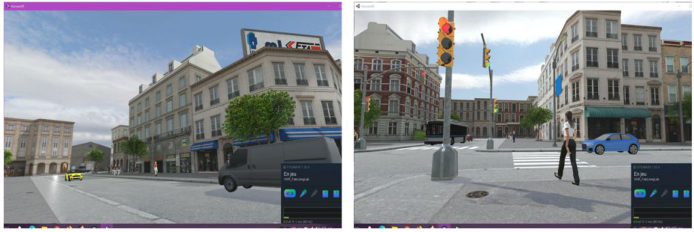
least 15 minutes per day, in their home, within this specific IVR while they were seated. They were asked to “simply explore the virtual town and to navigate in this town to become familiar with it”. Several training sessions were organized to familiarize participants with the IVR system.
As Table 2 shows, three main group differences and within differences have been obtained: (1) The mean weight and the mean waist circumference of participants using the specific IVR system decrease significantly while these data remain stable for the control group; (2) The number of steps outside and the perception of intensity of activity increase significantly for participants using the specific IVR system, while these data re-main stable for the control group; (3) the positive impacts related to the use of the IVR exist even if the time spent to use this IVR system decreases.
Even if future studies are needed to control the possible impact of some individual factors (e.g., gender, status, hobbies), our experiment confirms that as immersive virtual reality (IVR) has become more accessible, affor- dable, and comfortable, there provide an unique opportunity to use these technologies to enable older adults to escape from their often confined area (Appel et al., 2020). More precisely, the use of a specific IVR can modify positively human behaviors of older adults from the virtual world to the real
210 Dinet and Nouchi
Table 2. Results obtained for the two groups (experimental IVR Group and Control Group).
Table available in the original PDF paper.
Month 1 Month 2 Month 3 Month 4 p.
WEIGHT (in kg.) IVR Group 66.8 64.3 63.1 63.7 .002 Control Group 67.1 66.5 66.6 67 ns WAIST CIRCUMFERENCE (in cm.) IVR Group 102 100 98.7 97.5 .003 Control Group 101 100 99.8 100.5 ns NUMBER OF STEPS OUTSIDE IVR Group 3890 6895 7789 7604 <.001 Control Group 4002 4069 4238 3791 ns TIME OF USE OF IVR (in min. per day) IVR Group 15 36 23 12 .02 - - - - - - PERCEPTION OF INTENSITY OF ACTIVITY (from 0 to 7) IVR Group 1 3,1 5 5,5 <.001 Control Group 0,8 1 1,2 1.3 ns
and physical world. In other words, impacts of an immersive virtual rea- lity can be positive because its use can help individuals (here, older adults) to adopt new intentions and new positive behaviors in real and physical world.
REFERENCES
Abeele, V. V., Schraepen, B., Huygelier, H., Gillebert, C., Gerling, K., & Van Ee, R.
(2021). Immersive Virtual Reality for Older Adults: Empirically Grounded Design Guidelines. ACM Transactions on Accessible Computing (TACCESS), 14(3), 1–30. Ajzen, I. (1985). “From intentions to actions: A theory of planned behavior”. In: J.
Kuhl & J. Beckman (Eds.) Action-control: From Cognition to Behaviour. Springer, Heidelberg. Ajzen, I. (1991). The Theory of Planned Behavior: Organisational Behavior and Human (eds) Decision Processes. Ajzen, I., & Madden, T. J. (1986). Prediction of goal-directed behavior: Attitu-
des, intentions, and perceived behavioral control. Journal of experimental social psychology, 22(5), 453–474. Appel, L., Appel, E., Bogler, O., Wiseman, M., Cohen, L., Ein, N., ... & Campos, J. L.
(2020). Older adults with cognitive and/or physical impairments can benefit from immersive virtual reality experiences: a feasibility study. Frontiers in medicine, 6, 329. Armitage, C. J., & Conner, M. (2000). Social cognition models and health behaviour: A structured review. Psychology and health, 15(2), 173-189. Armitage, C. J., & Conner, M. (2001). Efficacy of the theory of planned behaviour:
A meta-analytic review. British journal of social psychology, 40(4), 471–499. Armitage, C. J., Sheeran, P., Conner, M., & Arden, M. A. (2004). Stages of change or changes of stage? Predicting transitions in transtheoretical model stages in relation to healthy food choice. Journal of consulting and clinical psychology, 72(3), 491.
Promoting Physical Activity for Elderly People with Immersive Virtual Reality (IVR) 211
(2018). Combatting social isolation and increasing social participation of older adults through the use of technology: A systematic review of existing evidence. Australasian Journal on Ageing, 37(3), 184–193. Baker, S., Waycott, J., Carrasco, R., Hoang, T., & Vetere, F. (2019, June). Bandura, A., Freeman, W. H., & Lightsey, R. (1999). Self-efficacy: The exercise of control. Exploring the design of social VR experiences with older adults. In Pro- ceedings of the 2019 on Designing Interactive Systems Conference (pp. 303–315). Dilanchian, A. T., Andringa, R., & Boot, W. R. (2021). A Pilot Study Exploring
Age Differences in Presence, Workload, and Cybersickness in the Experience of Immersive Virtual Reality Environments. Frontiers in Virtual Reality, 129. Dinet, J., Nouchi, R., Sakaki, K., Dupont, L., Coudrat, L., & Charpillet, F. (2021, October). Promoting Physical Activity for Elderly People: Towards a Hybrid Coaching?. In ERGO’IA 2021. Fishbein, M. (1975). Azjen. 1975. Belief, Attitude, Intention and Behavior: An
Introduction to Theory and Research. Reading: Addison-Wesley. Hardeman, W., Johnston, M., Johnston, D., Bonetti, D., Wareham, N., & Kinmonth, A. L. (2002). Application of the theory of planned behaviour in behaviour change interventions: A systematic review. Psychology and health, 17(2), 123–158. El Kamali, M., Angelini, L., Caon, M., Carrino, F., Röcke, C., Guye, S., ... & Mugel-
lini, E. (2020). Virtual coaches for older adults’ wellbeing: A systematic review. IEEE Access, 8, 101884–101902. Kim, A., Darakjian, N., & Finley, J. M. (2017). Walking in fully immersive virtual environments: an evaluation of potential adverse effects in older adults and indi- viduals with Parkinson’s disease. Journal of neuroengineering and rehabilitation, 14(1), 1–12. Munro, S., Lewin, S., Swart, T., & Volmink, J. (2007). A review of health behaviour
theories: how useful are these for developing interventions to promote long-term medication adherence for TB and HIV/AIDS?. BMC public health, 7(1), 1–16. Nisbet, E. K., & Gick, M. L. (2008). Can health psychology help the planet? Applying theory and models of health behaviour to environmental actions. Canadian Psychology/Psychologie canadienne, 49(4), 296. Taylor, D., Bury, M., Campling, N., Carter, S., Garfied, S., Newbould, J., & Rennie,
T. (2007). A Review of the use of the Health Belief Model (HBM), the Theory of Reasoned Action (TRA), the Theory of Planned Behaviour (TPB) and the Trans- Theoretical Model (TTM) to study and predict health related behaviour change. National Institute for Health and Clinical Excellence. Terry, D. J. (2015). Self-efficacy expectancies and the theory of reasoned action.
LISTED IN THE AHFE DIGITAL BOOKSTORE CATALOGUE
Explore the complete digital volume
Human Factors in Aging and Special Needs
Read this individual research paper free through the original publisher, or explore the full digital proceedings book.
ISBN 978-1-958651-14-8
Explore this ISBN in the AHFE Bookstore ↗Listed in the July 2026 bookstore catalogue; search by ISBN to confirm current availability · Digital book purchase optional