Cheng-li Liu, Shiaw-tsyr Uang (2024). An approximate metaverse virtual store designed for reducing cybersickness in middle-aged consumers. In: Human Factors in Aging and Special Needs. AHFE Open Access, vol. 133, pp. 91–97. https://doi.org/10.54941/ahfe1004897
With the rapid growth of online shopping, the business model of online stores has also shown diversified development. In the case of product display, when customers cannot experience the actual product in person, merchants will work hard to promote the products to gain the favor of customers on the display platform and then to purchase their products. However, traditional product catalogs in 2D images to present products cannot satisfy consumers' recognition. With the advancement of technology, online stores constructed with 3D virtual reality will significantly enhance consumers' attraction. Previous research in Taiwan found that the percentage of people over 40 engaged, especial in middle-aged, in online activities has increased significantly since 2011. If the virtual store added the metaverse concept, middle-aged people could interact with relatives and friends like in real life. It is convinced that this online store consumption model will profoundly affect middle-aged people to be happy to invite relatives and friends to participate in online shop shopping. However, the resulting problems, such as spatial orientation and spatial perception conflicts, need to be addressed as soon as possible so as not to affect the participation of middle-aged people. This study applied the concept of cross-zone navigation and the method of static clarity-reducing design in peripheral vision to reduce cybersickness infection and obtain a safe shopping environment. The results showed that cross-zone navigation developed in this study can assist middle-aged subjects in reaching the target location quickly, reducing disorientation problems.
With the rapid growth of online shopping, the business model of online stores has also shown diversified development. In the case of product display, when customers cannot experience the actual product in person, merchants will work hard to promote the products to gain the favour of customers on the display platform and then to purchase their products. However, tradi- tional product catalogues in 2D images to present products cannot satisfy consumers’ recognition. With the advancement of technology, online stores constructed with 3D virtual reality will significantly enhance consumers’
attraction, especially for the middle-aged people (Altarteer & Charissis, 2019). Since the COVID-19 pandemic in 2020, people’s shopping behavior has been restricted, resulting in an increase in online shopping. Relevant research in Taiwan found that the proportion of personal Internet access has grown rapidly since 2011 (13.1%), and has remained stable at more than 75% since 2018. The Internet access rate among 40–49 year olds reached 97.22%; the Internet access rate among 50–59 year olds reached 89.60%. In terms of online shopping: 68.86% for 40–49 year olds and 39.87% for 50–59 year olds in 2022; by 2023, it has increased to 74.54% for 40–49 year olds and 44.72% for 50–59 year olds. The increase rate is significant. The result shows that the participation of middle-aged people in online shopping is bound to grow rapidly (Taiwan Internet Information Center, 2023; Taiwan Internet Information Center, 2024).
To take advantage of the market opportunities, Spark Inc. opened its first 3D virtual store in New Zealand in 2020 (Spark News, 2020). If the vir- tual store added the metaverse concept, middle-aged people could interact with relatives and friends like in real life. It is convinced that this online store consumption model will profoundly affect middle-aged people to be happy to invite relatives and friends to participate in online shop shopping. However, the resulting problems, such as spatial orientation and spatial per- ception conflicts, need to be addressed as soon as possible so as not to affect the participation of middle-aged people.In the context of the metaverse, vir- tual reality makes people feel like they have entered another world. In such a virtual world, VR allows users to explore large virtual environments in a smaller physical space (Hirt et al., 2018). As in the real world, spatial orien- tation abilities allow us to determine our position relative to the environment (Carbonell-Carrera & Saorin, 2018). When observing objects in the spatial environment from different positions, people begin to establish the orien- tation and distance to the object, which is also called the ability to orient in the spatial environment (Fleishman & Dusek, 1971). Spatial orientation in humans is a complex behavior that plays a key role in daily activities: it provides the necessary ability to find one’s way around familiar and novel environments and allows individuals to move within the environment with spatial purpose (Carbonell-Carrera & Saorin, 2018). Due to the deteriora- tion of perceptual functions in middle-aged people, past research has found that spatial orientation ability is affected by age factors. Iaria et al. (2008) explained that spatial orientation ability decreases with age. In the virtual stores constructed by the metaverse, spatial movement will inevitably occur. The problem of spatial orientation among the middle-aged group is an issue that cannot be ignored.
Cybersickness is a physiological problem derived from the widespread use of virtual reality. Therefore, many researchers believe that cybersick- ness is the biggest threat to the success of virtual reality. This discom- fort will also affect the development of applications brought about by virtual reality (such as games, training, medical... and other activities) (Kim et al., 2021). Cybersickness is usually described as discomfort when
An Approximate Metaverse Virtual Store Designed for Reducing Cybersickness 93
experiencing virtual reality, which may lead to symptoms such as nau- sea, sweating, eye fatigue, dizziness, and disorientation (Ng et al., 2019). Relevant research found that cybersickness usually occurs when people are exposed to visual motion stimuli but remain relatively stationary in the real world. This situation is also called visually induced motion sickness (Cao et al., 2018). When middle-aged consumers enter the metaverse virtual store and enjoy the fun of shopping, due to improper system design and operational problems, cybersickness may cause middle-aged consumers to feel repelled and, therefore, choose to leave the metaverse virtual store. It will be the biggest threat to the development of the metaverse virtual store. The purpose of this study is to establish an approximate metaverse vir- tual store experimental environment, and apply the concept of cross- area navigation and peripheral blur to construct a visual field sys- tem that can reduce the induction of cybersickness, so as to obtain a safe shopping environment.
RESEARCH METHODOLOGY Navigation Design
In the real world, consumers entering a large shopping mall can refer to nav- igation maps to find the counters, restrooms, elevators, rest areas, entrances, and exits they want to go to. The channel among people, locations, and products can be constructed quickly. Additionally, the maps can also help consumers confirm the spatial location of exhibition venues and products, effectively help consumers understand unknown destinations, and quickly find the products they need. In the metaverse virtual store, except traditional map navigation, can we also use hyper-realistic method to reach the loca- tion of products quickly and result in less cybersickness caused by spatial object search? A cross-area navigation design method was used to transcend space limitations, so that after entering the virtual store, consumers can jump quickly to the exact location of the product by a hyper-realistic way of space. The specific designs are as follows:
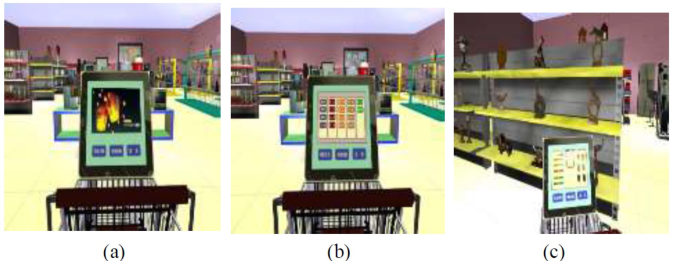
1. Virtual tablet navigation system: After entering the virtual store, con- sumer can activate the shopping cart. The car is equipped with a vir- tual tablet navigation system (see Figure 1(a)). There are three menus: “Product Catalog,” “Navigation Map” and “Projection.” 2. Clicking cross-area function: When consumers click on the “Product Cat- alog”function, a menu of 18 product categories will appear on the virtual tablet (see Figure 1(b)). Consumers can search for the product category on the virtual tablet based on the products they need, and then click on the product category, and the consumer will be instantly moved to the vicinity of the product counter. 3. Electronic assisted navigation map: If consumers want to know where they are, they can click on the “Navigation Map” function, and the sys- tem screen will display the mall space map and mark where they are (see Figure 1(c)).
94 Liu and Uang
Figure 1: The cross-area navigation system designed in the approximate metaverse virtual store: (a) virtual tablet navigation system; (b) clicking cross-area function; (c) electronic assisted navigation map.
Clarity-Reducing Design in Peripheral Vision In the metaverse virtual store, the multiple interactions between people are emphasized. In terms of system computing power, in addition to the original virtual situation dynamic computing, it is also necessary to increase the inter- actions between people and between people and things. The consumption of system resources is higher than in pure virtual environment operation, so this study used the method of static clarity-reducing design in peripheral vision for lower system resource consumption and reduced differences between visual and vestibular perception. The specific method is to add a filter in front of the user’s line of sight when browsing the virtual store.
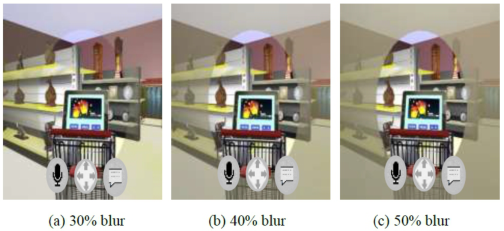
The process of gazing into the virtual environment is mainly done within the gaze area that can be observed by the visual center (the eyes are still, the head is still, and the eyeballs can rotate). This perspective covers approximately 40 degrees upward, about 50 degrees downward, and nearly 55 degrees left and right; the area where the visual field is more comfort- able is around 25 to 30 degrees. Therefore, in the design of the filter, the 30-degree area where the viewing area is more relaxed is used as the bound- ary. Within the range of a 30-degree viewing angle, the image resolution is slightly improved. In the area outside the 30-degree range, the image is blurred (as shown in Figure 2). This method emphasizes attention to the cen- tral vision image and blurs the peripheral images to reduce their interference, thereby reducing excessive eye movement or rotation, but does not affect the collection of peripheral image information to minimize the difference between vision and vestibular perception and cybersickness inducing because there is no relevant research information on the light projection intensity of the central sight image and the blur of the peripheral images on filter design, an experimental design was conducted to obtain the best level of blur design of the peripheral images.
An Approximate Metaverse Virtual Store Designed for Reducing Cybersickness 95
Figure 2: At the area outside of the 30-degree viewing angle, a clarity-reducing design of the approximate metaverse virtual store.
CYBERSICKNESS ASSESSMENT The subjective assessment of virtual space syndrome is mostly conducted through questionnaires. Lane and Kennedy (1988) determined 16 symptoms of motion sickness as psychometrically sound indicators of simulator sick- ness. SSQ symptoms indicate three constructs of simulator sickness: Nausea (N), Disorientation (D) and Oculomotor (O) effects, along with a second order more general factor as Total Severity (TS) (Kennedy et al., 2010). SSQ (Simulation Sickness Questionnaire) is used for measuring users’ level of sickness symptoms and is highly appreciated in VR research (Sevinc & Berkman, 2020). Since the questionnaire has 16 symptoms, it is not suitable for evaluation during the virtual environment operation. Generally, the test is conducted in two stages: before and after the operation, and then based on the results of the questionnaire to evaluate disease changes caused by the virtual environment.
RESULTS AND DISCUSSION
In this study, cross-area navigation mode and map navigation mode were established in the virtual store. Additionally, at the area outside of the 30-degree viewing angle, a clarity-reducing design in three blurs, 30%, 40%, and 50%, is to evaluate the effect on the cybersickness.
The SSQ test results were subjected to multivariate analysis before and after the VR store shopping operation. The results showed that cybersickness in subjects was significantly different in the navigation mode and clarity- reducing mode, but the interaction was not significant. Then, further testing of inter-subject effect items was carried out, and it was found that there was no significant difference in cybersickness among subjects before the experiment, but after the experiment, the effects of navigation mode and clarity-reducing mode in cybersickness were significantly different. Accord- ing to the results, a post-test was conducted, and the results showed that the cybersickness caused by traditional map navigation after the experiment was significantly higher than that of cross-area navigation. When cross- area navigation was combined with map navigation, the cybersickness was significantly lower than only cross-area navigation.
96 Liu and Uang
As for the clarity-reducing mode, the cybersickness caused by the 50% blur mode after the experiment was significantly lower than that of the 30% and 40% modes. By setting the static blur area, a higher degree of blur can reduce eyeball muscle tension and eye fatigue, thereby reducing the induction of cybersickness.
If the navigation mode and the clarity-reducing mode are combined, the statistical analysis results showed that cross-area navigation combined with the map navigation mode, in the 40% and 50% clarity-reducing design, may induce the cybersickness is the lowest; if only the map navigation mode, and when the blur degree is only 30%, the cybersickness that may be induced is the highest.
These results showed that the cross-area navigation could guide subjects to transcend time and space constraints so that after entering the virtual store, subjects can quickly arrive at the exact display location of the goods in a way of space jump. Compared with the traditional map navigation mode, cross-area navigation greatly reduces the exposure time in the virtual store and avoids disorientation. If coupled with the appropriate clarity-reducing function, the occurrence of cybersickness can be effectively reduced.
CONCLUSION
The cross-area navigation developed in this study can assist middle-aged sub- jects in quickly arriving at the target location, effectively reducing exposure time and disorientation. Based on the clarity-reducing design in periph- eral vision, filter blur is established, which can blur the surrounding area with lower resolution to reduce the difference between vision and vestibular perception. The integration of cross-area navigation and appropriate clarity- reducing function can effectively reduce the occurrence of cybersickness in middle-aged subjects.
ACKNOWLEDGMENT
The authors would like to thank the National Science and Technology Council of the Republic of China for financially supporting this work under Contract No. NSTC-111-2221-E-238-002.
REFERENCES
Altarteer, S. and Charissis, V. (2019. Technology acceptance model for 3d virtual reality system in luxury brands online stores, IEEE Access, 7, 64053–64062. Cao, Z., Jerald, J. and Kopper, R. (2018). Visually-induced motion sickness reduction
via static and dynamic rest frames, 2018 IEEE Conference on Virtual Reality and 3D User Interfaces (VR), Tuebingen/Reutlingen, Germany, pp. 105–112. Carbonell-Carrera, C. and Saorin, J. L. (2018). Virtual learning environments to enhance spatial orientation. Eurasia J Math Sci Technol Educ. https:// doi. org/ 10. 12973/ ejmste/ 79171 Fleishman, J. J. and Dusek, E. R. (1971). Reliability and learning factors associated
with cognitive tests. Psychol Rep, Vol. 29, No. 2, 523–530. Hirt, C., Zank, M., Kunz, A. (2018) “Geometry Extraction for Ad Hoc Redirected Walking Using a SLAM Device”, in: De Paolis, L.and Bourdot, P.(Eds) Augmented Reality, Virtual Reality, and Computer Graphics. AVR 2018. Lecture Notes in Computer Science, Volume 10850, S. 35–53.
An Approximate Metaverse Virtual Store Designed for Reducing Cybersickness 97
Iaria, G., Lanyon, L. J., Fox, C. J., Giaschi, D. and Barton, J. J. S. (2008). Navigational skills correlate with hippocampal fractional anisotropy in humans. Hippocampus, Vol. 18, 335–339. Kennedy, R. S., Drexler, J., Kennedy, R. C. (2010). Research in visually induced
motion sickness. Applied Ergonomic, Vol. 41, No.4, 494–503. Kim, Y. Y., Kim, E. N., Park, M. J., Park, K. S. and Kim, H. T. (2008). The application of biosignal feedback for reducing cybersickness from exposure to a virtual environment, Presence Teleoperators & Virtual Environments, Vol. 17, No. 1, 1–16. Lane, N. E., Kennedy, R. S. (1988). A new method for quantifying simulator sickness:
development and application of the simulator sickness questionnaire (SSQ). Essex Corporation, Orlando, FL 88–7. Spark news. (2020). Spark launches New Zealand’s first virtual and interactive 3D store, spark.co.nz/virtualstore. Sevinc, V., Berkman, M. I. (2020). Psychometric evaluation of simulator sickness
questionnaire and its variants as a measure of cybersickness in consumer virtual environments. Applied Ergonomics, Vol. 82, 102958. Taiwan Internet Information Center. (2022). Taiwan Internet Report 2022. Taiwan Internet Information Center. (2023). Analysis of personal online behavior trends over the years.
LISTED IN THE AHFE DIGITAL BOOKSTORE CATALOGUE
Explore the complete digital volume
Human Factors in Aging and Special Needs
Read this individual research paper free through the original publisher, or explore the full digital proceedings book.
ISBN 978-1-964867-09-0
Explore this ISBN in the AHFE Bookstore ↗Listed in the July 2026 bookstore catalogue; search by ISBN to confirm current availability · Digital book purchase optional