Paulo Dinis, Fernando Moreira da Silva, Rita Almendra (2022). The Car Segment Reconceptualization in Portugal: New Users, New Functions. In: Advances in Ergonomics In Design, Usability & Special Populations: Part II. AHFE Open Access, vol. 19. https://doi.org/10.54941/ahfe1001280
This article concerns to a current research that aims to develop and implement processes of analysis focusing on design, in particular with regard to the identification, study and the redefinition of new concepts for the automotive segmentation. The project also intends to identify the types most widely sold in Portugal from 1990 to 2013 and produce knowledge in the area of automotive design according to the characteristics and preferences of Portuguese drivers, mainly focusing on the user with the license under the age of 30. The user segmentation versus the automobile segmentation must be approached by common indicators, unlimited by technical terms non consistent with the Portuguese market, to its function and its user. Portugal offers good conditions suiting as a "living laboratory" to experience new mobility concepts. The small size of the territory is combined with the Portuguese willingness for innovation, gathering the ingredients to make of Portugal as a trial area and experimentation (Pinto, 2011). The analysis model centered on design aims to blur the technical barriers of the segmentation imposed by the several entities in the automotive sector and to produce a matrix more flexible and accessible to the user's knowledge, understanding and to its needs at the time of purchase.
The scope of this research focuses on the development and implementation of an examination process of analysis, centered in the Portuguese car design, namely in the identification, study and redefinition of the matrix which comprehends the user and car segmentation. In partnership with some entities and automotive sector companies, is expected to develop programs and projects concerning the creation of a niche-kind new individual Portuguese vehicle, highlighting concernings such as the research, concept, production, mobility, public space and security.
The research hypothesis - "The reconceptualization of the automobile sector in Portugal may represent an opportunity for an intervention in the design on the definition of formal and functional characteristics, aiming the needs of young drivers?" - refers to the statistics analysis about the car sales in Portugal and for the user’s needs in the country. The designer's role will be critical to the definition and redirection of the product in the competitive market, where the segments only meet the interests of manufacturers.
The case studies might be compelling for obtaining conclusions and research supportive on the construction of the analysis model proposal, focusing on Portuguese car design.
Ergonomics In Design, Usability & Special Populations II
A CONTEXT FOR THE REDEFINITON OF LIGHT-PASSENGER CARS SEGMENT The approach of the XXI century unleashed in the car designers the past evocation through conscious trends on the redesign, particularly on the large icons. The critical distance on what occurred in the past and self-criticism on the global car market development, allowed to explore a niche segment, appealing to the older drivers memories and capturing the younger drivers attention who find themselves flooded of several options, sometimes poorly differentiated and less tailored to their lifestyle.
The automobile has contributed to the societies development, always around a complex network of cultural, social, economic, technological and political interests. In the last two decades have been witnessed the globalization of markets and information. Nowadays, it can speak of design developed for the markets from Europe, Asia or America, meaning a style orientation for each market, regardless of the country origin of the brand (Marcelino, 2008).
Manufacturers tend to forecast the cars demand in terms of volumes and types such as models, versions or options. This kind of offer has been place since the beginning of the automotive industry.
The segmentation of products is made by the identification of subsets with similar characteristics to each other and distinguished from others.
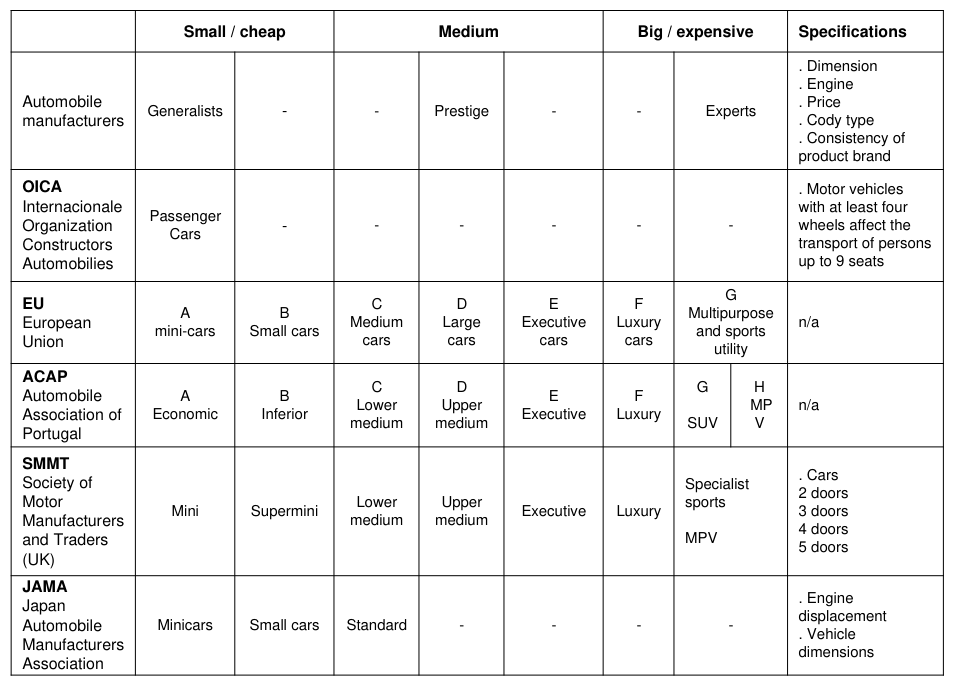
Among the different types of criteria to define the segment for each light passenger car, it is possible to distinguish them by characteristics such as dimensions, engine, bodywork, number of doors, function or price.
According to ACAP - Automobile Association of Portugal, the segmentation of a passenger car in Portugal is made by an alphabetical sequence - from the smallest to the largest bodywork: A - Economic and B - Low, C - Medium Low, D - Medium Superior; And - Superior, F - Luxury, G - SUV; H - MPV.
Ergonomics In Design, Usability & Special Populations II
Figure 1. Car body type (http://www.carsonelove.com/wp-content/uploads/2014/01/Car-Body-Types-1.jpg) In table 1 we can see some examples of segmentation / differentiation of a light passenger car bodywork.
Figure available in the original PDF paper.
Table 1: Segmentation of a light passenger car (addapted from Coutinho and Branco, 2001) Small / cheap Medium Big / expensive Specifications
SEGMENTATION AUTOMOBILE VS UNDERSTANDING AND NEEDS OF YOUNG DRIVERS Portugal is among the European countries with younger enabled to drive (Car Notebook Cetelem Observer 2011, sp), representing a strong market growth untapped by the brands. In the case of Portugal and Spain, the youth segment exceeds in proportion the elderly segment (Caldeira da Silva, 2011, s.p.).
Christopher Borroni-Bird (2011) – Director of General Motors in the area of advanced technologies and new vehicle concepts - states that future generations of users will be demanding and creative, forcing that the projects result in diversified and differentiated products, that offer various forms of mobility - car, motorcycle, bicycle and other - being the boldness the rule for new proposals.
Papanek (1995) states that designers and users should communicate more and allow could participate together to find solutions to your problems. As an example of this practice, Papanek, identifies two target groups who need services from industry and designers, the elderly, whose percentage in the world population has increased considerably in recent years and the young drivers that every year acquire their vehicle.
According Richers (1991), segmentation becomes necessary because a product or service may not meet all the Ergonomics In Design, Usability & Special Populations II requirements of all users at all times, and companies can not offer a product or a specific service for every consumer.
The differences between the consumers are used to define the process and the implementation on the market as strategic tool.
The advantages of market segmentation provide developing marketing opportunities and a more efficient and suitability of the products of a company in a more specialized market services and the definition of your target audience (Shiffman, 2000). Segmentation, according to Sheth (2001), is also characterized by intensive advertising and promotion, in order to promote the product, brand, company and consumer.
The company should give priority to a position in the market by differentiating the product offering with unique features that make it distinct from other competitive products or focus on a niche market still growing. For a differentiation strategy to be effective, it is important that the company consider the wants and needs of consumers (Shiffman, 2000).
A study by Bruno Fernandes (2007) around the market of automobile resulted in several segments between drivers, such as: those who like sports cars, and those who care about the safety of children, those who want functionality and costs reduced; those who pay more for luxury vehicles, and those who like to always have the newest models, etc.. Through the profiles or segments shown by the study, the sector companies can select their positioning for each product in order to achieve certain segment; produce another product to create a new segment; reposition some of your products or redesign existing ones.
To characterize the client are used as variables: geography, demography, socio-economic and psychographic, education, age, gender, culture, family size, hobbies, sports, work, etc.. (Shiffman, 2001).
According to Fernandes (2007) the result of their psychographic study in the automobile market in Belo Horizonte, Brazil, identified several segments of car users: Segment A - 9% - Passionate satisfied; Segment B - 23% - Young lovers; Segment C - 20% - planned Careful; Segment D - 19% - Traditional shaped; Segment E - 19% - visual Moderns; Segment F - 6% - Young hardworking; Segment G - 4% - Workers struggling..
A study of these characteristics, applied to Portuguese market, would allow professionals in the portuguese automobile design area to invest in a previously identified and receptive to new concepts market, not excluding the experience of the past 30 years, as we will present in the next section.
SEGMENTATION OF VEHICLES MADE IN PORTUGAL In the portuguese automotive history, there are few significant examples of producing a complete car, as are also there are few portuguese automotive companies that own products and own brands. In most cases, the conception or enhancement of a particular product is pre-defined by the integrator brand, leaving no room for the companies create their own products (Marcelino, 2008).
A critical overview of the literary evidence was possible to cross, systematize and organize a chart that summarizes chronologically the main examples of the professional activity of the Portuguese Automobile Design.
At the systematization of information about the experts were taken into account the following data available: company name or the host entity, the name of the specialist; training area; professional specialization; reference projects for our theme (CV; portfolio); contacts (email, phone).
After this collection, the data have been crossed and drew up a scheme that establishes a relationship between the experts, companies, case studies and professional areas integrated on teams, according to a growing chronology between the years 1977 and 2012.
The outside of the chronology, three professionals were inserted in the area of design to integrate our range of Ergonomics In Design, Usability & Special Populations II consultants:
. Designer Carlos Aguiar, by your professional resume and awards; . Designer Paul Bago D'Uva, by your professional resume, including automobile and boat design ;
. Designer José Vicente, by your recent PhD degree in design and creation of the model SDF Toolkit ¹.
By consulting the legend is possible to follow the chronological evolution and provide data about the companies and respective teams.
Diagram 1, Graphical Timeline - specialists, case studies, dates and professionals areas (author)
Ergonomics In Design, Usability & Special Populations II
¹ SDF Toolkit - Sustainable production and consumption in the furniture sector - qualitative tools of analysis, comparison and decision
In a brief analysis, it appears that the examples presented are focused on a niche market, namely, the segments of mini-cars, sports, off-road vehicles and heavy vehicles for passenger . In addition to the types of vehicles and their evolution over the years, it is also verified that the constitution of teams is unstable at the level of different professional areas, but where the design stands out for its presence in almost all projects from 2002 .
Case Studies Literary criticism and fieldwork conducted in parallel with the selection of experts allowed the identification of case studies of reference for our research.
The information collected was synthesized by a graphical model that consists of three distinct phases of work.
During the investigation were identified some automobile projects, where there was an attempt to solve the actual problems of users, the ability to adapt indoor and outdoor space, and the size of the vehicle as needs. Having regard to the objectives of the research, the case studies were analyzed in order to verify their potential and / or limitations, since they tried to implement new concepts of use and function. These new concepts of use and fuction broke down with some of the parameters rooted in society such as the "multi-purpose" car with monocoque chassis and rigid structure.
When analyzing the following five case study are expected some conclusions that allow the design of the analysis model centered on design to develop and implement an individual vehicle of niche at Portugal.
Ergonomics In Design, Usability & Special Populations II
Diagram 2, Specification sheet of case studies (author) Initially we selected the five most important case studies for the focus of our investigation. For these cases was created a factsheet with differentiating elements among themselves, taking into account the project team, function, production and marketing. It was also found that there are other predominant common elements for the caracterization of our study, which identify the specialties of the domestic industry of the Portuguese automobile.
In the second step of the scheme, the number of cases were reduced to three. The information collected so far on the five case studies, marked a prolongation in research timetable for collection and treatment of information, and in some situations inaccessible, complex or time consuming. Thus, before the critical success factors, were selected the three cars that allow its deeper study and the cross-checking between the available bibliography, quantitative data, interviews and questionnaires. The reduction of case studies also allows accentuate the projectual, formal, functional and commercial differences between them, making this study a sample of the Portuguese car design.
In the third and final stage, it is expected that the case studies are just two because of the range and quality of information between them.
The first case study refers to the UMM vehicle that is no longer in production, but that remains outstanding on the roads and has a legacy of countless followers who research and share all kinds of information on this model.
It was through the UMM Project which was confirmed the suitability of Portuguese industry for automobile manufacturing (Gouveia, 2010 p.30).
The second case study will focus on an actual car (still to be defined) with national production and marketing, but that still does not have a significant meaning in their commercial acceptance, sale and export.
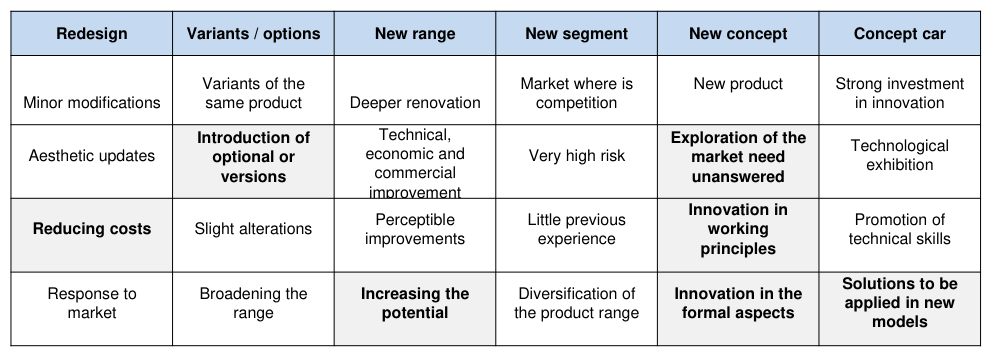
Based on the study and analysis of the 1st and 2nd schemes, was adopted the synthesis table (Table 2) prepared by Rui Marcelino (2008) to enumerate the types of products developed by industry and the market needs. These products are managed and segmented depending on the level of investment, type of market, innovation, or cosmetic change.
Table 2: Designing new products (addapted from Marcelino, 2008)
Ergonomics In Design, Usability & Special Populations II
Should be mentioned that were marked in this table some items relevant (bold) to the development of this research and its analysis model, based on the analysis of the 1st and 2nd schemes and the national market. Small and medium-sized enterprises automotive components Portuguese and the projects developed over the past 30 years in Portugal have captured the investment of large integrator companies, forcing them to take on new production paradigms. Flexibility, innovation, responsiveness and know-how are key features to create business opportunity and test new concepts for the Portuguese market automobile segment, and meeting the needs of young Portuguese drivers.
Diagram 1 summarizes the first attempt to adopt a methodology centered on automobile design to apply to the Portuguese case. It is intended that the vehicle meets all the conditions to identify the niche market to develop and implement a new concept to test in Portugal and in countries with similar characteristics to the Portuguese market.
According to Kotler (1997), through market segmentation is possible to best know the needs and desires of consumers. Such knowledge is deepened as new segmentation variables are combined together, providing a more individual consumer perception.
Ergonomics In Design, Usability & Special Populations II
Diagram 1: Study of Portuguese new concept car (author)
CONCLUSIONS
That research allows the crossing of information for the development of opportunities to gathering investment to the Portuguese automobile industry in the area of automobile customization.
The literature review and analysis of case studies demonstrate the gains of the national automobile component companies at the know-how level, flexibility of the production line, adaptation to new markets and responsiveness. The project teams are multidisciplinary and designers began to lead them.
The rapprochement between the designer and the user will provide a faster response, more effective and aware of their needs. The correct identification and interpretation of what are effectively the automobile segments and what differentiates them, will make the niche projects more suitable and more attractive for young portuguese drivers. The use of concepts such as redesign, the exterior and interior customization and the experimentation of new segments are preferential lines for development of new products. Themes like revivalism in the areas of fashion, product design, car design, architecture, etc.., have resulted in successful products throughout the world.
Ergonomics In Design, Usability & Special Populations II
There is a strong possibility of creating a new market trend, starting with the reconceptualization of the segments allocated in Europe, Portugal being the case study privileged for the performance of this paradigm shift from the user, leaving the car brands to the second plan.
In the second phase, in contact with the companies and associations in the automobile sector it is intended to explore strategies for incubating projects in Portugal to test mobility solutions for countries with similar characteristics and needs of the Portuguese market, in particularly concepts for new segments and individual niche vehicles incorporating Portuguese components.
The implementation of the "growth scenario" and the new cycle of industrial development based on research, design and final product, is the emergence of mobilizing projects and structuring of public / private investments with the active participation of national supply chains..
In the scientific field of design, the theme of the Portuguese automotive industry could stimulate a new line of research, allowing the creation of an expertise in transportation design individual niche, taking into account the results expected by the end of the investigation.
REFERENCES
ACAP (2012), “Estudos e inquéritos”, acessed 7 Mar 2012, < http://www.acp.pt/Defesa-do-Automobilista/Estudos-e- Inqueritos/entity/Observador-Cetelem-analisa-relacao-das-familias-europeias-e-o-veiculo-automovel> Borroni-Bird, C. (2011), “O Futuro visto pelo futuro”, in: Jornal de Negócios, 26 de Maio de 2011, pp. 2-3. Bruno Portela de Lima Fernandes, B.P. (2007), “Segmentação psicográfica de consumidores no Brasil: um estudo empírico no
mercado automotivo”, MSc thesis, Faculdade de Ciências Empresariais, Belo Horizonte. Coutinho, C., Branco M. C. (2001), “Segmentação do Mercado Automóvel”, in Anuário da Economia Portuguesa, pp. 200-212, acessed 15 May 2010. Gouveia, S. (2010), Automóveis Portugueses. Museu do Caramulo – Fundação Abel e João de Lacerda. Kotler, P. (1997), “Administração de marketing: análise, planejamento e controle”, Papanek, V. (1995), Arquitectura e Design – Ecologia e Ética. Edições 70, Lisboa. Pinto, F. (2011), “O Futuro visto pelo futuro”, in Jornal de Negócios, (supplement), 26 de Maio de 2011, pp. 4-5. Richers, R., Lima, C. P. (1991), “Segmentação: opções estratégicas para mercado brasileiro”, Nobel, São Paulo. Sheth, Jagdish et al. (2001), “Comportamento do cliente: indo além do comportamento do consumidor”, Atlas, São Paulo. Shiffman, L. G. Kanuk, L. L. (2000), “Comportamento do consumidor”, LTC, São Paulo.
Ergonomics In Design, Usability & Special Populations II
LISTED IN THE AHFE DIGITAL BOOKSTORE CATALOGUE
Explore the complete digital volume
Advances in Ergonomics In Design, Usability & Special Populations: Part II
Read this individual research paper free through the original publisher, or explore the full digital proceedings book.
ISBN 978-1-4951-2107-4
Explore this ISBN in the AHFE Bookstore ↗Listed in the July 2026 bookstore catalogue; search by ISBN to confirm current availability · Digital book purchase optional