Ana Cristina Dias, Rita Almendra, Fernando Moreira da Silva (2022). Teaching HFE in Industrial/Product Design Courses in Portugal. In: Advances in Ergonomics In Design, Usability & Special Populations: Part II. AHFE Open Access, vol. 19. https://doi.org/10.54941/ahfe1001286
This paper aims to present the results of a critical diagnosis about the presence of human factors and ergonomics contents into the academic curricula of industrial/product design in Portugal. This study is part of a PhD research focused on product design curricula’s adequacy to business challenges. Based on the gathering and interpretation of several Portuguese design education curricula, it turns out that the introduction of the practice of HFE is rarely linked with the design studio course, operating isolated, mostly as a theoretical course. However, the approach of human factors and ergonomics should be more practical and better linked with the design studio curricular unit. As previous conclusions of this study one can point out that there are better results in the education field when the HFE principles are earlier transmitted in the education process, which would have clear impacts on the quality and nature of the proposed design solutions, adding value to the final product. This way, students could be more prepared to respond with more social sustainable projects, increasing the chances of being more prepared and adjusted to the market and its demands.
Over the last decades, humanity has demonstrated to be more conscious about inclusivity and usability of products and spaces (Simões and Bispo, 2006). The principle of accessibility has become more evident and is no longer focused on accommodating people with disabilities, becoming clear that many adjustments could be designed to benefit everyone (Lidwell, Holden and Butler, 2010).
The current challenge involves the enhancement of inclusive design development, which demands a user centered approach, meaning an intense contact between users, designers, and other stakeholders involved in the process (Almendra, 2013). It starts on education and training, with the student’s awareness about the importance of human factor and ergonomics, as knowledge about human limitations and capabilities (Van der Linden, 2009). It would be more reasonable if it exists since the beginning of training, with a systematic incorporation of methods and techniques for ergonomic analysis and evaluation, such as product analysis, usability tests, and use of anthropometric data (Van der Linden, 2008).
This leads to a fundamental question on which we must reflect: How can education advance new ways to design, improving the ergonomic knowledge in the project practice?
Ergonomics In Design, Usability & Special Populations II https://openaccess.cms-conferences.org/#/publications/book/978-1-4951-2107-4
EDUCATING DESIGNERS FOR INCLUSIVITY AND USABILITY Along the last twenty years, the Design Education system has evolved its curricula in order to integrate and to accommodate contents related with sustainability and inclusivity (Almendra, 2013). The awareness of these issues is linked with the question of usability and the ergonomics’ ability to enhance value to products, helping to make them easier to use (Mont'Alvão, 2008). However, there is still a long ‘trail’ to make the application of ergonomic knowledge in the fluid project practice (Van der Linden, 2008).
Ergonomics and design should establish a methodological relationship, complementing each other through their common interests, objectives, and procedures, such as the user’s well-being, health, and safety (Zapata, 2011). To do this, ergonomics knowledge should be incorporated in all phases of the design project, from the conception level through correction and awareness (Barbosa and Guimarães, 2010), which would have clear impacts on the quality and nature of the proposed design solutions, adding value to the final product, namely in its usefulness, efficiency, effectiveness, satisfaction, readability and accessibility (Rubin and Chisnell, 2008).
Of course, ergonomics and design process should work together since the very beginning of the project process, but ergonomics are not always considered in projects (Barbosa and Guimarães, 2010) and education has a primary role in the formulation of a new mentality, presenting and applying it throughout the whole design process (Zapata, 2011).
Considering Human Factors and Ergonomics in Design Education According to International Ergonomics Association (2014) human factors and ergonomics comprehends the interactions among humans and other elements of a system, and applies theory, principles, data and methods to design in order to optimize human well-being and overall system performance. Within the discipline, there are three domains of specialization: i) physical, ii) cognitive and iii) organizational ergonomics, concerned with i) human anatomical, anthropometrical, physiological and biomechanical characteristics, ii) mental processes, such as perception, memory, reasoning, and motor response, iii) and the optimization of sociotechnical systems, including their organizational structures, policies, and processes, respectively (IEA, 2014).
Considering human factors and ergonomics to qualify design students, motivating them to the incorporation of knowledge of ergonomics in design practice, is extremely important to make students aware of the issue, to give them the necessary support to study the subject and to prepare them for socializing through upcoming real situations interventions (Van der Linden, 2009). The first step is the course contents’ tailor for the needs and characteristics of projective problems that students will face during their degrees. So, based on the most recognized authors in the field, Van der Linden (2009) proposed some principles that can help students to have a holistic view about HFE considerations, such as:
1. Introduction to applied ergonomics to design: ergonomics definition; what is the relationship with the ergonomics and design; how ergonomics is applied to design; how ergonomics affects the designer’s creativity.
2. Fundamentals of ergonomics: human factors (physiology, biomechanics, anthropometry, perception, cognition and affect) and environmental factors (physical, chemical, spatial, organizational); concept of the human-technology system; concept of constraints and human costs; concepts of task, activity and work.
3. Topics about applied ergonomics to design: accessibility; comfort; understandability; visibility and legibility; error; pleasure and risk; security and usability; usability and aesthetics.
4. Methods of applied ergonomics to design: task analysis; ergonomic intervention; macroergonomic design; production methods; predictive analysis of human error; ergonomic assessment protocols.
5. Ergonomics project principles applied to design: application of anthropometric data; product and information configuration.
6. Design principles applied to ergonomics: Gestalt theory; laws of symmetry.
7. Ergonomic evaluation integrated with product analysis: linguistic (diachronic/synchronic, denotative/connotative) and drawing analysis techniques (structural, functional and morphological).
Ergonomics In Design, Usability & Special Populations II https://openaccess.cms-conferences.org/#/publications/book/978-1-4951-2107-4
These principles deal with ergonomics not as an isolated or unidirectional but as an applied design approach.
It is really important to consider the HFE contents in design education because, despite the design students assert that ergonomics is indeed important for the design of products, the fact is that students fail to make the connection with the content of the discipline with design practice, finding very difficult to explain what is ergonomics and how to actually apply the concepts in the early stage of product design (Barbosa and Guimarães, 2010).
Linking Product Design and Ergonomics Practices From the craft production, which led to usable and functional forms (manufacture adapted according to user needs), to the advent of mass production that makes this practice technically and economically infeasible, ergonomics principles have been always along the conceptualization of products. From this emerges the need to develop products that are generically suitable to human factor and ergonomics (Van der Linden, 2008), which are industrial design products. This specific subarea of design is an interdisciplinary activity in which should work different types of professionals associated with product design and its education must provide multiple electives covering engineering, ergonomics, management, arts, and computer related courses (Yang, 2005).
So, linking to the ergonomics approach and according to Gomes (2009) who studied the designer competencies profile facing the emerging market, ergonomics must accompany the methods and techniques of industrial production. Thus, emerge a concept called ergodesign that is the integration of both disciplines – ergonomics theory and design application, coexisting interactively and seamlessly, like a hybrid discipline (Yap, 2011).
Sagot, Gouin and Gomes (2003) defined the field of the ergonomist actuation, whose work as advisor who ensures ‘human factor’ is correctly incorporated into the design approach. His analyses, which are based on ergonomic knowledge, about methods and tools, allows designer to be advised about the user, in order to adapt his/her ways to work according user expectation and needs. The ergonomist work help designer, assessing the design choices made in terms of safety, health, comfort and efficiency.
Following the theory of Sagot, Gouin and Gomes (2003), young designers, during the training process, need to receive and exercise a (minimally) solid learning within the HFE because having the possibility of going to work for a company that does not have the ergonomics department, they must be prepared to lead project responsibilities, requiring careful attention in what concerns safety precautions (Van der Linden, 2008).
HFE IN INDUSTRIAL DESIGN HIGHER EDUCATION - PORTUGAL AS CASE STUDY In Portugal, currently, industrial design higher education offers 29 undergraduation courses and 22 master courses. Integrating our PhD research, we mapped those courses and made the gathering and interpretation of their official curricula to verify the presence of human factors and ergonomics contents.
In order to make the curriculum benchmarking two analysis grids were created (one for undergraduate and another for the master) about the courses which offer curricular units (CU) about Human Factor and Ergonomics (HFE) component. Those grids were organized into three sections: i) identification of the institution of higher education (based on mapping previously done); ii) identification of the semester in wich CU(s) occurs; if the approach is theoretical (T), theoretic-practical (TP) or practical (P) and the ECTS number; iii) and the percentage of ECTS of those facing the total academic degree ECTS.
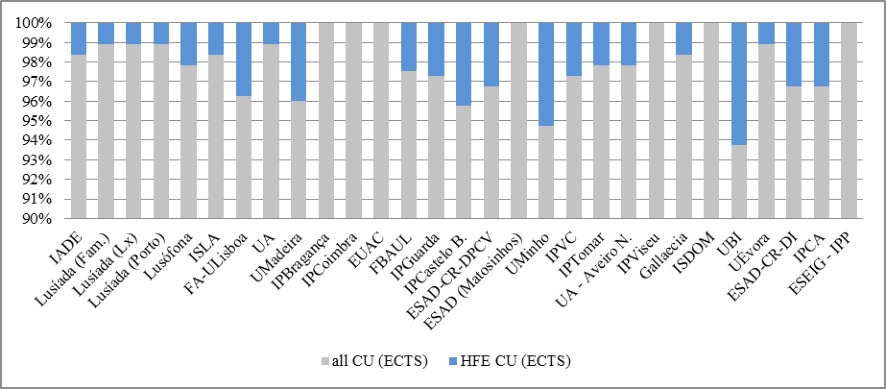
As it can be seen in Figure 1, the majority of the undergraduation courses offer HFE contents, being 22 of the 29. Nevertheless, this existence is reduced when we compare the curricular unit ECTS with the whole ECTS of the course (180 ECTS = 100%).
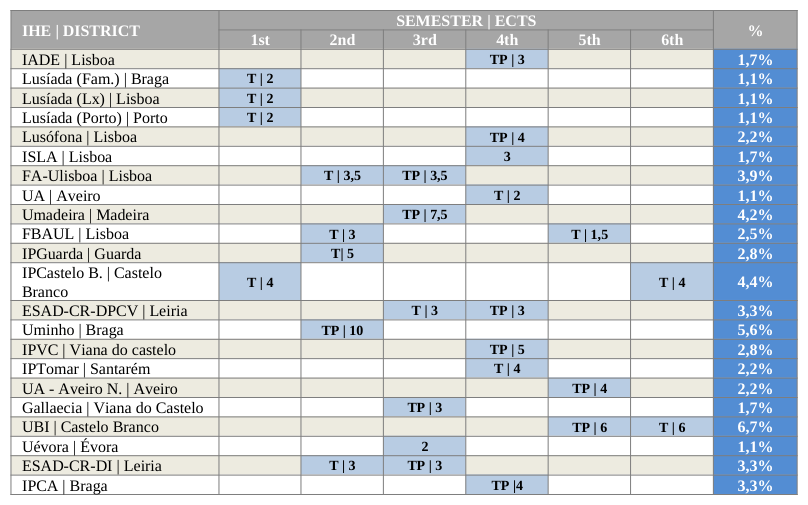
Table 1 shows that the prevalence of HFE curricular units varies between 1,1% and 6,7%, with an average of 4,9%. These approaches are mostly theoretical (T) and occur especially on two first years of the undergraduation programs.
Ergonomics In Design, Usability & Special Populations II https://openaccess.cms-conferences.org/#/publications/book/978-1-4951-2107-4
Figure 1. The existence of HFE CU in industrial design undergraduation programsTable 1: The existence of HFE CU in industrial design undergraduation programs IHE | DISTRICT SEMESTER | ECTS % 1st 2nd 3rd 4th 5th 6th IADE | Lisboa TP | 3 1,7% Lusíada (Fam.) | Braga T | 2 1,1% Lusíada (Lx) | Lisboa T | 2 1,1% Lusíada (Porto) | Porto T | 2 1,1% Lusófona | Lisboa TP | 4 2,2% ISLA | Lisboa 3 1,7% FA-Ulisboa | Lisboa T | 3,5 TP | 3,5 3,9% UA | Aveiro T | 2 1,1% Umadeira | Madeira TP | 7,5 4,2% FBAUL | Lisboa T | 3 T | 1,5 2,5% IPGuarda | Guarda T| 5 2,8% IPCastelo B. | Castelo Branco T | 4 T | 4 4,4%
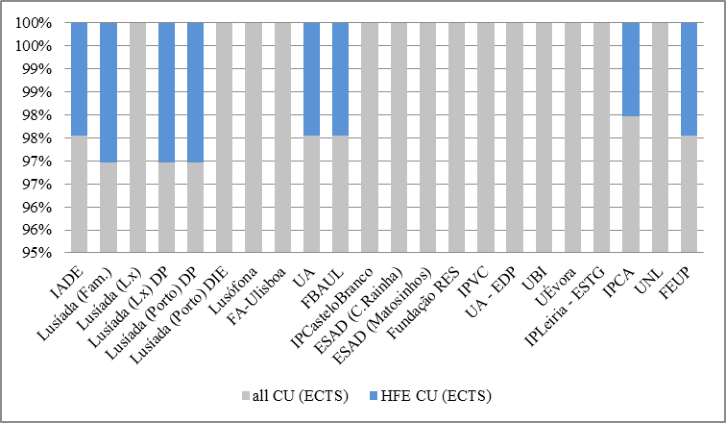
As it can be seen in Figure 2, eight of the master courses offer HFE contents. Nevertheless, this existence is reduced when we compare the curricular unit ECTS with the whole ECTS of the program (120 ECTS = 100%).
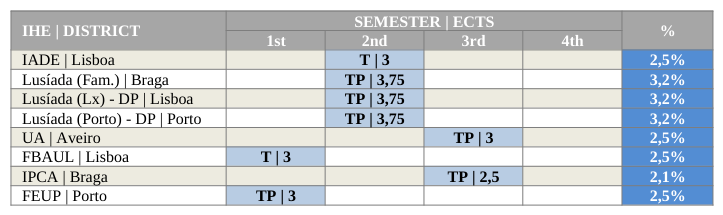
Table 2 shows that the presence of these curricular units varies between 2,1% and 3,2%, with an average of 2,7%. These approaches are mostly theoretical (T) and occur mainly on the second semester of the master programs.
Ergonomics In Design, Usability & Special Populations II https://openaccess.cms-conferences.org/#/publications/book/978-1-4951-2107-4
Figure 2. The existence of HFE CU in industrial design master programsTable 2: The existence of HFE CU in industrial design master programs IHE | DISTRICT SEMESTER | ECTS % 1st 2nd 3rd 4th IADE | Lisboa T | 3 2,5% Lusíada (Fam.) | Braga TP | 3,75 3,2% Lusíada (Lx) - DP | Lisboa TP | 3,75 3,2% Lusíada (Porto) - DP | Porto TP | 3,75 3,2% UA | Aveiro TP | 3 2,5% FBAUL | Lisboa T | 3 2,5% IPCA | Braga TP | 2,5 2,1% FEUP | Porto TP | 3 2,5%
About the CU program contents they are based on three main approaches: i) fundamentals of ergonomics, especially on the human factors as physiology, biomechanics and anthropometry, ii) topics about applied ergonomics to design such as accessibility, comfort, usability and safety, iii) and methods of applied ergonomics to design, concerning concepts of task, activity and work. Concerning the CU program goals, they mainly focus on the understanding of what is ergonomics and anthropometry, their contents and applications, and how these should be integrated into a design project.
DISCUSSION AND RESULTS This study aims to identify the given importance of teaching Human Factor and Ergonomics in the development of design projects on the part of the Portuguese Design Education system, keeping up the consciousness about inclusivity and usability of products and spaces. Based on the gathering and interpretation of industrial/product design undergraduation and master Portuguese curricula data, it turns out that the contact and learning of tools and methods of Human Factor and Ergonomics (HFE) occurs during the formation process,especially on undergraduate degree, although operating isolated, being rarely linked with the design studio course and mostly as a theoretical course.
Normally it focus on the fundamentals of ergonomics, mainly on the human factors as physiology, biomechanics and anthropometry, on topics about applied ergonomics to design such as accessibility, comfort and usability, and on the methods of applied ergonomics to design, concerning concepts of task, activity and work. Those courses should be more practical and better linked with the design studio curricular unit since the beginning of the training. Thus, Ergonomics In Design, Usability & Special Populations II https://openaccess.cms-conferences.org/#/publications/book/978-1-4951-2107-4 the ergonomics knowledge should be incorporated in all phases of the design project, which would have clear impacts on the quality and nature of the proposed design solutions, adding value to the final product and emancipating the designer, who would be prepared to lead project.
The current challenge involves the enhancement of inclusive design development and design education and training should anticipate the business demands, providing the adequate professional skills and instilling in students the knowledge about human limitations and capabilities for product design project’s support.
In a period of significant change when the principle of accessibility has become more evident and is no longer focused on accommodating people with disabilities, contemporary society has demonstrated to be more conscious about inclusivity and usability of products and spaces, which demands a user centered approach. That domain contributes to a better preparation of the design students to the market and its demands and challenges.
REFERENCES
Almendra, R. (2013), “Designing the difference in an inclusive way”, in: International Conference on Engineering and Product Design Education, Dublin Institute of Technology. pp. 428-433 Barbosa, M.L., Guimarães, L.B. (2010), “Ergonomics as a discipline of the Design and Architecture courses in the city of
Curitiba-PR”, Estudos em Design, Volume 7. pp. 1-31 Gomes, A.C. (2009), “Design – a construção contínua de competências”, PhD thesis submitted to University of Minho. International Ergonomics Association (2014), Definition and Domains of ergonomics; The IEA Website: http://www.iea.cc/whats/index.html Lidwell, W., Holden, K., Butler, J. (2010), “Universal principles of design: a cross-disciplinary reference”, Rockport Publishers. Simões, J.F., Bispo, R. (2006), “Design Inclusivo: acessibilidade e usabilidade em produtos, serviços e ambientes”, Centro Português de Design, 2nd Ed. Mont’Alvão, C. (2008), “Hedonomia, Ergonomia Afectiva: afinal, do que estamos falando?”, in: Design, ergonomia e emoção,
MAUAD (Ed.). pp. 19-30 Rubin, J., Chisnell, D. (2008), “Handbook of Usability Testing: How to Plan, Design and Conduct Effective Tests”, Wiley Publishing, 2nd Ed. Sagot, JC., Gouin, V., Gomes, S. (2003), “Ergonomics in product design: safety factor”, Safety Science 41, Elsevier Science,
Pergamon. pp. 137-154 Van der Linden, J. (2008), “Ergonomia aplicada ao Design/Desenho Industrial: por que aplicá-la e como aplicá-la?”, in: Pensando Design 2, UniRitter (Ed.), Porto Alegre. pp. 66-77 Van der Linden, J. (2009), “Redesenho do ensino de Ergonomia em curso de Design”, Revista D, Volume 2. Yang, MY. (2005), “Competencies and qualifications for industrial design jobs: implications for design practice, education, and
student career guidance”, Design Studies, Volume 26, No.2. pp. 155-189 Yap, L. (2011), “Ergodesign: harmonizing art and science methods & tools in evidenced-based human-centered system research, design and development”, in: 6th International Conference Senses & Sensibility in Lisbon. Zapata, L.M.S. (2011), “Integration of Ergonomics in the Design Process: Conceptual, Methodological, and Practical
Foundations”, in: Human Factors and Ergonomics in Consumer Product Design: Methods and Techniques, Taylor & Francis (Ed.). pp. 155-175
Ergonomics In Design, Usability & Special Populations II https://openaccess.cms-conferences.org/#/publications/book/978-1-4951-2107-4
LISTED IN THE AHFE DIGITAL BOOKSTORE CATALOGUE
Explore the complete digital volume
Advances in Ergonomics In Design, Usability & Special Populations: Part II
Read this individual research paper free through the original publisher, or explore the full digital proceedings book.
ISBN 978-1-4951-2107-4
Explore this ISBN in the AHFE Bookstore ↗Listed in the July 2026 bookstore catalogue; search by ISBN to confirm current availability · Digital book purchase optional