Marita Canina (2022). Wearable Devices: A Design Approach Through Biodesign and Ergonomics. In: Advances in Ergonomics In Design, Usability & Special Populations: Part II. AHFE Open Access, vol. 19. https://doi.org/10.54941/ahfe1001242
Nowadays there is a great inclination to modify well-being concept and health care by changing the technology in “wearable”. For this reason the relation between human body and new technologies are changing deeply and continually. The design necessarily should drive these changes. It is fundamental to understand if design is able to filling the gap in wearables project, caused by the absence of a user-oriented approach. The design development of the wearable device needs to accomplish the requirements of comfort and adaptableness connected to the anatomy of human body. From this point of view, the wearable is not an overlapping structure but “a second skin”. These aspects require a study about the ergonomics and “wear-ability”. Users often reject objects felt unfamiliar to own body, even if they can improve daily life. This happens because sometimes the designer overlooks the relationship between body and wearables, which involve both physical and psychological side. The study in wearable area is directed toward a new phase, where the attention is on the user desire. This paper presents the result of the research developed by Biodesign Lab of Politecnico di Milano: a methodological approach, which is based on a combination between the Lines of Non Extension, a theory made by Iberall and the unobtrusive areas set by the Institute of Complex Engineered System. The research has developed an instrument able to support and guide the design process.
INTRODUCTION: THE ADVANTAGES OF THE WEARABLE TECHNOLOGY The technological innovations and the development of the micro and nanotechnologies are pushing to new strategic directions towards a market of the Wearable Technologies that, although still embryonic, is in wide growth. The market of the Smart Fabrics and Interactive Textile will reach about 1,8 billions of dollars by 2015 according to Report Smart Fabrics and Interactive Textile of the Global Industry Analysts Inc (2011). This market is mainly addressed to the sectors of consumer electronics, sport, biomedical and wellbeing.
In the last decade, indeed, a remarkable progress can be seen in the research and development of smart wearable systems that put technology at the service of the user, trying to make it more available and less invasive as possible. The miniaturization and the best efficiency of the new technologies allow to build devices that are able to measure in a reliable and economic way the various and complex signals coming from the human body. The design, therefore, has moved not only to the interpretation of the biological signals, but also to the development of applications in wearable devices as clothes or other accessories. Such change is possible according to the remarkable progresses in the fields of the materials’ sciences, of the development of new polymers and of innovative textiles and, in the electronic field, of the miniaturization and of the nanotechnologies (De Rossi et al., 2003).
After the first applications in the military field, the fast technological development has led to the realisation of designs in the biomedical field. In this area of research, the enormous potentialities of the wearable systems have been immediately seen, since these are able to completely modify the sanitary sector, thus permitting at the same time both a high quality level in the offered services and an easy access to customized care programmes without increasing the costs. Interesting development and research suggestions, coming from the miniaturization of the electronic and informatics circuits, manage to combine the various and innovative intelligent functions in the wearable systems, by developing new sceneries and applications.
Today, moreover, we see a growing market demand towards the detection of biological parameters not only for clinical and diagnostic purposes, but also for a better quality of life in healthy subjects. New life styles have prepared, at the same time, the proliferation of a series of diseases as stress or obesity, with the increase of both physical and psycho-emotional problems in the persons. Consequently, the attention to sensorial functions is not only limited to diagnostic aims, but also to more extended wellbeing purposes just concerning the quality of life, the health and the wellbeing, in the different sectors, such as medical, ergonomic, sport and wellness.
In the Wearable Futures Conference 2012, a design led approach has been proposed for the development of wearable systems, in order to face the significant discrepancy between technological reliability and acceptability by the users. We are therefore at the beginning of a new «industrial revolution» where there is the combination of textiles and electronics and, from the design point of view, everything is done in order to reply to the needs of the users, according to the aspects of dimensioning, shape, prevailing posture, thermal regulation, humidity control and to psychological aspects as the acceptance of this technology. Up to now, the devices in medical field have been developed from a small and secondary aesthetical research that has brought to a poor design of the user interfaces, so that the wearable technology is not promptly accepted by some destination markets. As the emerging technologies can be not familiar for the traditional stylists, also the doctors and the electronic experts do not usually have familiarity with the textile technology. Therefore, a common language and vision are necessary in order to facilitate the communication between these sectors and the users wearing the sensorized dress. The application of smart textiles in “stratified dressing systems” can improve the quality of life but, in order to be accepted, they have to be comfortable, elegant, lasting and reliable in accordance with the technical, aesthetical and cultural needs of the users.
A design methodology that works on the potentialities of a comfortable and elegant dressing system for the promotion of the wellbeing and the autonomy must, thus, be led by efficient researches with the users (McCann, 2008). In front of this reality, the designer becomes not only an expert who is aware of his own socio-cultural contest, but also proactive actor in understanding the current scenarios, in identifying tendencies and creating action strategies, in satisfying social needs and changing the context itself. His role is mainly to design experiences enhancing the acceptance of the devices by the users themselves. However, nowadays, the devices to detect the biological parameters are still characterized by physical, cognitive and psychological being invasive, obstruction of movements and necessity of close and constant contact between sensors and skin. All these factors cause problems of wearability in the everyday life, in particular when a prolonged and / or constant monitoring has to be realized.
FASHIONABLE WEARABLES In this moment the development of the wearable technologies grows rapidly and the visions of the future become step by step reality. The embedded technologies have a strong impact on the wearability, the comfort and the aesthetic of a wearable system. Therefore the fashionable technology is born (Seymour 2008), as the intersection between design, fashion, science and technology. It shows itself in clothing designs, accessories, jewels that combine aesthetic and style with the functional technology.
As designer of fashionable wearables, it is necessary to consider the final users as persons who are careful to the style and to the great potentialities of the wearable technologies.
The main aim of the researches in the field of the fashionable wearables design is to design devices whose functionalities develop the promotion of the psycho-physical wellbeing through the use of wearable technologies. The study of prêt-à-porter collections that assure the monitoring of the user emotional variables and that are not felt as invasive, is the essential requirement for the development of these new applications. In the wearable devices for biomedical applications, the user does not have to receive any feedback and the data are transmitted directly to the medical personnel. In the new application sectors (i.e. the valuation of a worker’s stress, of his attention level or of his capacity of reaction to danger), the control of user’s own condition to decrease the physical and emotional diseases is a distinctive characteristic.
In the wearable devices, many design constraints are connected to the physical characteristics of the sensors, others are determined by the nature of the human body. Since the comfort is a required quality, the design parameters as wearability, portability, modularity, aesthetic, invisibility and adaptability for the constant monitoring must be satisfied. The design philosophy is based on the principle that the dressing is the direct interface with the environment and, therefore, constant transmitter and receiver of emotions, experiences and meanings. The fashionable wearables are much more than simple fashion, since they include technological elements that change them in interactive interfaces. The interaction required for the fashionable wearables determines inputs and outputs. The inputs can be active or passive. The first are data that can be consciously controller by the user, by using a system of tactile or acoustic feedback allowing an intuitive use of the dressing. The second are also of two types (Seymour 2008): data generated by persons (pressure, inclination, movement, biometrical data, sound, images, humidity, proximity, smell, acceleration) and data coming from the environment (light, humidity, sound, temperature, smoke, micro-particles, images).
The possible applications are basically unlimited: in order to better orienteer in this paragraph, some useful starting points will be given to catch the potentialities of the wearable technologies. The detection of the input parameters, as mentioned, is applied in various fields: clinic, sport, entertainment and also in work environments (firemen, civil defence, industry area), extreme environments (space, high mountain), domestic automation and care for the elderly (Di Rienzo et al., 2007). In psychology, in particular, a so-called biofeedback procedure is being tested, where to the patient are shown his own psycho-physical information through different equipment (Katsis, 2011). The aim is to develop the self-regulation of the biological functions that usually are out of the voluntary control (heart rate, brain activity, blood pressure, muscular strain, skin resistance). Besides the knowledge of the physical context of the person, other researches are being addressed towards the knowledge of the emotional context, so that we have a complete image of the user. The biological parameters can be put in relation to the emotional conditions and it is therefore possible to evaluate the emotions or the stress. Such valuation is at the root of the emotional computing (Picard, 1995), thanks to which it is possible to change the output in accordance with the emotional condition of the person (for example a car limits the max speed in accordance with the driver’s stress condition, or the domestic environment fits light and music to relax the person) (Healey, 2000).
In this moment many researchers are addressing their efforts to the identification and correlation of physiological parameters for identifying complex phenomenon connected to the physical and psychological conditions of the persons (as stress, drive strain, and others) (Bundele and Banerjee 2009; Begum et al. 2009). The correlation between physiological parameters and psycho-emotional conditions is far from simple. It is necessary to do many researches and experimentations for the construction of a set of parameters that, connected, allow to date back to a complex phenomenon. Strain and stress, which are used only here as example of complex phenomenon, are a manifold group of sensorial, muscular and cognitive factors, and they are often used improperly as synonym of other displays as fatigue or sleepiness, anxiety or depression fits. It is obvious that there are different methods to identify and characterize each of the complex phenomenon, therefore the design choice will be conditioned not only by the type of phenomenon to be detected but also by the availability of wearable sensors and by their position on the body: very many are the possible applications, that differ each other according to the measurement parameters and investigation objectives. In not purely clinical applications, the users will have to be motivated to use a wearable device, since a real need is missing. In this case the design becomes prevailing for the success of a technological product.
THE DESIGN PROCESS In the design of wearable systems one has to face many functional, technical, physiological, social, cultural and aesthetic specifications so that they can be attractive, comfortable, functional and reliable. A design method that considers all these parameters has been developed by the Biodesign Lab of the Design Dept. of Politecnico di Milano, taking into consideration the aspects of wearability and applying an Human Centred Design (HCD) approach, where the person becomes the central point of the design process (Canina, 2010).
In order to face such approach in the design of bio-monitoring wearable systems, it is necessary to consider first of all the main constraints (or variables) that are: the unavoidable contact between bio-sensors and body; the prolonged use of the system during the whole day for a period and consequently the adaptability of sensorized modules to the clothes of a possible collection; the invisibility of the technology that is integrated to the dress and consequently the wearability. Another important reference for the structure of the design process, besides the physical, biological and anthropometrical variables, is the subjectivity of the individual, that considers the psycho-cognitive, emotional and hedonistic factors and the behavioural models coming from the interaction with the objects. The interactions among user, device and context define the usage congruousness of the wearable device. For this reason it is essential to use of guidelines to design a fashionable wearable from the point of view of Biodesign.
An interesting approach for the design process is the one based on the design thinking that develops the idea of design as “a human-centred creative process of discovery that is followed by iterative cycles ” (Brown, 2008). According to this definition, the design process is metaphorically considered as a space – system and not as a step series, where the following can be identified:
Inspiration: where does the idea come from?
Ideation: generation, analysis development
Implementation: focus on the market The design thinking approach is useful for the development of a methodology for the wearables design process. For this reason, an experimental method has been developed (Canina and Ferraro, 2011) through the combination of different approaches, such as: design thinking and co-design matched with the guidelines for wearability and Lines of non-extension theory.
Methodology and Guidelines In order to change the design of the wearables in design of fashionable wearables it will be necessary:
To analyse the relations among an user, his “Self” and the body and the dress, so that they are both the perceptive and the expressive result of his own identity;
To investigate and identify some negotiations made by the user in the choices of the everyday dressing (i.e. the choice made in consideration of the use circumstance, sex, age, biotype, message to be communicated);
To investigate the “small interactions” of the body with the dress and the corresponding meanings in the everyday life (for example the act of unfastening a tie to feel free and released from work, or open the hinge of the dress to seduce, etc.);
To create an intuitive system of correspondence between the body movements and these dress/body small- interactions.
A designer must take into consideration many factors for a project, as already anticipated; besides to aim, user, interactions, commercial applications, we also find: body ergonomics and wearability, perception, functionality (the characteristics are indicated in Fashionable Wearable). In developing the design method for fashionable wearable we have decided to use a human-centered approach just because it begins with the persons we are designing for. As already made obvious, the starting point is to examine the needs, the desires and the behaviours of the user. The co- design approach gathers together researchers, industrial partners and interested users (for example elderly persons who are active in the research “Smarter Outdoor Clothing for Active Ageing”) (McCann, 2008). in the development of a stratification system that includes base, intermediate and external dressing, and incorporates smart textiles and wearable technologies.It is necessary, in order to simplify, to proceed with the schematization of the whole process, that, then, will be later made explicit and investigated. For the realisation of a project it will be, indeed, necessary: 1_in the Inspiration phase
To identify new business opportunities and on-going changes;
To observe the persons – what they do, think, the desires and the dreams;
To investigate how emotional and cognitive aspects are realized at a psycho-physical level;
To involve many subjects from the beginning (for example engineering and marketing, medicine, anatomy and biomechanics) and also extreme users;
To search specific technologies that allow changes;
To organize the information and synthesize the possibilities.
2_in the Ideation phase
To clearly define a specific aim (for example in the field of stress, to create an intelligent wearable system that is able to monitor the physiological parameters connected to the emotional condition and to intervene in a pro-active way on the user)
To develop a creative session in co-design (with different users) and realize innovative scenarios, sketches of ideas and “dirty” prototypes;
To identify the bio-signals that are able to define a particular condition (for example of psycho-physical stress, of strain, of sleepiness);
To identify the appropriate technologies to detect the identified bio-signals;
To map and define the positioning points of the sensors very closely with the body;
To process a state of art;
To set an aesthetic – formal study;
To improve the ideas following the guidelines for “objects around the body” design;
To plan and define an intuitive correspondence system between the sensors catching the bio-signals (input) of the user and the output of the dress; 3_in the Implementation phase
To test both the technology and the positioning on the body;
To realize different prototypes and test both with the users and inside;
To select the most adapted materials (colour, performance, cut, etc.);
To study the paper patterns and choose the appropriate ones
To verify the functions - ergonomic, aesthetic, cultural and commercial.
In this part of the paper, the most interesting and distinctive phases in the design of the wearable systems will be examined. In the first phase of “inspiration” a key role is hold by the user sessions (Canina and Ferraro, 2009). The HDC methodology allows to prepare and lead the analysis of the research. In order to make the decisional process easy, indeed, the design procedure requires a global view of the target and the indication of the wearable category to be developed. Obviously, the requirements of adaptability and usability of a device for a child doing sport will be very different from the ones of a fireman who works in extreme environments or from those of an obese person who has to wear the clothes every day. User’s profile has to be added to the considerations connected to the formal configuration and to the nature of the human body. The role of the user has changed in the latest years, going towards a so called participatory approach. While in the classic approach the user is an object of passive study and the researcher gets the results through the observation and the interviews, in the participatory design, on the other hand, the user undertakes a pro-active role and participates in all the phases of the design process (Sanders and Stappers 2008). In the participatory design, the user, as partner in the design process, follows the largest part of the phases from the analysis to the concept and the tests.
This approach is very efficient in the development of the wearables, because it allows to verify step by step the real needs and requirements of the user. Moreover, it allows the evaluation of the formal assumptions through the tests given to the user himself, thus identifying the degree of “felt” comfort compared to the technologies in contact with the body.
An investigation on the life style of the persons wearing the garment in terms of behaviours and environments is necessary to supply the consciousness of the fundamental requirements of the dressing and of the application of the new wearable technologies with appropriate functionalities and uses for the identified user.
The designers have to realize the research activities by observing and getting a feedback from the technological garment wearer to identify their needs in accordance with the chosen activity.
Practically, therefore, for the “user sessions” we shall proceed by designing a set up of significant tests with the users. In order to begin the work with the users’ groups it is necessary to select an “advisory group” with the function of supervision on the design team. The members of the advisory group are different from the participants in the creative workshop, since they do not play an active role in the co-design process, but they act according to their global advisory skill to guarantee a correct direction with the participants during the design.
The introduction of the users into the design implies: to catch the requirements during the everyday activities; to capture new aspects during particular and specific activities; use questionnaires; to guide interviews; to gather empirical data.
Initial prototypes are designed in order to address the identification of the user’s needs and demonstrate how the characteristics of the innovative textiles and the new production processes can reinforce the independency, the safety and the wellbeing in the users themselves.
During a first workshop the initial prototypes are used with the aim to examine what seems the most appropriate for the personal comfort, by comparing the preferences of the participants with samples of clothing available in the market. The contribution of the user goes on also in subsequent moments: during the Ideation phase where he participates as “expert of his experience” and again through “dirty prototype” he gives back sensations and perceptions; and at the end in the implementation where he carries out usability tests on the device.
In the Ideation phase, as Dorst and Cross (2002) confirm, the exploration is one of the four cognitive operations that are strictly functional to the scope. For this reason, in the precise definition of the aims, it is fundamental to have understood, first of all, that the smart wearable system must supply a non invasive, safe and hypoallergenic control, that, at the same time, has to be invisible, resistant and easy to use in any moment of the everyday life, regardless of the insertion of electronic micro-devices inside the dress. Sensorial considerations are the key for the efficiency of the wearable, where the textile selection and the characteristics of the dressing can be designed to face matters such as the touch, the protection, etc.
Secondly, to proceed with the phases of exploration and generation, the designer must be always conscious of the anatomy of intelligent clothes, in other words, in general, that the wearables for bio-signals detection consist of three elements: a sensorized garment | garment with integrated sensors; a portable electronic module | usually independent but attached to the garment, for the gathering of data that are shown by the sensors and eventually the transmission to a remote monitoring system; a system of data analysis | able to divide the biological information of interest from the recorded ones.
If we are dealing with non purely clinical applications, the sensorized garment necessarily becomes more complex and stratified. We will have therefore:
A base module | underclothes with fixed sensors that have to fit close against the body to guarantee the reliability of the signals. The solutions is subject to the everyday use in all the seasons, guaranteeing comfort and transpirability;
An external module or “fashion” | an external article of clothing or a not necessarily adherent accessory with some bio-sensors and the output. The base module and the external one must communicate each other.
Obviously in this phase the designer cannot fail to consider the parameters to be monitored and the technology they can be acquired through. The detection of bio-signals is complex, it depends on different factors and just by these it is influenced. Such factors are:
The positioning of bio-sensors – definitive for the data reliability;
The contact surface – it has to be wide enough;
The stability of the contact between sensors and skin – the sensor does not have to move in order to avoid noises that could disturb the signals or could cause the total loss of these.
The reliability of the supplied data;
The use and the context of the measure – a measure can work in specific contexts but not in others (for example the heart rate during a physical activity can result to be unreliable);
The wearability – to allow the user to do normally all the everyday activities avoiding cognitive efforts;
The comfort – to guarantee a wellbeing level that is felt by the user;
The discretion – the user does not have to feel the presence of bio-sensors, moreover, his privacy has to be guaranteed.
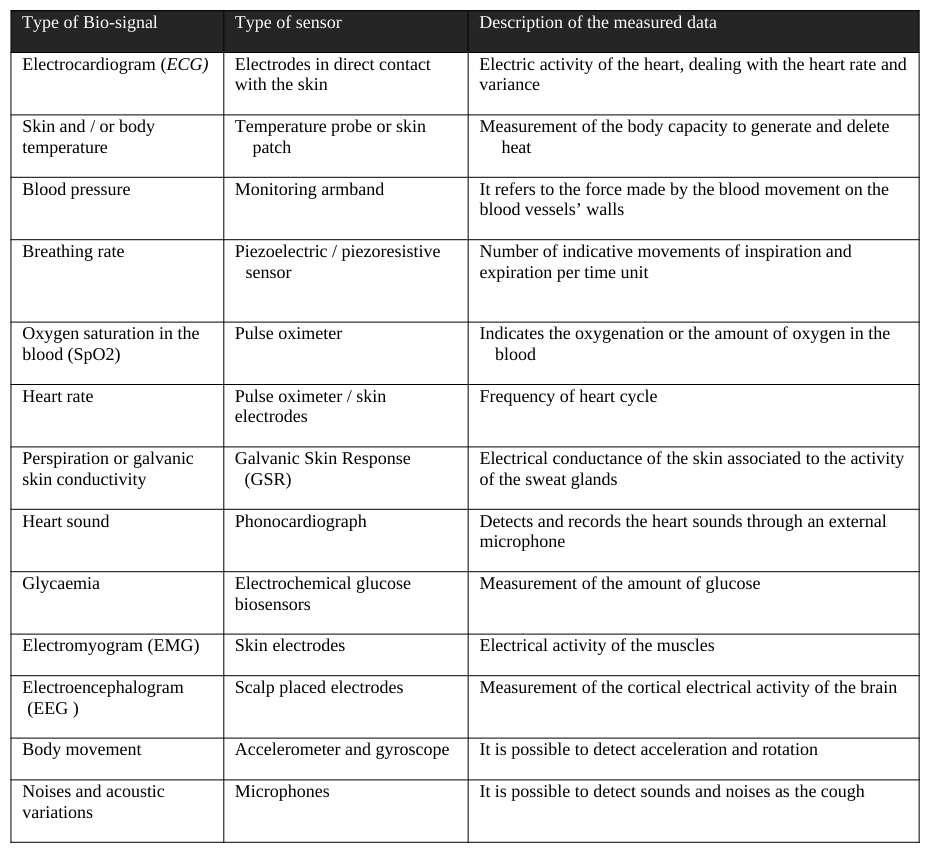
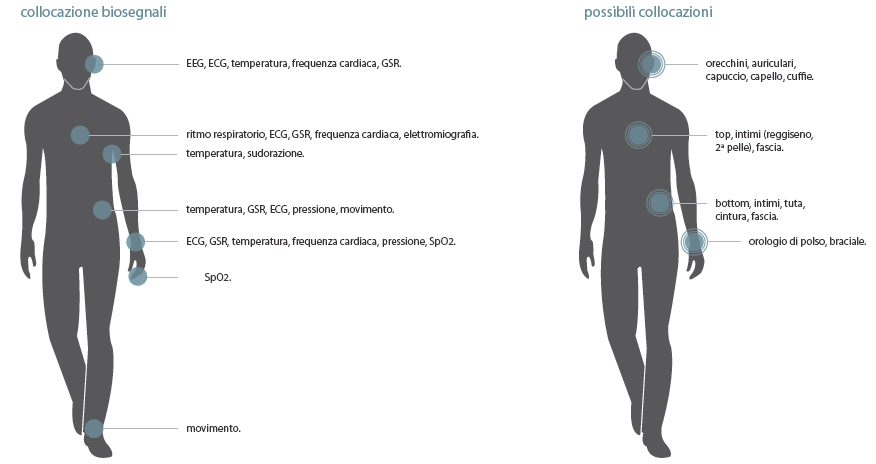
The different detection technologies that can be integrated in a monitoring wearable system are listed in Table 1 together with the corresponding measured physiological signals (Pantelopoulos and Bourbakis, 2010). Such indications, together with the position of the bio-signals shown in the diagram (see Figure 1), complete the useful information for a designer who has to face the design of a wearable system.
Table 1. Bio-signals and corresponding detection technologies Type of Bio-signal Type of sensor Description of the measured dataFigure 1. Map of the position where it is possible to detect the bio-signals (left) and positioning assumptions for the selected bio-signals, which are ECG, Heart Rate, GSR and Temperature (right).
As it is possible to see in the figure, the same type of bio-signal can be detected in different parts of the body. According to the design aim and in accordance with comfort, wearability, aesthetic and acceptability, the designer chooses the bio-signals identifying the proper position that is able to satisfy all the requirements. Such choice implies a continuous iteration of the ideation process in order to define the decisive formal solution. With regard to the choice of the bio-signals, to their position and to the connection among the same it is possible to assume the different applications, as shown in figure (see Figure 1, right). By selecting, for example, the bio-signals as ECG, Heart Rate, GSR and Temperature, according to their position, different design solutions are allowed: on ears or on the pulse the system could be an accessory (earring, earphone, cap, headphones, watch, bracelet, etc); while on the chest or waist it becomes part of the dressing. Obviously the acquisition of the signals can be dissociated, it is not necessary the signals, even though possible, are all detected in the same point, mainly when we deal with every day dressing and accessories.
Another essential point in the fashionable wearable design is the body. The aspects that complement the design of the wearable system are connected to the perception of the body dimensions from the user. Notably variable, individually and cognitively, the brain feels a more extended sensorial area and such perception modifies according to the body condition and the development.
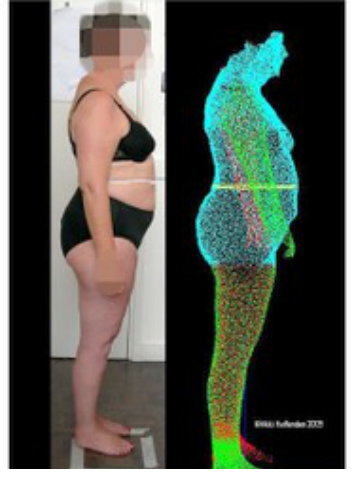
To the conformation of the felt body are associated also aspects connected to the dimensions and shape variation and to the accessibility of objects that are connected to the body. Although the standard measures, the body changes also according to the prevailing posture in the different activities and to the groups of different ages. The dressing should ideally support the body, where necessary, without limiting the movements. The design of a wearable device must consider the size and the shape of the users who wear it, so that it can perfectly fit to a underweight, middleweight, overweight or obese person. The body scanner technologies allow nowadays the reconstruction of the body in its real configuration. On the base of the methodological considerations up to now, the design guidelines for the fashionable wearable that are developed by the Bio-design Lab are realized by integrating studies on the wearability with researches on the anatomic lines of the body.
The assumption of the method that has been developed for the design of wearable devices is based on the idea of combining the studies on comfort, wearability and anatomic lines of the body where there is less extensibility. The defined parameters take into consideration the interaction among the physical shape of the objects, the body dimensions and their relation with the human movement.
Figure 2. Changes of the configuration of a body and extended perception (on the upper part on the left); Movement and Interference Test between object and body segments, proprioception and interaction (in the lower part on the left) (Images taken by Design for Wearability) and reconstruction through body scanner taken from the research: Design for Ageing Well.
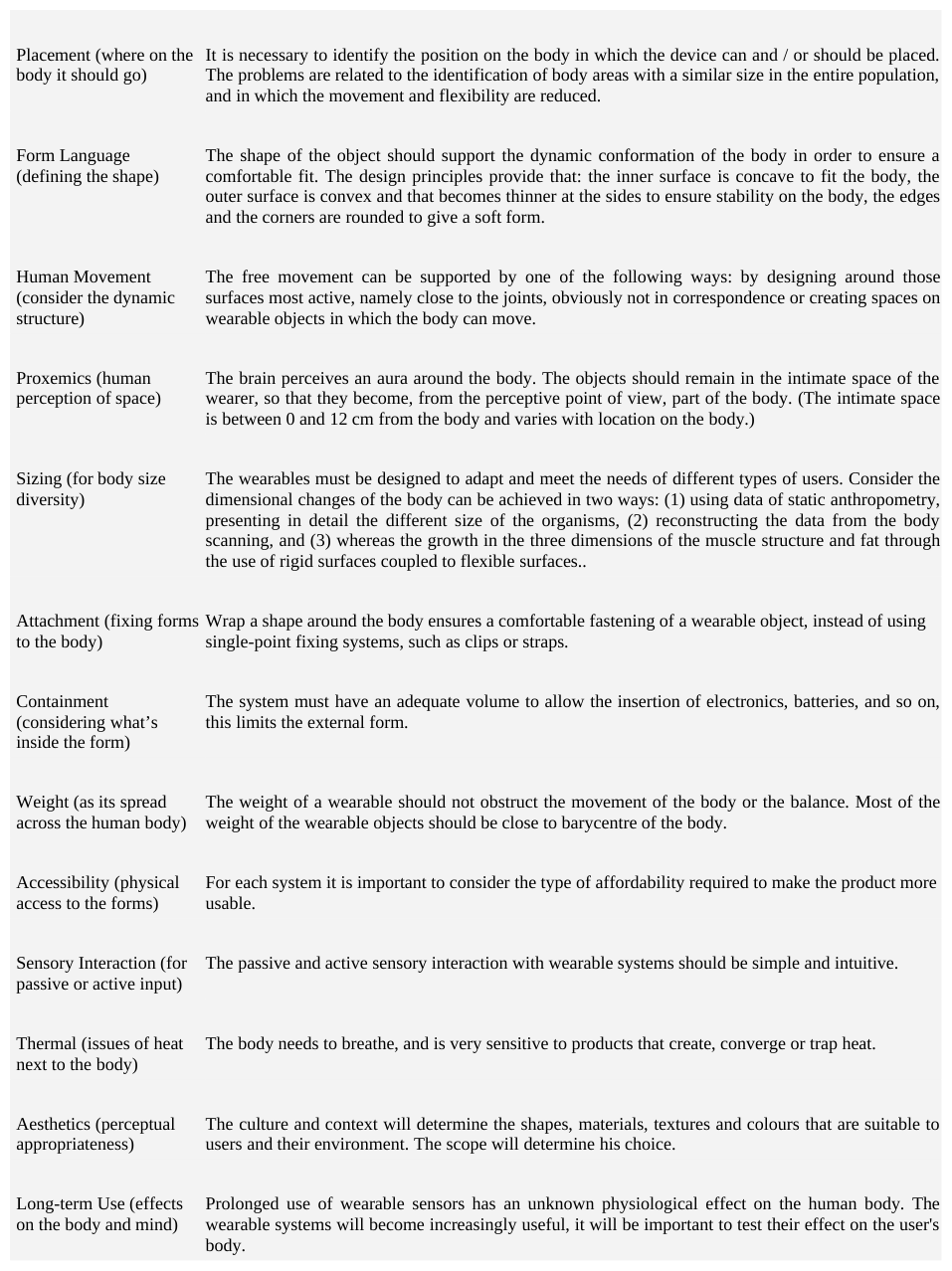
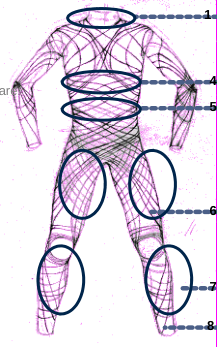
The tools have been implemented making a correspondence between the areas of less intrusiveness of the Design Guidelines for Wearability (Gemperle et al., 1998) with the Lines of Non Extension (Iberall, 1964; Bethke, 2005) and/or Langer’s Lines (US Patent 6418339). Widely accepted on an international level, the guidelines that have been developed in the field of the research “Design for Wearability”, by the Institute for Complex Engineered Systems (ICES) of the Carnegie Mellon University, become one of the key points in the design of wearable systems. Gemperle et al. have identified in the design guidelines for wearability a list of parameters to be considered in the design act of wearable objects.
The wearability parameters that have been decided by ICES are:
formal language: how the different shapes merge each other ;
dimensions: variations of the transversal section of the human body;
human movement: how the body shape changes with the simple movement;
unobtrusivity: the less intrusive body areas for the wearable products.
Here below are shown the characteristics corresponding to a series of parameters (Siewiorek et al., 2008) that are shown in the design guidelines for wearability.
Table 2. Parameters shown in the design guidelines for wearability (Adapted from Application Design for Wearable Computing, Mahadev Satyanarayanan Series Editor, Morgan & Claypool Publishers).
The wearability tests, considering the guidelines shown by the Carnegie Mellon University, allow to gather data of objective (use of cameras for photos and videos) and subjective (with questionnaires) nature through the evaluation of parameters such as:
1. emotion ˗ the pleasantness of wearing or not the garments / aesthetic aspect;
2. attachment ˗ the sensation of having the garment in contact with the body;
3. perceived change ˗ feel different by wearing the garment;
4. motion ˗ how the garment interferes or not on the work done and the positions taken;
5. anxiety ˗ sensation of alienation.
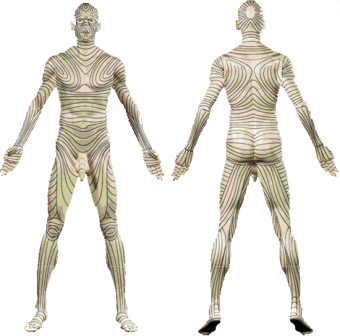
The concept of non extension lines (LONE – Lines of Non-Extension) by Arthur S. Iberall (1964) is based on the bio-medical principle according to which the human body is crossed by inextensible lines, got by the union of points where there is no relative shifting regardless the movements of the body itself. The skin along such lines is subject to almost null extension. On the same principle are also the Langer’s Lines, according to which are arranged the fibres of the outer muscular bundles, that are used by the surgeons in case of cuts, in order to avoid phenomenon of cicatricial retraction. The main idea is to use the overlay areas to put the strict parts of the devices and design their shape following the anatomic lines of the body (Canina, 2010).
Figure 3. Anatomic Lines of the skin: Langer’s Lines (left) and Lines of Non-Extension (right) Unobtrusivity
1
2
4
Unobtrusive areas for wearable objects are:
5
3
collar area
6
rear of the upper arm
7
forearm
8
rear, side, and front ribcage
Figure 4. The areas with less intrusiveness are overlaid on the Lines of Non Extension waist and hips thigh
top of the foot
Re-elaboration of Carnagie Mellon studies on wearability guidelinees
CONCLUSIONS
To close this paper, some short considerations that are connected to the aesthetic and formal study of a possible collection. This refers to those considerations coming from the fashion and that allow to change a wearable into fashionable wearable: the group of shapes, volumes, colours, materials, textiles that meet very well to the need of wellbeing by creating garments in harmony with the body, without imposing an anonymous and careless design. The designer has to design taking into consideration the necessity that the sensation/perception of wellbeing is not exclusively introduced in the dresses technologically, but also it has to be immediately visible and sensed. It will have to create itself through the mediation performed by the item of clothing, by the look to the touch, from the hearing to the smell. To the comfort it is important to combine an aesthetic and physical study that considers also the cognitive and psychological aspect of the article: lightness, pureness of shapes, simplicity, elegance and dynamism. The use of the system for the whole day during a prolonged period and the close contact that has to be guaranteed between the bio-sensors and the body creates many ties for the realisation of a collection. The realisation of a series of garments that allow an everyday monitoring by inserting all the necessary sensors for this aim can be of difficult actuation and economically disadvantageous. Consequently, the designer is called to think upon new development strategies that foresee the adaptability of sensorized modules to the dresses of a possible collection. The designer can decide between two solutions: the first is the realisation of tight-fitting garments where the sensors are embedded into the textile and the other two parts of a wearable, electronic module and data analysis system, are detachable; the second is the creation of overlaid articles where a first overlay, fitted to the body, includes the fix sensors in contact with the skin, the second is external or a not necessarily fitted accessory containing the other two modules.
A collection consisting of few elements that are easily combined and interchangeable each other with simple, loosen, soft shapes, in clear contrast with the module fitting to the body becomes the ideal solution, without the austerity or the lack of wearability of the traditional functional garments.
REFERENCES
AA.VV. Report “Smart Fabrics and Interactive Textile – A global strategic business report”, Global Industry Analysts Inc Web site: http://www.strategyr.com/. Begum, S., Ahmed, M.U., Funk, P., Xiong, N., Scheele, B.V., Linden, M., Folke, M. (2009), “Diagnosis and biofeedback system
for stress”, 6th International Workshop on Wearable Micro and Nano Technologies for Personalized Health (pHealth). Bethke K. (2005), “The Second Skin Approach: Skin Strain Field Analysis and Mechanical Counter Pressure Prototyping for Advanced Spacesuit Design”, Master of Science in Aeronautics and Astronautics at the Massachusetts Institute of Technology. Brown T. (2008), “Design Thinking” in: Harvard Business Review, June 2008. Bundele, M.M., Banerjee, R. (2009), “An SVM Classifier for Fatigue-Detection using Skin Conductance for Use in the BITS-
Lifeguard Wearable Computing System”, 2nd International Conference on Emerging Trends in Engineering and Technology (ICETET). Canina, M., Ferraro, V. (2008), “The Biodesign approach to Wearable Devices”, 5th International Workshop on Wearable and Implantable Body Sensor Networks, with the 5th IEEE-EMBS International Summer School and Symposium on Medical Devices and Biosensors (ISSS-MDBS 2008), China. Canina, M., Ferraro, V. (2009), “Design for pro-active wearability”, Multiple Ways to Design Research, SwissDesign Network
Symposium 2009, Lugano. Canina M. (2010) “IndossaME. Il design e le tecnologie indossabili”, FrancoAngeli, Milano, De Rossi, D., Carpi, F., Lorussi, F., Mazzoldi, A., Paradiso, R., Scilingo, E.P., Tognetti, A. (2003), “Electroactive fabrics and wearable biomonitoring devices”, AUTEX Research Journal, vol. 3 (4), pp. 180-185. Di Rienzo M., Rizzo F., Meriggi P., Castiglioni P., Mazzoleni P., Ferrarin M., Ferratini M. (2007), MagIC: a Textile System for
Vital Signs Monitoring. Advancement in Design and Embedded Intelligence for Daily Life Applications, In Proc. 29th Ann. Int. Conf. IEEE EMB, Lyon. Dorst, K., Cross, N. (2002), “Creativity in the design process: co evolution of problem–solution”, Design Studies Vol. 22 Ferraro, V., Canina, M. (2011), “A new approach to wearable systems: Biodesign beyond the boundaries”, Proceedings of the International Conference on Research into Design (ICoRD ’11), Indian Institute of Science, Bangalore, India. Gemperle, F., Kasabach, C., Stivoric, J., Bauer, M., Martin, R. (1998), “Design for Wearability”, Proceedings of the 2nd IEEE
International Symposium on Wearable Computers, Pittsburgh, Pennsylvania, October 19-20. Healey J.A. (2000), Wearable and Automotive Systems for Affect Recognition from Physiology, PhD Thesis, Massachusetts Institute of Technology (MIT), Dept. of Electrical Engineering and Computer Science. Iberall A. (1964), “The use of Lines Of Non-Extension To Improve Mobility In Full-Pressure Suits”, in: Behavioral
Sciences Laboratory, Aerospace Medical Research Laboratories, Aerospace Medical Division, Air Force Systems Command, Wright-Patterson Air Force Base, Ohio.
Katsis, C.D., Katertsidis, N. S., Fotiadis, D. M. (2011), “An integrated system based on physiological signals for the assessment of affective states in patients with anxiety disorders”, Biomedical Signal Process and Control, Vol. 6, pp.261-268. Locher, I., Tröster, G. (2007), “Fundamental building blocks for circuits on textiles”, IEEE Transactions on Advanced
Packaging, 30, 837. McCann J. (2008), “Design for Ageing Well: Improving the Quality of Life for the Ageing Population Using a Technology Enabled Garment System”, Advances in Science and Technology, Vol. 60, pp154-163. McCann, J., Bryson, D. (a cura di) (2009), “Smart Clothes and wearable technology”, Woodhead Publishing in Textiles. Pantelopoulos, A., Bourbakis, N.G. (2010), “A Survey on Wearable Sensor-Based Systems for Health Monitoring and
Prognosis”, IEEE Transactions On Systems, Man, And Cybernetics—Part C: Applications And Reviews, Vol. 40, No. 1, JANUARY 2010. Picard, R.W. (1995), “Affective Computing”, Massachusetts Institute of Technology (MIT), Laboratory of Perceptual Computing, Technical Report No. 321, Web site: http://affect.media.mit.edu/pdfs/95.picard.pdf. Sanders, E., Stappers, P. (2008), “Co-creation and the new landscapes of design”, CoDesign, Taylor & Francis, March 2008,
Web site: <http://journalsonline.tandf.co.uk>. Seymour S. (2008), “Fashionable Technology. The Intersection of Design, Fashion, Science, and Technology”, Springer-Wien, New York. Siewiorek, D., Starner, T., Smailagic, A. (2008), “Application Design for Wearable Computing”, Mahadev Satyanarayanan
Series Editor, Morgan & Claypool Publishers. Zysset, C., Kinkeldei, T., Cherenack, K., Tröster, G. (2010), “Woven Electronic Textiles: An Enabling Technology for Healthcare Monitoring in Clothing”, 5th International Workshop on Ubiquitous Health and Wellness (UbiHealth 2010), September 26th 2010, Copenhagen, Denmark. Method and apparatus for determining the lines of optimal direction for surgical cuts in the human skin - US Patent 6418339
LISTED IN THE AHFE DIGITAL BOOKSTORE CATALOGUE
Explore the complete digital volume
Advances in Ergonomics In Design, Usability & Special Populations: Part II
Read this individual research paper free through the original publisher, or explore the full digital proceedings book.
ISBN 978-1-4951-2107-4
Explore this ISBN in the AHFE Bookstore ↗Listed in the July 2026 bookstore catalogue; search by ISBN to confirm current availability · Digital book purchase optional