Ingvar Tjostheim (2026). Meta Ray Ban Smart Glasses - Watching the Watchers. In: Human Interaction and Emerging Technologies (IHIET 2026). AHFE Open Access, vol. 236, pp. 238–247. https://doi.org/10.54941/ahfe1008099
Smart glasses are emerging as consumer grade wearable technologies that integrate cameras, sensors, connectivity, and, in some cases, augmented reality displays into everyday eyewear. While these devices offer hands free, context aware interaction and potential benefits for users, they also raise concerns related to surveillance, privacy, and social acceptability. This study examines citizens’ attitudes toward artificial intelligence (AI) and smart glasses, with particular emphasis on perceptions of surveillance and intentions to adopt protective or privacy enhancing technologies. Drawing on two nationally representative Norwegian surveys conducted in 2020 with 1290 respondents and 2026 with 1086 respondents, the study analyses changes in general attitudes toward AI following the widespread adoption of tools such as ChatGPT, as well as public agreement with six AI related concerns identified by experts in the Pew Research Center’s AI100 project. In addition, the study investigates predictors of citizens’ intentions to use technologies that alert them when smart glasses are recording in their vicinity. The findings show that general attitudes toward AI have become more positive over time, especially among younger age groups. Nevertheless, a majority of respondents have concerns regarding the societal implications of AI, including threats to human agency, corporate data abuse, misinformation, and loss of control. Using binary logistic regression, the analysis identifies concerns about corporate data abuse and fake news and propaganda as significant predictors of intentions to use warning technologies, alongside demographic variables, overall attitudes toward AI, and individual characteristics associated with early technology adoption. Overall, the results highlight a persistent tension between growing acceptance of AI enabled technologies and sustained concerns about surveillance and privacy.
Smart glasses are wearable devices in the form of eyeglasses that integrate digital technologies—such as sensors, cameras, microphones, wireless connectivity, and, in some cases, displays—into everyday eyewear. A key feature of smart glasses is hands-free, context-aware interaction, which allows users to record or photograph what is in front of them. As a result, smart glasses can capture information and, in some cases, communicate with and provide access to digital services. The user therefore has powerful wearable technology readily available while perceiving the physical world
Meta Ray Ban Smart Glasses - Watching the Watchers? 239 from a first-person perspective, such that the device becomes part of the lived body experience (Ihde, 2002).
Some smart glasses, such as the Meta Ray-Ban Smart Glasses, incorporate augmented reality (AR) visuals. These glasses are currently available in many optical retail stores. In the near future, Google, Apple, and Samsung are expected to launch similar smart glasses, some with AR functionality and some without. These devices are expected to be marketed as consumer products at price levels that are affordable for a broad segment of the population.
For some people, smart glasses are primarily perceived as a surveillance technology. Google’s X division launched Google Glass in 2013 as a prototype featuring a novel hardware design but also notable technical limitations. The product was discontinued within two years, largely due to negative publicity and widespread concerns related to surveillance and privacy (Bergstein, 2013). Technological development continues, and the role of technology in society is rapidly evolving. OpenAI launched ChatGPT in November 2022, and the technology was adopted at an unprecedented pace, with applications spanning nearly every sector of society. How will smart glasses be received in this evolving technological landscape? Will public reactions in 2026 resemble earlier responses to wearable technologies such as Google Glass, or will smart glasses be broadly adopted and used alongside mobile phones? The aim of this paper is to examine citizens’ attitudes and opinions regarding smart glasses based on national survey data, and to analyse factors that can predict whether citizens wish to be informed about surveillance and take steps to protect their privacy. The Pew Research Center (Anderson, 2018) has asked experts to identify societal concerns and challenges associated with technologies that may enhance human capabilities while simultaneously posing significant risks to human autonomy, privacy, independence, and cognitive and decision-making skills. Which of these concerns correspond to the public’s views on artificial intelligence (AI)? Furthermore, are any of these concerns useful predictors of individuals’ intentions to take protective or privacy-enhancing measures when smart glasses are used by others in their vicinity?
The research questions are as follows: RQ1. Have general attitudes and opinions about AI among the population
changed following the launch of ChatGPT by OpenAI? RQ2. Among the AI-related concerns identified by experts interviewed by the Pew Research Center, which—if any—can be used as predictors of citizens’ adoption of protective technologies?
THE CITIZENS OPINION ABOUT AND ATTITUDES TO AI The Norwegian study was inspired by the Pew Research Center’s One Hundred Year Study on Artificial Intelligence (AI100) project (Stone et al., 2016; Anderson, 2018). The Pew research focuses on the role of AI, concerns related to AI, and the future of humanity. A shortlist of concerns
240 Tjostheim was developed based on interviews with an international group of experts, including technology pioneers, innovators, developers, business and policy leaders, researchers, and activists. In the present study, citizens expressed concerns related to the following topics: (i) human agency, (ii) data abuse by corporations, (iii) data abuse by governments, (iv) dependence and lock-in, (v) fake news and propaganda, and (vi) mayhem and lack of control. For more information about how these six are defined, see (Kalimeri & Tjostheim, 2020). To recruit representative samples, the surveys were commissioned by two market research companies, Pollstat AS/Norstat AS and Opinion AS. Both companies recruit panel members from the national population. According to the market research companies, a minimum of 600 respondents is required to obtain a representative sample of the population, although a sample size of at least 1,000 respondents is preferred in most cases. The two surveys targeted citizens aged 16 to 69 years.
To characterise the participants, Tables 1 and 2 present their demographic profiles with respect to gender, education, and the three age groups used in the analysis. The demographic profile of the participants is as follows – see Table 1:
Table 1: Gender and the age profile of the participants, 2020 and 2026.
Table available in the original PDF paper.
16–29 Years 30–49 Years 50–69 Years
Equation reproduced from the original PDF.
2026
Equation reproduced from the original PDF.
* for the six AI 2030 questions, the 2020 survey had an ”no opinion” alternative. In the analysis the “no opinion” is excluded. Therefore N is between 758 and 932 depending on the question for the six AI 2030 questions.
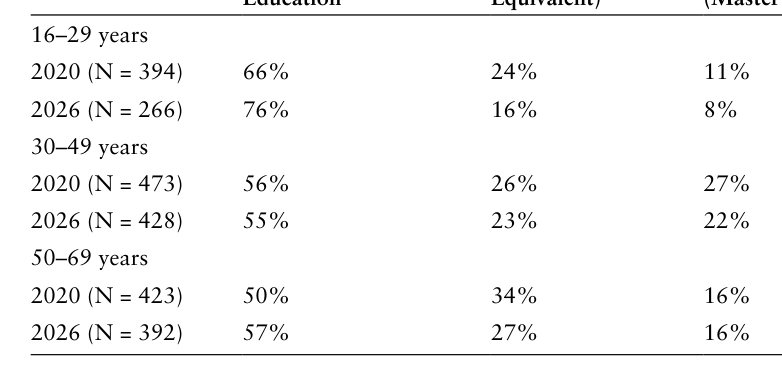
Table 2: Educational profile of the participants.
Table available in the original PDF paper.
Primary or Secondary Education
Bachelor Degree (or Equivalent)
Higher Degree (Master or Higher)
Equation reproduced from the original PDF.
Table 1 and 2 show only minor differences between the participants in the two surveys. For the question about general AI Attitude, the following question was used in 2020: In newspapers and media, news stories about machine learning and artificial intelligence are increasing. What do you think about this new technology?
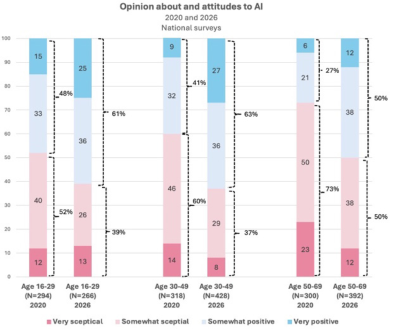
The response-alternatives were very sceptical, somewhat sceptical, somewhat positive and very positive. In the 2026 survey, the question was: regarding AI, what do you think about this new technology? Figure 1 shows the answer to the general AI-question in the two surveys.
Figure 1: Opinion and attitudes to AI (Artificial Intelligence), 2026 vs 2020.
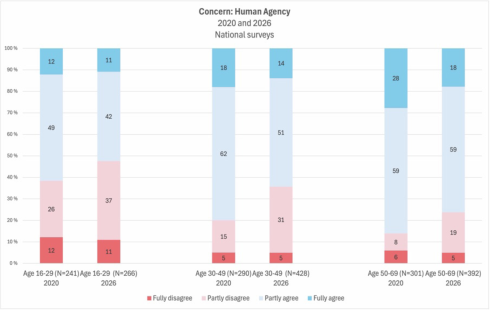
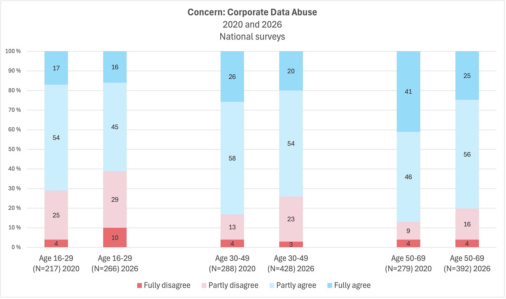
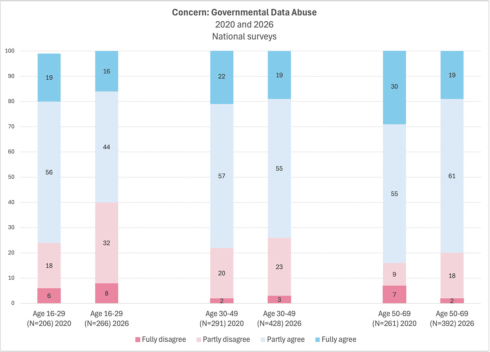
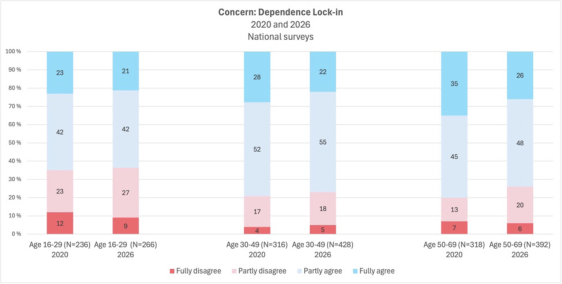
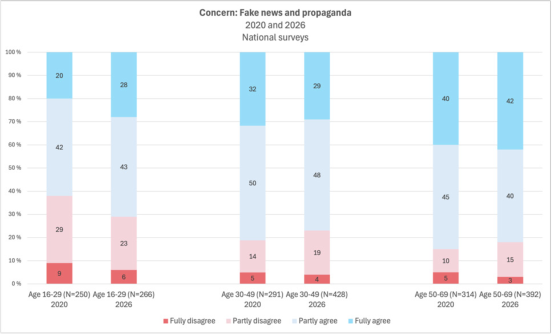
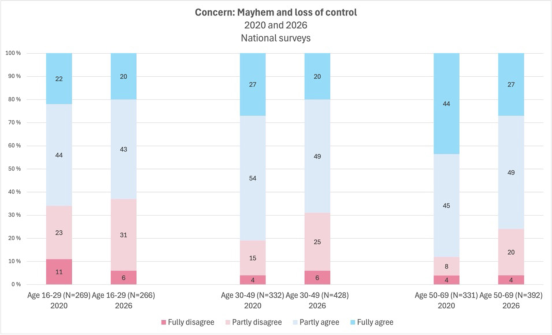
AI TOWARDS 2030 - THE FUTURE OF HUMANITIES The general questions about AI and the respondents’ demographic characteristics are presented above. In the next section of the survey, respondents answered questions about smart glasses, followed by a final section addressing AI-related issues in 2023, focusing on six key concerns. Citizens’ views on these six concerns are presented in the following six figures.
Figure 2: Human agency.Figure 3: Corporate data abuse.Figure 4: Governmental data abuse.Figure 5: Dependence lock-in.Figure 6: Fake news and propaganda.Figure 7: Mayhem and loss of control.
Across all six concerns, the majority of respondents report agreement with the statements in 2020. This pattern is also observed in 2026, although the youngest age group appears less sceptical. Among respondents aged 16–29, between 28% (for concerns related to fake news) and 45% (for concerns related to human agency) disagree with the statements. From 2020 to 2026, only minor changes are observed. Overall, the pattern remains stable, with a majority of citizens sharing the concerns expressed by the experts in the Pew Research project.
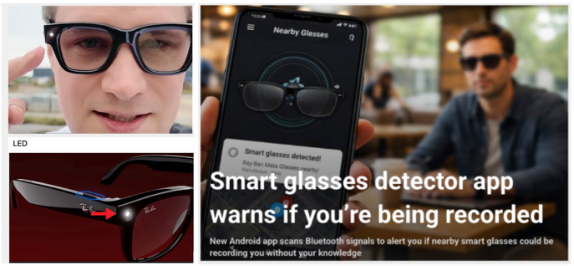
In the survey, respondents were presented with a text and an image describing smart glasses. In addition to explaining the recording capabilities of the glasses, the survey included an example of an application that can alert citizens when someone in their vicinity is using Meta RayBan Smart Glasses. This type of application may be described as an anti-surveillance technology, or at least as a technology that functions as a warning or monitoring aid. While video recording for personal use is relatively common—using devices such as GoPro cameras or mobile phones—it is often socially unacceptable, and in many cases illegal, to publish such recordings without consent.
Figure 8: Meta smart glasses and a detector app.
Figure 8 shows the picture presented to the participants in the survey. To what extent do citizens perceive smart glasses as a form of surveillance technology, and to what extent do they intend to use technologies that alert them when someone in their vicinity is recording with smart glasses?
To address these questions, respondents were asked the following survey question: “Regarding cameras near you, which of the following options do you agree with the most?”
1. I have no interest in using technology that tells me which cameras are operating in my vicinity. 2. I have some interest in this technology. I might use a technology that tells me which cameras are operating in my vicinity. 3. I am very interested. I believe I will use a technology that tells me which cameras are operating in my vicinity.
In the next section, we present the predictive analysis.
PREDICTING INTENTION TO USE A TECHNOLOGY THAT ALERTS THE USER - AN ANALYSIS WITH BINARY LOGISTIC Binary logistic regression is a form of regression analysis in which the dependent variable is dichotomous and coded as 0 or 1. In the present study, respondents who indicated an intention to be alerted about the use of smart glasses in their vicinity were coded as 1, while all other respondents were coded as 0. The independent variables in a binary logistic regression model may be continuous or categorical. In our model, three demographic variables were included: age, gender, and education. Additional independent variables comprised six concerns about AI in 2030, a general attitude toward AI, and a personal characteristic that previous research has shown to be associated with early adoption of new technologies and digital tools (Qian, 2019).
Due to space limitations, only the percentages for the variables included in the final model and their predictive power with respect to citizens’ intentions to use privacyprotecting technologies are reported. The survey also included whether the respondents use Smart house Technology, IoT.
Table 3: The binary logistics regression model– variables, first step.
Using IoT/ SmartHouse -2 Log likelihood Cox and Snell R2
Nagelkerke R2
Hosmer and Lemeshow Test Chi-square (Sig.)
1283.250 0.065 0.091 4.669 (0.792)
Summary final model The Nagelkerke R² is a pseudo-R-squared measure that can be used to assess model adequacy (Hosmer, 1989). In our model, the Nagelkerke R² was 9.1%. The Hosmer–Lemeshow test yielded p-values greater than .05, indicating adequate model fit and suggesting that the variables included in the model are suitable for predictive purposes (see Table 3).
Table 4: Classification. The binary logistics predictions of intention to use warning technologies.
Table available in the original PDF paper.
Predictions Sum
0 1
458 284 742
No intention to use a warning technology. Correct; 61,7%
140 204 344
Intention to use a warning technology. Correct; 59,3% Percentage correct, for both groups: 61,0%
In binary logistic regression, cases with predicted probabilities above a specified numerical cut-off are classified as positive outcomes. In this study, a cut-off value of 0.317 was chosen, as 448 of the 1086 participants belonged to the group expressing an intention to use technology that alerts the user. Cases with predicted probabilities equal to or above this cut-off were classified as 1 (success), whereas cases below the cut-off were classified as 0 (failure). This procedure allows for assessment of the model’s classification performance. Generally, higher percentages of correctly classified cases indicate better model performance. As shown in Table 4, the overall classification accuracy was 61% for both outcome groups together.
RQ1. Have general attitudes and opinions about AI in the population changed following the launch of ChatGPT by OpenAI? RQ2. Among the AI-related concerns identified by experts interviewed by
the Pew Research Center, which—if any—can be used as predictors of citizens’ use of protective technologies?
According to Figure 1, opinion and attitudes about AI have become more positive, 2026 compared to 2020. It that the attitudes have changed. This finding is not unexpected, given the increasing use of AI tools by a growing number of users, extending beyond citizens with a particular interest in technology.
With respect to the second research question, Table 3 shows that education, users of smart house technology, concerns related to corporate data abuse and fake news and propaganda are two of the six concerns that significantly on a 0.05 level (and additional one on 0.10 level) predict citizens’ intention to use a technology that alerts them when smart glasses are recording in their vicinity.
CONCLUSION
This study examined public attitudes toward smart glasses and artificial intelligence (AI), with particular attention to privacy, surveillance concerns, and citizens’ intentions to adopt protective technologies. Drawing on two nationally representative Norwegian surveys conducted in 2020 and 2026, the study analysed changes in general attitudes toward AI, levels of concern related to six AI-related risks identified by the Pew Research Center, and factors predicting intentions to use technologies that alert individuals when smart glasses are recording in their vicinity.
The findings indicate that general attitudes toward AI have become more positive over time, particularly among younger age groups, following the widespread adoption of AI tools such as ChatGPT. Despite this growing acceptance, a majority of respondents continue to express concern about societal implications of AI, including threats to human agency, data abuse, fake news and propaganda, and loss of control. These concerns remained relatively stable across the two surveys.
Using binary logistic regression, the study identified key predictors of citizens’ intentions to use warning technologies related to smart glasses. Concerns about corporate data abuse and fake news and propaganda emerged as significant predictors, alongside education and use of smart house technology. We speculate that citizens that have installed smart house technology better understand the surveillance aspect of the technology that an average citizen. Overall, the results highlight a tension between increasing acceptance of AI and sustained concerns about surveillance and privacy.
Smart glasses represent a novel technology that major technology companies are currently introducing as consumer products. To facilitate commercialization, these companies often collaborate with established
Meta Ray Ban Smart Glasses - Watching the Watchers? 247 eyewear manufacturers and retailers. In the case of Meta, the smart glasses are developed in partnership with Ray-Ban, a well-known brand in the consumer eyewear market. As a form of wearable technology, smart glasses may function as an extension of the body. However, the smart glasses may not necessarily be well received by people in the wearer’s vicinity, as the smart glasses are also perceived—and are likely to continue to be perceived— as a form of surveillance technology.
In the present study, survey-data with demographic characteristics, concerns related to AI, and demographic characteristics were examined as predictors of citizens’ intentions to use technologies that provide alerts about smart glasses recording nearby. The findings indicate that there is interest in technologies that can alert citizens when smart glasses are being used to record in their vicinity. Future research should examine whether such technologies will achieve widespread adoption and whether governmental regulation will be introduced to protect citizens’ privacy.
REFERENCES
Anderson, J., Rainie, L. & Luchsinger, A (2018). Artificial intelligence and the future of humans. Pew Reserch Center 10:12. Bergstein, B. (2013). The Meaning of the Google Glass Backlash, MIT Technology
Rev., 14 Mar. 2013; www.technologyreview.com/s/512541/the meaning-of-the- google-glass-backlash. Brooks, R., Brynjolfsson, E., Calo, R., Etzioni, O., Hager, G., Hirschberg, J., Kalyanakrishnan, S., Kamar, E., Kraus, S., et al.: Artificial intelligence and life in 2030. one hundred year study on artificial intelligence: Report of the 2015–2016 study panel. Stanford University, Stanford, CA, http://ai100. stanford.edu/2016- report. Hosmer, W. & Lemeshow, S. (1989). Applied logistic regression. 1989. New York:
Wiley. Ihde, D. (2002). Bodies in Technology, University of Minnesota Press, Minneapolis. Kalimeri, K., & Tjostheim, I. (2020). “Artificial intelligence and concerns about the future: A case study in Norway.” In International Conference on Human- Computer Interaction, 273–284. Springer. Qian, M., Plucker, J. A., & Yang, X. (2019). Evidence of the psychometric integrity
of the creative personality scale using item response theory models. Creativity Research Journal, 31(3), 349–355. https://doi.org/10.1080/10400419.2019.164 7758 Stone, P., Brooks, R., Brynjolfsson, E. Calo, R., Etzioni O., Hager, G., Hirschberg, J., Kalyanakrishnan, S., Kamar, E., Kraus, S., Leyton-Brown, K., Parkes, D., Press, W., Saxenian, AL., Shah, J. Tambe, M., & A. Teller. (2016). Artificial Intelligence and Life in 2030.”One Hundred Year Study on Artificial Intelligence: Report of the 2015-2016 Study Panel, Stanford University, Stanford, CA, September 2016. Doc: http://ai100.stanford.edu/2016-report. Accessed: September 6, 2016.
SEARCH THE AHFE DIGITAL BOOKSTORE BY ISBN
Explore the complete digital volume
Human Interaction and Emerging Technologies (IHIET 2026)
Read this individual research paper free through the original publisher, or explore the full digital proceedings book.