Tatiana Efremenko, Carmen Bruno, Eva Monestier, Marita Canina (2025). The Design Futures Art-driven (DFA) Method: Structuring Art-Tech Collaboration for Sustainable Future of Food System. In: Human Factors in Design, Engineering, and Computing. AHFE Open Access, vol. 199, pp. 93–104. https://doi.org/10.54941/ahfe1006821
The contemporary food system is among the most environmentally damaging sectors, contributing significantly to greenhouse gas emissions and sustainability challenges. A fundamental transformation across production, consumption, and waste management is urgently needed to ensure both human and planetary wellbeing. While technology and corporate innovation play crucial roles, growing attention is being paid to artists for their capacity to foster reflection, imagination, and transformative thinking. However, structured methods to guide and scale Art–Tech collaboration remain limited (Schnugg & Song, 2020). The Horizon Europe MUSAE project addresses this gap through the MUSAE Factory Model, a structured approach for future-driven innovation based on the Design Futures Art-driven (DFA) method. Integrating Futures Thinking, Design Thinking, and Art Thinking, the DFA method enables artists, designers, and SMEs to explore preferable futures and develop prototypes using emerging technologies. This article presents results from two art–tech residencies under the theme of Food as Medicine. In the first, 12 artists created visionary scenarios reimagining food practices for human and planetary health. In the second, 11 artist–SME teams translated selected scenarios into future-oriented prototypes (TRL5). Starting from shared values rather than predefined problems fostered systemic perspectives, stakeholder alignment, and the translation of future visions into actionable innovations. Findings show that structured art–tech collaborations based on the DFA method can accelerate ethical and sustainable technological innovation by generating future scenarios that inspire industrial practices and fostering early alignment between SMEs and creatives through guided facilitation. Projects like SOIL, Growing Futures, BITZ demonstrate the DFA method’s ability to produce diverse results based on future visions while integrating ethical and emotional dimensions often absent from traditional R&D. Overall, the MUSAE Factory Model, rooted in the DFA method, illustrates how structured, futures-oriented collaborations between art and technology can align innovation with human values, sustainability goals, and cultural meaning.
The current “polycrisis” (World Economic Forum, 2023) is severely impacting our global food systems and hindering progress towards the Sustainable Development Goals (SDGs) by 2030 (United Nations, 2023). Modern agriculture – one of the most impactful of human activities - is a major contributor to environmental degradation. Food systems, for instance, drive 80% of deforestation, 70% of freshwater use (UNCCD, 2022), and are the leading cause of terrestrial biodiversity loss (Benton et al., 2021). Intensive monocultures and their related consequences not only cause significant carbon emissions from land use alterations but also release potent greenhouse gases such as nitrous oxide from fertilizers and methane from livestock (UNCCD, 2022). Furthermore, since up to 17% of food is currently wasted across household, food service, and retail levels, it is now becoming increasingly urgent to address food loss and waste through dedicated, data-informed policies and investments in technology, infrastructure, education, and monitoring (United Nations Statistics Division, 2023). Given the wide range of challenges affecting the food sector, it is clear that agrifood systems must undergo a transformation to become enablers of the affordable, safe, and nutritious delivery of food in a sustainable and inclusive manner and, thus, contribute to achieving SDG 2 (Zero Hunger), SDG 3 (Good Health and Well-being, and SDG 11 (Sustainable Cities and Communities) (FAO et al., 2022). This transformation can be approached from various angles, one of which is the creative dimension.
Creativity and the arts are acknowledged to play an increasingly important role in sustainability transitions (Dolejšová et al., 2021; Saleh & Brem, 2023). Artistic practice can reframe complex challenges, stimulate collective imagination, and inspire behavioral and systemic change. At the same time, the digital transformation of the European economy, promoted through the Digital Europe Programme (European Commission, 2025), represents a crucial opportunity to foster innovation that is both technologically advanced and environmentally responsible. However, this requires transdisciplinary collaboration - bridging design, art, science, and technology - to anticipate future challenges and co-create ethical and desirable technological applications.
Despite growing recognition of the value of art–technology collaboration for driving sustainable innovation, there remains a lack of structured and future-oriented frameworks to guide such interactions (Hochman & Reben, 2019). Addressing this gap, the MUSAE project developed a People- Planet-Centred Factory Model grounded in the Design Futures Art-driven (DFA) method. This paper presents the DFA method and its application within MUSAE to envision sustainable futures for food, exploring how art-driven and future-oriented collaboration can support responsible digital transformation in the “food as medicine” domain.
The Design Futures Art-Driven (DFA) Method: Structuring Art-Tech Collaboration 95
ART, TECHNOLOGY, AND FUTURES THINKING: TOWARDS A FRAMEWORK FOR SUSTAINABLE INNOVATION To meet European sustainability goals and thrive in the digital era, organizations must integrate creativity, emotional intelligence, and critical thinking into their innovation processes alongside technological development (Leopold et al., 2018; Vocke et al., 2020; Klein et al., 2021). Within this frame, artistic practices emerge as catalysts for transformation: they broaden perspectives on technological development, stimulate critical reflection, and generate novel solutions.
Art–tech collaboration offers multiple opportunities, yet it also entails significant challenges (Monestier et al., 2024). On one hand, such collaborations can enhance technological innovation through critical thinking, diffuse creativity across organizational contexts, and enrich strategies and technologies with empathy, ethics, and emotional value. On the other hand, they often face obstacles that can hinder their effectiveness, such as communication and linguistic barriers between artistic and corporate cultures (Strauß, 2017; Hochman & Reben, 2019), divergent priorities and timeframes (O’Dea et al., 2020), and the absence of structured, vision-led frameworks that sustain long-term collaboration (Hochman & Reben, 2019). Without shared language and aligned objectives, artistic interventions risk remaining peripheral to organizational innovation.
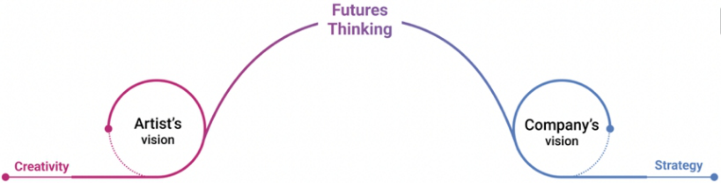
To overcome these challenges, Futures Thinking can act as a bridging approach - a conceptual and methodological lever that connects the creativity-driven vision of artists with the strategy-driven orientation of companies (Fig. 1). It provides a common ground for dialogue and co- creation, encouraging participants to look beyond immediate constraints and to engage in collective sensemaking about long-term possibilities.
Figure 1: Futures thinking to bridge the gap between creativity-driven and strategy- driven visions of innovation (Monestier et al., 2024).
Futures Thinking also offers practical tools for addressing complex environmental and societal challenges, enabling stakeholders to envision and design preferable futures that can catalyze deep systemic transformations (Pereira et al., 2018). Thus, it provides a structured yet imaginative framework that helps art–tech collaborations anticipate change, align diverse stakeholders, and developing future-oriented innovation pathways (Monestier et al., 2024). Particularly in the food sector, where technology,
culture, and ecology intersect, this approach can foster transformative alliances that merge artistic and scientific rigors to shape sustainable futures.
DESIGN FUTURES ART-DRIVEN (DFA) METHOD Building on the theoretical foundation concerning the potential of art- technology collaboration and the contribution of futures thinking to such processes, the IDEActivity research team within the Department of Design at Politecnico di Milano developed the Design Futures Art-driven (DFA) method within the MUSAE Horizon Europe project (O’Gorman et al., 2025).
The DFA method is a structured, open-source framework designed to guide artists, designers, SMEs, and technology experts in co-creating solutions for a 5–10-year future span, fostering forward-looking, disruptive, and responsible innovation. Rooted in a people & planet-centered approach, the method supports the anticipation of innovation impacts and the envisioning of alternative futures to address global challenges - such as the sustainable transformation of food system. It serves as a guide for the meaningful and socially grounded application of emerging technologies through the lenses of creativity, art, and design. Developed as part of the MUSAE Factory Model, the DFA method operates within a broader ecosystem of open-source formats, guidelines, and tools to structure participatory and interdisciplinary Art–Tech collaborations. The MUSAE Factory Model1 establishes a framework for residencies where artists and companies work together to imagine and prototype desirable futures, ensuring that creativity acts as a driver for both technological adoption and sustainable transformation. Within this ecosystem, the DFA method functions as the operational process enabling guided facilitation, shared learning, and value alignment among diverse actors.
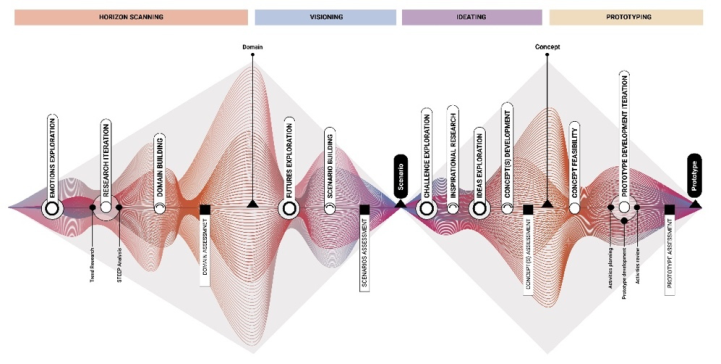
The method integrates Design Futures and Art Thinking in a four-phase process - Horizon Scanning, Visioning, Ideating, and Prototyping - each supported by dedicated activities and tools (Fig. 2). The process begins with Horizon Scanning, where participants explore macro-level trends, weak signals, and drivers of change to build a critical understanding of the context. This phase feeds into Visioning, in which alternative futures are constructed and communicated through narrative and visual storytelling. In Ideating, participants generate concepts aligned with these futures, while Prototyping transforms selected ideas into tangible artefacts that express the envisioned future applications of emerging technologies. Activities are categorized into co-design sessions (e.g., Emotions Exploration, Futures Exploration, Challenge Exploration, Ideas Exploration), individual and iterative activities (e.g., Research Iteration, Scenario Building, Concept Development), and assessment meetings that serve as checkpoints for alignment and decision- making.
A distinctive aspect of the method is its integration of AI as a co- creator, positioning artificial intelligence not merely as a tool but as an active, generative partner in the creative process. This hybrid collaboration 1 https://musae.starts.eu/factory-model-pack/
The Design Futures Art-Driven (DFA) Method: Structuring Art-Tech Collaboration 97
between humans and AI opens new ethical, emotional, and epistemological dialogues on the co-evolution of creativity and technology. The DFA process is supported by a digital platform offering open-access descriptions, tools, and guidelines, and by a collaborative board on Miroverse that facilitates online teamwork and visualization of outcomes. The DFA Method reframes creativity as a strategic capability for innovation by combining artistic sensitivity and imagination, design strategy, and futures literacy within a guided facilitation structure. It promotes hybrid thinking, embracing human–technology–ecosystem interdependence, and encouraging a more- than-human perspective oriented toward regenerative outcomes. Embedded within the MUSAE Factory Model, it contributes to establishing shared values and practices that enable organizations to anticipate change and co- develop responsible, ethical and future-oriented technological applications.
Figure 2: Visualization of the DFA method phases and activities.
APPLICATION OF THE DFA METHOD IN THE ART-TECH RESIDENCIES ON THE FUTURE OF FOOD The DFA method was implemented and tested through two art–tech residencies within the MUSAE project under the theme of Food as Medicine, aimed at reimagining food systems for both human and planetary wellbeing. The residencies involved 23 artists and 11 tech companies, organized around three thematic areas: Reducing carbon footprint in dietary behavior, Role of food in holistic well-being, and Rethinking the food chain in our environment.
The first residency engaged 12 artists, each exploring one of the three thematic through the first initial phases of the DFA method – Horizon Scanning, where they collected trends and signals to define specific domains, and Visioning phase, where they created multiple alternative futures before focusing on a preferable future scenario. The resulting scenarios propose visionary responses to emerging transformations in food and
health, articulated through narratives, personas, and artefacts that offer an immersive glimpse into possible futures. The DFA method enabled the development of a broad spectrum of future scenarios, providing possible future visions for the topics such as soil regeneration, biodiversity loss, climate change, waste management, industrial agriculture pressures, evolving food cultures, and others.
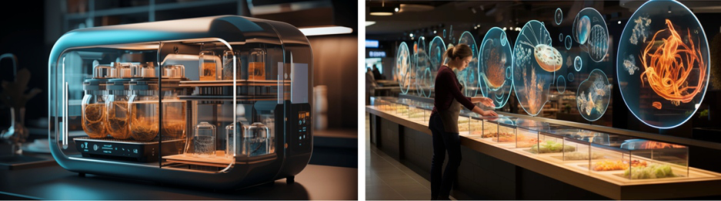
These scenarios serve as a foundation for imagining and developing innovative products, services, and systems by shifting attention from present needs to those anticipated 5–10 years ahead. For example, in Microbial Renaissance scenario created by Chloé Rutzerveld, microorganisms act as “cell factories,” that produce sustainable, animal-free ingredients through precision fermentation and AI, enabling entirely new culinary experiences. This vision calls for transformation not only in revolutionizing food technology but also demanding a cultural shift toward embracing microbial- based diets. The scenario is further supported by various elements created by the artist, such as Microbial Synthesizer - a kitchen device allowing users to design and cultivate microbial ingredients in real time illustrates how biotechnology and culinary creativity merge in this future (Fig. 3). The scenario also envisions new learning spaces, such as Education & Training section, where citizens engage with microbial food culture through interactive and practical experiences (Fig. 3). The elements and artefacts of the scenario offer an opportunity and context to envision the future world and develop innovations responding to future needs. Beyond technological innovation, the scenarios also reimagine how the world itself might transform - envisioning new relationships between food, technology and humans, changing dietary habits and social norms.
Figure 3: Scenario element: microbial synthesizer (on the left); scenario element: education & training section (on the right) (author: Chloé Rutzerveld).
The second residency involved 11 artist-SME teams to develop technological prototypes. Building on the outcomes of the first residency, each team selected one future scenario as a starting point and followed the last two phases of the DFA process – Ideating, where they co-designed the concept and Prototyping, where the teams developed functional prototypes using technologies. The residency resulted in 11 functional prototypes, each reaching Technology Readiness Level 5 (TRL5), tested in relevant environment outside the laboratory.
The Design Futures Art-Driven (DFA) Method: Structuring Art-Tech Collaboration 99
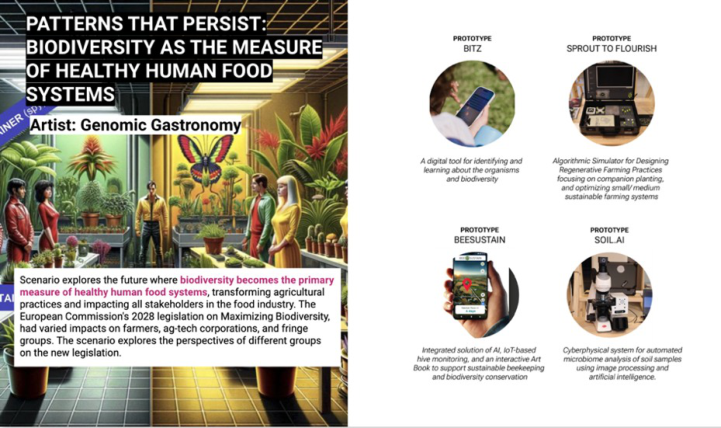
These prototypes translated future scenarios into tangible, real-world applications. A two-step process, moving from scenarios to prototypes, allowed future scenarios to act as catalysts for innovation, revealing opportunities often overlooked in conventional R&D contexts. For example, the scenario Patterns that Persist by the Center for Genomic Gastronomy inspired four distinct prototypes - tools for biodiversity assessment (BITZ), regenerative farming design (Sprout to Flourish), AI- assisted beekeeping (BeeSustain), and soil microbiome monitoring (Soil.AI) (Fig. 4). It demonstrates how a single future narrative can stimulate diverse, cross-sector innovations.
Figure 4: Connection between the future scenario patterns that persist and four functional prototypes that emerged from it (Source: MUSAE [https://musae.starts.e u/activities-dfa-projects/]).
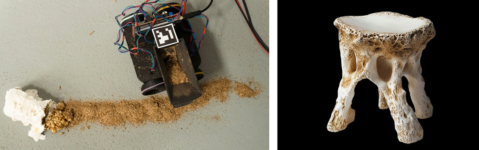
As a result, the broad variety of future scenarios, combined with the DFA method, stimulated the teams of artists and SMEs to develop diverse outputs during the second residency, ranging from products, service systems to new design processes. For example, Growing Futures project, developed by artist Daniela Amandolese in collaboration with Basque Biodesign Center, envisions a novel design process in which robots guide mycelium growth, mimicking natural networks to create self-repairing, bio-responsive habitats (Fig. 5). This prototype demonstrated the potential to generate and design a wide range of products at different scales created by the collaboration of nature and technology.
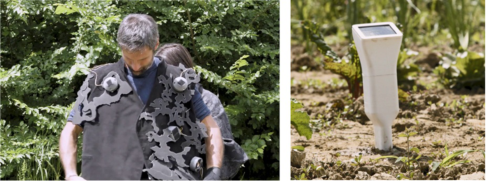
Another example of the residency result is a product - SOIL prototype, created by artist Letizia Artioli together with SME Uptoearth. It is a wearable device that translates soil data through sensors into tactile and sonic feedback directly on a farmer’s clothing, fostering a sensory and emotional dialogue between farmers and the land (Fig. 6). This co-creation process brought
together an artist, SME, farmer, and a fashion designer, following the DFA method to develop the prototype.
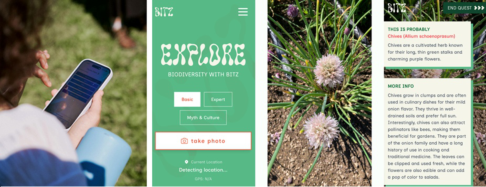
Finally, a different form of the result can be considered as a service – BITZ project, which was developed by the Center for Genomic Gastronomy and Nicetrails company. It is a digital tool for participatory, place-based species quests on small-scale farms to assess and monitor agricultural biodiversity integrating AI and citizen science (Fig. 7). This tool can be offered as a service to various stakeholders, including farmers, authorities and educational institutions, supporting ecological awareness and biodiversity stewardship.
Figure 7: BITZ prototype (authors: Center for Genomic Gastronomy, Nicetrails).
DISCUSSION
The implementation of the DFA method in two art–tech residencies over two years with 23 artists and 11 SMEs demonstrates the transformative
The Design Futures Art-Driven (DFA) Method: Structuring Art-Tech Collaboration 101
potential of futures-oriented, art-driven approaches in addressing systemic challenges within global food systems. By positioning artistic practice as a catalyst for reflection and innovation, the DFA method offered a structured yet imaginative space where creativity, technology, and futures thinking converged to explore desirable futures for food and planetary wellbeing.
By integrating artistic and creative practice with technological development, the DFA method enabled companies to anticipate emerging trends, envision preferable scenarios, and develop functional prototypes addressing the near-horizon challenges. This hybrid approach fosters technical, cultural, ethical, and experiential innovation, extending beyond conventional R&D processes to anticipate short-term futures informed by trends and weak signals. In doing so, it positions innovation at the frontline of change, translating evidence-based future visions into tangible applications. Balancing collective imagination with real-world implementation proved essential for generating novel solutions to complex environmental and food challenges.
By merging art thinking together with futures and design thinking, the DFA method created a shared ground for cross-disciplinary stakeholders, aligning values and future visions. Activities, such as immersive workshops and reflective meditations, nurtured empathy, dialogue, and shared purpose. Collaborative projects like Growing Futures, SOIL, BITZ integrated aesthetic sensitivity, scientific reasoning, and environmental awareness. These outcomes highlight the relational dimension of innovation, prioritizing ethics and interdependence between humans, nonhumans, and ecosystems for climate challenges.
Finally, the DFA method positions itself beyond merely a design tool, but as an approach, cultivating futures literacy and creative ethical reflection among diverse actors. Its application in the MUSAE project points toward a new model of innovation that aligns technological progress with ecological responsibility and social wellbeing through reimagining the narratives, relationships, and values that shape how we produce, distribute, and experience food.
CONCLUSION
The Design Futures Art-driven (DFA) method provides a platform for innovation and serves as a transferable methodology, guiding future- oriented innovation across sectors through its structured four-phase process: Horizon Scanning, Visioning, Ideating, and Prototyping. The method ensures open access to DFA tools and knowledge developed through experimental activities, making them available to wider public to promote a fair and inclusive transition. Its application in the Food as Medicine residencies, involving 23 artists and 11 tech companies, produced 12 actionable scenarios and 11 industrial prototypes (TRL5) promoting healthier, more sustainable food practices. Beyond the food sector, the DFA method is adaptable to healthcare and other sustainability-focused domains, integrating AI as a generative partner to enhance creativity, imagination and future thinking.
Importantly, the DFA method, and more broadly the MUSAE Factory model, contributes strong evidence to EU policy frameworks supporting a fair, green, and digital transition. The Factory Model provides a replicable structure for art–tech collaboration, offering a guided platform for co- creation between artists, companies, and researchers. By embedding a people & planet–centered innovation approach, the DFA method demonstrates how creativity and design futures can guide responsible technological development in line with the European Green Deal, Farm to Fork Strategy, and Digital Europe Programme. Scenarios and prototypes from MUSAE residences can inform policy recommendations to strengthen art–technology collaboration, integrate futures thinking, and promote participatory, ethical innovation across creatives, SMEs, and universities.
Future research should focus on developing robust evaluation frameworks, exploring sector-specific adaptations of the DFA method, and assessing its long-term social, environmental, and economic impacts, ensuring the continued scalability and policy relevance of art-driven, future-oriented innovation.
ACKNOWLEDGMENT
This paper presents reflections from the research tasks carried out by the authors within the MUSAE. A Human-Centred Factory for a Future Technological Sustainable Development driven by Arts Project. This project has received funding from the Horizon Europe Framework Programme under grant agreement No 101070412. The views expressed in this paper do not necessarily reflect the views of the EC.
REFERENCES
Benton, T. G., Bieg, C., Harwatt, H., Pudasaini, R., & Wellesley, L. (2021, February). Food system impacts on biodiversity loss: Three levers for food system transformation in support of nature (Chatham House). Retrieved from https://www.chathamhouse.org/sites/default/files/2021– 02/2021–02-03-food-system-biodiversity-loss-benton-et-al_0.pdf. Last accessed: 23.10.2025. Booher, H. R., Minninger, J. (2003) “Human systems integration in army systems
acquisition”, in: Handbook of human systems integration, Booher, Harold (Ed.). pp. 663–698. Booher, Harold, ed. (2003). Handbook of human systems integration. New Jersey: Wiley. Chapanis, A. (1996). Human factors in systems engineering. Wiley Series in Systems
Engineering and Management. Andrew Sage, series editor. Hoboken, NJ: Wiley. Dolejšová, M., Ampatzidou, C., Houston, L., Light, A., Botero, A., Choi, J., Wilde, D., Altarriba Altarriba Bertran, F., Davis, H., Gonzales Gonzales Gil, F., & Catlow, R. (2021). Designing for Transformative Futures: Creative Practice, Social Change and Climate Emergency. Creativity and Cognition, 1–9. https://doi.org/10.1145/ 3450741.3465242. European Commission. (2025). The Digital Europe Programme [Web page]. Shaping
Europe’s digital future. https://digital-strategy.ec.europa.eu/en/activities/digital- programme.
The Design Futures Art-Driven (DFA) Method: Structuring Art-Tech Collaboration 103
FAO, IFAD, UNICEF, WFP and WHO. 2022. The State of Food Security and Nutrition in the World 2022. Repurposing food and agricultural policies to make healthy diets more affordable. Rome, FAO. https://doi.org/10.4060/cc0639en. Folds, Dennis. Gardner, Douglas and Deal, Steve. (2008). Building Up to the Human
Systems Integration Demonstration, INCOSE INSIGHT Volume 11, No. 2. Friedenthal, S. Moore, A. Steiner, R. (2008) A Practical Guide to SysML: The Systems Modeling Language, Morgan Kaufmann; Elsevier Science. Hochman, N., & Reben, A. (2019). Art + Tech Report 2019: Stakeholder
investigation (Commissioned by EUNIC Silicon Valley). EUNIC Silicon Valley. https://eunic.eu/media/site/4f725e1ad1–1753182943/ art-tech-report-2019_eunic-silicon-valley.pdf. Honour, Eric C. (2006) “A Practical Program of Research to Measure Systems Engineering Return on Investment (SE-ROI)”, proceedings of the Sixteenth Annual Symposium of the International Council on Systems Engineering, Orlando, FL. Klein, M., Gerlitz, L., & Spychalska-Wojtkiewicz, M. (2021). Cultural and creative
industries as a boost for innovation and sustainable development of companies in cross-innovation process. Procedia Computer Science, 192, 4218–4226. https: //doi.org/10.1016/j.procs.2021.09.198. Leopold, T. A., Ratcheva, V., Zahidi, S. (2018) The Future of Jobs Report
2018. Available at: https://www.weforum.org/reports/the-future-of-jobs-report- 2018/. Meilich, Abe. (2008) INCOSE MBSE Initiative Status of HSI/MBSE Activity (Presentation). O’Dea, T., Alacovska, A., & Fieseler, C. (2020). The Role of Art in Enterprise.
Artsformation Report Series. http://dx.doi.org/10.2139/ssrn.3716274. O’Gorman, A., Lauryn, M., Efremenko, T., Canina, M., Radeva, P. I., Puig, L. E., Cangelosi, A., Ferro, F., Dellino, F., Van Gansbeke, R., Bulgheroni, M., Jovanovic, K., Brennan, L., 2025. MUSAE: Fusion of art and technology to address challenges in food and health. Nutrition Bulletin 50, 120–131. https://doi.org/10.1111/nbu. 12723. Pereira, L. M., Hichert, T., Hamann, M., Preiser, R., & Biggs, R. (2018). Using
futures methods to create transformative spaces: Visions of a good Anthropocene in Southern Africa. Ecology and Society, 23(1). https://www.jstor.org/stable /26799045. Saleh, R., & Brem, A. (2023). Creativity for sustainability: An integrative literature review. Journal of Cleaner Production, 388, 135848. https://doi.org/10.1016/j.jc lepro.2023.135848. Strauß, A. (2017). Dialogues Between Art and Business: Collaborations, Cooptations, and Autonomy in a Knowledge Society. Cambridge Scholars Publishing. Taubman, Philip. (June 25, 2008) Top Engineers Shun Military; Concern Grow. The New York Times Website: http://www.nytimes.com/2008/06/25/us /25engineer.html. United Nations. (2023). Secretary-General’s report: UN Food Systems Stocktaking
Moment [PDF]. Retrieved from https://www.unfoodsystemshub.org/docs/unfood systemslibraries/stocktaking-moment/un-secretary-general/sgreport_en_rgb_upd ated_compressed.pdf. United Nations Convention to Combat Desertification. (2022). GLO 2 Report [PDF].
United Nations. (n.d.). Fast facts: What are sustainable food systems? UN Sustainable Development. Retrieved October 9, 2025, from https://www.un.org /sustainabledevelopment/fast-facts-what-are-sustainable-food-systems/. United Nations Statistics Division. (2023). The Sustainable Development Goals Report 2023. Retrieved from: https://unstats.un.org/sdgs/report/2023/The-Sustai nable-Development-Goals-Report-2023.pdf. Last accessed: 23.10.2025. Vocke, C., Constantinescu, C., & Popescu, D. (2020). Status quo and quo vadis:
creativity techniques and innovation methods for generating extended innovation processes. Procedia CIRP, Enhancing design through the 4th Industrial Revolution Thinking 91, 39–42. https://doi.org/10.1016/j.procir.2020.02.148. World Economic Forum. (2023, January 11). Global risks report 2023. https:// www.weforum.org/publications/global-risks-report-2023/.
LISTED IN THE AHFE DIGITAL BOOKSTORE CATALOGUE
Explore the complete digital volume
Human Factors in Design, Engineering, and Computing
Read this individual research paper free through the original publisher, or explore the full digital proceedings book.
ISBN 978-1-964867-75-5
Explore this ISBN in the AHFE Bookstore ↗Listed in the July 2026 bookstore catalogue; search by ISBN to confirm current availability · Digital book purchase optional