Yuqi Liu, Liang Xiao, Ye Zhang (2024). Design for multiverse healthcare: The innovation spaces and transformation paths of the medical and health industry in the Digital Era. In: Human Factors in Design, Engineering, and Computing. AHFE Open Access, vol. 159, pp. 1360–1371. https://doi.org/10.54941/ahfe1005703
With the popularization of intelligent technology and digital survival methods, the medical and health industry faces numerous opportunities, challenges and changes. This study aims to explore the innovation space and transformation path of the medical and health industry in the era of digital survival. First of all, this study starts with the concepts of big health and big health industry, and summarizes the whole life cycle of individual health and the multiple innovation spaces of health design. In the exploration of multiverse healthy design, the study starts with the analysis of human identity, and defines the way of human existence in the future society as conscious human, physical human, social human, and digital human; thus, different types of health are derived, namely mental health, physical health, social health, and digital health; and the multiple innovation spaces of the medical and health industry are analyzed, namely, consciousverse (conscious space), physicalverse (physical space), socialverse (social space), and digitalverse (digital space). Each innovation space has its own unique characteristics and functions, and they can influence, intersect and interact with each other, providing new possibilities for improving people's health level and quality of life. Secondly, the study analyzes the five major transformation paths of the health industry, namely"Digitalization&Intelligence","Inclusion&Accessibility","Personalization&Customization","Systematicness&Intersectionality", and "Globalization&Localization". The content of this study will expand new innovation space, provide new innovation inspiration and transformation ideas for designers, technicians, researchers engaged in the development of health products, services and experiences, as well as institutions, organizations, enterprises and practitioners related to the health industry.
Design for Multiverse Healthcare: The Innovation Spaces and Transformation Paths 1361
absence of disease or infirmity (Schramme, 2023). Therefore, according to this definition, human health can be divided into three aspects: physical health, mental health and social health. In 2016, Senior Chinese officials emphasized at the National Health and Wellness Conference that China should advocate a healthy and civilized lifestyle, establish the concept of big health, also known as comprehensive health, and shift the focus from diseases treatment to people’s healthy state (Organization, 2017). Since then, the concept of big health has been popularized in China. “Big health”is a concept proposed based on the development of the times, social needs and changes in the spectrum of diseases. It revolves around people’s food, clothing, housing, transportation, birth, aging, illness and death, pays attention to various risk factors that affect health, and advocates self-health management. It is proposed under the guidance of the concept of comprehensive care for the whole process of life. It pursues not only individual physical health, but also complete health in terms of spirit, psychology, physiology, society, environment, and morality (Metzl et al., 2010). It advocates not only scientific and healthy living, but also correct healthy consumption. The scope involves all kinds of health-related information, products and services, as well as the actions taken by various organizations to meet the health needs of society. With the popularization of intelligent technology and digital lifestyle, the medical and health industry faces numerous opportunities, challenges and changes (Jayaraman et al., 2020). Under the guidance of “big health”, the concept of health permeates all aspects of our study, work and daily life. This study starts with the definition of the big health, analyses the relevant industry content of the whole life cycle of human health, and finally explores the innovation space and transformation path of the medical and health industry from five aspects: “Path 1: Digitalization & Intelligence”, “Path 2: Inclusion & Accessibility”, “Path 3: Personalization & Customization”, “Path 4: Systematization & Intersectionality”, and “Path 5: Globalization & Localization”.
THE DEFINITION OF BIG HEALTH INDUSTRY The big health industry encompasses a broad spectrum of activities aimed at maintaining, restoring, and enhancing individuals’ health status, spanning product manufacturing, service provision, and information dissemination (Luo, 2022). It embraces multiple production and service sectors that are intimately tied to human health, encompassing medical services, healthcare products, nutritional and wellness foods, medical equipment, leisure and wellness services, as well as health consultation and management. However, relying solely on this definition, the boundaries of the big health industry appear somewhat abstract and indistinct. Numerous experts and scholars in China have ventured to define the concept of big health and its corresponding industry, yet a unified definition of the scope of the big health industry in China remains elusive. Broadly speaking, the big health industry can be categorized from two perspectives. Based on the nature of products and services, it can be segmented into medical products and services and health products and services. Within the medical realm, this includes the medical
industry, which is predominantly driven by medical service institutions, and the pharmaceutical industry, which focuses on the production and sale of drugs, medical devices, and other medical consumables. On the other hand, health products and services encompass the health product industry, which specializes in the production and sale of health foods and wellness products; the health management service industry, which emphasizes personalized health testing, evaluation, consulting, rehabilitation, and supportive promotion; and the elderly care service industry, which relies on home-based, community-based, and institutional support.
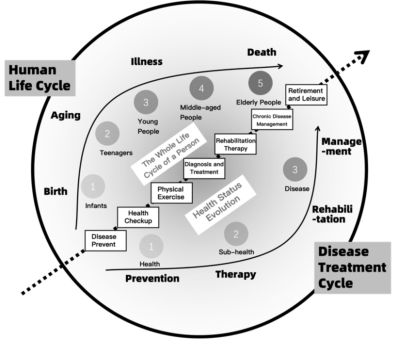
THE ENTIRE LIFECYCLE OF BIG HEALTH From the perspective of individual life cycle, humans go through different stages of life, including birth, aging, illness, and death, from infancy, adolescence, youth, middle age to old age (Alwin, 2012); The evolution of its health status will go through a state of health, sub health, and disease; For the life cycle of disease treatment, there are different stages from prevention, treatment, rehabilitation to management (Y. Liu & Tamura, 2020). Overall, the entire lifecycle of individual health undergoes different stages of change, from disease prevention, health testing, physical exercise, diagnosis and treatment, rehabilitation therapy, chronic disease management to elderly care and leisure. As shown in Figure 1. Innovation and health interventions in the related medical industry can occur at various stages of the individual’s health lifecycle, in order to seek opportunities and expand the space for innovation.
Figure 1: The entire lifecycle of big health.
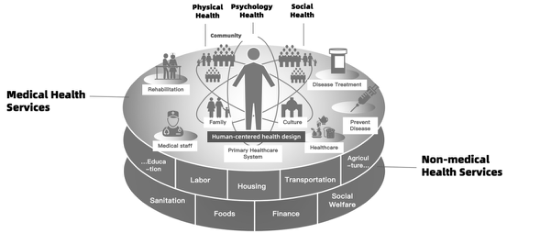
THE INNOVATION SPACE OF BIG HEALTH INDUSTRY According to the concept of big health, there are medical and non-medical health services that intervene in health (Gabrielová & Veleminsky, 2014). In terms of medical and health services, a human-centered health design has a basic health support service system, including family, community, culture, medical staff, rehabilitation medicine, disease treatment, healthcare,
Design for Multiverse Healthcare: The Innovation Spaces and Transformation Paths 1363
disease prevention, etc (Johnson et al., 2008). In terms of non-medical health services, people’s health is closely related to education, labour, housing, transportation, agriculture, hygiene, food, finance, and social welfare, which together form a support and intervention system to ensure people’s healthy lives (Bambra et al., 2010).
Figure 2: Medical and non-medical services.
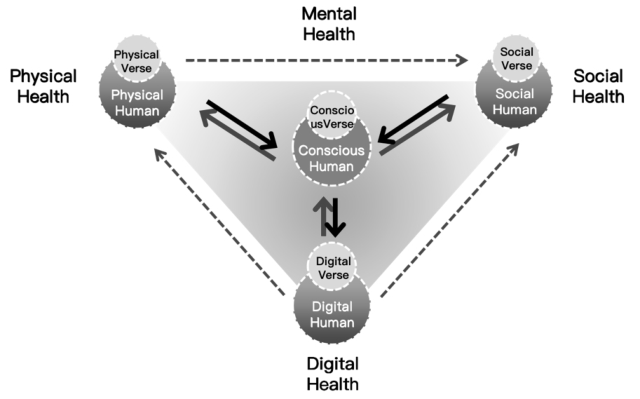
For the innovation space of healthcare, we start from human consciousness and divide future human identities into physical, social, digital, and conscious human (Davis et al., 2019; Emanuel & Stanton Fraser, 2014). Among them, conscious human are the core and foundation of the other three identities, playing a leading role in human behaviour, mind, and decision-making. Physical, social, and digital human identity interact and transform with each other. They respectively represent physical health, social health, digital health, and mental health, and correspond to the physicalverse, socialverse, digitalverse, and consciousverse. They together form a diverse space which we called multiverse for healthcare innovation (Yuqi Liu & Fu, 2024). Among them, the conscious universe is in a central and dominant position, controlling behaviour through consciousness and having a significant impact on the other three spaces (Chartrand, 2005), while the digital universe is more of a way, means, and tool to have obvious effects on the other three spaces (Murray et al., 2016).
Consciousverse-Mental Health: The consciousverse is mainly related to mental health. The innovative application of consciousness space in the field of mental health refers to the creation of relevant health products, services and experiences to intervene and intervene in the cognition, attitudes and values of personal mental health. This includes the understanding of mental health problems, the view of mental illness, and the demand and expectation for mental health services. The health innovation of consciousness space emphasizes raising public awareness of the importance of health, and promoting mental health education and self-care practices.
Physicalverse-Physical Health: The physicalverse is mainly related to physical health. The innovative application of physical space in the field of physical health refers to the creation of relevant health products, services and experiences for the prevention, diagnosis, treatment and rehabilitation intervention of physical diseases, such as health drugs, equipment and places. For example, hospitals, clinics, operating rooms, rehabilitation centres, etc.
are equipped with necessary medical equipment and professionals, and are healthy places for physical examinations, disease treatment and rehabilitation training. The health design innovation of the physical universe will directly intervene in the patient’s physical body state to promote the health of the individual’s physical body.
Socialverse - Social Health: The socialverse is mainly related to social health, and the innovative application of social space in the field of social health refers to the creation of related health products, services, and experiences that intervene and influence health status from social factors, social structure, and culture. This includes the impact of interpersonal relationships, social status, economic status, work environment, community support systems, etc. on individual and group health. Social space emphasizes improving health conditions, enhancing people’s sense of social belonging, value, and achievement through social intervention.
Digitalverse - Digital Health: The digitalverse is mainly related to digital health, and the innovative application of digital space in the field of digital health refers to the use of digital technology to create related health products, services, and experiences to improve individual health status. This includes electronic health records, telemedicine, online health consultations, health applications, wearable devices, health data analysis, and more. The digital space can help individuals better manage their health by providing convenient health information and services, and provide more accurate diagnosis and treatment support for medical service providers.
In general, each space has its unique characteristics and functions, and they can influence, intersect, and interact with each other. With the development of society and technological progress, the comprehensive application of these four different innovation spaces has become increasingly important in the medical and health industry, providing new possibilities for improving people’s health level and quality of life.
Figure 3: The multiverse innovation space of big health industry.
Design for Multiverse Healthcare: The Innovation Spaces and Transformation Paths 1365
THE TRANSFORMATION PATH OF BIG HEALTH INDUSTRY This section will analyze the transformation path of the healthcare industry in the digital era from five aspects: “Digitalization & Intelligence”, “Inclusion & Accessibility”, “Personalization & Customization”, “Systematicness & Intersectionality”, and “Globalization & Localization”.
Digitalization and Intelligence
Smart Healthcare. The development of technologies such as artificial intelligence (AI), virtual reality (VR), big data, cloud computing, Internet of Things (IoT), and 5G has provided strong technical support for the healthcare industry. Smart healthcare is an important component of the digital transformation of the healthcare industry, including intelligent diagnosis, intelligent treatment, intelligent care, etc. It improves the quality and efficiency of medical services through intelligent devices and systems.
Data Empowerment. The digital transformation of the healthcare industry requires the integration and application of medical big data, encouraging patients to participate in their own health management, using digital tools for self-monitoring and management, and providing support for clinical decision-making, disease prevention, and health management through data analysis and mining. The intelligence of medical equipment and devices, such as intelligent temperature management and intelligent hearing aids, can improve the convenience and accuracy of medical services.
Drug Development. The application of digital technology in the field of drug development can accelerate the process of drug discovery and development, reduce research and development costs, and improve the success rate of research and development. Through computer simulation and molecular modeling, artificial intelligence technology can quickly process large-scale data, discover patterns and associations hidden behind the data, help accelerate the drug discovery process, and provide new ideas for drug repositioning and reuse.
Digital Education. The application of digital technology in the field of medical and health can greatly reduce the physical cost of medical education, enhance the learning effect of medical skills and knowledge, and help cultivate a group of medical and health talents with digital skills to meet the needs of medical digital transformation. At the same time, through digitization, enhance cross-border cooperation between the medical industry and other industries such as IT, communication, finance, etc., and jointly promote industrial innovation.
Inclusion and Accessibility
Policy Guidance. To formulate and implement inclusive policies to ensure that medical services are open to all populations, especially vulnerable groups such as the elderly, disabled, women, children, and unemployed, in order to prevent medical discrimination. At the same time, provide financial support, tax incentives, subsidies, and other measures to reduce the cost of medical services and improve their affordability. Relevant
departments should establish a sound regulatory system and standards for medical and health services to ensure the quality and safety of medical services.
Digital Coverage. To utilize digital technologies such as electronic health records, online appointments, remote healthcare, etc. to improve service accessibility. Applying artificial intelligence and machine learning technologies to improve diagnostic accuracy and treatment efficiency. Reduce the administrative burden on medical staff and improve work efficiency through technological means. Solve cost issues by optimizing operational models and adopting digital strategies to control medical costs and improve the affordability of medical services.
Talent Reserve. To cope with the shortage of medical staff, strengthen the cultivation of medical professionals, improve the professional level and service awareness of medical service personnel, especially in rural and remote areas. On one hand, the realization of universal coverage of medical and health services has brought new experiences, and the cross-industry data connectivity mechanism has promoted relevant technological innovation and deep integration of resources from different industries. On the other hand, promoting social care, establishing a more resilient talent pool for social care, and enhancing the attractiveness of related professions. Strengthen the construction of community medical centers to make medical services more accessible to the public.
Public Welfare. To strengthen the infrastructure construction of the public health system and improve the ability to prevent and control infectious diseases, chronic diseases, and other diseases. Medical and health enterprises should assume social responsibility by providing public welfare services and improving medical facilities to enhance the inclusiveness of medical services. Encourage cooperation and sharing among medical institutions to improve the efficiency of utilizing medical resources.
Personalization and Customization
Electronic Archives. By collecting and analyzing patient health data, including genetic information, lifestyle habits, and past medical records, personalized disease prevention, treatment, and management plans are provided. Establish a digital health platform, integrate medical resources, provide convenient services such as online consultation, electronic prescriptions, remote diagnosis and treatment, and meet the personalized needs of patients. Utilize technologies such as artificial intelligence, machine learning, and big data analysis to enhance diagnostic accuracy and develop personalized treatment plans.
Patient Participation. To encourage patients to participate in their own health management, customize services based on data provided by patients, increase patient satisfaction and compliance with treatment plans, and continuously monitor health through smart devices. Encourage patients to participate in the decision-making process of medical services, improve service transparency and patient satisfaction. At the same time, pay attention to patient privacy and data security, establish strict data protection mechanisms, and enhance patient trust in personalized services.
Design for Multiverse Healthcare: The Innovation Spaces and Transformation Paths 1367
Precision Customization. Developing precision medical technology, providing patients with more targeted treatment plans through genetic testing and other means, achieving maximum treatment effectiveness and minimal side effects. Develop customized medical products and services, such as patient specific drug formulations, customized rehabilitation plans, and personalized health management procedures.
Systematicness and Intersectionality
Technology Integration. The healthcare industry integrates various innovative technologies, such as artificial intelligence, machine learning, big data analysis, remote healthcare, wearable devices, etc. At the same time, the integration of medical equipment and tools is also an important aspect of medical technology integration, which is conducive to reducing the learning and usage costs of technology, equipment, and tools for relevant medical personnel. In addition, while integrating, it is necessary to develop technical standards and specifications to ensure the quality of medical and health products and services.
System Fusion. The healthcare industry needs to build a systematic solution that integrates multiple links such as medical information, medical resources, and patient data to provide health management services throughout the entire lifecycle. This includes various stages of medical services such as disease prevention, diagnosis, treatment, rehabilitation, and long-term care. At the same time, promoting interoperability and interoperability between different systems and platforms is also a very important aspect, which is conducive to improving the overall efficiency of medical services.
Industrial Collaboration. The big health industry is not just limited to the medical industry, it can deeply intersect with many other industries. For example, health+architecture, health+gaming, health+food, health+education, health+art, health+gardening, health+tourism, health+transportation, etc. Integrating the health industry into relevant formats of other industries, advocating lifestyle interventions and intervention-based lifestyles, allowing the concept of health to permeate all aspects of production and life.
Knowledge Sharing. The fields of medicine and biology, physics, materials science, computer science, etc. can promote the research and development of innovative products and services through interdisciplinary approaches. Establish an open innovation platform to promote collaboration and knowledge sharing within and outside the healthcare industry, connect medical institutions, researchers, pharmaceutical companies, and patients, and jointly promote the progress of medical research and clinical applications. At the same time, involving patients in the entire process of medical decision-making, improving their awareness, and understanding of their own health status, and enabling them to better participate in their treatment process is also an important aspect of knowledge sharing.
Globalization and Localization
Local Innovation. The local medical and health industry needs to strengthen its own research and development capabilities, and develop products and services that meet the needs of local patients to meet the affordability and acceptance of patients in different regions. This includes understanding of local epidemiology, respect for local culture and medical practices, utilization of local medical resources, and strategies for local marketing. In the context of globalization, localized production can help the healthcare industry reduce costs, improve supply chain stability and response speed. This includes establishing local production bases and supply chains, as well as developing local raw material and component suppliers.
Cooperation & Exchange. Share local experiences and achievements through international organizations and platforms, while learning and absorbing global best practices. Through international cooperation, the local medical and health industry can introduce advanced medical technology and management experience and improve the level of local medical services. Meanwhile, by participating in international clinical trials and research, the local healthcare industry can integrate more quickly into the global healthcare innovation network. While respecting local culture and medical habits, it is also necessary to comply with international medical and health standards and norms to ensure the quality and safety of medical services.
Supervision & Training. Regulatory agencies need to develop regulatory policies that adapt to the needs of globalization and localization, ensure the safety and effectiveness of new drugs and medical equipment, and accelerate the approval process to enable local patients to access innovative medical products in a timely manner. Strengthen talent cultivation in the field of healthcare, especially professional education, and training in the context of localization and globalization, to meet the needs of the development of the healthcare industry.
Global Governance. Actively participate in global healthcare cooperation and governance. Actively participate in global health emergency response when encountering public health emergencies. At the same time, actively participate in global health governance, provide international medical assistance to areas with medical backwardness or underdevelopment around the world, such as dispatching medical teams, providing medical supplies, sharing medical experience, etc. Integrating non communicable disease medical services into humanitarian emergency operations can help save more lives.
CONCLUSION
This study starts with the definition of health, big health, and the big health industry, proposes that based on the concept of “big health”, there are medical and non-medical health services that intervene in health. The article summarizes the entire life cycle of individual health, which undergoes different stages of changes from disease prevention, health testing, physical
Design for Multiverse Healthcare: The Innovation Spaces and Transformation Paths 1369
exercise, diagnosis and treatment, rehabilitation therapy, chronic disease management to elderly care and leisure. In the exploration of innovation space in the medical and health industry, starting from the analysis of human identity, the existence of humans in the future society is defined as conscious humans, physical humans, social humans, and digital humans; This has led to different types of health, namely mental health, physical health, social health, and digital health; And analyzed the multiverse innovation spaces of the medical and health industry, namely the consciousverse (consciousness space), the physicalverse (physical space), the socialverse (social space), and the digitalverse (digital space). Among them, the innovative application of consciousness space in the field of mental health refers to the intervention of creating related health products, services, and experiences in the cognition, attitude, and values of individual mental health; The innovative application of physical space in the field of physical health refers to the creation of relevant health products, services, and experiences for the prevention, diagnosis, treatment, and rehabilitation intervention of physical diseases; The innovative application of social space in the field of social health refers to the creation of relevant health products, services, and experiences that intervene and influence health status from social factors, social structure, and culture; The innovative application of digital space in the field of digital health refers to the use of digital technology to create related health products, services, and experiences to improve individual health status.
Secondly, the five major transformation paths of the health industry were analyzed, namely “Digitalization&Intelligence”, “Inclusion&Accessibility”, “Personalization&Customization”, “Systematicness&Intersectionality”, and “Globalization&Localization”. Among them, “Path 1: Digitalization&Intelligence” includes using AI, big data and other technologies to improve the quality and efficiency of medical services in smart healthcare, empowering health management with data, accelerating drug development and reducing costs through digital technology, and cultivating medical talents with digital skills in medical education. These applications not only promote the digital transformation of healthcare, but also strengthen cross-border cooperation between the healthcare and other industries, jointly promoting industrial innovation. “Path 2: Inclusion&Accessibility” includes the government developing inclusive policies to ensure fairness and accessibility of healthcare services, and reducing service costs through financial support. It utilizes digital technology to improve service accessibility and efficiency, reduce the burden on healthcare workers, and control medical costs. This path also strengthens the cultivation of medical talents, improve professional level, and strengthen the construction of community medical centers. At the same time, strengthening the public health system, improving disease prevention and control capabilities, encouraging cooperation and sharing among medical institutions, improving resource utilization efficiency, and jointly enhancing the inclusiveness and sustainability of medical services. “Path 3: Personalization & Customization” includes the collection of patient data in the medical and health field through electronic record systems, providing personalized prevention, treatment, and management plans. The digital platform integrates resources, provides convenient services,
and utilizes technologies such as AI to enhance diagnostic accuracy. This path encourages patients to participate in health management, improve satisfaction and compliance, while emphasizing privacy protection. It also developing precision medical technology to provide patients with targeted and optimal treatment plans and promoting personalized and precise medical and health services. Path 4: Systematization & Intersectionality includes the healthcare industry integrating technologies such as AI and big data to achieve efficient medical services and setting standards to ensure quality. At the same time, building a system solution that integrates medical information and provides full lifecycle management. Industrial integration integrates health concepts into multiple fields, achieving a deep integration of life and health. Knowledge sharing promotes interdisciplinary cooperation, accelerates innovative research and development, enables patients to better participate in medical decision-making, and jointly promotes the progress of the healthcare industry. Path 5: Globalization&Localization includes strengthening research and development in the local healthcare industry, developing products and services that meet local needs, reducing costs, and improving supply chain stability. Through international cooperation and exchange, learn global best practices, introduce advanced technology and management experience, and integrate into the global medical innovation network. Regulatory authorities should develop policies that meet demand, ensure product safety and effectiveness, and accelerate approval. At the same time, strengthen talent cultivation, participate in global healthcare cooperation and governance, especially provide international medical assistance in public health events, to improve global healthcare service levels and save more lives. For example, the health industry also has many innovative entry points in areas such as Asia, Africa, and Latin America, where the world’s medical and health conditions are poor, food is scarce, medical resources are insufficient, clean drinking water is lacking, remote mountainous areas, regions with frequent natural disasters, and international medical and humanitarian support. The content of this study will expand new innovation space, provide new innovation inspiration and transformation ideas for designers, technicians, researchers engaged in the development of health products, services and experiences, as well as institutions, organizations, enterprises and practitioners related to the health industry.
REFERENCES
Alwin, D. F. (2012). Integrating varieties of life course concepts. Journals of Gerontology Series B: Psychological Sciences and Social Sciences, 67(2), 206–220. Bambra, C., Gibson, M., Sowden, A., Wright, K., Whitehead, M., & Petticrew, M.
(2010). Tackling the wider social determinants of health and health inequalities: evidence from systematic reviews. Journal of Epidemiology & Community Health, 64(4), 284–291. Chartrand, T. L. (2005). The role of conscious awareness in consumer behavior.
Journal of Consumer Psychology, 15(3), 203–210. Davis, J. L., Love, T. P., & Fares, P. (2019). Collective social identity: Synthesizing identity theory and social identity theory using digital data. Social Psychology Quarterly, 82(3), 254–273.
Design for Multiverse Healthcare: The Innovation Spaces and Transformation Paths 1371
Emanuel, L., & Stanton Fraser, D. (2014). Exploring physical and digital identity with a teenage cohort. Proceedings of the 2014 Conference on Interaction Design and Children, 67–76. Gabrielová, J., & Veleminsky, M. (2014). Interdisciplinary collaboration between
medical and non-medical professions in health and social care. Neuro Endocrinol Lett, 35(Suppl 1), 59–66. Jayaraman, P. P., Forkan, A. R. M., Morshed, A., Haghighi, P. D., & Kang, Y. (2020).
Healthcare 4.0: A review of frontiers in digital health. Wiley Interdisciplinary Reviews: Data Mining and Knowledge Discovery, 10(2), e1350. Johnson, B., Abraham, M., Conway, J., Simmons, L., Edgman-Levitan, S., Sodomka, P., & Ford, D. (2008). Partnering with patients and families to design a patient-and family-centered health care system. Institute for Patient-and Family-Centered Care and Institute for Healthcare Improvement. Liu, Y., & Tamura, R. (2020). Application of Game Therapy in the Health of
Future Elderly: An Experience Design Perspective. In Lecture Notes in Computer Science (including subseries Lecture Notes in Artificial Intelligence and Lecture Notes in Bioinformatics): Vol. 12426 LNCS. https://doi.org/10.1007/978-3-030- 60149-2_46 Liu, Yuqi, & Fu, Z. (2024). Hybrid Intelligence: Design for Sustainable Multiverse via Integrative Cognitive Creation Model through Human–Computer Collaboration. Applied Sciences, 14(11), 4662. Luo, L. (2022). Analysis of coupling coordination degree between big health industry and pension service. Journal of Healthcare Engineering, 2022(1), 6427024. Metzl, J., Kirkland, A., & Kirkland, A. R. (2010). Against health: How health became
the new morality. NYU press. Murray, E., Hekler, E. B., Andersson, G., Collins, L. M., Doherty, A., Hollis, C., Rivera, D. E., West, R., & Wyatt, J. C. (2016). Evaluating digital health interventions: key questions and approaches. In American journal of preventive medicine (Vol. 51, Issue 5, pp. 843–851). Elsevier. Organization, W. H. (2017). Promoting health in the SDGs: report on the 9th Global
conference for health promotion, Shanghai, China, 21–24 November 2016: all for health, health for all. World Health Organization. Schramme, T. (2023). Health as complete well-being: The WHO definition and beyond. Public Health Ethics, 16(3), 210–218.
LISTED IN THE AHFE DIGITAL BOOKSTORE CATALOGUE
Explore the complete digital volume
Human Factors in Design, Engineering, and Computing
Read this individual research paper free through the original publisher, or explore the full digital proceedings book.
ISBN 978-1-964867-35-9
Explore this ISBN in the AHFE Bookstore ↗Listed in the July 2026 bookstore catalogue; search by ISBN to confirm current availability · Digital book purchase optional